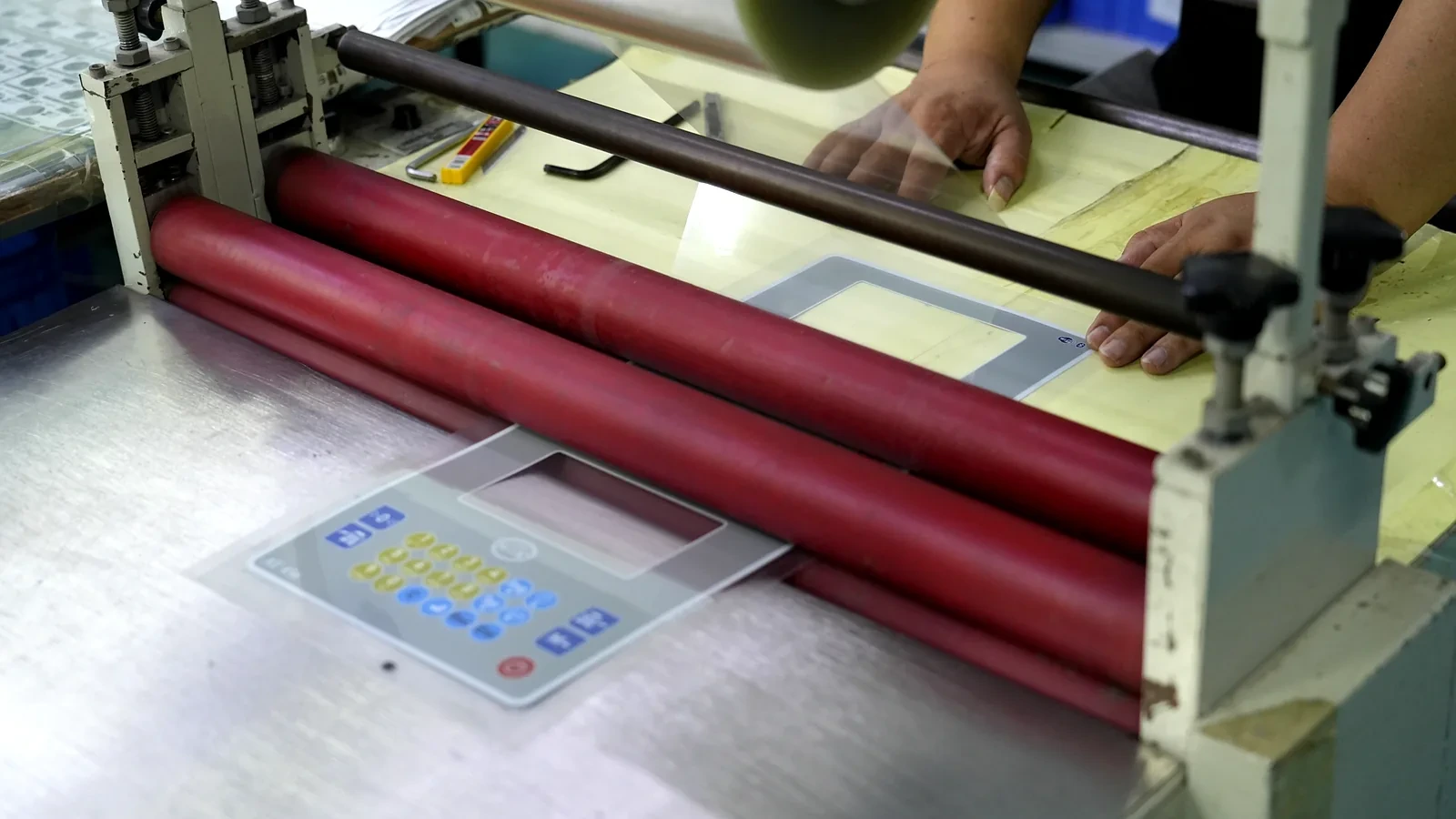
The right membrane switch adhesive depends on three variables: substrate surface energy, operating environment, and which layer you are bonding. For smooth ABS or polycarbonate housings in indoor applications, 3M 467MP (2 mil, 200MP acrylic) handles most designs. For textured, powder-coated, or outdoor surfaces, move to 3M 9472LE (5 mil, 300LSE acrylic).
- 1. Why Adhesive Selection Matters More Than You Think
- 2. The 8-Point Adhesive Selection Framework
- 2.1 Substrate Surface Energy Match
- 2.2 Operating Temperature Range
- 2.3 Adhesive Thickness vs. Surface Roughness
- 2.4 Environmental Exposure (Moisture, Chemicals, UV)
- 2.5 Component Layer Specificity
- 2.6 Peel Adhesion and Shear Strength
- 2.7 Reworkability and Serviceability
- 2.8 Outgassing and Regulatory Compliance
- 3. Adhesive Comparison: 3M Products for Membrane Switch Applications
- 4. Step-by-Step Selection Process
- Step 1 — Identify the substrate at each bond interface
- Step 2 — Classify each substrate as HSE or LSE
- Step 3 — Select adhesive thickness by surface roughness
- Step 4 — Verify temperature and environment compatibility
- Step 5 — Request first-article adhesion testing
- 5. Red Flags That Signal the Wrong Adhesive Choice
- 7. What to Do Next
Adhesive accounts for less than 5% of a membrane switch bill of materials, yet it causes more than 30% of field failures reported by OEM service teams. The gap between “it sticks in the lab” and “it stays bonded for 7 years on a forklift dashboard” comes down to matching adhesive chemistry to the actual substrate, temperature cycle, and chemical exposure the assembly will face. Adhesive selection depends on eight measurable criteria, commonly specified 3M products, and a clear sequence from RFQ to first-article approval.
1. Why Adhesive Selection Matters More Than You Think
A membrane switch or graphic overlay that delaminates in the field is not a cosmetic problem. It exposes circuitry to moisture ingress, disables tactile feedback, and voids the equipment’s IP rating. For a medical-device OEM, a single adhesive-related field return can trigger a corrective action report under FDA 21 CFR 820. For industrial equipment, delamination on a textured powder-coated enclosure mid-shift means unplanned downtime at $400–$800 per hour in lost production.
The root cause is almost always a mismatch between adhesive capability and substrate surface energy. Polypropylene measures approximately 29 mN/m. Powder-coated aluminum sits around 30–36 mN/m depending on coating chemistry. Standard acrylic pressure-sensitive adhesives (PSAs) bond reliably only above 36 mN/m. Below that threshold, the bond fails progressively under thermal cycling — not immediately, but 6–18 months into service life.
Choosing the correct adhesive at the design stage costs nothing extra. Choosing the wrong one costs a redesign, requalification, and field retrofit. The 8 criteria below give design engineers a repeatable framework to get it right the first time.
2. The 8-Point Adhesive Selection Framework
These 8 criteria are listed in order of failure frequency — criterion 1 causes the most field returns, criterion 8 the fewest. Evaluate each against your specific application before specifying an adhesive on the assembly drawing.
2.1 Substrate Surface Energy Match
Surface energy determines whether a PSA can wet the substrate enough to form a durable bond. High-surface-energy (HSE) materials — ABS (42 mN/m), polycarbonate (46 mN/m), stainless steel (>50 mN/m), glass (>70 mN/m) — bond readily with standard 200MP-family adhesives. Low-surface-energy (LSE) materials — polypropylene (29 mN/m), polyethylene (31 mN/m), powder-coated metals (30–36 mN/m), TPE/TPU (32–38 mN/m) — require 300LSE-family adhesives formulated to wet surfaces below 36 mN/m.
Good signal: Adhesive technical data sheet (TDS) explicitly lists your substrate material in its recommended-surfaces table, with published 90° peel data on that substrate.
Red flag: Supplier recommends a “universal” adhesive without asking what substrate you are bonding to, or the TDS only shows peel data on stainless steel.
2.2 Operating Temperature Range
Acrylic PSAs maintain bond strength across a wider temperature window than rubber-based alternatives. The 3M 200MP and 300LSE families are rated −40°C to +149°C for short-term exposure and −29°C to +120°C for continuous service. Rubber-based PSAs typically fail above +80°C as the rubber softens and shear strength drops below holding threshold.
For under-hood automotive applications (IATF 16949 environments), specify adhesives tested per ASTM D3654 shear at +120°C for 10,000 minutes minimum. For cold-chain equipment (−30°C walk-in freezers), verify the TDS shows peel adhesion tested at −40°C — some adhesives become brittle and crack at low temperature rather than delaminating.
Good signal: TDS shows peel and shear data at both temperature extremes of your operating range, not just room temperature (23°C).
Red flag: Only room-temperature bond strength published; supplier says “it should work” at your temperature extremes without test data.
2.3 Adhesive Thickness vs. Surface Roughness
A smooth substrate (Ra <1.6 µm) needs only 2 mil (0.05 mm) of adhesive to achieve full contact. A textured or machined surface (Ra 3.2–12.5 µm) requires 5 mil (0.127 mm) or thicker adhesive to flow into valleys and eliminate air pockets that become stress concentrators under thermal cycling.
The practical rule: if you can feel texture with a fingernail, specify 5 mil minimum. Die-cast aluminum housings with as-cast surfaces often measure Ra 6–12 µm and need 5 mil adhesive plus firm application pressure (15–25 psi roller pressure for 2 passes).
Good signal: Supplier asks for substrate surface finish (Ra value or sample) before recommending adhesive thickness.
Red flag: 2 mil adhesive specified for a textured surface, or no discussion of surface roughness during design review.
2.4 Environmental Exposure (Moisture, Chemicals, UV)
Outdoor graphic overlays on agricultural equipment, marine controls, or fuel dispensers face UV radiation, humidity cycling, chemical splash, and pressure washing. Acrylic PSAs resist UV degradation and maintain bond strength after 1,000+ hours of accelerated weathering (ASTM G154). Rubber-based PSAs yellow and lose cohesion under UV within 200–400 hours.
For chemical resistance, closed-cell acrylic adhesives outperform open-cell alternatives because they resist wicking of solvents along the bond line. Equipment exposed to hydraulic fluid, diesel fuel, or isopropyl alcohol cleaning requires adhesive tested per ASTM D1151 (humidity) and customer-specific chemical immersion protocols.
Good signal: Adhesive qualified to IP65 or IP67 sealing requirements as part of the membrane switch assembly, with test reports showing bond integrity after 500-hour salt spray (ASTM B117).
Red flag: Rubber-based adhesive specified for outdoor use, or no environmental testing beyond room-temperature peel.
2.5 Component Layer Specificity
A membrane switch assembly uses adhesive in up to 4 distinct locations, each with different requirements:
| Layer | Function | Typical adhesive |
|---|---|---|
| Graphic overlay lamination | Bonds printed overlay to switch body | 3M 7945MP or equivalent thin-film laminating adhesive |
| Spacer layer | Creates air gap for tactile dome actuation | Die-cut 3M 7953MP or FLEXcon SWITCHmark |
| Circuit-to-backer | Bonds flexible circuit to structural backer | 3M 467MP (2 mil) for smooth backers |
| Mounting (backing) | Bonds entire assembly to equipment housing | 3M 467MP, 468MP, or 9472LE depending on substrate |
Good signal: Assembly drawing specifies adhesive by layer with separate part numbers, and the manufacturer confirms each layer’s adhesive is optimized for its specific substrates.
Red flag: Single adhesive callout for the entire assembly (“use 3M 468MP everywhere”) without layer-specific justification.
2.6 Peel Adhesion and Shear Strength
Peel adhesion (90° peel per ASTM D3330) measures resistance to lifting forces — relevant when an operator catches a fingernail on an overlay edge. Shear strength (ASTM D3654) measures resistance to sliding forces — relevant for vertically mounted panels where gravity and vibration create sustained parallel load.
For membrane switches, target 90° peel ≥25 N/25mm on the actual substrate (not just stainless steel reference). Shear hold time should exceed 10,000 minutes at the maximum operating temperature under a 1 kg load on a 25×25 mm bond area.
Good signal: Supplier provides peel and shear test data on your specific substrate material, tested at your operating temperature.
Red flag: Only stainless-steel reference data provided; no testing on actual application substrate.
2.7 Reworkability and Serviceability
Some equipment designs require periodic membrane switch replacement — medical devices with sterilization-limited panel life, or industrial HMIs on leased equipment returned at end-of-contract. Permanent high-tack adhesives (3M 300LSE family, 90° peel >40 N/25mm) make removal destructive, often damaging the housing finish.
For serviceable designs, specify repositionable or medium-tack adhesives (3M 9415PC or equivalent) that allow clean removal without substrate damage. Trade-off: lower initial tack means the assembly requires higher application pressure and longer dwell time to reach full bond strength (typically 72 hours vs. 24 hours for permanent grades).
Good signal: Design review explicitly addresses whether the panel is permanent or field-replaceable, and adhesive grade matches that decision.
Red flag: Permanent adhesive on a panel the service manual says to replace every 2 years.
2.8 Outgassing and Regulatory Compliance
Sealed electronics enclosures trap volatile organic compounds (VOCs) released by adhesives during thermal cycling. In confined spaces, outgassing residues can deposit on optical sensors, LED lenses, or display covers — causing haze or signal degradation over time.
For aerospace applications, adhesives must pass NASA ASTM E595 (TML <1.0%, CVCM <0.10%). For consumer electronics in enclosed housings, UL 94 V-0 flammability rating is typically required. Medical devices may require USP Class VI biocompatibility testing if the adhesive contacts skin or is within a sealed patient-environment enclosure.
Good signal: Adhesive TDS includes outgassing data (TML/CVCM values) or UL 94 rating, and the supplier can provide lot-specific certificates of compliance.
Red flag: No outgassing data available for an adhesive going into a sealed enclosure with optical components.
3. Adhesive Comparison: 3M Products for Membrane Switch Applications
Compare the 3M adhesive transfer tapes most frequently specified in membrane switch and graphic overlay assemblies. All are acrylic PSA systems supplied as unsupported transfer tapes (adhesive only, no carrier film) on release liners.
| Product | Adhesive family | Thickness | Temp range (continuous) | Substrate target | Primary use in membrane switch |
|---|---|---|---|---|---|
| 3M 467MP | 200MP acrylic | 2.0 mil (0.05 mm) | −40°C to +149°C | HSE: ABS, PC, glass, smooth metals | Mounting on smooth housings; circuit lamination |
| 3M 468MP | 200MP acrylic | 5.0 mil (0.127 mm) | −40°C to +149°C | HSE: textured metals, die-cast aluminum | Mounting on rough/textured HSE surfaces |
| 3M 9472LE | 300LSE acrylic | 5.0 mil (0.127 mm) | −40°C to +149°C | LSE: polypropylene, powder coat, TPE | Mounting on LSE or powder-coated housings |
| 3M 9495LE | 300LSE acrylic | 5.5 mil (0.14 mm) | −40°C to +120°C | LSE: textured LSE surfaces needing gap fill | Thick-gap LSE mounting |
| 3M 7945MP | 200MP acrylic | 5.0 mil (0.127 mm) | −40°C to +149°C | HSE films: PET, PC overlay films | Graphic overlay lamination to switch body |
| 3M 7953MP | 200MP acrylic | 3.0 mil (0.076 mm) | −40°C to +149°C | PET spacer films | Spacer layer bonding |
Key distinction — 467MP vs. 468MP: Both use identical 200MP adhesive chemistry. The only difference is thickness. Use 467MP (2 mil) when the mounting surface is smooth (Ra <1.6 µm). Switch to 468MP (5 mil) when the surface has visible texture, machining marks, or grain (Ra >3.2 µm). The thicker adhesive fills surface irregularities that would create air voids under a 2 mil film.
Key distinction — 200MP vs. 300LSE: The 200MP family bonds to high-surface-energy substrates (>36 mN/m). The 300LSE family is reformulated to wet and bond low-surface-energy substrates (<36 mN/m). Using 200MP on polypropylene or powder coat will produce an initial bond that fails under thermal cycling within 3–6 months.
4. Step-by-Step Selection Process
Step 1 — Identify the substrate at each bond interface
Document the housing material (ABS, polycarbonate, aluminum, powder-coated steel, stainless steel, or other). Measure or request the surface finish specification (Ra value). If the substrate is painted or coated, the adhesive bonds to the coating — not the base metal. Obtain a sample coupon for adhesion testing.
Step 2 — Classify each substrate as HSE or LSE
Test with a dyne pen set (available from 3M or Diversified Enterprises). If the ink wets the surface at 36 dyne/cm or above, the substrate is HSE — use 200MP-family adhesives. If the ink beads up below 36 dyne/cm, the substrate is LSE — specify 300LSE-family adhesives.
Step 3 — Select adhesive thickness by surface roughness
Smooth surfaces (Ra <1.6 µm): 2 mil adhesive. Textured surfaces (Ra 1.6–6.3 µm): 5 mil adhesive. Heavily textured surfaces (Ra >6.3 µm): 5 mil adhesive with increased application pressure, or consider mechanical fastening as a supplement.
Step 4 — Verify temperature and environment compatibility
Cross-reference the adhesive TDS temperature rating against your product’s operating and storage temperature range. For outdoor applications, confirm UV resistance and request accelerated weathering test data (ASTM G154, 1,000 hours minimum). For chemical exposure, request immersion test data in the specific fluids your equipment contacts.
Step 5 — Request first-article adhesion testing
Before production commitment, require the membrane switch supplier to perform 90° peel testing on your actual substrate coupon — not a reference panel. Acceptable result: ≥25 N/25mm peel after 72-hour dwell at room temperature, and ≥15 N/25mm after thermal cycling (−40°C to +85°C, 100 cycles per IEC 60068-2-14).
5. Red Flags That Signal the Wrong Adhesive Choice
These indicators during design review or supplier qualification suggest the adhesive selection will cause field problems:
- “We use 3M 468MP for everything” — A single adhesive cannot optimize for all substrates, layers, and environments. This signals no engineering analysis was performed.
- No substrate question asked — If the supplier never asks what material the switch mounts to, they are defaulting to a generic selection.
- Rubber-based PSA proposed for outdoor use — Rubber adhesives degrade under UV within 200–400 hours. Acrylic is the only chemistry suitable for outdoor graphic overlays.
- 2 mil adhesive on a textured surface — Guaranteed air voids and progressive delamination under thermal cycling.
- No peel test data on your actual substrate — Generic stainless-steel data does not predict performance on powder coat or textured plastic.
- Permanent adhesive on a serviceable panel — Creates destructive removal, housing damage, and increased service cost.
- No outgassing consideration for sealed enclosures — VOC deposits on optical components cause warranty claims 12–24 months after installation.
6. Frequently Asked Questions
What is the difference between 3M 467MP and 468MP for membrane switches?
Both use identical 200MP acrylic adhesive chemistry and share the same temperature range (−40°C to +149°C) and substrate compatibility. The difference is thickness: 467MP is 2 mil (0.05 mm) for smooth surfaces, while 468MP is 5 mil (0.127 mm) for textured or rough surfaces where the thicker adhesive fills surface irregularities.
What 3M adhesive works best on textured or powder-coated surfaces?
For powder-coated surfaces (surface energy 30–36 mN/m), use 3M 9472LE — a 5 mil 300LSE adhesive designed for low-surface-energy substrates. For textured surfaces that are high-surface-energy (machined aluminum, textured ABS), 3M 468MP (5 mil, 200MP) provides sufficient gap-filling without requiring LSE chemistry.
How do I choose adhesive for a graphic overlay on outdoor equipment?
Select an acrylic PSA (not rubber-based) rated for UV exposure. Verify the adhesive TDS shows accelerated weathering data per ASTM G154 at 1,000+ hours. For the overlay-to-switch lamination layer, 3M 7945MP provides UV-stable bonding. For mounting to the equipment housing, match the adhesive family (200MP or 300LSE) to the substrate surface energy.
Can I use the same adhesive for the spacer layer and the mounting layer?
Technically possible, but not recommended. The spacer layer requires precise thickness control (typically 3 mil) to maintain consistent dome actuation force. The mounting layer thickness depends on substrate roughness (2–5 mil). Using a single adhesive compromises either actuation feel or bond reliability.
What adhesive thickness do I need for a rough mounting surface?
Measure or estimate the surface roughness (Ra). For Ra <1.6 µm, use 2 mil. For Ra 1.6–6.3 µm, use 5 mil. For Ra >6.3 µm, use 5 mil with increased application pressure (15–25 psi, 2 roller passes). If Ra exceeds 12.5 µm, consider surface preparation (sanding, priming) before adhesive application.
Does membrane switch adhesive need to meet UL or outgassing standards?
It depends on the end application. Sealed electronics enclosures benefit from low-outgassing adhesives (NASA ASTM E595: TML <1.0%, CVCM <0.10%) to prevent haze on optical components. UL 94 V-0 flammability rating is required for adhesives in consumer electronics per most OEM specifications. Medical devices may require USP Class VI biocompatibility certification.
7. What to Do Next
Match each bond interface in your assembly to the 8 criteria above, then cross-reference the 3M comparison table to identify candidate adhesive part numbers. Request substrate-specific peel test data from your membrane switch supplier before locking the design. The difference between a 7-year bond and a 7-month failure is a 15-minute engineering conversation at the design stage.
Disclosure: JASPER Electronics authored the technical framework as a membrane switch and graphic overlay manufacturer based in Shenzhen, China. The selection framework applies to any supplier’s adhesive specification process.
Ready to Start Your Project?
Tell us about your membrane switch, keypad, or graphic overlay requirements. Our engineering team will review your specifications and provide a detailed quote.