
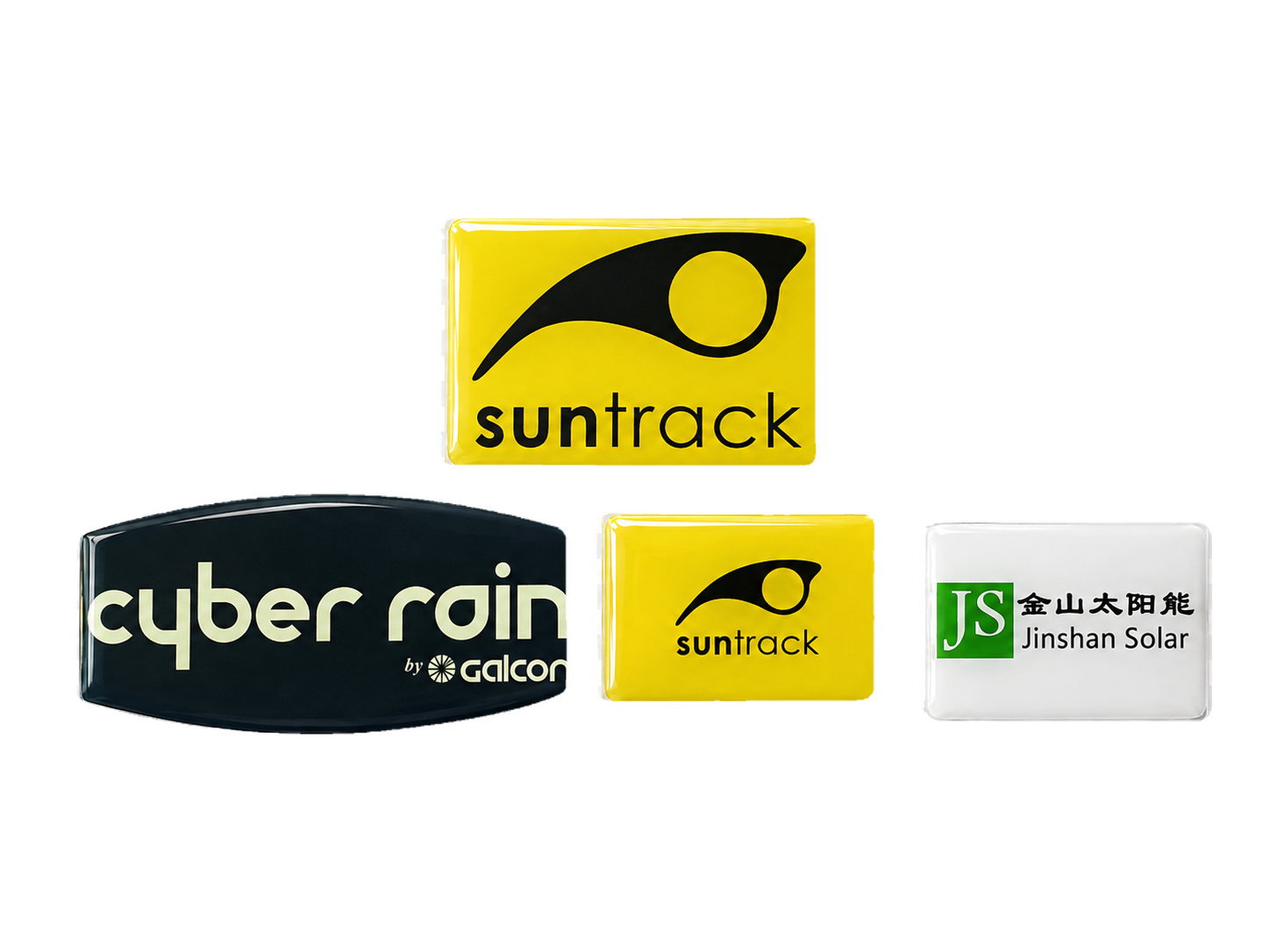
Polyurethane 3D domes · resin emblems · brand badges
Doming Label Nameplates — Polyurethane 3D Resin Emblems for OEM Branding
Printed labels finished with a clear two-part polyurethane dome — a glossy 3D lens that lifts a logo and seals the print.
JASPER makes custom doming label nameplates for OEM branding: 3D resin logo emblems, product badges, branded nameplates, and durable identification labels finished with an automotive-grade polyurethane dome.
OEMs that ship with our interface parts inside




The 3D end of the family
A label with a clear 3D dome on top.
Pick up a doming label and the first thing you notice is the dome. It is a glossy bubble of clear resin, sitting proud of the surface, and it bends the light so the logo underneath looks deeper than it is. Slide a fingernail across it and you feel hard, smooth plastic, not paper. Under all that, though, it is still a label: printed graphics, adhesive on the back. The dome is just what turns it into a little emblem.
Making one is almost low-tech. You print the label, you pour a measured shot of two-part polyurethane resin over the face, and you wait. The liquid creeps out to the die-cut edge on its own, levels into a lens, and cures hard. Two things happen in that one step. The art gets lifted into 3D, and the print gets sealed under a scratch-proof skin.
You will hear other names for them — domed decals, 3D labels, gel labels, bubble labels. Whatever you call it, the dome is the point. Strip it off and you are back to a flat label nameplate; pour it on and you have a doming label.
One thing to get straight up front: the resin matters. Automotive-grade polyurethane stays crystal clear, resists UV, and does not yellow over the years. Epoxy doming is cheaper, but it tends to yellow, harden, and shrink as it ages. We dome with polyurethane for that reason.
Quick Answer
What is a doming label nameplate?
A doming label nameplate is a printed label with a clear two-part polyurethane dome cured over the top. That dome magnifies the art, gives a logo or badge a raised glossy look, and seals the print against scratches, weather, and chemicals. Why polyurethane? Because the automotive grade stays UV-resistant and never yellows, where cheaper epoxy doming clouds and shrinks. You will see them sold as domed decals, 3D labels, or bubble labels. The usual jobs are brand emblems, product badges, and durable ID, and they go on with high-tack adhesive or a magnet back. Take the dome away and you just have a flat label nameplate — the dome is the whole point.
Build and material options
A doming label is built in layers, and each one is a choice.
We confirm all of them before we quote — the resin, the dome, the print, the base, the adhesive, and the shape.
| Component | Typical options | Design note |
|---|---|---|
| Dome resin | Two-part polyurethane (automotive grade); crystal-clear, UV-resistant, non-yellowing | Polyurethane over epoxy — epoxy is cheaper but yellows, hardens, and shrinks over time. |
| Dome profile | Standard rigid dome; adjustable rigidity; flexible dome for curved surfaces | Rigid suits flat faces; flexible domes bend for curved parts and automotive floor mats. |
| Printed graphic | Digital full-color, color-matched (Pantone/PMS) ink | Digital printing gives crisp full-color art with no plate or die charges for short runs. |
| Base material | Vinyl, polyester, polycarbonate, mylar | The print carrier under the dome; chosen by surface, durability, and adhesive needs. |
| Adhesive | High-tack permanent acrylic adhesive; magnet backing option | High-tack acrylic suits smooth plastics, polished metals, and glass; magnet backing for repositionable badges. |
| Shape and size | Custom die-cut shapes and sizes; round, oval, rectangle, logo-shaped | The resin flows to the die-cut edge, so the dome follows the label outline. |
| Durability | UV-resistant, scratch-resistant, weatherproof, chemical-resistant; indoor or outdoor | The dome seals and protects the print; automotive-grade resin holds up outdoors for years. |
Where doming labels fit
Where appearance and durability both matter.
Doming labels earn their place when a logo has to look premium and survive at the same time. The dome makes a brand mark pop, and the resin keeps it that way outdoors, on equipment, or anywhere it takes handling.
Common uses are brand emblems, product identification badges, point-of-purchase branding, equipment nameplates, and automotive emblems. They go onto appliances, power tools, vehicles, electronics, and machinery — anywhere a brand mark needs to stand out and survive. Add a magnet backing and the same badge becomes repositionable for displays or demos.
Material route comparison
Doming, flat label, acrylic, glass, and metal each do a different job.
A doming label is the decorative, 3D end of the lineup. The other routes solve different problems.
Doming label nameplate
A printed label under a clear polyurethane dome; for premium 3D brand emblems and badges.
Label nameplate
A flat label nameplate in polycarbonate or polyester for durable identification without the dome.
Acrylic / glass
A rigid acrylic panel or a glass nameplate when the front is a hard panel, not a label.
Metal nameplate
A metal nameplate for rugged etched or embossed metal plates.
Design checks
The art, the shape, and where it lives.
A doming label quote depends on all three. We look at the whole stack before we pour resin.
- Label size, die-cut shape, and dome profile (rigid or flexible)
- Artwork: full-color, Pantone/PMS matching, logo outline
- Base material: vinyl, polyester, polycarbonate, or mylar
- Adhesive: high-tack permanent acrylic, or magnet backing
- Mounting surface: smooth plastic, polished metal, glass, painted steel
- Environment: indoor or outdoor, UV, chemicals, temperature, handling
- Whether the part should be domed, flat-printed, or a metal plate
What to send
Send vector artwork — an Adobe Illustrator file, an EPS, or a press-ready PDF — with the logo outline and any die-cut shape called out.
If we think a flat label or a metal plate would serve the application better than a dome, we will say so before tooling.
Request a QuoteDoming label questions
What is a domed label, and why is it called a bubble label?
Print a label, pour clear two-part polyurethane over it, and the resin cures into a raised 3D lens — that is a domed label. The smooth, glossy bubble it forms is where the names bubble label and gel label come from. The look is half the reason people choose it; the other half is protection, since the cured dome shields the print from scratches, weather, and chemicals whether the part lives indoors or out.
Polyurethane or epoxy — does the doming resin matter?
More than you might think. Go with automotive-grade polyurethane and the dome stays crystal clear, takes UV, and never yellows. Go with epoxy to save money and you pay for it later: it yellows, hardens, and shrinks with age, which both dulls the look and can crack the dome. So we pour polyurethane, and the emblem keeps its clarity and shape for years.
What is the difference between a domed label and an embossed label?
A domed label is flat printed art with a clear resin bubble on top, so the 3D effect is the dome resting above the graphic. An embossed label raises the material itself into the shapes or text, like the raised feel of a wine label. Doming adds a clear lens over the print; embossing reshapes the substrate underneath.
Continue the front-surface material review
Graphic overlays
Head back to the Graphic Overlays hub to weigh every printed front-surface option.
Review graphic overlays →Label nameplate
See the flat polycarbonate and polyester label that sits under the dome.
Review label nameplates →Acrylic panels
Compare a domed emblem with a rigid PMMA panel or cover lens.
Review acrylic panels →Graphic overlay materials
Weigh PET, PC, acrylic, glass, resin, adhesive, and coating trade-offs in one place.
Review materials →Get a doming label reviewed before tooling
Send the artwork, the shape, the mounting surface, and where the part has to live. We will confirm the base material, the dome profile, the adhesive, and whether polyurethane doming is the right finish — or whether a flat label nameplate or a metal nameplate fits better.
Start RFQ ReviewStill weighing materials? Start with our graphic overlay materials reference.