
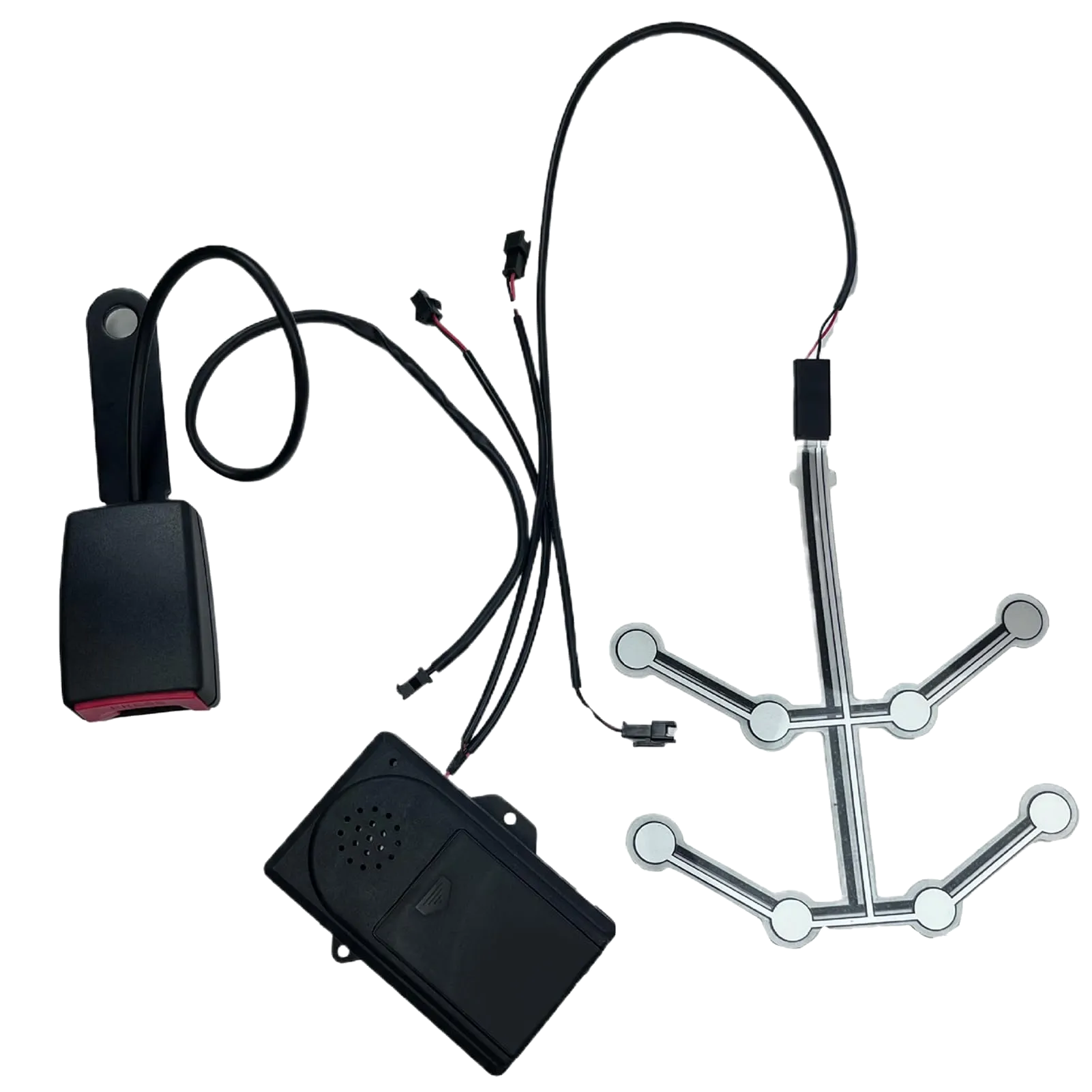
Custom automotive seat sensing
Seat Belt Reminder Sensor
Custom seat belt reminder sensors that detect seat occupancy for SBR logic, built around your seat structure and electronics.
OEMs that ship with our interface parts inside





Quick Answer
A seat belt reminder sensor helps a Seat Belt Reminder system know whether a seating position is occupied. SBR means Safety Belt Reminder or Seat Belt Reminder. In a JASPER seat mat project, the sensor is normally discussed as an occupancy or pressure-detection part inside the cushion structure; a separate buckle sensor reports whether the belt is fastened. The OEM program then decides how those inputs are used for a warning light, warning chime, or other reminder behavior.
For a quotation, we do not start with a fixed catalog pad. At JASPER Electronics, we review the seat drawing first, then adapt the SBR sensor mat shape, sensing area, trigger force concept, cable length, connector, and installation position around the foam and harness layout.
Custom Seat Belt Reminder Sensor Manufacturer
JASPER Electronics manufactures custom sensor mats for automotive seat belt reminder systems, passenger detection, rear-seat occupancy detection, bus seats, and custom vehicle seating modules. Buyers may call the same part a seat belt reminder sensor, automotive SBR sensor, car seat SBR sensor, or seat belt reminder pressure mat. The wording changes. The seat problem is usually the same.
One practical boundary matters here: the sensor mat is not the whole vehicle warning system. Our work is the seat occupancy or pressure-sensing component. The OEM or Tier 1 team owns the buckle input, harness interface, warning behavior, validation method, and vehicle-level documentation.
Our Dongguan team can adjust the SBR sensor mat for seat foam thickness, cushion layout, cable exit direction, and connector position. We keep unconfirmed values out of public copy: no material-stack number, no electrical-output value, no operating-temperature claim, no cycle-life claim, no vehicle-program name, and no certification claim unless the customer program has confirmed it.
How a Seat Belt Reminder Sensor Works
A seat belt reminder sensor supplies an occupied-seat input. In many seat projects, the sensor mat sits inside or below the cushion area where the passenger load produces repeatable compression. When the seat is occupied, the sensor responds according to the confirmed pressure or occupancy design.
The buckle sensor answers a different question: is the belt fastened? The vehicle warning system can compare the occupied-seat input with the buckle-status input and then apply the program-defined reminder behavior. JASPER does not define the final ECU logic. We supply the custom sensor mat used by the seat project.
| SBR system input | Typical role | JASPER scope |
|---|---|---|
| Seat occupancy or pressure sensor mat | Detects whether the seat position is occupied | Custom sensor mat shape, sensing zone, trigger force concept, cable, connector |
| Seat belt buckle sensor | Detects whether the belt is fastened | Not the main product on the JASPER scope; used as a related system input |
| Vehicle warning light or chime | Gives the occupant a reminder according to vehicle design | Defined by OEM or Tier 1 system design |
| ECU or vehicle controller | Interprets seat and buckle inputs according to program logic | Customer-side system integration and validation |
This division keeps engineering discussions clear. A seat belt reminder occupancy sensor detects the seat condition. A buckle sensor detects belt status. The vehicle program decides how those 2 signals are interpreted.
OEM Reference Context for SBR Sensor Projects
SBR projects are often documented next to vehicle-level safety references. Common names in the discussion include FMVSS No. 208 in the United States, UNECE Regulation No. 16 for seat belt systems in UNECE markets, Euro NCAP assessment language, and ISO 26262 process terminology for road-vehicle functional safety. Those references are context. They are not a statement that a JASPER sensor mat has a specific approval, rating, ASIL level, or vehicle-program validation.
| Public reference | How an OEM team may use it | JASPER wording on the JASPER scope |
|---|---|---|
| FMVSS No. 208 | Vehicle-level occupant protection context in the United States | No JASPER certification claim |
| UNECE Regulation No. 16 | Vehicle-level seat belt and restraint-system context | No JASPER approval claim |
| Euro NCAP | Consumer assessment context for seat belt reminder performance | No rating claim for a sensor component |
| ISO 26262 | Functional-safety process language for road vehicles | No ASIL claim; customer program defines scope |
The practical path is shorter than the paperwork discussion: define the seat position, define the occupied-seat condition, build samples, and validate the complete seat and warning system under the OEM program.
SBR Sensor Applications
JASPER custom SBR sensor mats can be designed for front passenger seats, rear seats, bus seats, commercial vehicle seats, and custom vehicle seating projects when the seat structure and detection target are clear. Each seating position can require a different sensor outline, cable route, and connector position.
| Application | Sensor role | Design notes |
|---|---|---|
| Front passenger seat | Detect whether the front passenger position is occupied | Sensor area should match the main cushion load zone and seat foam behavior |
| Rear seat | Provide an occupied-seat input for rear SBR functions | Cable exit and connector location often differ from the front seat |
| Bus or commercial vehicle seat | Support passenger occupancy detection for commercial seating modules | Validate seat width, cushion compression, passenger use pattern, and harness route |
| Custom vehicle seating | Fit a non-standard seat shape or module structure | Start from the CAD drawing, seat sample, or marked installation area |
| OEM seating project | Supply an engineered sensor mat for a defined seat system | Use customer validation data before fixing the final trigger condition |
JASPER focuses on legitimate OEM and custom seating applications. We do not provide content for changing or defeating vehicle warning behavior.
Custom Design Options
A seat belt reminder sensor mat should be designed around the seat, not chosen only from a catalog photo. Seat foam thickness, upholstery tension, cushion compression, wire routing, and connector space can change the final sensor layout. JASPER reviews those items before recommending a sample design.
| Custom item | What JASPER can adjust | RFQ input needed |
|---|---|---|
| Sensor mat shape | Rectangular, contour-cut, or custom outline | Seat drawing, cushion boundary, target installation area |
| Sensing zone | Single sensing area or multiple sensing areas | Occupant load area, seat section, detection target |
| Trigger force / activation pressure | Trigger concept tuned to the seat foam and cushion behavior | Expected occupant condition, foam compression note, validation method |
| Cable length | Cable length matched to seat harness route | Exit side, routing path, bend area, harness distance |
| Connector | Connector selected to match the customer harness | Connector drawing, mating part, pin requirement if confirmed |
| Installation position | Under foam, inside cushion, below upholstery, or module cavity | Seat stack drawing, foam sample, assembly sequence |
| Moisture protection | Moisture-resistant construction according to project need | Exposure area, cleaning condition, seat location |
| OEM/ODM production | Drawing review, sample build, revision support, production preparation | Sample quantity, annual quantity target, packaging requirement |
If the project already has a car seat occupancy sensor for seat belt reminder drawing, we can review the file directly. If the project starts from a seat sample, we can begin with the load area, cable exit, and connector requirement.
Integration Notes for Engineers
A seat belt reminder pressure sensor depends on the mechanical stack around it. Foam thickness can change how much load reaches the sensing zone. Cushion compression behavior can change between a flat bench seat, a contoured passenger seat, and a bus passenger seat. Upholstery tension can also affect the activation condition.
For this reason, we discuss trigger force or activation pressure as a project-specific concept rather than a fixed public number. The customer program should define the occupant load threshold concept, the empty-seat condition, and the validation method. JASPER can then adjust the sensing zone and sensor mat geometry during the sample stage.
Cable exit direction needs early attention. A cable that leaves the sensor through a high-bend area can create assembly strain. Connector compatibility also needs confirmation before sample build. A connector drawing, mating part, and harness route help avoid late-stage redesign.
Sample validation should include the real seat foam, cushion, upholstery, and installation position whenever possible. Bench tests can screen the first design, but final review should be tied to the actual seat structure used by the OEM or custom seating project.
RFQ Information Needed
A clear RFQ helps us quote the correct seat belt reminder pressure mat and avoid assumptions. If one item is not ready, mark it as “not decided” and we will identify the next engineering question.
| RFQ item | What to send | Why it matters |
|---|---|---|
| Seat position | Front passenger, rear seat, bus seat, commercial vehicle seat, custom seat | Defines the load area and installation condition |
| Installation location | Under foam, inside cushion, below upholstery, module cavity | Controls sensor shape and cable exit |
| Target detection condition | Occupied-seat condition and activation concept | Guides trigger force and sensing zone discussion |
| Seat drawing or sample | CAD file, 2D drawing, cushion sample, or marked photo | Reduces geometry guesswork |
| Cable route | Exit side, cable length, bend area, harness path | Prevents assembly conflict |
| Connector requirement | Connector drawing, mating part, pin requirement if confirmed | Supports sample fit and harness review |
| Quantity target | Sample quantity and annual demand estimate | Helps plan tooling, packaging, and production preparation |
The most useful first package is a seat drawing, a marked sensor area, a connector drawing, and a short note explaining how the project defines an occupied seat.
Manufacturing and Sample Workflow
JASPER’s workflow for a passenger seat belt reminder sensor or rear seat belt reminder sensor starts with the seat structure. We review the application, define the sensor mat layout, build samples, and adjust the design after customer validation feedback.
| Step | What JASPER does | Buyer output |
|---|---|---|
| 1. Requirement review | Review seat position, installation area, cable route, connector need, and target detection condition | Confirmed project brief |
| 2. Sensor layout | Define sensor outline, sensing zone, cable exit, and connector plan | Drawing approval or comments |
| 3. Sample build | Produce engineering samples according to the agreed layout | Seat-level test feedback |
| 4. Design adjustment | Tune geometry, sensing zone, cable route, or trigger concept if needed | Updated drawing or validation note |
| 5. Production preparation | Prepare production files, packaging details, and inspection points | Purchase plan and delivery schedule |
This process keeps the project tied to the real seat. It also helps engineering and sourcing teams discuss the same part using different search terms: automotive SBR sensor, seat occupancy sensor for seat belt reminder, seat pressure sensor for seat belt reminder, or seat belt reminder sensor mat.
FAQ
What does SBR sensor mean?
SBR sensor means Safety Belt Reminder sensor or Seat Belt Reminder sensor. In an automotive seat project, it usually refers to a sensor input that helps identify whether a seat is occupied so the vehicle system can compare seat presence with seat belt buckle status.
How does a seat belt reminder sensor detect an occupied seat?
A seat belt reminder sensor detects an occupied seat by using a pressure or occupancy sensor mat inside the seat cushion structure. When a passenger applies load to the seat, the sensor mat detects the occupied-seat condition according to the confirmed design and installation position.
Can one sensor design be used for front and rear seats?
One sensor design may work for related seat structures, but front and rear seats often need different sensing zones, cable exits, and connector positions. JASPER recommends reviewing each seat drawing, foam thickness, and cushion compression behavior before fixing one shared SBR sensor mat design.
Can JASPER customize SBR sensor mats for OEM projects?
Yes. JASPER can customize SBR sensor mats for OEM projects by adjusting the sensor mat shape, sensing zone, trigger force concept, cable length, connector, installation position, and moisture protection structure after reviewing the seat drawing, sample, and target detection condition.
Related Links
– Car Seat Occupancy Sensor — hub page for JASPER automotive seat occupancy and pressure sensor solutions. – Seat Occupancy Sensor Mat — physical mat/pad page for seat presence detection. – Bus Seat Occupancy Sensor — commercial vehicle and bus passenger seat application page.
Related seat sensor products
Car Seat Occupancy Sensor
Back to the seat sensor hub to compare all seven routes.
Back to hub →Car Seat Pressure Sensor
Pressure-sensing assembly matched to your seat electronics.
Review →Seat Belt Reminder Sensor
Occupancy input paired with belt-buckle status for SBR logic.
Review →Request a Quote
Send your seat drawing, sensing zone, cable route, and connector.
Start RFQ →Request a custom seat belt reminder sensor quote
Send the seat drawing, installation position, sensing zone, cable route, connector requirement, and sample schedule. We will review the build and come back with materials, approach, and quote.
Request a Custom Seat Sensor Quote