
A laser-etched silicone keypad uses a controlled color and coating stack rather than a laser mark alone. The usual engineering problem is to expose the intended base or light-transmitting layer without leaving weak edges, residue, pinholes, color inconsistency, or damage to the molded key. Approval therefore needs separate evidence for unlit appearance, powered appearance, coating adhesion, legend registration, abrasion, liquid contamination, key flexing, and production repeatability. A sample that looks correct under one lamp and one viewing angle does not establish durability or backlight performance in the finished control.
For an OEM interface that needs durable legends, illuminated symbols, or color-separated key groups, begin with the laser-etched silicone keypad product route. The artwork and surface can be reviewed early, but production release should wait until the complete molded, coated, laser-processed, and assembled stack has passed the project’s visual and functional criteria.
What Is a Laser-Etched Silicone Keypad Legend?
A laser-etched legend is a symbol, letter, number, or light window formed by selectively removing an upper color layer from a silicone key surface. The exposed layer provides the visible contrast. In a backlit construction, it also becomes part of the optical path between the LED and the operator.
The laser does not create good contrast by itself. Contrast comes from the relationship among:
- molded silicone color;
- any light-blocking or intermediate color layer;
- the visible top color;
- the geometry and depth of the removed area;
- a clear or tinted protective coating;
- ambient light, LED color, and viewing direction.
This distinction matters during sourcing. Laser etched describes one operation. It does not specify the whole legend system or its acceptance.
Define the Complete Surface Stack
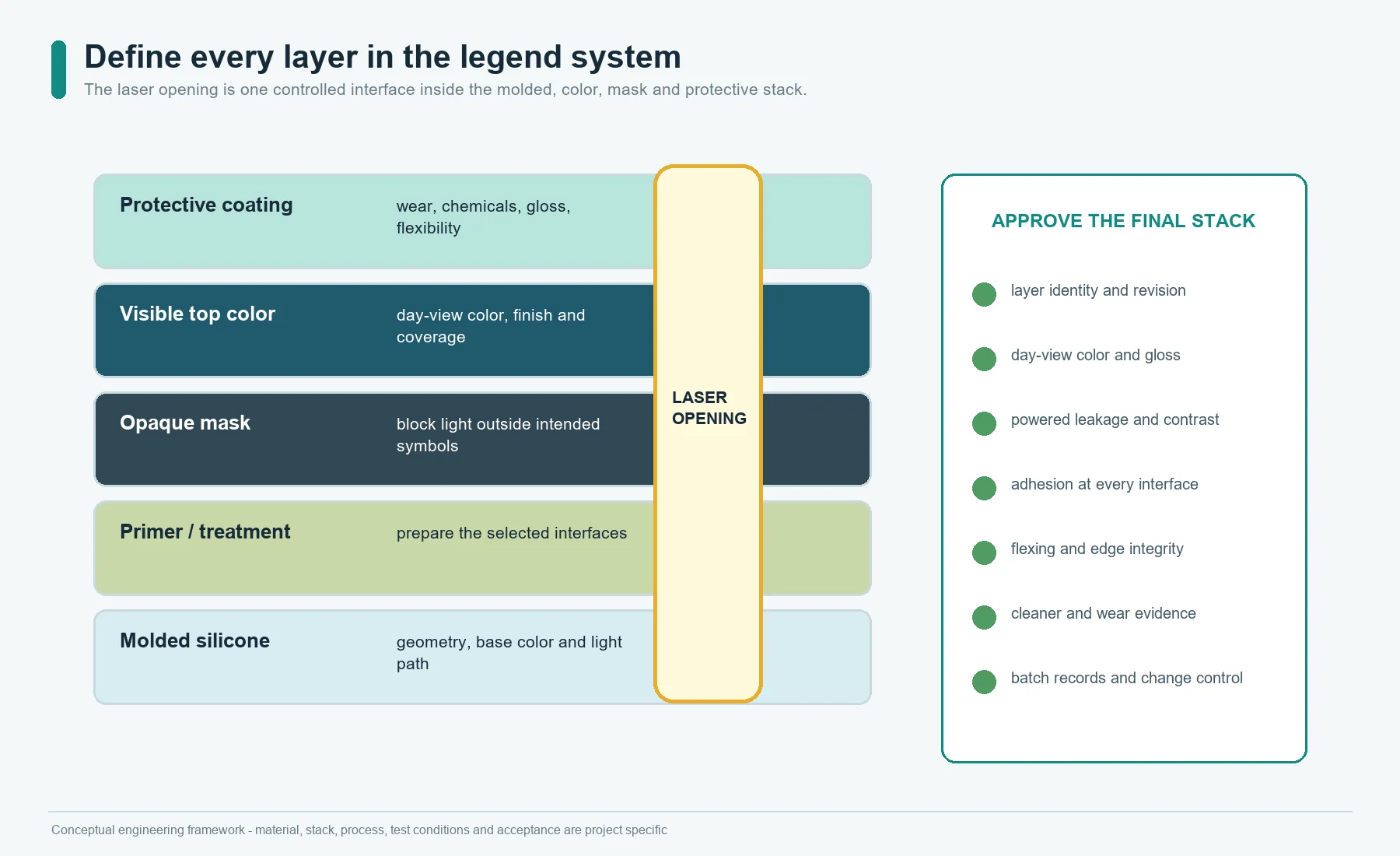
The drawing should name every layer that affects appearance, adhesion, light, or wear. A generic note such as black keypad with white laser legends leaves several production decisions unresolved.
| Stack element | Main job | Approval question |
|---|---|---|
| Molded silicone | key geometry, elastic body, base color or light path | which material, color system, finish, and molded revision are represented? |
| Primer or surface treatment | prepare the silicone surface for a later layer | is it required, and how is treatment state controlled? |
| Intermediate color or mask | create contrast or block unwanted light | where must it cover, and where may it not appear? |
| Visible top color | provide the normal daytime key appearance | what color, gloss, texture, and coverage are accepted? |
| Laser opening | expose the intended layer in the artwork shape | what registration, edge, residue, and damage criteria apply? |
| Protective coating | reduce direct wear and chemical contact with the color stack | which coating, cure, appearance, flexibility, and adhesion are required? |
Not every keypad needs every row. The important requirement is that the actual construction be documented. If the supplier changes from one color layer to two, or adds a protective coat after sample approval, the revision is no longer the same surface system.
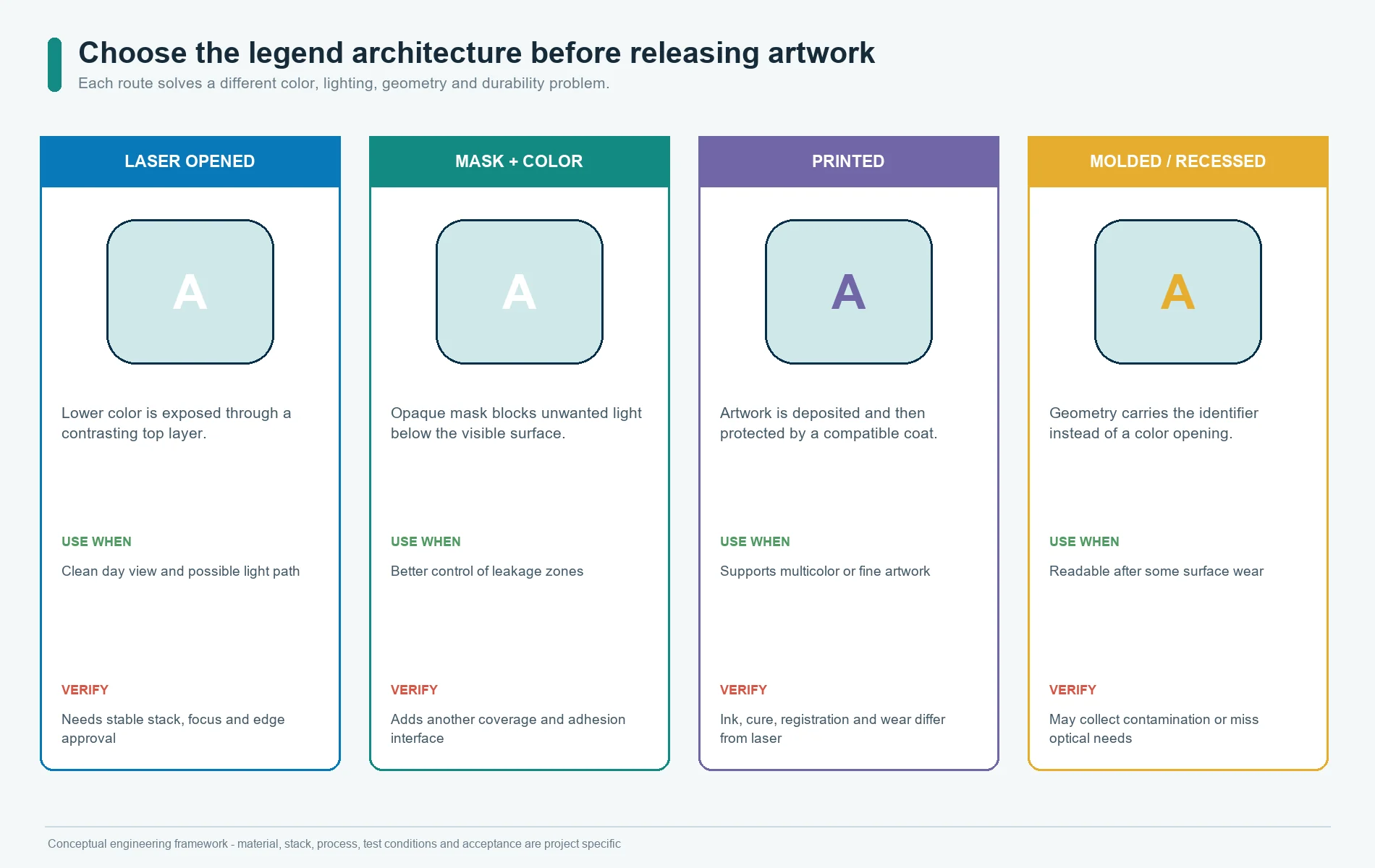
Choose the Legend Architecture Before Artwork Release
Several constructions can produce a readable key, but they do not behave identically.
Molded color with a contrasting top layer
The molded key provides the exposed legend color. A contrasting layer covers the visible surface, and the laser removes selected areas. This can create a clean day-view symbol and may support backlighting when the base material and complete optical stack transmit the required light.
Opaque mask plus visible color
An intermediate opaque layer can reduce light leakage through areas that must remain dark. The visible top layer then defines the key color. This arrangement adds another interface whose coverage and adhesion must be controlled.
Printed legend under a protective coating
Some artwork is better printed than laser-opened, especially when it needs multiple colors, fine halftones, or a result that does not depend on a contrasting lower layer. Printing has its own ink, registration, cure, adhesion, and wear requirements.
Molded or recessed legend
A molded feature can remain readable after surface wear, but it may not provide the desired color separation or illuminated appearance. Deep recesses can also collect contamination or make coating coverage harder to inspect.
The correct route follows the product’s day-view, night-view, cleaning, wear, texture, and cost constraints. Laser etching should not be selected merely because the artwork contains text.
Start with the Operator and Use Environment
Surface design begins with use conditions, not a laser-machine setting. Record:
- bare finger, glove, stylus, or another actuator;
- press frequency and high-use keys;
- sliding, rubbing, twisting, or fingernail contact;
- dust, grit, metal particles, or other trapped debris;
- cleaners, disinfectants, oils, fuels, cosmetics, sweat, or food residue;
- sunlight, heat, cold, humidity, condensation, and storage;
- required service life and replacement strategy;
- whether the control is read mainly unlit, backlit, or in both states;
- viewing distance, viewing angle, and operator posture;
- safety, warning, identification, or decorative role of each legend.
A rarely pressed indoor setup key and a frequently cleaned machine-stop key should not inherit the same approval plan without review.
Treat Silicone Surface Preparation as a Controlled Operation
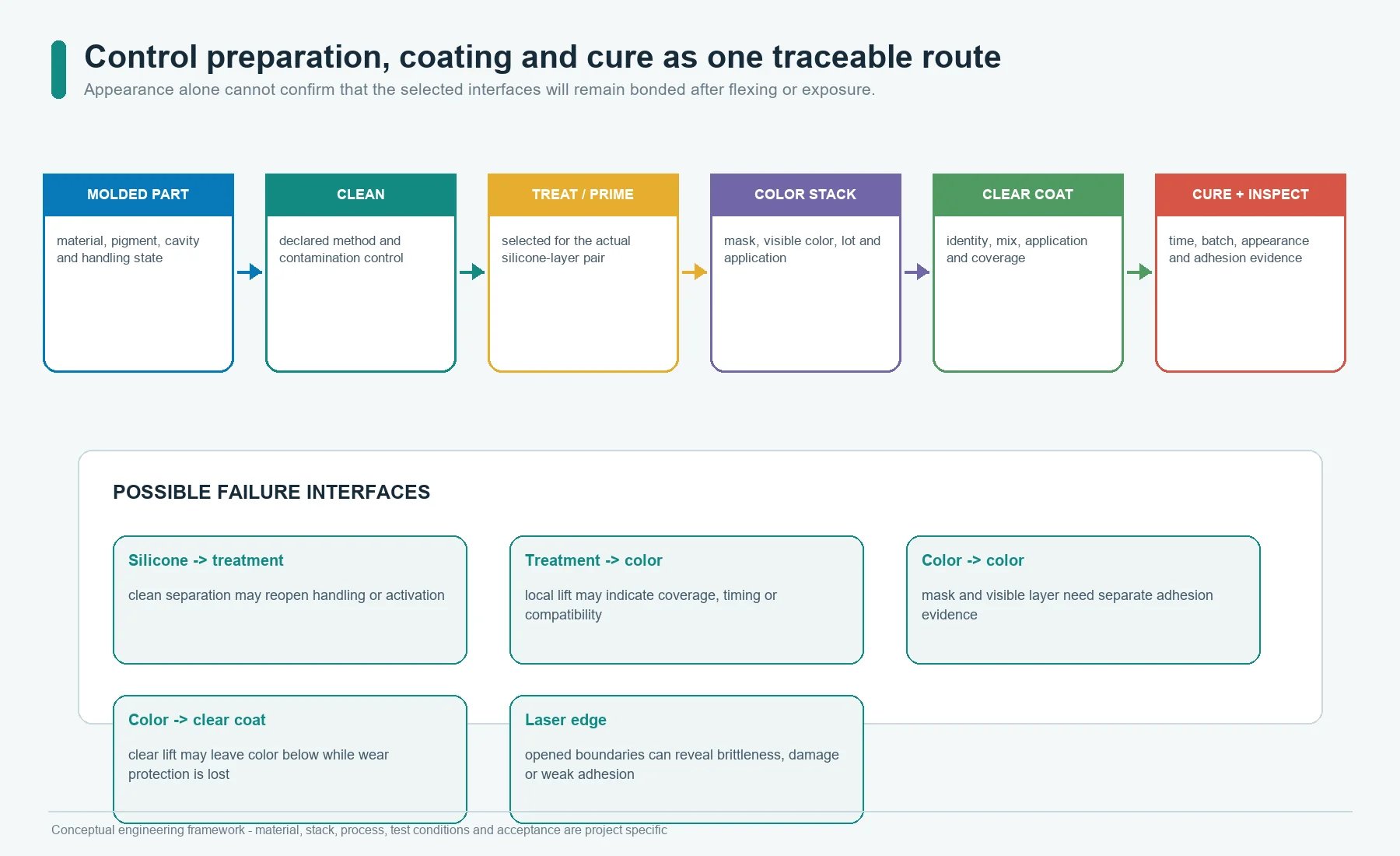
Silicone rubber has a low-energy surface, so later coatings or inks may require cleaning, activation, primer, or another preparation selected for the actual material and coating pair. Treat cleaning, surface activation, priming, coating, and printing as distinct secondary operations. There is no universal preparation recipe for every keypad.
The process record should identify:
- molded material and color lot;
- time and handling state before preparation;
- cleaning materials and method;
- surface treatment or primer identity;
- treatment date or process batch;
- maximum allowed delay before coating, when relevant;
- contamination controls;
- coating identity, mix, application, cure, and lot;
- rework or retreatment rule.
Surface preparation should not be accepted through appearance alone. A layer may look continuous and still separate after flexing, rubbing, cleaner exposure, or aging.
Control Coating Adhesion at the Interfaces
The stack contains more than one possible failure plane:
- molded silicone to primer or treatment boundary;
- primer to color layer;
- one color layer to another;
- color layer to protective coat;
- local edge created by laser removal.
An adhesion result should state which interface was stressed and what failure appeared. Coating peeled is not enough for diagnosis.
Useful observations include:
- cohesive tear within a layer;
- clean separation at the silicone surface;
- separation between two color layers;
- clear-coat lift with color remaining below;
- edge lifting around the legend;
- cracking without separation;
- gloss or color change with no visible lift.
The corrective action differs for contamination, wrong treatment state, incomplete cure, incompatible layers, excessive coat buildup, and laser damage. Keep photographs and sample identity with the test record.
Release Artwork for the Actual Key Geometry
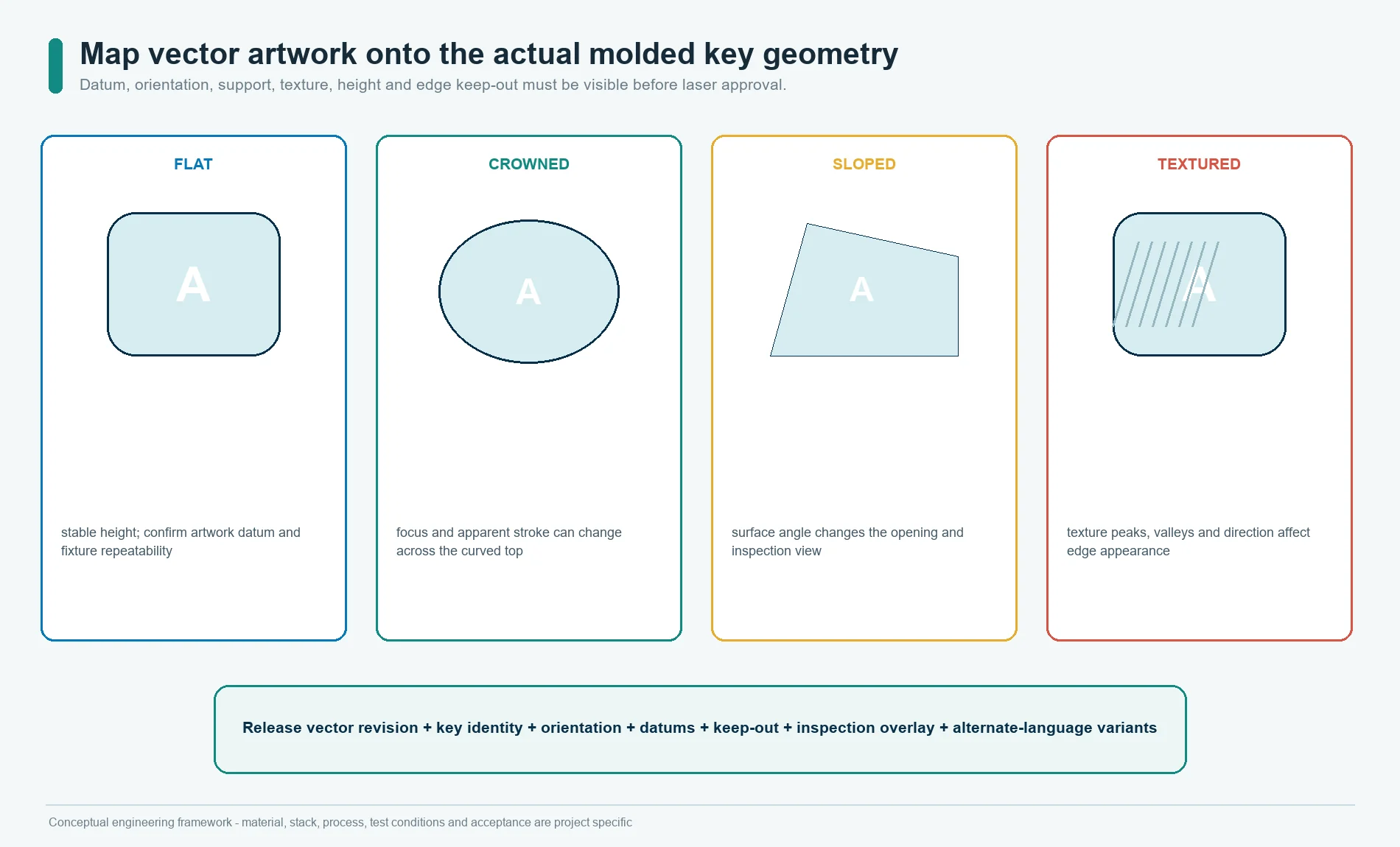
Flat artwork does not show how a legend will sit on a curved, sloped, textured, or flexible key top. The artwork package should include:
- vector source and controlled revision;
- key identity and orientation;
- legend center relative to product datums;
- permitted rotation and positional tolerance;
- minimum visible stroke and gap agreed for the process;
- keep-out from edges, radii, parting lines, texture transitions, and trim areas;
- day-view color assignment;
- night-view light assignment;
- symbols that require regulatory or customer approval;
- mirrored, inverted, or alternate-language variants;
- inspection overlay or coordinate method.
Do not scale all symbols automatically to fill each key. A smaller key may need a different layout, while a warning symbol may require more clear space than a digit.
Account for Curvature, Texture, and Laser Focus
A laser process is easier to stabilize on a flat, repeatable surface than across a tall crown, steep wall, deep texture, or flexible unsupported region. The sample plan should challenge the actual feature rather than a convenient flat plaque.
Review:
- height variation across the legend;
- surface angle relative to the beam and vision system;
- molded texture depth and direction;
- key movement during fixturing;
- fixture support beneath the key;
- locator repeatability;
- part warpage and part-to-part height;
- whether one focal or energy condition covers the whole symbol;
- whether the edge closest to a radius differs from the center.
The laser recipe belongs to the qualified supplier process. The OEM drawing should control the result and the traceability needed to reproduce it, not publish a generic power, speed, frequency, wavelength, pass count, or focal offset.
Establish a Laser Process Window with Representative Samples
Recipe development should separate insufficient removal from excessive exposure.
| Process observation | Possible meaning | Evidence to collect |
|---|---|---|
| top color remains in the opening | removal is incomplete or coverage is thicker than expected | microscope view, color-layer lot, coat record, recipe revision |
| legend looks gray or dirty | residue, redeposition, scorched material, or exposed layer variation | cleaned and uncleaned comparison, surface image, color reading |
| edge is ragged or enlarged | registration, focus, motion, texture, or excessive exposure issue | artwork overlay, key-height record, edge image |
| pinholes appear outside the symbol | weak mask coverage, contamination, voids, or overexposure | powered dark-room view and unpowered close-up |
| base color changes around the mark | heat-affected or chemically altered lower layer | reference coupon and material review |
| coating lifts after laser | poor adhesion, brittle stack, or excessive local damage | cross-section or staged adhesion evidence |
Development coupons can help compare process conditions, but the final window must be confirmed on molded keys with representative curvature, texture, color stack, support, and artwork.
Inspect Laser Edges, Residue, and Substrate Damage Separately
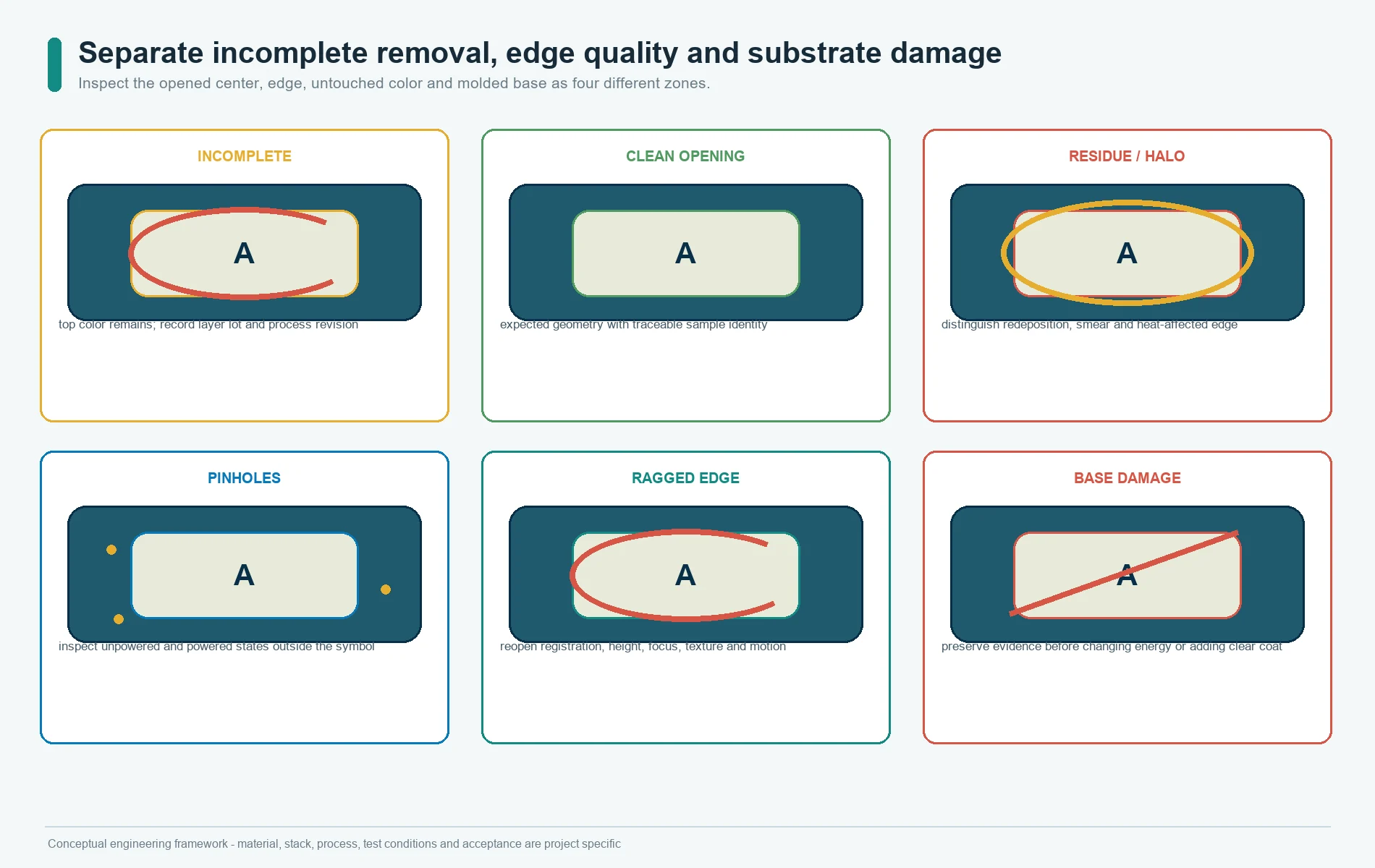
A legend can have the right shape and still contain a weak boundary. Inspect at least four distinct conditions:
- center of the opened area;
- transition from opened area to top color;
- nearby top color that should remain untouched;
- molded silicone beneath the stack.
Set visual terminology before approval. Examples include residual top coat, halo, char, smear, pinhole, edge lift, undercut, overburn, exposed intermediate layer, base discoloration, and substrate nick. Use project-specific photographs or diagrams to define each term.
Do not hide edge defects under a later clear coat without disposition. A protective layer can change the appearance of a defect while leaving the damaged interface below.
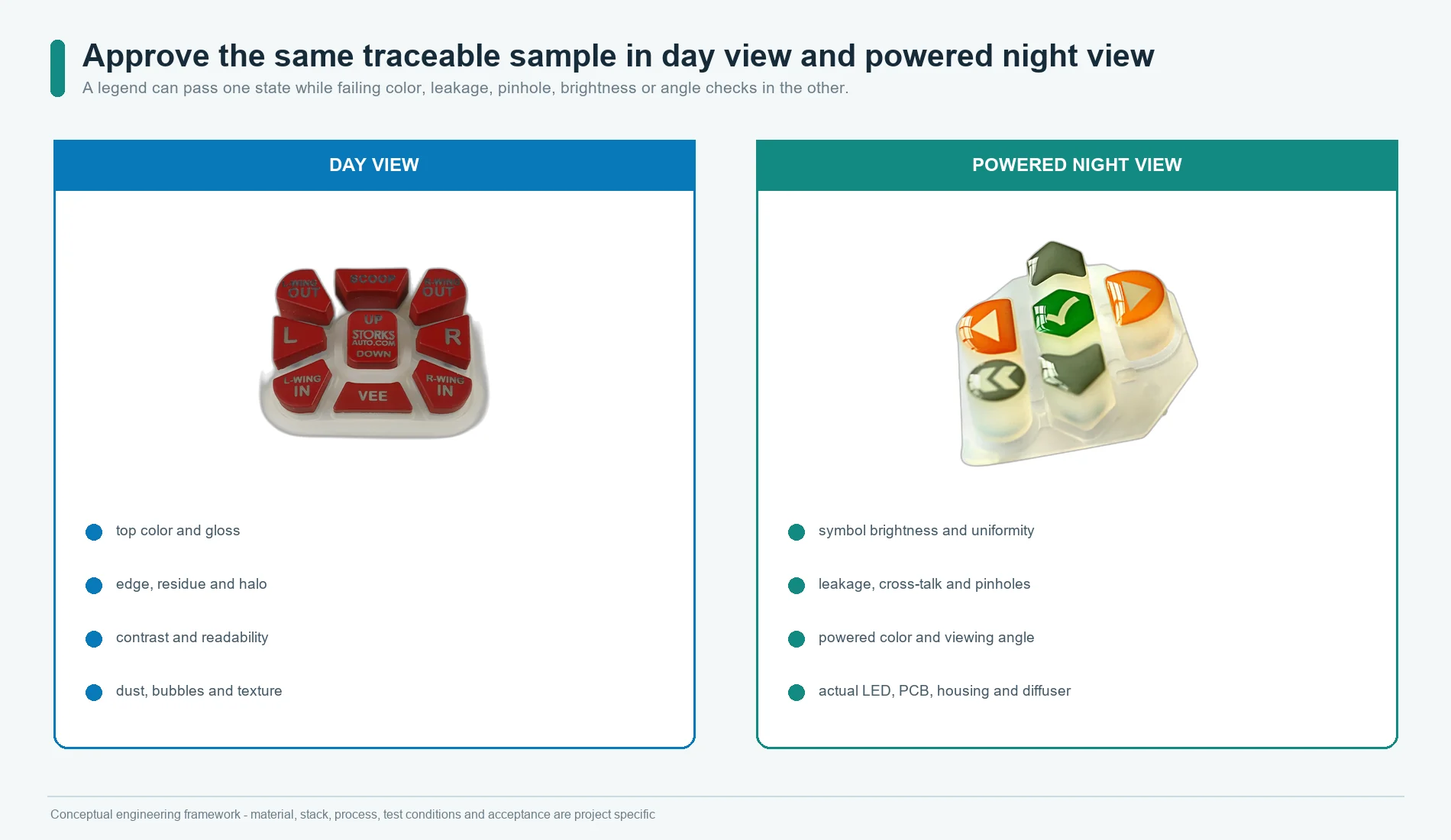
Approve Day View and Night View as Two Different States
The same legend should be reviewed with the backlight off and on.
Day-view approval
Record ambient-light type and level, viewing angle, viewing distance, background, sample orientation, observer or instrument method, and whether the key is installed in the final bezel. Inspect:
- top color and gloss;
- exposed legend color;
- contrast and readability;
- edge quality;
- residue and halo;
- color variation among keys;
- coating flow, dust, bubbles, and texture change.
Night-view approval
Use the actual LED, PCB, current-control condition, diffuser, light guide, housing, and stack revision when possible. Inspect:
- symbol brightness and readability;
- hot spots and dark zones;
- light leakage outside the artwork;
- cross-talk between keys;
- pinholes in opaque areas;
- color shift through silicone and coatings;
- differences among keys, cavities, or positions;
- appearance across the required viewing angles.
The backlit silicone rubber keypad page is the relevant commercial route when the light system is part of the project. The lighting decision still belongs to the complete LED-to-operator stack, not to the laser opening alone.
Map the Complete Optical Path
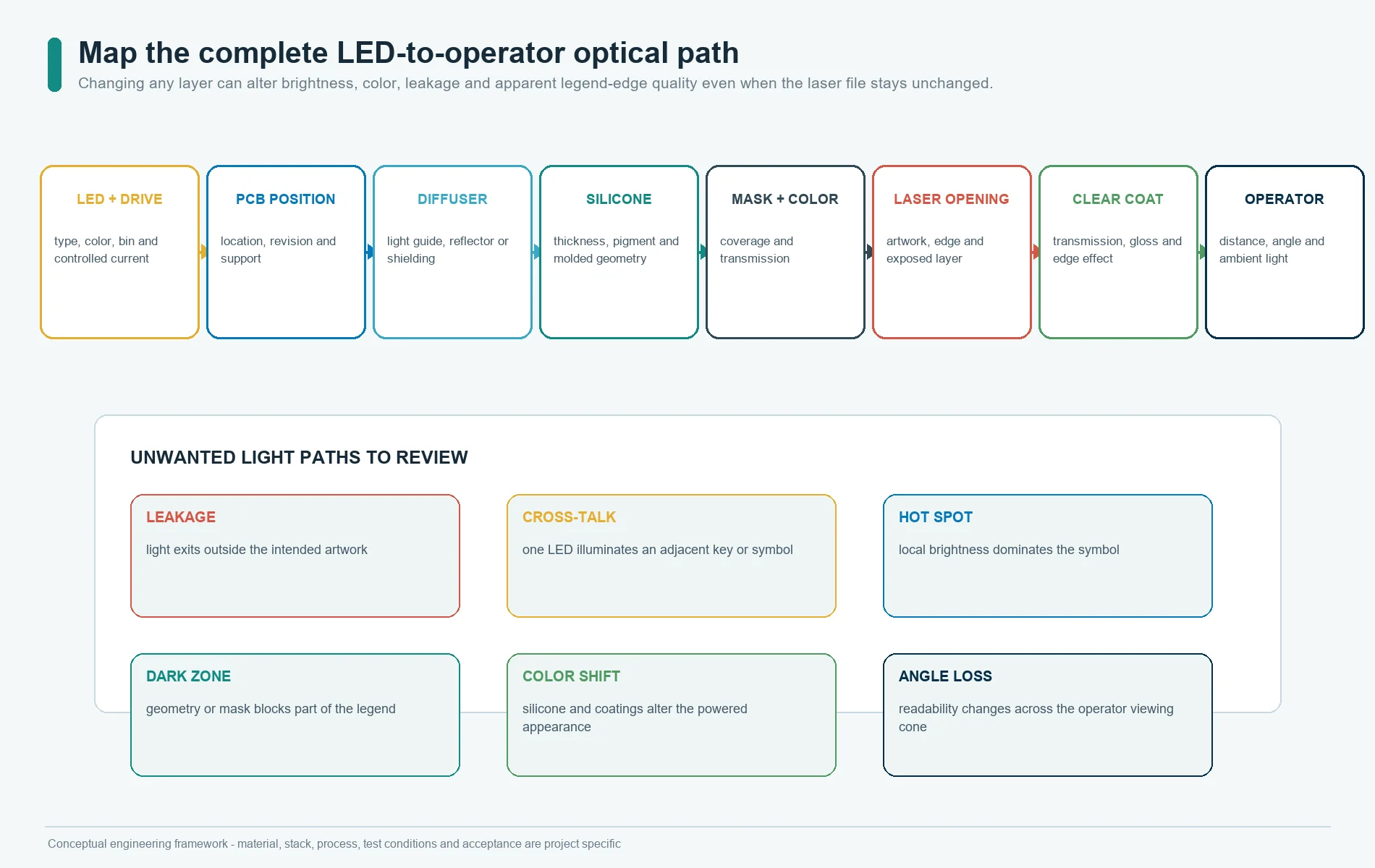
Backlit legend performance can be written as a chain:
LED and drive -> PCB position -> air gap or light guide -> molded silicone -> mask and color layers -> laser opening -> protective coat -> operator
Every element can change the result. Moving an LED, changing its bin, replacing a diffuser, altering key-wall thickness, changing pigment, increasing mask coverage, or adding a clear coat may shift brightness or uniformity even when the laser file is unchanged.
The approval sample should therefore identify:
- LED manufacturer, type, color, bin or controlled equivalent;
- drive condition and PCB revision;
- LED-to-key location;
- reflector, diffuser, light guide, or shielding;
- molded part and cavity identity;
- complete color and coating stack;
- laser artwork and recipe revision;
- housing and bezel revision;
- powered inspection condition.
The backlit control-panel case study can provide application context for symbols that must remain legible in changing light. It is not a substitute for a keypad-specific optical validation record.
Control Color, Contrast, and Gloss with Defined Conditions
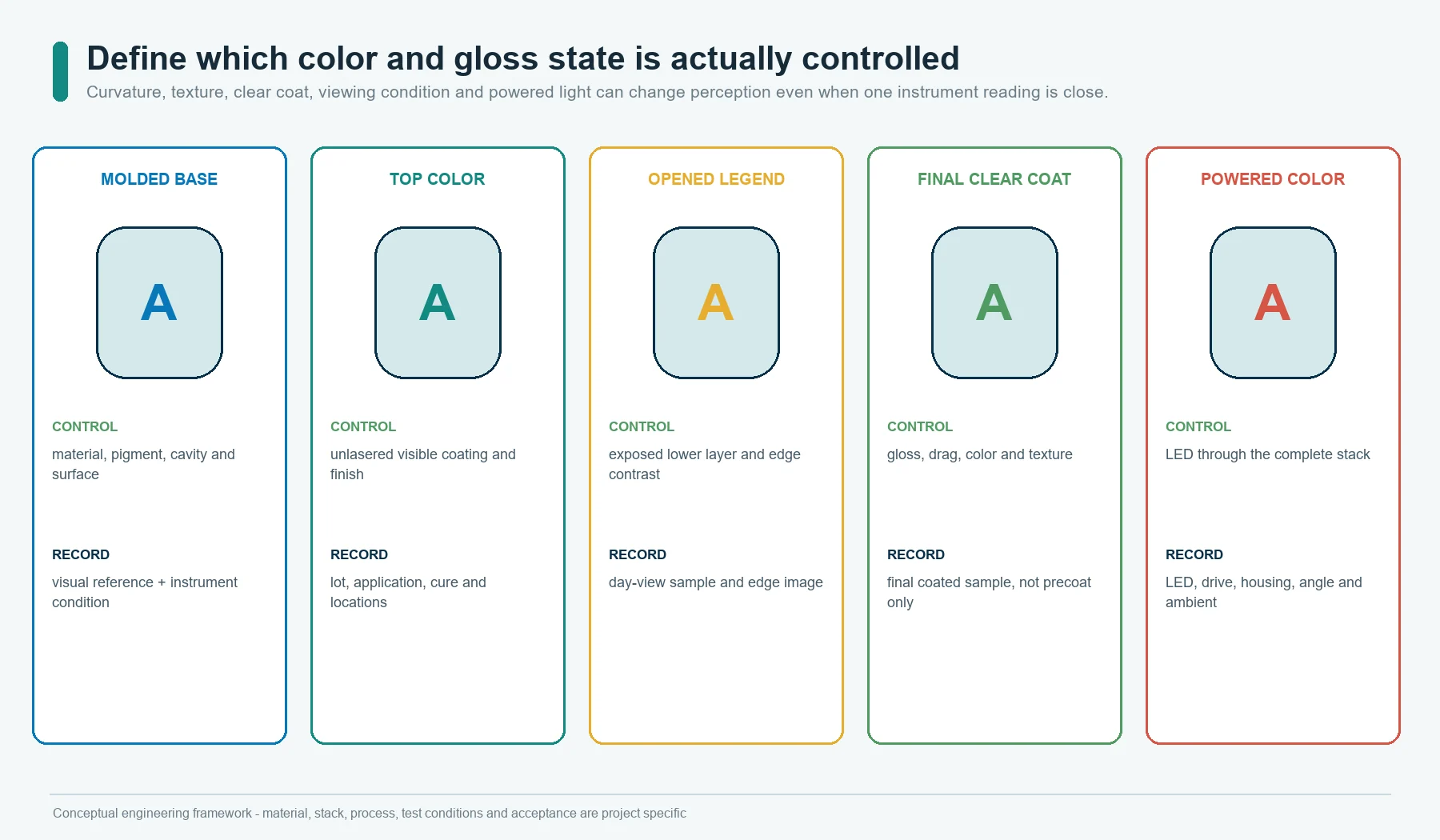
Visual color boards are useful for design selection. Production acceptance needs a documented comparison method. ASTM D2244 describes calculations for color differences from instrumentally measured color coordinates. The method can support a color-tolerance system, but the project must still define the instrument geometry, illumination, observer condition, sample presentation, measurement locations, and acceptance rule.
For a coated silicone key, decide whether the controlled object is:
- molded base color;
- top color before laser;
- exposed legend color;
- clear-coated final surface;
- powered legend color;
- unpowered assembly color.
Gloss and texture can alter perceived color and readability even when instrument values are close. A master plaque also may not represent curved keys, thin sections, different cavities, or the final coating. Keep the visual reference, instrument record, and assembled sample connected.
Select the Protective Coating for the Actual Wear Path
A protective coating can reduce direct contact with the color layers, but it is not an invisible guarantee. It may alter:
- gloss and texture;
- finger drag;
- optical transmission;
- color and contrast;
- legend-edge appearance;
- flexibility and key feel;
- adhesion at radii;
- repair and rework options.
The choice should consider whether wear is mainly rubbing, scratching, particulate abrasion, cleaner exposure, oil contact, repeated flexing, or a combination. A hard layer that performs well on a rigid coupon may crack on a frequently flexed key. A flexible layer may resist bending yet show surface polish or chemical change.
Approve the coating as part of the keypad stack, not as a generic supplier material.
Build a Realistic Wear and Contamination Matrix
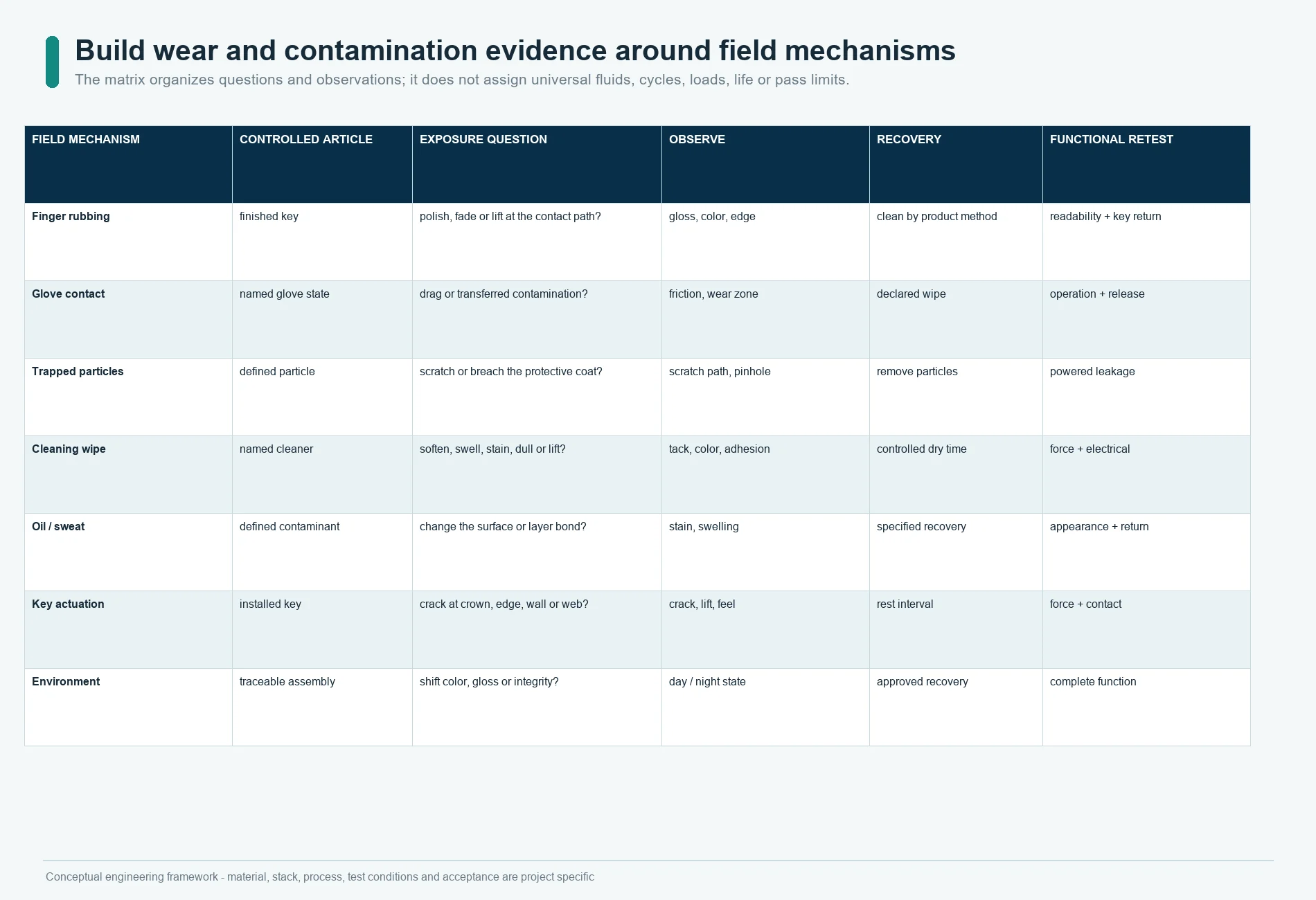
The validation plan should connect each exposure to a field mechanism.
| Field mechanism | Representative test question | Observe before, during, and after |
|---|---|---|
| repeated finger rubbing | does the legend edge polish, fade, or lift under hand contact? | gloss, color, edge, residue, readability |
| glove contact | does the glove material increase drag or carry contamination? | friction, transfer, wear location, key return |
| trapped particles | do particles scratch the clear coat or open the color layer? | scratch path, pinholes, edge breach |
| cleaning wipe | does the declared cleaner soften, swell, stain, dull, or lift a layer? | mass or dimensions if relevant, color, tack, adhesion |
| oil or sweat contact | does prolonged contamination change the surface or layer bond? | stain, swelling, softening, loss of contrast |
| repeated key actuation | does flexing crack the coating at crowns, edges, or webs? | crack, lift, key feel, return |
| light and environment | does exposure shift color, gloss, or coating integrity? | day/night appearance and adhesion |
IEC 60068-2-70 provides a framework for testing markings and lettering against rubbing caused by fingers and hands. IEC 60068-2-74 addresses fluid contamination tests. These standards help define test families; they do not select the product-specific method, fluid, severity, duration, sample state, or pass limit for a silicone keypad.
Use Abrasion Standards Within Their Scope
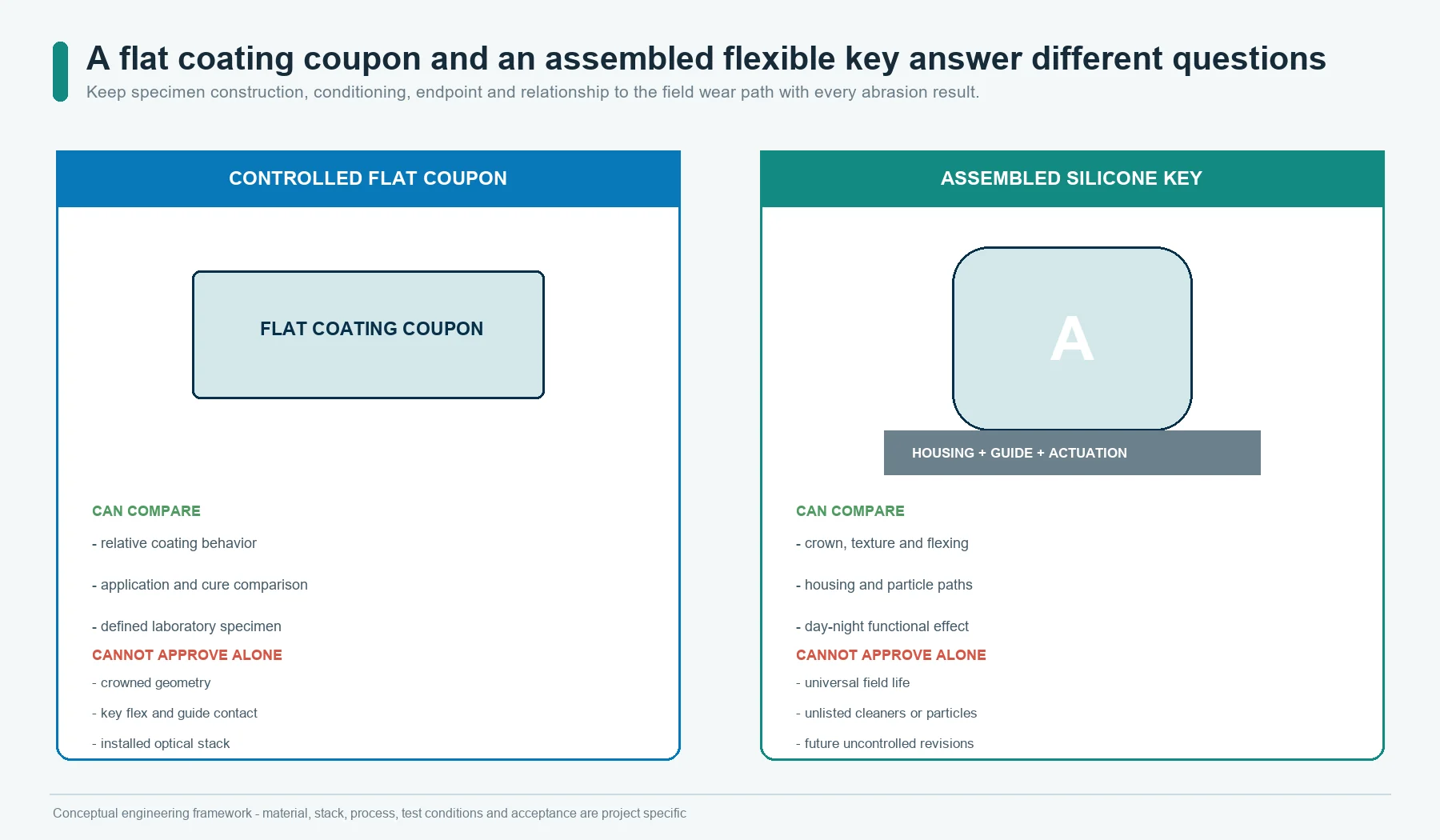
ASTM D4060 covers abrasion resistance of organic coatings by a rotary-platform abraser. It can be useful for comparing controlled coating specimens under a defined method. A result on a prepared panel or convenient coupon does not automatically represent a crowned, textured, flexible key that bends during actuation and is cleaned in service.
If the project uses an ASTM D4060 comparison, document:
- specimen construction and substrate;
- whether it matches the keypad stack;
- coating application and cure;
- conditioning;
- selected apparatus configuration;
- endpoint and measurement;
- relationship to the assembled-key test;
- reason the method is relevant to the field wear path.
Do not advertise an abrasion count without the complete method and acceptance context. A large number with no specimen, wheel, load, endpoint, or post-test criterion cannot be compared.
Test the Legend After Key Flexing and Actuation
Surface layers experience strain when a key crown bends, when a wall rubs a guide, or when the key bottoms against a stop. Testing only a flat, unpressed top misses these paths.
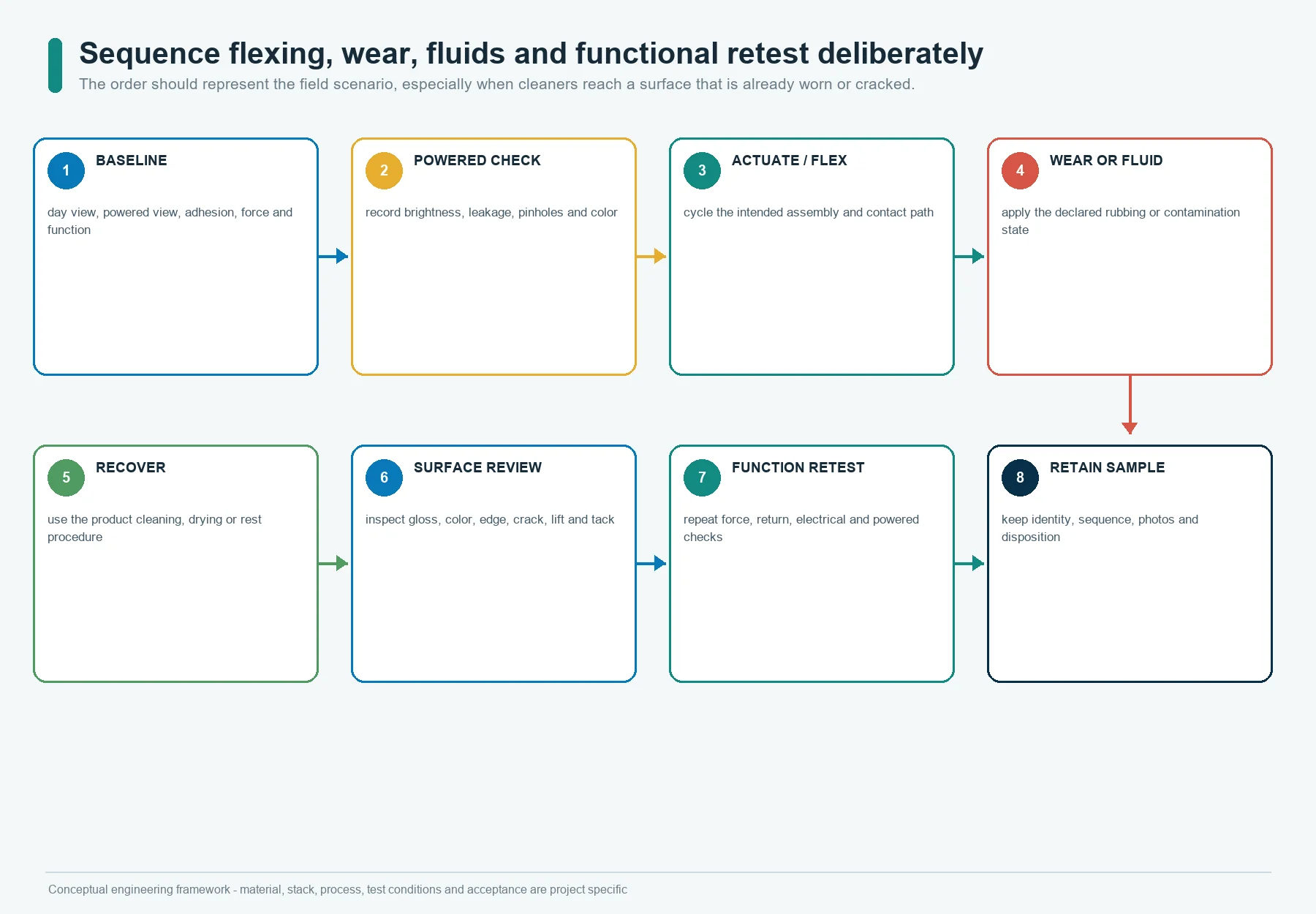
A useful sequence can include:
- inspect and record the new keypad;
- measure day-view and powered appearance;
- run the defined actuation or flexing exposure in the intended assembly;
- inspect for cracking, lifting, polishing, and light leakage;
- apply the declared rubbing or contamination exposure;
- clean or recover using the product procedure;
- inspect appearance, adhesion, force, return, and electrical function;
- compare with uncycled controls;
- retain failed and passed samples with full identity.
The order should follow the field scenario. If a cleaner normally reaches an already worn surface, pristine-only chemical testing is incomplete.
Define Cleaner and Fluid Exposure from a Controlled List
Chemical resistant is too broad for a drawing. Ask the OEM to provide:
- commercial product name and manufacturer;
- formulation or safety data where available;
- concentration and dilution water;
- wipe, spray, splash, immersion, or residue condition;
- contact time and frequency;
- temperature;
- rinse, wipe, and drying method;
- mixed or sequential exposures;
- acceptance after exposure and recovery.
Substitute fluids can be useful during development, but the substitution and its limits should be approved. A cleaning product can change formulation, and two products with similar marketing names may use different solvents, surfactants, oils, or disinfectants.
Separate Cosmetic Change from Functional Failure
The acceptance table should state which changes are allowed, which require review, and which are failures.
| Observation | Possible consequence | Decision needed |
|---|---|---|
| gloss increases on a high-use key | visible wear but legend remains readable | cosmetic limit and comparison condition |
| top color thins | contrast loss or future light leak | remaining coverage and durability disposition |
| clear coat lifts | contamination trap and faster color-layer wear | adhesion failure rule |
| edge halo grows | reduced definition or local damage | dimensional and visual limit |
| pinhole appears when powered | false light point | optical defect limit |
| legend remains visible but color shifts | inconsistent panel appearance | color-tolerance decision |
| crack forms after actuation | moisture or cleaner path into lower layers | functional failure and cause review |
| coating becomes tacky | dirt pickup and poor operator feel | material compatibility failure |
| key return changes | coating buildup, rubbing, swelling, or mechanical damage | mechanical and electrical retest |
Avoid a single pass statement such as no visible damage. It does not tell inspection which state, lighting, magnification, viewing distance, or defect class applies.
Diagnose Legend and Coating Failures from Evidence
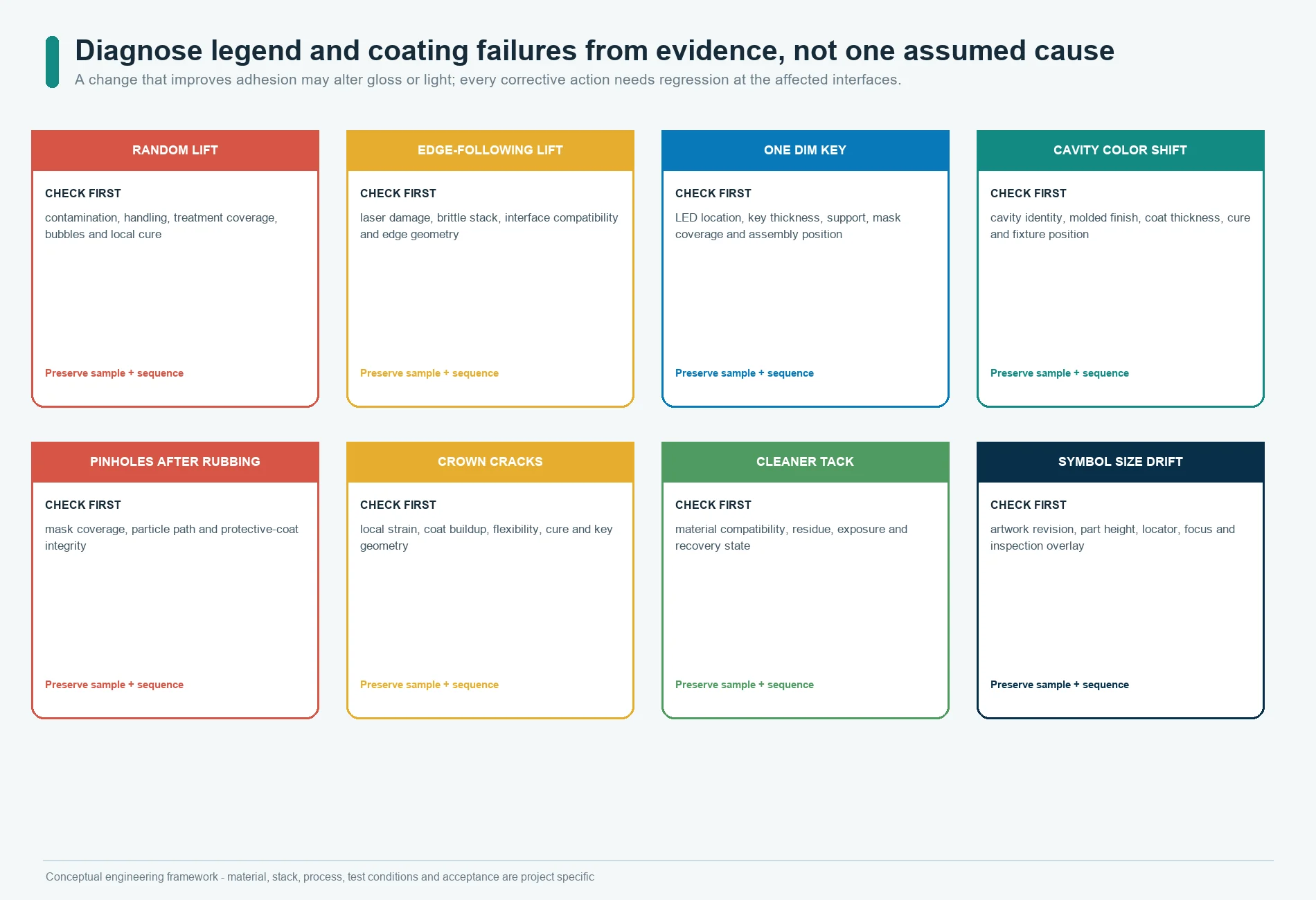
When a failure appears, preserve the sequence and the sample. Do not immediately increase laser energy or add more clear coat.
| Failure pattern | Evidence to check first |
|---|---|
| random small lift areas | contamination, surface-treatment coverage, handling, bubbles, local cure |
| lift follows every legend edge | laser damage, incompatible interface, brittle stack, edge geometry |
| one key position is dim | LED location, support, key thickness, mask coverage, assembly position |
| one cavity differs in color | cavity identity, molded finish, coat thickness, cure, fixture position |
| pinholes appear after rubbing | mask coverage, particle wear, protective-coat integrity |
| cracking follows a crown radius | local strain, coat thickness, flexibility, cure, key geometry |
| cleaner causes tack but no lift | material compatibility, residual fluid, recovery condition |
| symbol size drifts by batch | artwork revision, focus, part height, locator, recipe, inspection overlay |
Link every corrective action to affected requirements. A change that improves adhesion may alter gloss or light transmission. A change that removes residue may widen the opening. Regression testing should follow the changed interfaces.
Approve Samples in Defined Stages
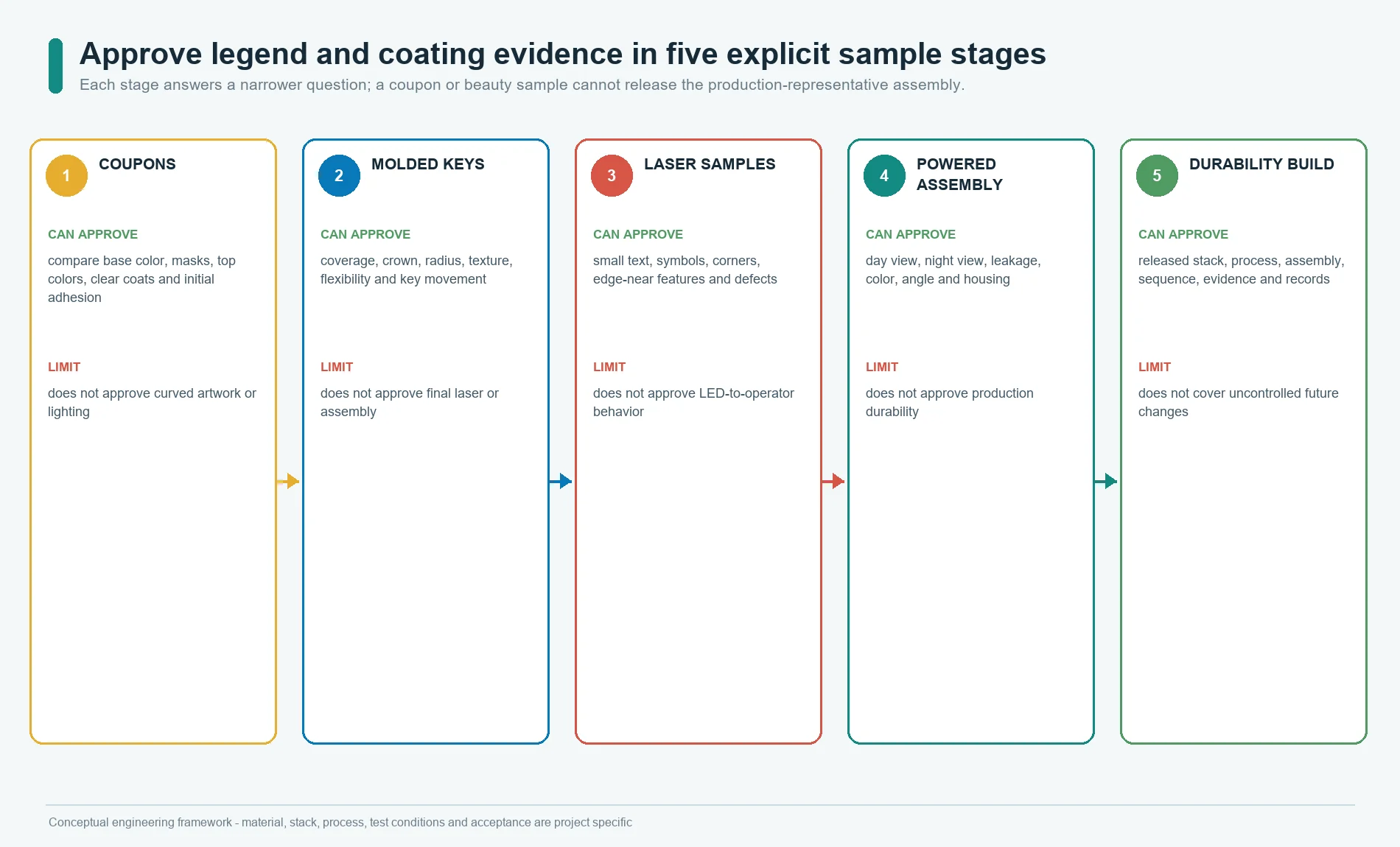
Stage 1: color and coating coupons
Use controlled coupons to compare base colors, mask coverage, top colors, clear coats, surface preparation, and initial adhesion. Record why the coupon represents the planned keypad and where it does not.
Stage 2: molded and coated keys
Apply the selected stack to molded keys with representative crowns, radii, textures, and cavities. Review coverage, thickness effects, adhesion, key movement, and visual uniformity.
Stage 3: laser artwork samples
Run representative small text, large symbols, line corners, dense artwork, edge-near features, and the actual product legends. Establish the accepted result and the process-control evidence.
Stage 4: powered assembled keypad
Install the actual or controlled-equivalent PCB, LEDs, housing, diffuser, supports, and bezel. Approve day view and night view under defined conditions.
Stage 5: production-representative durability build
Use the released material, color layers, preparation, coating, cure, laser, assembly, inspection, and packaging route. Apply the agreed actuation, abrasion, contamination, environmental, and recovery tests.
Each stage should state what it can approve. A flat coupon can compare materials. It cannot approve artwork registration on a curved key or light leakage in the enclosure.
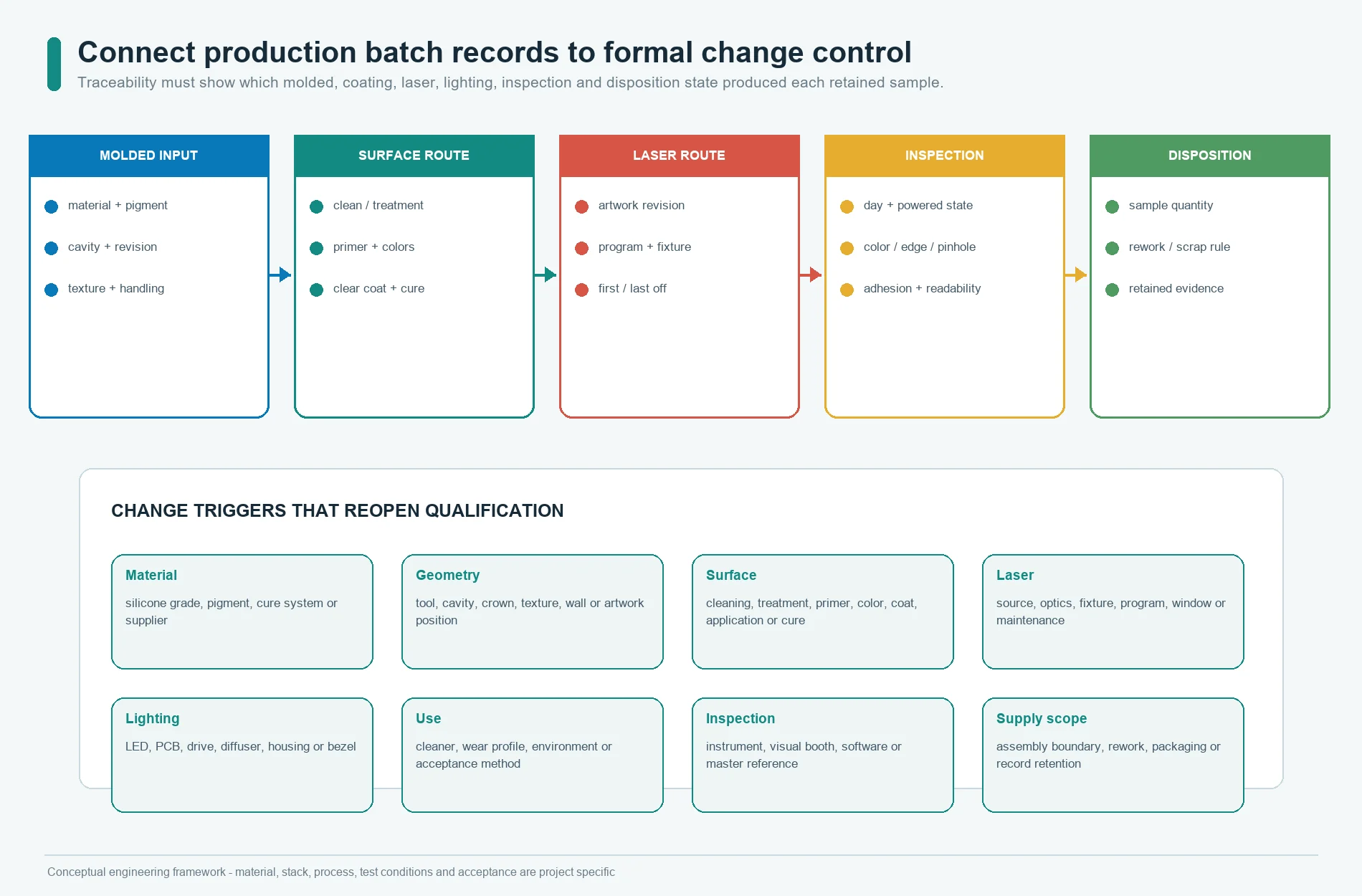
Control Production Inspection and Batch Records
The production plan should identify:
- molded part, material, pigment, cavity, and revision;
- preparation, primer, color, and protective-coating lots;
- application and cure records;
- artwork file and laser program revision;
- fixture and locator identity;
- first-off and last-off inspection;
- day-view and powered inspection conditions;
- color, gloss, edge, pinhole, adhesion, and readability criteria;
- sample quantity and batch disposition;
- rework and scrap rules;
- retained samples and record period.
The testing and quality-control page describes broad visual, dimensional, electrical, tactile, adhesion, packaging, and lot-control planning. The exact coating, laser, abrasion, liquid, color, optical, and lifecycle capability for this keypad still needs project confirmation.
Put Surface Changes Under Formal Change Control
Requalification may be needed when any of the following changes:
- silicone grade, cure system, pigment, or supplier;
- molded texture, cavity, tool, or key geometry;
- cleaning, activation, primer, or handling;
- color layer, coating, mix, lot family, application, or cure;
- artwork, legend size, line width, position, or orientation;
- laser source, optics, fixture, program, or process window;
- LED, PCB, drive, diffuser, housing, or bezel;
- cleaner list, wear profile, environment, or acceptance method;
- inspection instrument, visual booth, software, or master reference.
Do not qualify only the changed characteristic. Review the interfaces it can influence. A pigment change can affect color and light transmission. A cure change can affect adhesion and flexibility. An LED change can alter powered color and perceived edge quality.
Know When Laser Etching Is Not the Best Route
Consider another legend architecture when:
- the artwork needs several visible colors in one small symbol;
- the lower layer cannot provide the required contrast or transmission;
- the surface curvature prevents stable focus or readable geometry;
- the legend must remain readable after the complete surface layer is worn;
- the product cannot accept the required coating or preparation;
- repeated harsh cleaner exposure exceeds the validated stack;
- service replacement is easier with a separate overlay or label;
- the operator needs a molded tactile identifier rather than visual artwork;
- the required marking belongs on the housing, display, or graphic overlay.
Laser etching is valuable when its color-removal and optical behavior match the design. It should not become a mandatory process after the rest of the interface points elsewhere.
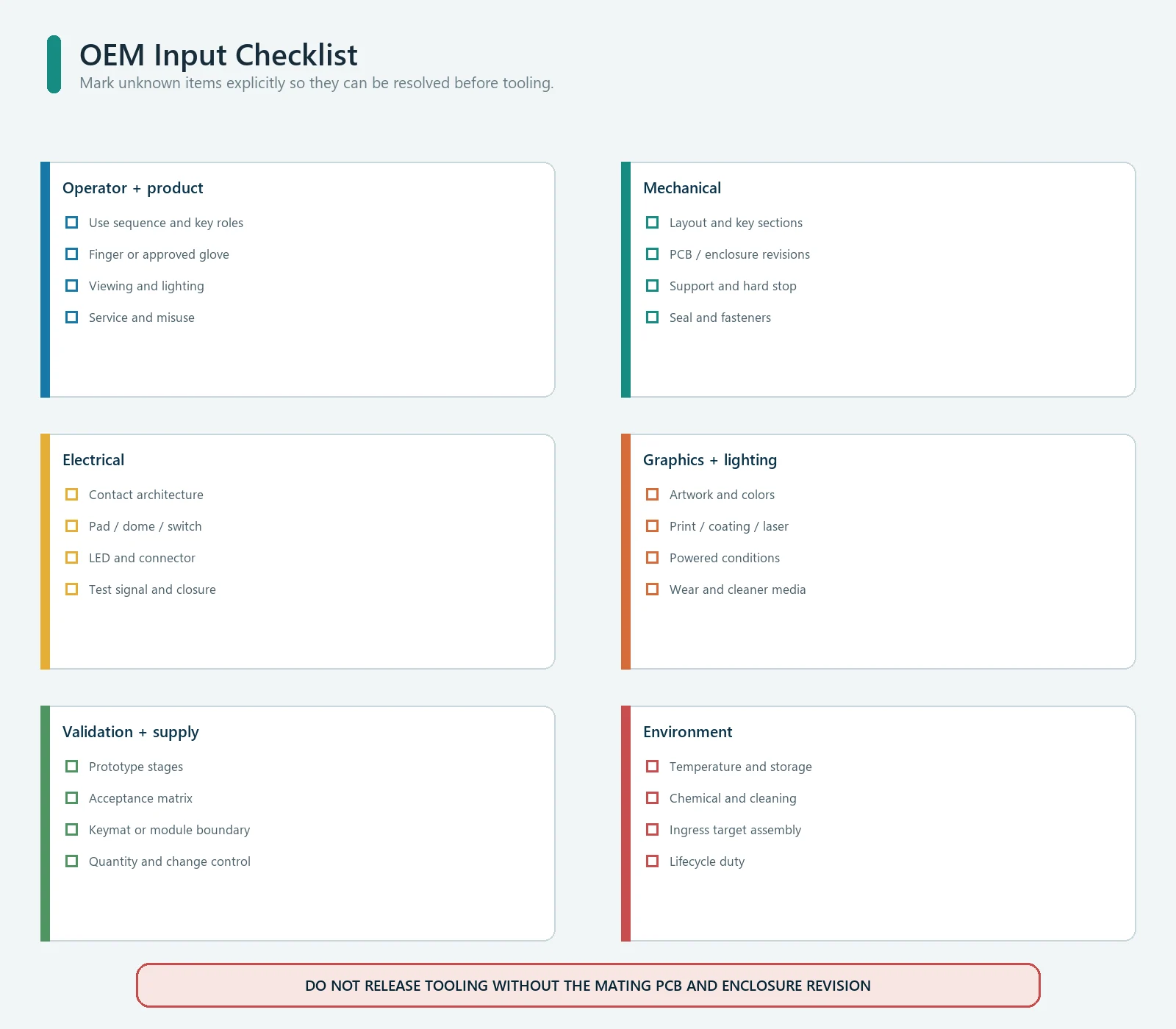
What Should the OEM Send for a Legend and Coating Review?
Product and use
- product type and application;
- indoor, outdoor, vehicle, medical, industrial, or consumer environment;
- operator, glove, press frequency, and high-use keys;
- expected service life and replacement policy;
- safety-critical or regulated symbols.
Keypad and artwork
- 2D drawing, 3D model, and current keypad revision;
- vector artwork with key identity and orientation;
- molded material, color, texture, and finish requirements;
- day-view color and contrast targets;
- legend position, edge, readability, and defect criteria;
- alternate language and branding variants.
Lighting and assembly
- LED, PCB, drive, diffuser, light guide, housing, and bezel files;
- powered color, brightness, leakage, and uniformity criteria;
- viewing angle, distance, and ambient-light conditions;
- supplied assembly boundary.
Wear and validation
- declared cleaners, oils, fluids, sweat, dust, and particle exposure;
- abrasion, rubbing, actuation, environmental, and storage profiles;
- test order, conditioning, recovery, inspection, and pass criteria;
- prototype quantity, annual quantity, documentation, traceability, and change-control needs.
Frequently Asked Questions
Is laser etching the same as printing a silicone keypad legend?
No. Printing deposits artwork on the surface. Laser etching removes selected material from an existing color layer to reveal a lower layer. The two routes need different artwork, stack, adhesion, registration, wear, and optical controls.
Does a laser-etched legend always support backlighting?
No. Backlighting depends on the molded silicone, pigments, masks, color layers, opening, protective coat, LED system, geometry, and assembly. An exposed lower layer can still transmit too little light or create nonuniform illumination.
Can the laser settings be specified on the OEM drawing?
The drawing should specify the required result and traceability. Process settings normally belong to the qualified supplier because they depend on the laser system, coating stack, part geometry, fixture, and process window. Any contractual process parameter should be agreed with the responsible manufacturer.
Why can a clear protective coating change the legend appearance?
The coating can change gloss, surface texture, refraction, color perception, edge contrast, and light transmission. It can also fill or emphasize local laser-edge features. Approval should use the final coated state.
Is a flat abrasion coupon enough to approve a silicone key?
No. A coupon can compare controlled materials or processes, but it does not reproduce a curved, textured key that flexes, rubs a guide, sees trapped particles, or carries a complete optical stack. Use coupons and assembled-key evidence for different questions.
What cleaner information is needed?
Provide the exact product, concentration, application method, contact time, frequency, temperature, wiping or rinsing procedure, drying, and acceptance after exposure and recovery. Alcohol resistant or disinfectant resistant is not a complete test input.
Should day-view and night-view acceptance use the same sample?
Prefer the same traceable assembled sample when practical so color, registration, optical behavior, and defects can be compared directly. Record both conditions. Additional samples may be needed for destructive adhesion, abrasion, or contamination tests.
What is the minimum package for a useful RFQ?
Send the keypad drawing or sample, vector artwork, color and finish requirements, LED and assembly information, cleaner and wear exposures, visual and functional acceptance criteria, quantities, and required validation records.
Request a Legend and Coating Sample Review
Use the RFQ form to send the keypad drawing, vector artwork, color stack, LED and assembly files, declared cleaners, wear profile, quantities, and required approval records. Ask for a review of representative legend and coating samples before production release. JASPER should confirm the actual material, preparation, coating, laser, lighting, inspection, validation, and supplied-assembly boundary in the quotation.
Ready to Start Your Project?
Tell us about your membrane switch, keypad, or graphic overlay requirements. Our engineering team will review your specifications and provide a detailed quote.