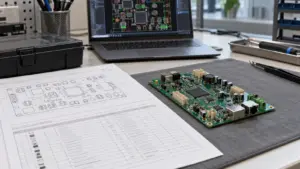
Managing obsolete components in PCB assembly starts with confirming the exact part’s order status, then choosing an approved replacement, a controlled redesign, or a final inventory purchase against remaining demand. Keep the affected repeat order on hold until engineering authorizes its configuration. Use a release benchmark of 100% lot traceability for affected components and zero unapproved substitutions. A last-time buy suits a finite, supportable demand horizon; redesign suits a product whose future demand exceeds a defensible stock plan. Neither route removes the need for verification.
- Why a Repeat Order Needs a New Obsolescence Decision
- Ten Criteria for Evaluating Obsolete Components in PCB Assembly
- Confirm the Component’s Actual Lifecycle and Order Status
- Keep the Two Deadlines Separate
- Estimate Remaining Product Demand and Service Obligations
- Worked Example: A Finite Product Horizon
- Protect the Service Reserve
- Evaluate an Approved Replacement Before Reopening Production
- Compare Last-Time Buy with a Controlled Redesign
- Compare Total Cost and the Transition Date
- Protect Stored Inventory and Preserve Traceability
- Separate Shelf Life from Floor Life
- Keep the Lot History with the Material
- Release the Repeat Order After Engineering Approval
- Step 1 — Freeze the Affected Configuration
- Step 2 — Confirm the Notice and Supply Position
- Step 3 — Approve Demand and Select the Route
- Step 4 — Close the Required Verification
- Step 5 — Release Controlled Documents
- Step 6 — Reconcile the Order and Build Records
- Eight Signals That Require a Hold or Escalation
- Prepare the Next Repeat-Order Review
Why a Repeat Order Needs a New Obsolescence Decision
A repeat PCBA order becomes a new supply decision when a component reaches end of life, even if the PCB files have not changed. The previous build proves that an earlier configuration worked with its approved material. It does not establish the authenticity, condition, availability, or suitability of today’s offered stock.
Buying immediately can lock cash into components that outlive the product. Delaying can close the manufacturer’s final ordering window. A hurried substitution can create firmware, thermal, or test failures that appear only after assembly, while an oversized final purchase can still leave the wrong quantities reserved for repairs.
The commercial comparison therefore includes engineering effort, delivery interruption, qualification expense, storage, financing, and unused inventory. Unit price alone cannot decide it. Assign the OEM design authority, purchasing lead, quality owner, and service planner before accepting a supply proposal; their decisions must refer to the same BOM revision and remaining product horizon.
Ten Criteria for Evaluating Obsolete Components in PCB Assembly
Evaluate obsolete components in PCB assembly against ten criteria before selecting a recovery route. The useful outcome is a supported decision for a particular part and product revision, with clear ownership of every unresolved issue. A favorable price or available reel cannot compensate for a failed engineering or traceability requirement.
| Evaluation Criterion | Good Signal | Red Flag |
|---|---|---|
| 1. Exact component identity | Manufacturer, complete orderable MPN, package, grade, and affected BOM positions agree. | A quote uses a family name or drops a suffix that defines the ordered device. |
| 2. Lifecycle evidence | The latest manufacturer notice identifies the affected order code and any revised dates. | A distributor stock label is treated as the only evidence of discontinuation. |
| 3. Order and delivery status | Written acknowledgment states accepted quantity, order terms, and shipment schedule. | A quote is counted as allocated stock, or last order and last shipment are confused. |
| 4. Remaining production demand | A dated product plan converts remaining PCBAs into component quantities by revision. | The final purchase simply repeats last year’s consumption despite a changing product plan. |
| 5. Service obligations | A service owner approves the repair horizon, spare strategy, and reserved quantity. | Warranty or installed-base support disappears from the calculation after production ends. |
| 6. Replacement readiness | The design authority approves the exact alternative and its verification evidence. | A supplier’s cross-reference is accepted as production authorization. |
| 7. Redesign viability | The plan includes engineering, firmware, validation, fixtures, and the production transition. | Only PCB layout cost is compared with the price of final stock. |
| 8. Source and lot traceability | Source records, manufacturer lot/date codes, and received quantities stay connected. | Repacked stock has labels but no defensible chain of supply or lot separation. |
| 9. Storage and handling | Package-specific instructions, MSL exposure records, and custody responsibilities are defined. | An old reel is accepted because it looks sealed, with no storage history. |
| 10. Release authority | A controlled change or disposition record identifies approvers, scope, and effective builds. | An email saying “equivalent is fine” becomes open-ended substitution permission. |
Apply the matrix to each route. A last-time purchase can preserve the design yet fail the demand or storage test; a redesign can remove the old MPN yet create a firmware dependency. A bridge lot covers only its approved builds. Record each unresolved criterion with an owner and a closure date.
Tie the decision to the earliest binding event: the next production release, final ordering deadline, or consumption of protected service stock. Keep the approved quantity, BOM revision, and decision expiry together so a short-term purchasing exception cannot silently become the product’s long-term configuration.
Confirm the Component’s Actual Lifecycle and Order Status
Confirm obsolescence at the complete manufacturer part number, then separate the lifecycle notice from the status of the purchase order. A part can be discontinued for new orders while previously accepted orders remain scheduled for shipment. Stock availability is a separate question.
Start with the manufacturer’s current product page and latest Product Discontinuance Notice, including amendments. Match the package, temperature grade, packing suffix, and other ordering options against the released BOM. A notice may affect only some variants. Save its identifier, issue date, affected-part list, final order date, final shipment date, and any limited-availability condition in the component’s purchasing record.
“Not recommended for new designs” (NRND) does not itself mean that production has stopped. Distinguish it from EOL, during which final orders may still be accepted, and from a no-longer-manufactured status that ends ordering and manufacture. Confirm the manufacturer’s definitions for the actual part before deciding whether it remains available.
Final-order windows vary. One documented obsolescence policy provides 12 months for final orders and shipments up to 18 months after the Product Discontinuance Notice. These are that policy’s milestones, not universal deadlines. Schedule the affected device against its applicable notice and accepted order.
Keep the Two Deadlines Separate
The last-time-buy deadline controls final order acceptance. The final shipment or delivery milestone controls fulfillment under the notice’s definition; it does not automatically mean arrival at the assembly plant. Add transit, incoming inspection, and any required material disposition to the project schedule.
Revision control matters: updated discontinuation notice 202601026DNU01 corrected the final order date to 30 July 2026 and the final delivery date to 30 April 2027. Those dates apply only to the notice’s affected-part list. The later shipment milestone does not extend the earlier ordering deadline.
Ask the seller to confirm the exact accepted order, quantity, allocation, cancellation terms, and shipment commitments. A quotation is not an acknowledgment. If the ordering window has closed, evaluate documented remaining stock or another route; do not describe an ordinary stock purchase as a manufacturer last-time buy.
Estimate Remaining Product Demand and Service Obligations
Estimate final component demand from remaining production, service support, and expected consumption losses, then subtract usable stock and confirmed incoming supply. Calculate in components, not a mixture of reels, PCBAs, and repair events. Use the product’s actual end-of-production and service dates.
A practical calculation is:
Net purchase requirement = max(0, production demand + service demand + process-loss allowance + verification demand − usable uncommitted stock − confirmed incoming stock).
Production demand is planned PCBAs multiplied by the number of affected components on each applicable BOM revision. Convert the result to the supplier’s order multiple only after checking every deduction. Quarantined stock, stock reserved for another product, and unacknowledged quotations do not reduce the requirement.
Worked Example: A Finite Product Horizon
Consider an illustrative OEM plan for 3,000 more PCBAs over 24 months, with two affected components per board and service continuing for 5 years after the final product shipment. The quantities below are planning assumptions, not standard buffers or a JASPER customer record. That service end date belongs in the storage plan.
| Demand or Supply Input | Calculation Basis | Effect on Requirement, Components |
|---|---|---|
| Remaining production | 3,000 PCBAs × 2 components | +6,000 |
| Service reserve | Approved estimate, expressed as components | +240 |
| Process losses | Forecast allowance for expected assembly and handling losses | +120 |
| Engineering and verification | Parts consumed by approved checks and trial work | +40 |
| Usable stock | Accepted, uncommitted inventory | −1,000 |
| Confirmed incoming stock | Acknowledged supply available before consumption | −600 |
| Net purchase requirement | 6,000 + 240 + 120 + 40 − 1,000 − 600 | 4,800 |
The base case needs 4,800 components before order-multiple rounding. If a higher-demand case adds 500 PCBAs and 80 service components, the same calculation gives 5,880. The difference is 1,080 components. Compare that exposure with the consequence of a shortage, keeping the approved forecast distinct from its sensitivity case.
Protect the Service Reserve
The service planner should distinguish component-level repair from complete-board replacement. Finished spare PCBAs can cover some obligations, but only when their configuration and storage plan suit the supported equipment. Avoid counting both the board and its fitted components as separate available supply.
Base service demand on the installed population, repair history, replacement policy, and support commitments. Allocate the approved reserve separately so a routine production shortage cannot consume it without authorization. Recalculate after a product forecast changes, a repair trend shifts, or a redesign changes interchangeability. A final purchase is a dated decision that still needs inventory control throughout the remaining support period.
Evaluate an Approved Replacement Before Reopening Production
Use an alternative only after the OEM design authority approves the exact device for the intended board and operating conditions. A manufacturer’s suggested replacement or distributor cross-reference identifies a candidate; it does not authorize a repeat production build. The buyer obtains supply evidence, while engineering owns technical acceptance.
Check whether an existing approved alternative remains valid for the current PCB revision, firmware, temperature range, loading, and test requirements. Previous approval may have applied only to a prototype, a particular customer, or a limited quantity. Record those limits before purchasing production material.
For a new candidate, engineering must decide whether the released design remains valid. Footprint matching is insufficient. Pin behavior, startup conditions, timing, analog performance, thermal behavior, programming, and assembly handling can alter the result even when the nominal function matches. Keep the detailed comparison in the substitution approval record; bring its decision, verification plan, owner, and completion date into the obsolescence review.
If approval requires circuit, layout, firmware, or system-interface changes, budget a controlled redesign even when the supplier markets the part as equivalent. Also inspect the candidate’s own lifecycle and supply path. Replacing an obsolete part with another device nearing withdrawal can merely postpone the same decision.
Close verification against written acceptance criteria and retain the results with the Engineering Change Order or controlled disposition. Define the first applicable production lot and any service interchangeability restriction. Approval must have a scope. A concession for one repeat order does not authorize the same substitution on every later build.
Compare Last-Time Buy with a Controlled Redesign
Choose a last-time buy when credible remaining demand can be covered by accepted supply and a sustainable storage plan. Choose redesign when future demand, support duration, or inventory uncertainty makes a finite stockpile an inadequate solution. Compare both routes over the same production and service horizon.
| Response Option | Engineering Work | Inventory Exposure | Verification Need | Best-Fit Condition |
|---|---|---|---|---|
| Approved drop-in alternative | Confirm approval covers the current BOM and application; document the change. | Transition stock and minimum order quantities; usually less dependence on the obsolete MPN. | Applicable electrical, functional, assembly, and regression checks. | A supported alternative is approved without a board redesign and available for the planned builds. |
| Functionally equivalent redesign | Revise circuit, PCB, firmware, fixtures, and documentation where affected. | Bridge inventory plus possible write-off of old boards and parts. | Prototype validation, production tests, and system qualification required by the change. | Continued product demand justifies engineering effort and a new supply basis. |
| Last-time purchase | Approve demand, source, storage, and release conditions for the existing design. | Upfront commitment, carrying cost, deterioration risk, and unused final stock. | Source and condition acceptance; defined checks before later production releases. | The OEM has a finite, defensible demand horizon and can still secure an accepted final order. |
| Qualified remaining stock | Approve the offered source and lots for the existing BOM. | Limited quantities, uneven lot history, and no assured replenishment. | Traceability review and risk-based authenticity, condition, and assembly verification. | Documented stock covers a bounded build or bridges a redesign already in progress. |
| Product retirement | Approve production closure, configuration support, and service arrangements. | Residual inventory and remaining service obligations. | Confirm the support plan and disposition of affected orders and spares. | Continued manufacture is no longer justified and commitments can be fulfilled through an approved exit plan. |
Compare Total Cost and the Transition Date
Compare complete budgets. The final-purchase budget includes component cost, finance, storage, packaging maintenance, inspection, expected unusable material, and residual stock; the redesign budget includes engineering, prototype boards, firmware, fixtures, validation, applicable requalification, and inventory needed until the new release. Include schedule consequences on both sides.
Stress-test both budgets. A low-demand case exposes final-stock write-off; a high-demand case exposes shortage. For redesign, compare the verified release date with the date usable old stock runs out, while keeping the service reserve out of the production balance. Any gap requires an approved bridge or a changed delivery commitment.
A mixed route can work: buy a bounded quantity of qualified stock for a bridge build, protect the service reserve, and redesign subsequent orders. Specify the last build using the old BOM and the first build using the new revision. Otherwise the bridge quantity can become an uncontrolled lifetime commitment.
Protect Stored Inventory and Preserve Traceability
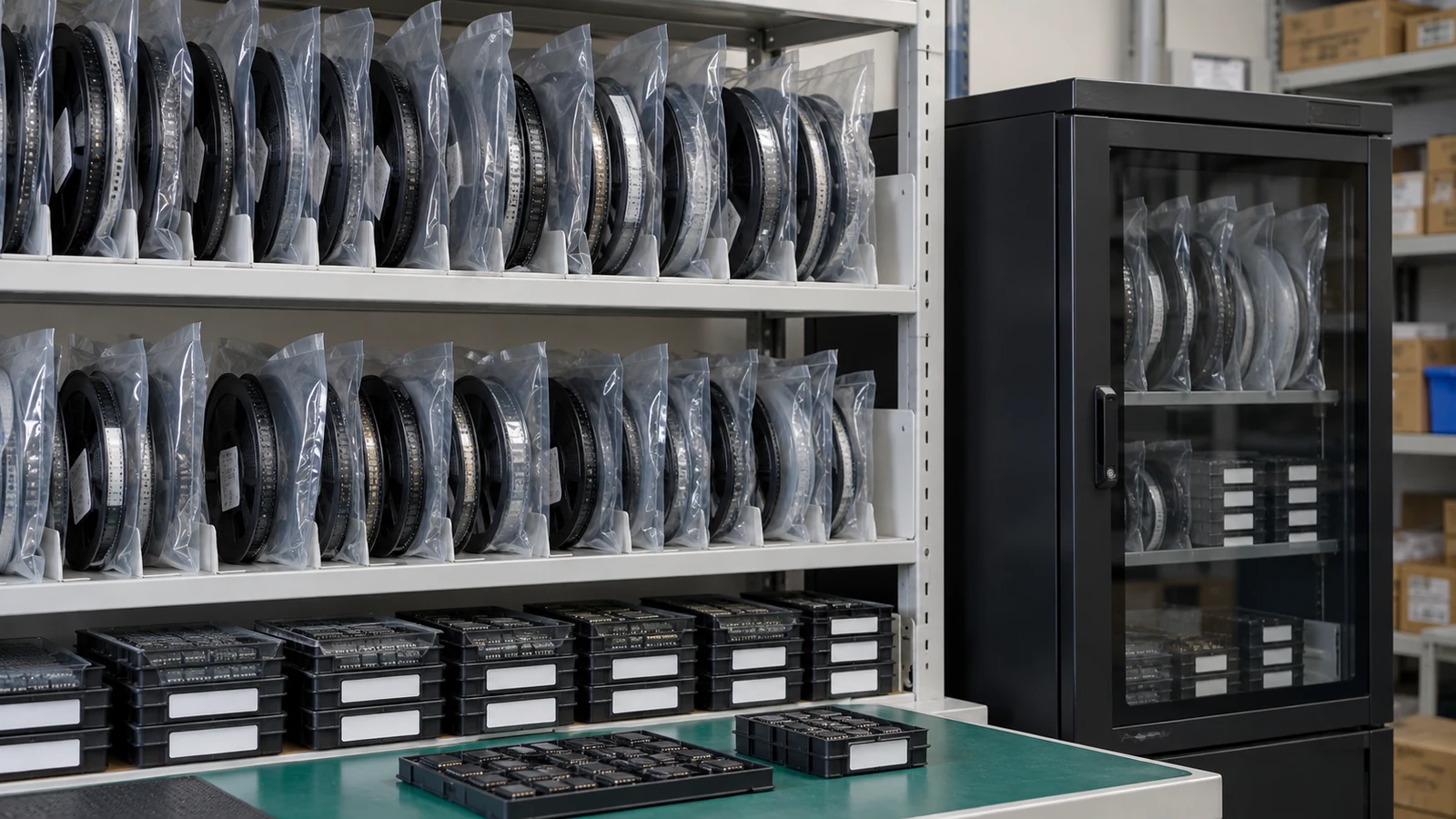
Protect final-stock inventory through package-specific storage, recorded moisture exposure and traceable lot custody. Continued suitability depends on storage and handling. An old date code alone does not make stock unusable, while an intact-looking bag cannot establish that unknown storage conditions were acceptable.
Separate Shelf Life from Floor Life
Shelf life concerns storage before use. Moisture sensitivity level (MSL) controls permitted exposure before solder reflow under stated conditions. The complete class set below describes floor life, not an expiration schedule for obsolete inventory. Apply the class and handling requirements specified for the actual device.
| Moisture Sensitivity Class | Floor Life Under the Reference Conditions | Reference Environment |
|---|---|---|
| MSL 1 | Unlimited for the moisture/floor-life criterion | At or below 30°C / 85% RH |
| MSL 2 | 1 year | At or below 30°C / 60% RH |
| MSL 2a | 4 weeks | At or below 30°C / 60% RH |
| MSL 3 | 168 hours | At or below 30°C / 60% RH |
| MSL 4 | 72 hours | At or below 30°C / 60% RH |
| MSL 5 | 48 hours | At or below 30°C / 60% RH |
| MSL 5a | 24 hours | At or below 30°C / 60% RH |
| MSL 6 | Mandatory bake; reflow within the time stated on the label | At or below 30°C / 60% RH |
For an MSL 3 device, 168 hours at the stated conditions is an exposure limit, not permission to store an opened reel for years. These reference conditions are not warehouse storage setpoints. The component’s actual rating and handling instructions govern; a higher MSL number does not mean higher quality.
Keep the Lot History with the Material
Retain manufacturer labels, lot/date codes, source documents, seal information, and quantities through storage and issue. Record opening, exposure, drying when required, and resealing. Simply resealing a bag does not reset accumulated exposure. Apply electrostatic-discharge controls separately, and follow the supplier’s requirements for moisture barrier bags, desiccant, humidity indicator cards, and storage conditions.
If exposure exceeds the allowed condition, quality should disposition the material before assembly. Baking requires a suitable component and carrier-specific procedure; it cannot repair corrosion, establish authenticity, or restore missing history. Decide whether solderability or other condition checks are needed for the actual stock and application.
Maintain 100% lot traceability for affected components from accepted supply to the build record. Split a reel only if the new container preserves that link. Set review intervals from the storage plan and condition evidence, and reassess material before each later release. There is no universal date-code cutoff or universal shelf-life value that replaces this decision.
Release the Repeat Order After Engineering Approval
Release the repeat PCBA build only when engineering has approved its configuration and quality has accepted the applicable material disposition. Purchasing approval addresses the commercial commitment; it does not replace either release. Use the following six steps to connect the obsolescence decision to the actual order.
Step 1 — Freeze the Affected Configuration
Identify the repeat order, PCB revision, BOM revision, firmware, quantities, and required delivery. Map the discontinued MPN to its reference designators and any other products consuming the same stock. Put the affected build on hold while the response is selected. Preserve the previous approved configuration as the comparison baseline.
Step 2 — Confirm the Notice and Supply Position
Attach the latest notice and its amendments. Purchasing records final-order and shipment milestones, current usable stock, confirmed incoming orders, offered lots, and commercial terms. Quality identifies material already quarantined or requiring disposition. Keep offered stock outside the usable balance until the required acceptance decision is made.
Step 3 — Approve Demand and Select the Route
The product and service owners approve the remaining demand assumptions. Engineering approves the response plan after comparing the five routes with purchasing. Record the authorized buying basis, bridge quantity if applicable, protected service reserve, funding owner, and the trigger for reconsidering the decision. Production authorization remains a separate gate.
Step 4 — Close the Required Verification
Engineering defines and completes the applicable alternative or redesign verification. Quality closes the source and condition review for purchased stock. If a final ordering deadline arrives before qualification finishes, obtain separate written authorization for the commercial risk of buying material; production remains blocked until its verification and acceptance conditions are closed.
Step 5 — Release Controlled Documents
The design authority signs the change or disposition, with quality and other required approvals. Specify the exact MPN, authorized source or lot restrictions, quantity scope, effective builds, and verification records. Update the BOM, drawings, firmware, and test instructions where affected. Maintain zero unapproved substitutions as a release condition.
Step 6 — Reconcile the Order and Build Records
Match purchase and work orders to the approved release before kitting. Verify that component identity and reference designators agree with placement data. The BOM defines parts; the CPL defines position, rotation and board side.
Record the accepted material lots and actual consumption against the build. Reconcile the remaining service reserve after production, and investigate differences before promising the next repeat order.
The release flow is: confirmed lifecycle notice → approved demand and engineering response → authorized purchase commitment → completed verification → engineering and quality production release → repeat build. A purchasing deadline never removes the production approval gate.
Eight Signals That Require a Hold or Escalation
Hold the affected purchase or build when an obsolescence proposal fails a release condition, and escalate the issue to the responsible owner. These eight signals override a favorable price or an urgent delivery request.
- The MPN or ordering suffix does not match. Engineering must identify the exact device before the offer can support the BOM.
- Notice dates conflict or an amendment is missing. Purchasing must confirm the applicable final-order and shipment dates with the manufacturer or authorized channel.
- The seller cannot connect stock to its source and lots. Quality must resolve traceability before acceptance.
- A replacement is proposed without design-authority approval. Hold its use until the change and verification are authorized.
- The proposed buy exceeds the supported demand horizon. Product management and finance must approve the exposure or select another route.
- The plan consumes protected service stock. The service owner must approve a revised reserve and explain how support remains covered.
- Packaging, exposure, or condition records fail acceptance. Quarantine the affected material pending quality disposition.
- Redesign verification finishes after the old stock runs out. Replan the bridge build, delivery commitment, or product exit before releasing production.
Frequently Asked Questions
Obsolete-component decisions in repeat PCB assembly require a defined supply route, a remaining-demand plan, and engineering approval. These answers address the purchasing and release questions that determine whether the next build can proceed.
Can an obsolete component be used in a repeat PCBA order?
Yes, an obsolete component can be used when its exact identity, source, condition, and application remain acceptable under the approved build configuration. Engineering must authorize the repeat build and quality must accept the material disposition. Obsolete status alone neither qualifies nor disqualifies remaining inventory.
When is a last-time buy preferable to redesign?
A last-time buy is preferable when an accepted final order can cover credible remaining production and service demand at a lower total burden than redesign. Include storage, verification, carrying cost, and unused-stock exposure. A long or uncertain demand horizon weakens the case for a finite stockpile.
Who approves an alternative after a component reaches end of life?
The OEM design authority, or a formally delegated engineering authority, approves the alternative for the specified application. Quality and other required stakeholders approve their parts of the release. A distributor recommendation or purchasing acknowledgment does not authorize a component change, even when the replacement is described as drop-in.
How should service-spares demand affect the purchase decision?
Service-spares demand belongs in the final purchase calculation and in a protected allocation. Convert repair or spare-board needs into the appropriate component quantities, account for existing usable spares, and avoid double counting. The service owner approves the support horizon and any later transfer of reserved stock into production.
Does an old date code automatically make remaining stock unusable?
No, an old date code does not automatically make remaining stock unusable. Assess source history, packaging, storage, moisture exposure, and the applicable acceptance requirements. Date code is a traceability input, not a universal expiration date; unknown history still requires a quality disposition before assembly.
What is the difference between a last-time buy and qualified remaining stock?
A last-time buy is a final order accepted within the manufacturer’s discontinuation process; qualified remaining stock is existing material accepted for a defined use. Remaining stock may be purchased after the final ordering window closes. Its availability does not reopen that window or establish a future replenishment commitment.
Can a final purchase bridge a controlled redesign?
Yes, a bounded purchase can support approved builds until a redesigned configuration is released. Size the bridge against the transition schedule and protect service allocations. Define which builds use each BOM revision, and reassess the quantity if verification or production dates move.
Do stored obsolete components need testing before every repeat order?
Every repeat release needs a material suitability review, but the required testing follows the approved risk and acceptance plan. Lot history, packaging condition, exposure, and the application determine whether additional checks are necessary. Repeating a generic test does not replace traceability or prove that unknown stock is suitable.
What records must accompany the repeat-order release?
The release needs the approved BOM and change or disposition, relevant verification results, accepted source and lot records, and the applicable assembly and test instructions. Preserve 100% lot traceability for affected components and zero unapproved substitutions. Keep the demand decision and protected service balance linked to the same product plan.
Prepare the Next Repeat-Order Review
Prepare a review package that connects the obsolete component to the repeat order, remaining demand, and proposed response. Include the released BOM and board revision, manufacturer notice, production quantities, service horizon, stock and source records, and any existing alternative approval. Identify the engineering and quality owners who can close the release conditions.
When requesting PCB assembly services from JASPER, state whether the request concerns an approved replacement, a bounded stock purchase, or a redesign transition. Resolve that route and its verification requirements before committing the build schedule. Release production against the signed configuration and accepted material, then preserve the records for the next order.
Ready to Start Your Project?
Tell us about your membrane switch, keypad, or graphic overlay requirements. Our engineering team will review your specifications and provide a detailed quote.