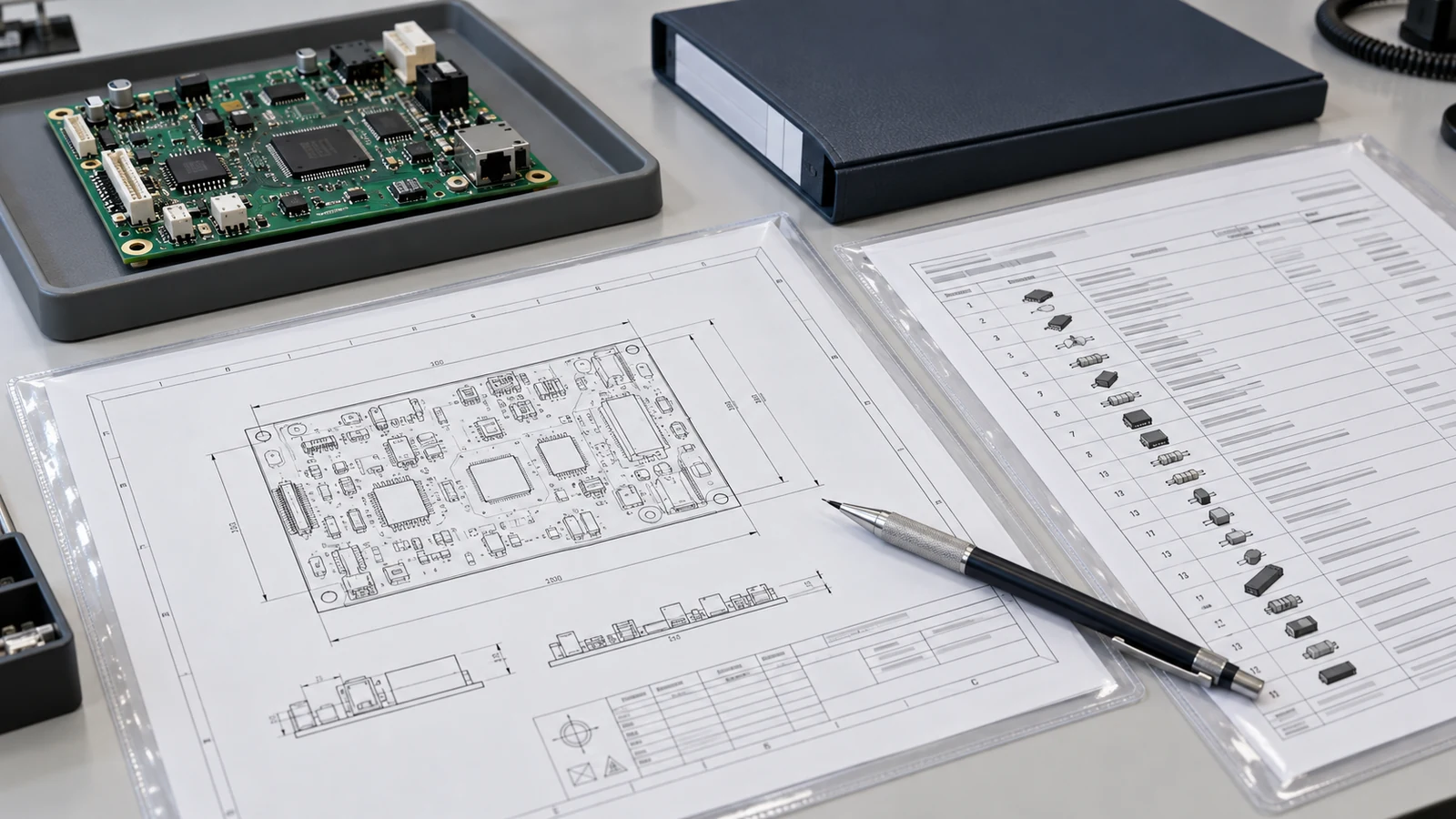
A PCBA manufacturing transfer checklist should establish what is moving, who owns each handover item, and what evidence qualifies the receiving manufacturer to build it. Transfer the released manufacturing package, approved materials, inventory, tooling, process history, deviations, and test system as one controlled baseline. Authorize production only after the new site demonstrates that it can reproduce the required assembly and acceptance results. Matching the BOM or moving a fixture is not enough. Keep shipment approval separate from permission to run the transfer trial.
- What an Incomplete PCBA Transfer Can Cost
- Inventory the Released Manufacturing Package Before Transfer
- 1. Released baseline and revision consistency
- 2. Build instructions and manufacturing derivatives
- Transfer Approved Sources, Open Orders and Consigned Stock
- 3. Approved sources and substitution authority
- 4. Stock identity, condition and open-order ownership
- Check Tooling Ownership, Condition and Compatibility
- 5. Asset ownership and maintainability
- 6. Mechanical, electrical and software interfaces
- Explain Process History, Deviations and Known Failure Modes
- 7. Process history and actual operating windows
- 8. Deviation disposition and failure containment
- Establish Test Correlation at the Receiving Manufacturer
- 9. Reproducible software, limits and records
- 10. Paired measurements and challenge coverage
- Release the Transferred Build Through a Controlled Trial
- PCBA Manufacturing Transfer Checklist: Responsibility Matrix
- Run the Handover in Six Approval Steps
- Eight Signals to Stop or Escalate the Transfer
- Prepare the Transfer Review Package
What an Incomplete PCBA Transfer Can Cost
An incomplete PCBA transfer can shift work rather than remove it: the receiving factory may have to reconstruct instructions, replace incompatible tooling, or investigate acceptance differences before it can ship. Evaluate the handover against those exposures, not the quoted assembly price alone.
Build a transfer budget that separates recurring board cost from data recovery, fixture adaptation, software deployment, material reconciliation, correlation work, and trial evaluation. Assign each activity an owner and an acceptance output before approving the schedule.
Consider a fixture that arrives with no wiring drawing and software that depends on the sending factory’s network. Physical delivery has occurred, but the receiving team cannot independently restore or maintain the test station. Recreating that capability becomes part of the transfer scope. Distinguish the complete deployable test system from its individual software files.
Use the ten criteria below to distinguish a documented handover from a transfer that still depends on undocumented knowledge at the sending site.
Inventory the Released Manufacturing Package Before Transfer
The released manufacturing package must describe one approved product configuration and the information needed to manufacture, inspect, program, and identify it. Freeze that baseline before the receiving manufacturer prepares production data; do not treat the newest file in each folder as an approved set.
1. Released baseline and revision consistency
Create a manifest linking the assembly part number and revision to the bare-board data, fabrication requirements, schematic, BOM, placement file, assembly drawings, firmware, and test specification. Include variants, do-not-fit positions, engineering changes, and the serial or lot boundary at which each change became effective.
The referenced supplier’s BOM and CPL guidance distinguishes component identity from placement position, rotation, and board side. During transfer, reconcile both against the assembly drawing rather than checking that the files merely exist.
Ask the receiving engineer to identify a fitted component, a polarized component, and an unpopulated position across the relevant files. Resolve contradictions through the OEM’s release process, not an operator’s assumption.
Good signal: A signed manifest identifies compatible revisions and the approving authority.
Red flag: The receiving site must choose between conflicting BOMs or infer polarity from photographs.
2. Build instructions and manufacturing derivatives
Inventory panel drawings, stencil specifications, placement corrections, soldering instructions, inspection programs, coating masks, depaneling instructions, labeling, and packaging requirements where applicable. Record what is transferable, what must be regenerated, and what requires permission from its owner.
Do not assume the original CAD paste layer matches the production stencil. The referenced supplier explicitly describes process-specific changes to solder-paste data. Request the actual derivative or sufficient approved requirements to recreate and validate it. Proprietary sending-site programs need not be copied when the receiving site develops and verifies its own equivalent process.
Good signal: Each production derivative has a revision, purpose, and receiving-site verification task.
Red flag: Important aperture changes or placement corrections exist only inside an old machine program.
Transfer Approved Sources, Open Orders and Consigned Stock
Material transfer must preserve approved part identity, supply authorization, usable condition, and commercial ownership. Reconcile what may be purchased separately from what physically arrives, and do not release unidentified or disputed stock into the receiving factory’s production stores.
3. Approved sources and substitution authority
Transfer exact manufacturer part numbers, approved alternatives, qualification restrictions, approved purchasing channels, and any customer-controlled sources. Define who may propose a substitution and who approves it before procurement or use. Include bare-board fabrication requirements, not just populated components.
Carry open supplier change notices into the transfer review. Check the affected products, expected impact, qualification evidence and implementation timing for each notice. A component-change notification provides input to the review; it does not constitute approval of a PCBA manufacturing transfer.
Check whether existing component approvals remain applicable to the product configuration being transferred. Do not interpret a distributor stock code as unrestricted permission to buy any nominally equivalent device.
Good signal: The receiving buyer can trace each permitted source or alternative to an OEM decision.
Red flag: Purchasing is told to use whatever matches the value and footprint.
4. Stock identity, condition and open-order ownership
Reconcile stock by part number, lot or date code where required, quantity, owner, location, and disposition. Separate unopened material, opened reels, work in progress, finished boards, rejected material, and scrap. Request packaging and storage records, including moisture-exposure information for sensitive components and shelf-life information for time-limited materials.
At receipt, verify labels, count, packaging condition, and restrictions before accepting stock for use. Missing handling history requires a documented engineering disposition against the actual component or material requirements, not an invented universal baking instruction.
Map open purchase orders to retain, cancel, redirect, or replace decisions. Confirm supplier acceptance of any redirection, ownership of excess material, and the allocation between the sending site’s final build and the receiving site’s trial.
Good signal: Shipped, received, quarantined, and released quantities reconcile to signed records.
Red flag: Mixed lots arrive without identity, or both factories assume the same open order supplies their next build.
Check Tooling Ownership, Condition and Compatibility
Transferred tooling must be authorized for use, physically serviceable, and compatible with the receiving process. Audit the complete operating system around each asset, including interfaces, documentation, utilities, maintenance, and software access, before treating a shipment receipt as acceptance.
5. Asset ownership and maintainability
List stencils, solder pallets, assembly nests, programming adapters, test fixtures, depaneling tools, inspection aids, and reference boards. Record asset identity, drawing revision, ownership, permitted use, condition, maintenance history, spares, and responsibility for repair or replacement.
Confirm rights to use, modify, and reproduce relevant drawings or software through the transfer agreement. Where a tool belongs to the sending manufacturer, obtain permission or arrange a replacement; do not presume the OEM’s assembly purchase included that asset.
Keep reference boards distinguishable from saleable stock. Record their configuration and characterization history. NIST’s check-standard guidance emphasizes stable, representative artifacts and measurement history; a board labeled “golden” without that history is a weak reference.
Good signal: The receiving team can identify, service, and replace the tool without relying on one departing operator.
Red flag: Ownership is disputed or the only usable adapter has no drawing or spare.
6. Mechanical, electrical and software interfaces
Check locating datums, clamping, probe alignment, connector pinout, cable routing, board support, and clearance. Review supply voltage, current capacity, grounding, pneumatic requirements, interlocks, and instrument control interfaces against the fixture’s requirements. Verify compatibility before applying power.
For test-dependent tooling, request the computer configuration, runtime versions, drivers, instrument settings, licensing arrangements, and external services. Check for dependencies that may not be captured automatically, such as dynamically referenced files and configuration data.
Classify each asset as reuse after verification, adapt and revalidate, or replace and qualify. A matching connector or test-equipment brand is not an acceptance criterion.
Good signal: A documented installation check covers the fixture, station, and supporting services.
Red flag: The fixture fits mechanically but its pinout, interlock operation, or software license cannot be established.
Explain Process History, Deviations and Known Failure Modes
Process history should tell the receiving manufacturer what has affected this assembly and how those issues were controlled. Transfer evidence with its configuration and operating context; neither historical yield nor an old deviation authorizes the new factory’s process.
7. Process history and actual operating windows
Request build travelers, actual board-temperature profiles, material specifications, inspection findings, defect summaries, rework instructions, and corrective-action records. Link the records to product revisions, board variants, tooling, and material lots where relevant.
Use the historical process to identify sensitive operations, then verify the receiving site’s implementation. For reflow, compare the board’s thermal exposure against the solder-paste and component requirements rather than copying oven settings. The referenced supplier discusses localized hot and cold spots, reinforcing the need to consider conditions on the assembly itself.
Make yield comparisons use the same denominator, inspection coverage, and treatment of retests. Keep first-pass failures visible instead of allowing eventual passing results to erase the original fault history.
Good signal: Each recurring defect has a detection point, containment method, and documented corrective action.
Red flag: A high final pass rate is offered without failure counts or rework records.
8. Deviation disposition and failure containment
Create a register of active and expired deviations, concessions, temporary repairs, approved substitutions, and unresolved failure investigations. Identify the affected revision, quantity or serial range, technical rationale, approving authority, expiration condition, and product risk.
Assign each deviation one of three outcomes: close before transfer; reapprove for a defined receiving-site scope; or incorporate into a formally released engineering change. Do not silently continue an exception merely because it appeared in the previous build.
For known failure modes, explain the symptom, triggering conditions, detection method, and containment. Use the trial to confirm that the receiving controls detect the relevant problem, rather than simply passing an undemanding reference board.
Good signal: The OEM signs the disposition, and the receiving instructions reflect the approved outcome.
Red flag: An expired concession becomes the new factory’s normal work instruction.
Establish Test Correlation at the Receiving Manufacturer
Test correlation must establish whether the receiving test system produces sufficiently comparable measurements and acceptance decisions under controlled conditions. Use the same identified boards wherever practical, retain raw results, and evaluate systematic differences, repeatability, and behavior near acceptance limits separately.
9. Reproducible software, limits and records
Release the test sequence, executable, supporting files, firmware image, configuration data, approved limits, units, and result format together. Distinguish product specification limits from any station screening limits or approved guard bands. Keep calibration coefficients separate from pass/fail criteria.
Require a clean installation demonstration using the intended receiving-site configuration. Exercise variant selection, programming, serial-number assignment, result storage, and failure reporting. Include path assumptions and driver versions in the deployment review. Resolve those dependencies without altering product acceptance to make installation easier.
Provision authorized access to protected services separately from the handover documents. Test executable availability, maintenance rights, and access to signing or provisioning services are distinct questions.
Good signal: The receiving team restores the released system and produces a complete traceable result without undocumented support.
Red flag: The station runs only from the original engineer’s account, or limits can change without revision control.
10. Paired measurements and challenge coverage
Define the correlation protocol before collecting acceptance data. Select characterized passing boards that cover relevant variants and measurement range, plus safely controlled failure challenges for the detection functions being evaluated. A single golden board cannot demonstrate range coverage or rejection behavior.
Repeat measurements after unloading and reloading the fixture, and across operators or shifts where those factors matter. NIST distinguishes short-term and longer-term variability; a one-time comparison does not characterize both.
| Correlation Element | Conditions to Control or Record | Evidence to Review |
|---|---|---|
| Board identity | Same serial number, assembly revision, firmware, and configuration | Paired records for each board and test |
| Electrical conditions | Supply measured at the defined point, inputs, loads, grounding, and settling time | Actual settings and measurement units |
| Station configuration | Instrument identity, range, calibration status, cables, and fixture revision | Differences and their technical disposition |
| Environment and sequence | Temperature, stabilization, test order, and handling | Comparable runs or explained differences |
| Repeated measurements | Reloading, operators, and relevant time separation | Within-station variation and between-station differences |
| Acceptance behavior | Released limits and controlled pass/fail challenges | Missed faults, false rejects, and near-limit disagreements |
Check reference-board condition before and after transport so damage or drift is not mistaken for a station difference. Keep failure-challenge units identified and outside saleable inventory. For each numeric test, compare the receiving result with the sending result for the same board and condition. Examine average difference and spread, not just a correlation coefficient. A consistent offset can preserve a strong correlation while changing pass/fail decisions. NIST’s bias discussion also cautions that calibration alone does not eliminate every source of measurement bias.
Set allowable differences test by test, using product tolerances, measurement uncertainty, and decision risk. NIST’s uncertainty guidance explains why uncertainty matters when deciding whether a result is fit for use. Do not apply one arbitrary percentage to voltage, current, timing, and digital checks. Investigate near-limit disagreements against the approved decision rule; do not widen product limits or introduce an undocumented offset to force agreement.
If the sending station is unavailable or suspect, qualify the receiving method against the product specification and suitable references, and record that direct station correlation was not performed. Never designate the old factory’s measurement as truth solely because it was used first.
Good signal: Preapproved criteria address bias, variation, challenge detection, and unresolved disagreements.
Red flag: Both stations passed the same board once, and that is presented as proof of equivalence.
Release the Transferred Build Through a Controlled Trial
The controlled transfer trial must demonstrate that the receiving site can build and accept the released configuration using the intended materials, tooling, process, personnel, and records. It qualifies the receiving implementation; it does not inherit the sending site’s production capability.
Before starting, approve the trial scope, variant coverage, inspection and test requirements, stop conditions, defect disposition, and the authority for shipment release. Choose trial quantity from the risks and operations that need evidence, not a universal transfer batch size.
Track each trial board through material issue, assembly, programming, inspection, test, and rework. Investigate new failure patterns and unexplained measurement shifts before further release. Repeat affected verification after changing a material, process, fixture, software version, or test method during the trial.
The release dossier should identify the as-built configuration, material genealogy, measured process evidence, test-system qualification, raw results, defects, rework, deviation dispositions, and approvals. When a trial used selected materials, extra engineering supervision, or a different inspection route, identify the difference and verify the intended production arrangement before extending approval. Define receiving-site acceptance separately from permission to ship the trial units.
Use three explicit gate outcomes: hold; limited release; or production release. A limited release identifies its quantity or serial boundary, containment, expiration, and approver. Production release applies only to the approved scope and change-control rules; it is not evidence of indefinite process stability or finished-product certification.
PCBA Manufacturing Transfer Checklist: Responsibility Matrix
This transfer responsibility matrix assigns evidence to the sending site, verification to the receiving site, and approval to the OEM. A requalification trigger initiates a risk review and appropriately scoped verification, not an automatic repeat of every possible test.
| Transfer Item | Sending-Site Record | Receiving-Site Check | OEM Approval | Requalification Trigger |
|---|---|---|---|---|
| Released file package | Manifest, revisions, variants, and effective changes | Import, cross-check, and resolve discrepancies | Approve baseline and exceptions | Changed design, variant, or conflicting files |
| Approved material list | Exact parts, alternatives, source restrictions, and supplier notices | Match purchasing records to permitted sources | Approve substitutions and source changes | New part, source, or relevant supplier change |
| Transferred inventory | Quantities, ownership, identity, condition, and restrictions | Count, inspect, quarantine, and release by disposition | Accept usable stock and resolve excess | Lost identity, handling history, or material condition |
| Assembly and test tooling | Asset register, drawings, maintenance, and usage rights | Check installation, condition, interfaces, and function | Approve reuse, adaptation, or replacement | Repair or interface change affecting performance |
| Historical deviations | Scope, rationale, approvals, expiry, and failure history | Match exceptions to receiving instructions | Close, reapprove, or formalize changes | Expired scope or changed process assumptions |
| Test software and limits | Released package, configuration, limits, and reference results | Restore, verify dependencies, and correlate | Approve method, criteria, and coverage | Changed software, limits, instrument, or fixture |
| Process history | Actual profiles, defects, rework, and corrective actions | Verify relevant controls in trial conditions | Accept the process evidence | Changed materials, sequence, or operating window |
| Open orders and cutover | Commitments, allocations, and final-build records | Reconcile receiving supply and trial needs | Approve cutover and residual responsibilities | Supply shortfall or conflicting revision allocation |
Run the Handover in Six Approval Steps
A six-step handover should move from baseline control to receiving-site release through evidence-based approvals. Name the responsible people and schedule the reviews before moving irreplaceable assets or ending access to the sending site’s records.
| Step | Lead Responsibility | Required Output Before Proceeding |
|---|---|---|
| 1. Freeze the transfer baseline | OEM engineering and quality | Approved revision manifest, scope, risks, and change authority |
| 2. Reconcile commitments and assets | OEM procurement with sending site | Material and tooling registers, rights, open-order allocation, and cutover plan |
| 3. Accept receipt and close gaps | Receiving engineering and quality | Signed receipt, discrepancy dispositions, and verified installation readiness |
| 4. Qualify the test implementation | Test engineering with OEM quality | Restorable software baseline, approved correlation or alternative qualification evidence |
| 5. Execute the controlled trial | Receiving manufacturing and quality | Traceable build dossier, defect analysis, and required repeat verification |
| 6. Authorize production and close transfer | OEM release authority | Signed gate decision, approved shipment scope, and retained-record responsibilities |
Maintain a single issue register throughout these steps. For every gap, record the affected item, consequence, owner, containment, evidence needed, due date, and closing approver. A closed action needs a linked result, not a comment saying the issue was discussed.
Plan continuity around the last approved sending-site build and the first approved receiving-site shipment. Retain records and access for unresolved defects, returns, and warranty investigation under the agreed arrangement. Any temporary overlap serves the cutover; it is not a substitute for qualifying the receiving manufacturer.
Eight Signals to Stop or Escalate the Transfer
Stop or escalate a PCBA transfer when an unresolved condition prevents controlled manufacture, credible acceptance, or authorized use of transferred assets. Escalate commercial and documentation gaps to their owners; do not waive technical acceptance merely to meet a shipment date.
- Conflicting baseline: Freeze production preparation until the OEM resolves revision or variant disagreement.
- Untraceable material: Quarantine affected stock until identity, condition, and permitted use are established.
- Unresolved tooling rights: Obtain authorization or qualify replacement assets before use.
- Unrestorable test system: Close missing software, license, configuration, or service dependencies before accepting results.
- Unexplained station disagreement: Investigate bias, variation, and near-limit decisions before release.
- Inherited exceptions without approval: Stop affected operations until deviation scope is formally resolved.
- Trial process differs from production: Verify the intended production route rather than approving a special demonstration setup.
- Missing traceability or release authority: Hold shipment until board history and the responsible approver are identifiable.
Frequently Asked Questions
These PCBA transfer questions address handover completeness and receiving-site qualification. The answers apply to the approved product configuration and transfer scope, not to an unrestricted guarantee of equivalence between factories.
Which files are commonly missing during a PCBA transfer?
Look beyond the BOM and Gerbers for production stencil data, placement corrections, variant instructions, programming configuration, test limits, fixture drawings, and deviation records. Reconcile these items against the sending site’s actual build route. A file manifest should show which records transfer directly and which the receiving manufacturer must recreate and verify.
Can a test fixture move to a new manufacturer without changes?
Yes, when its condition, permitted use, mechanical interfaces, electrical connections, supporting equipment, and software environment remain suitable. Verify installation and measurement performance after relocation. Physical compatibility alone does not demonstrate test equivalence, and a fixture that needs adaptation must undergo verification appropriate to the affected measurements and safety functions.
Should the new manufacturer inherit old deviations automatically?
No. The OEM should close each deviation, reapprove it for a defined receiving-site scope, or incorporate the change into the released design or process. Check revision, quantity, expiration, rationale, and risk. Preserve the history, but do not treat a previous factory’s temporary exception as permanent manufacturing authorization.
How can test results be correlated between two factories?
Test the same identified boards under controlled electrical, environmental, software, and fixture conditions, then compare paired raw measurements and acceptance decisions. Include repeated loading and relevant variants or failure challenges. Approve allowable differences before collecting acceptance data, using product tolerances, measurement uncertainty, and the consequences of missed defects or false rejects.
Does using the same BOM guarantee equivalent transferred boards?
No. The BOM does not establish every fabrication detail, assembly condition, firmware setting, test method, or deviation disposition. Verify the released package and receiving process together. Equivalent acceptance results require evidence under the approved conditions, while long-term reliability or finished-product performance may require separate validation within the project’s scope.
How many boards should a transfer trial include?
Set the quantity through the transfer risk assessment and validation plan rather than using a universal batch size. Cover relevant variants, critical operations, material differences, and sources of measurement variation. The approved plan should explain the evidence needed and the release decision it supports; one passing board does not establish production capability.
What happens when the old manufacturer will not release its tooling or programs?
Resolve ownership and usage rights, then replace unavailable assets or recreate the necessary process from authorized product requirements. Budget and qualify that work explicitly. Do not copy restricted intellectual property or rely on undocumented access. Missing sending-site support changes the transfer scope and may prevent direct test-station correlation.
Can transferred stock be used immediately on receipt?
Only after the receiving site accepts its identity, quantity, condition, ownership, and applicable handling history. Keep questionable material quarantined pending documented disposition. Reconcile the accepted stock against the approved BOM and allocation plan so that trial consumption does not unintentionally remove material committed to the sending site’s final approved build.
When is the PCBA transfer complete?
The transfer is complete when the OEM approves the receiving-site evidence, resolves or formally controls remaining issues, and records production and shipment authority. The receiving team must have maintainable access to required data, tooling, software, and material controls. Retain the sending-site history and responsibilities needed for traceability, returns, and unresolved investigations.
Prepare the Transfer Review Package
Prepare the PCBA transfer review package before requesting a receiving-site commitment. Send the released manifest, BOM and approved sources, material and open-order register, tooling inventory, process history, deviation register, test requirements, and proposed cutover needs.
For a transfer discussion with JASPER, use its PCB assembly services route and identify the existing assembly revision, interfaces, and required acceptance scope. Separate transferred assets from items that need development or replacement. Request a gap review and a controlled-trial proposal before treating a quotation or sample delivery as production approval.
Ready to Start Your Project?
Tell us about your membrane switch, keypad, or graphic overlay requirements. Our engineering team will review your specifications and provide a detailed quote.