A PCB assembly NRE tooling cost quote should identify the engineering work, stencils, fixtures and programs being purchased, then define ownership, acceptance, reuse and repeat charges for each item. NRE means non-recurring engineering; the label alone does not define the deliverable or prevent later setup fees. Use a procurement reference target of 100% of chargeable items linked to a named deliverable, revision, responsible party and acceptance record. Agree what that record must demonstrate before ordering, and complete it before releasing the item for production.
- Why an Undefined NRE Line Creates Repeat Costs
- Identify Stencils, Fixtures and Programs in the NRE Scope
- 1. Match the Stencil to the Approved Print Baseline
- 2. Identify the Fixture Assembly and Its Wear Items
- 3. Identify Each Released Program and Programming Setup
- Distinguish Development Work from Physical Tooling
- 4. Define Engineering Outputs and Acceptance
- 5. Specify a Usable Test-Software Package
- Document Ownership, Storage and Access Rights
- 6. Separate Physical Title from Data and Software Rights
- 7. Agree Custody, Retention and Retrieval
- Decide When a Revision Requires Tooling Changes
- 8. Authorize the Actual Change and Its Evidence
- Clarify Reuse, Maintenance and Repeat-Order Charges
- 9. Tie Repeat Charges to Asset Condition and Named Work
- Attach a Tooling Register to the Commercial Agreement
- 10. Make Every Charge Traceable to an Accepted Item
- Review and Release NRE in Six Steps
- Eight Signals That Require Escalation
- Turn the NRE Quote into an Approved Scope
Why an Undefined NRE Line Creates Repeat Costs
An undefined NRE charge obscures the difference between completed engineering, reusable assets and recurring work. The consequences surface later. A reorder or supplier change can expose a missing file, worn fixture or disputed access right just when the OEM expects production to restart.
Consider an illustrative reorder. Although the PCB outline is unchanged, a revised component package and panel layout can invalidate the stencil, leave fixture contacts misaligned with the approved test points, and require changes to a saved program’s limits. The product name still matches.
Scope matters just as much. A test-development fee can exclude deployment licenses and source delivery; a stencil price can exclude its frame. Evaluate the asset and its evidence together. The ten criteria below connect the initial payment to acceptance, reuse and additional work.
Identify Stencils, Fixtures and Programs in the NRE Scope
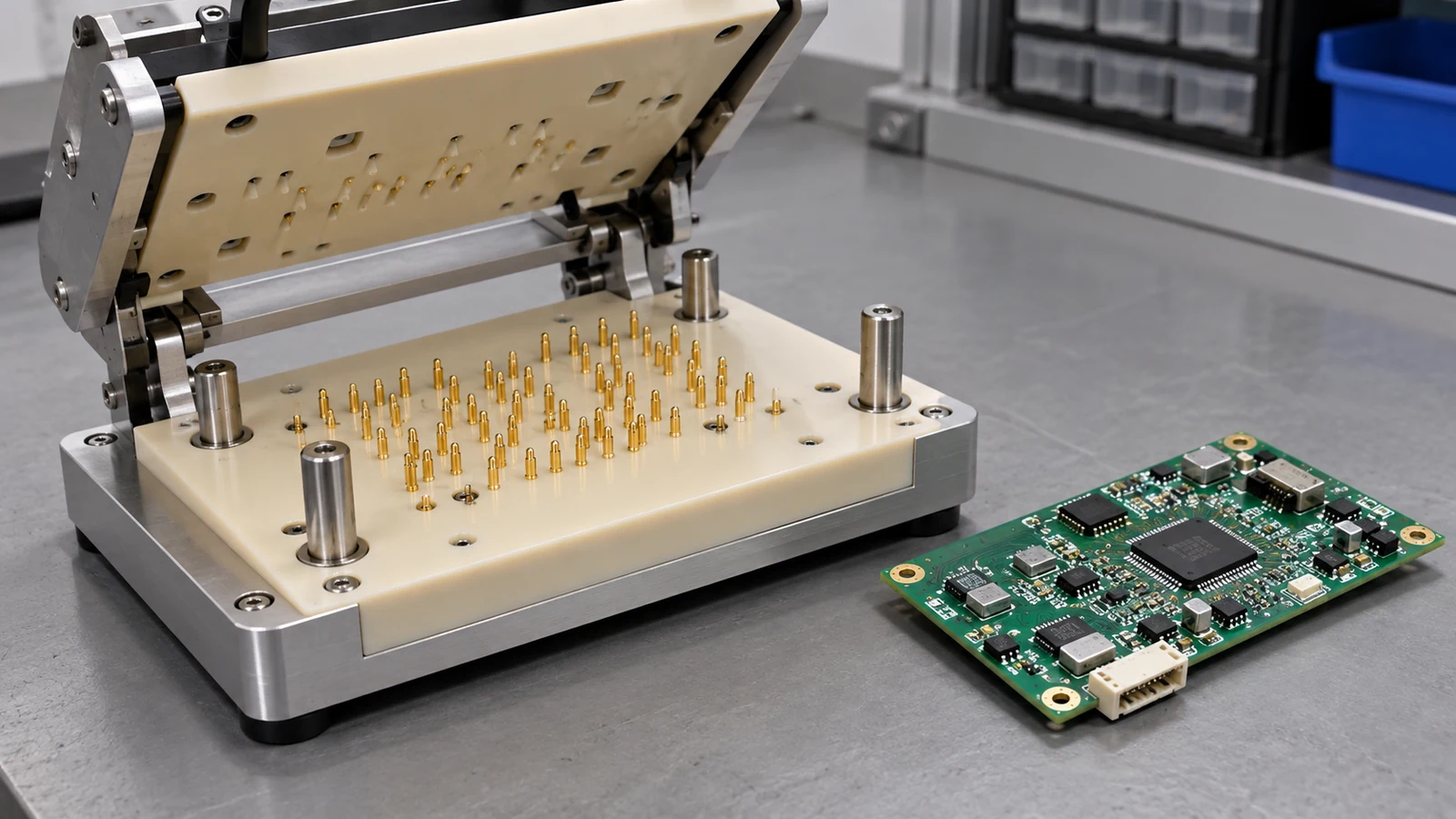
The NRE scope should name every product-specific physical tool and released program, including quantities, versions and acceptance evidence. Separate the six item types below even when the supplier offers a bundled price; separate rows make inclusions and charging boundaries reviewable.
| NRE Item | Deliverable | Ownership Question | Reuse Condition | Change Trigger |
|---|---|---|---|---|
| Solder-paste stencil | Identified foil; frame if included; approved aperture file and inspection record | Does OEM title cover the foil, frame and edited aperture data? | Same approved paste pattern, panel, thickness and printer interface; acceptable condition | Aperture, panel, foil specification or mounting changes; wear or damage |
| Assembly fixture | Identified support, pallet or nest; drawing and fit-check record | Is the dedicated insert OEM property, and who owns the common base? | Approved board geometry, component clearance and process exposure remain suitable | Outline, support, clearance, process or condition changes |
| Test fixture | Identified probe plate, nest, wiring map and verification record | Are base, probes, harnesses and design files included in ownership? | Correct test-point map, contact condition, instrument interface and validation | Test access, coverage, loading, interface or wear changes |
| Machine program | Released placement or inspection job; associated setup and library references | Is the OEM entitled to the native job, an export, or specified use rights? | Compatible machine, software, component library and assembly baseline | BOM, placement, panel, inspection criteria or platform changes |
| Functional-test software | Released sequence, limits, code deliverables and deployment manifest | Which source, modification, runtime and deployment rights are included? | Validated hardware, dependencies, product firmware and test specification | Test coverage, limits, firmware behavior or dependencies change |
| Programming setup | Target configuration, approved image reference, adapter definition and verification method | Who controls project files, adapters and rights to use the programming package? | Correct device, interface, image, configuration and serialization controls | Device, image, security configuration, adapter or programming sequence changes |
1. Match the Stencil to the Approved Print Baseline
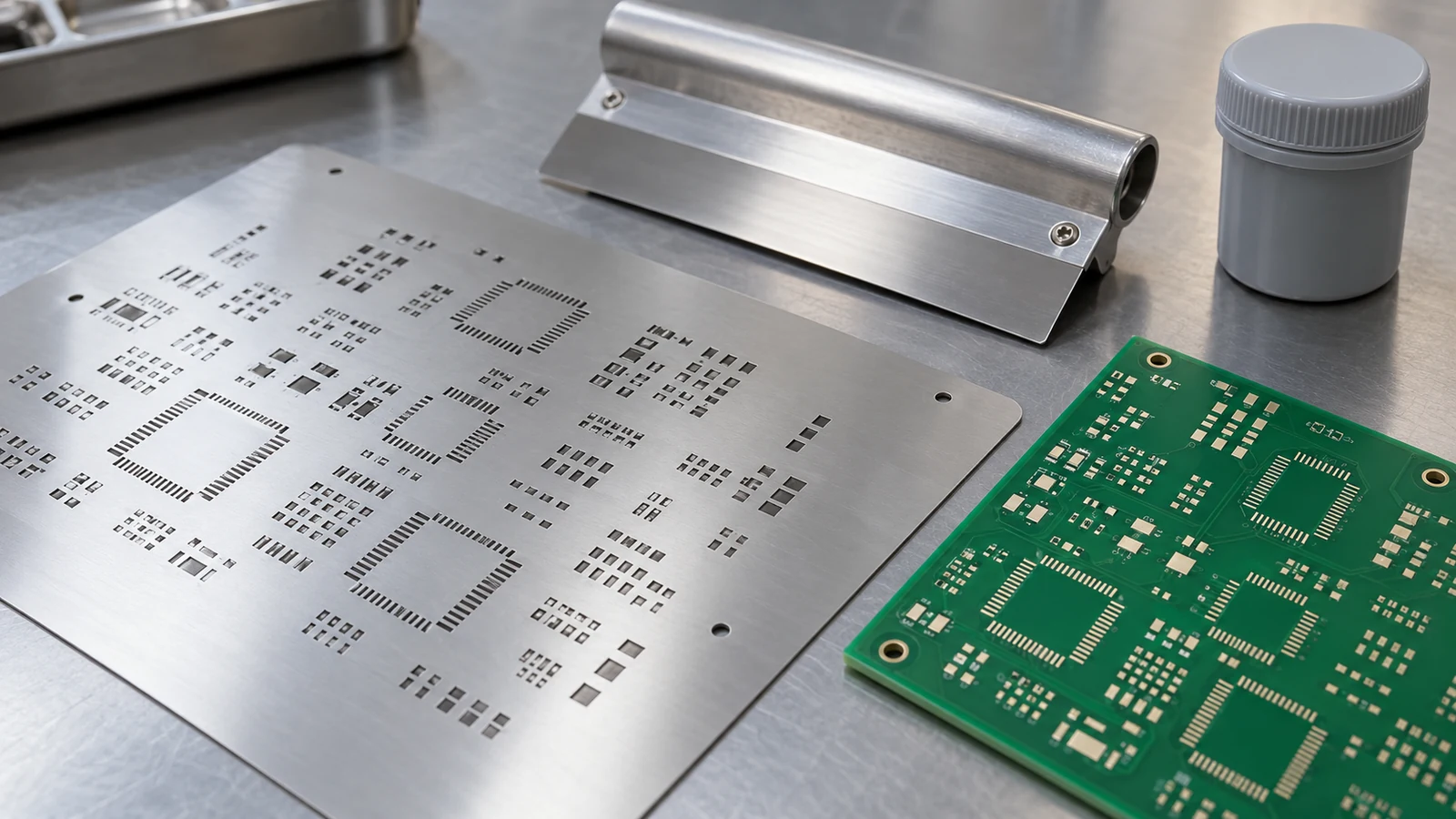
Identify the finished stencil. Record Stencil ID, Stencil Revision, Assembly Revision, Panel Revision, Print Side, Aperture Revision, Foil Thickness in µm and Mounting Definition, including any aperture modifications made after the OEM released its PCB data. Retain the approved cutting file. A board revision alone does not capture that manufacturing definition.
Retain the final stencil manufacturing definition alongside the original paste data. Record aperture modifications, a unique stencil identifier, orientation and mounting requirements, together with the inspection record and archived data. This makes the ordered tool and any later replacement traceable to the approved design.
Good signal: The engraved Stencil ID resolves to the approved aperture file and inspection record.
Red flag: “One stencil” has no side, revision, frame scope or data reference.
2. Identify the Fixture Assembly and Its Wear Items
Identify what is dedicated. Separate the common base from the nest, probe plate, harness and contacts, then record Fixture ID, Drawing Revision, Assembly Revision, Contact Map, Working Stroke, Loading Conditions and Acceptance Method for the actual configuration being purchased. Assembly supports and electrical test fixtures need separate scope decisions.
Retain the wear history. Track Cycle Count, Maintenance Record, Replaced Parts and Condition Check against the actual assembly; a base’s endurance rating does not establish the replacement interval for every probe or connector.
Good signal: The fixture drawing and wear-parts list identify what the quoted price buys.
Red flag: A lifetime claim covers “the fixture” without identifying the assembly, wear items or operating conditions.
3. Identify Each Released Program and Programming Setup
Identify the released machine job. Require Program ID, Program Revision, Machine Model, Software Version, Library Baseline and Validation Record. A centroid file supplies placement inputs but does not demonstrate acceptance of the resulting machine job; validate component orientation, fiducials, nozzles and feeders for the actual setup.
Keep programming assets distinct. Record Image Reference, Target Configuration, Algorithm Version and Adapter Definition. Configuration and device-data files serve different purposes, and some programming systems require a separate device algorithm. Define secure-provisioning responsibility separately and keep secret values out of the ordinary register.
Good signal: A release manifest identifies the exact image, configuration, adapter and verification method.
Red flag: “Programming included” leaves image control, target settings and setup deliverables undefined.
Distinguish Development Work from Physical Tooling
Development NRE pays for defined engineering outputs; physical tooling charges buy or fund identified hardware under agreed terms. Put these on separate quote lines, even when they share one project milestone. Neither the effort spent nor a delivered fixture proves that the complete production process has been accepted.
4. Define Engineering Outputs and Acceptance
Define the output first. For stencil-data preparation, fixture design, machine-job creation, test development or programming setup, record the Deliverable Description, Review Allowance, Acceptance Method and Correction Responsibility so the quoted effort has a measurable end point. Agree the baseline. Separate correction of nonconforming work from a new OEM requirement.
For fixture acceptance, specify Drawing Revision, Fit Check and Contact Verification against the released board. For test acceptance, specify Coverage Matrix, Limit Revision and Result Record, together with approved challenge samples where needed to demonstrate the agreed fault detection. Resolve exclusions before acceptance.
Good signal: The Statement of Work links each milestone to an Acceptance Record and named approver.
Red flag: The invoice milestone is “engineering complete,” with no agreed output or acceptance test.
5. Specify a Usable Test-Software Package
Specify the software package. Define Source Delivery, Executable Release, Sequence Revision, Limit Table, Driver Version, Deployment Instructions and License Scope, while separating permitted use of supplier libraries from ownership of the commissioned product-specific code. Test execution is one requirement. Future maintenance is another.
Deploying test sequences requires the associated code modules and supporting files; dynamically referenced dependencies may need explicit inclusion in the deployment package. Require a Deployment Manifest. Prove installation on the agreed station using its Instrument Configuration and Runtime Entitlement.
Good signal: The accepted software package can be restored and executed from its documented release.
Red flag: A copy of the operator interface is presented as the entire test-software deliverable.
Document Ownership, Storage and Access Rights
The commercial agreement should define physical ownership, rights to technical files, permitted software use and custody separately. Paying an NRE invoice is not a sufficient description of those rights. Each tooling-register entry should identify the owner, custodian, permitted users and conditions for access or release.
6. Separate Physical Title from Data and Software Rights
State when title to dedicated hardware transfers and exactly which parts it covers. A paid probe plate may sit in a supplier-owned base. Owning that plate does not describe the right to reproduce the wiring design or modify the test software.
For digital deliverables, specify source delivery, editing, backup, use at other sites and access by an authorized manufacturing partner. Identify supplier background technology and third-party license restrictions. Where ownership transfer is unnecessary, define the license that gives the OEM the required continuity.
Good signal: The Ownership Schedule distinguishes dedicated hardware, common equipment, product-specific files and licensed dependencies.
Red flag: “Customer tooling” is treated as proof of unrestricted rights to every file and platform.
7. Agree Custody, Retention and Retrieval
Name the Storage Location, Custodian, retention period, storage-charge basis, retrieval notice and release process. Define responsibility for loss, damage and maintenance during custody. Require notice and written disposition before scrapping, reallocating or disposing of customer-owned items after inactivity.
For files, include backup, restoration and access arrangements. For physical tools, specify protective storage and identification. If another manufacturer may use the assets, resolve the permission and release terms now; receiving-site compatibility and qualification remain separate work.
Good signal: The OEM can obtain a current inventory and request release under defined terms.
Red flag: Assets may be discarded after an unspecified idle period, or access depends entirely on one employee.
Decide When a Revision Requires Tooling Changes
A PCBA revision requires tooling work when it changes the features, data or operating conditions on which the accepted tool or program depends. Review the engineering change against each affected register entry. A new revision letter neither proves that every tool needs replacing nor establishes that reuse is safe.
8. Authorize the Actual Change and Its Evidence
For stencils, compare paste apertures, component lands, panel layout, fiducials, foil thickness, step geometry and mounting. A silkscreen-only correction may preserve the print definition; a panel change can invalidate it even when each individual PCB is unchanged.
For fixtures, compare datums, outline, component clearance, support locations and test-point access. For software, compare BOM, placement data, test coverage, limits, firmware behavior and target platform. An alternative component with the same footprint can still require library or test changes.
Use these four dispositions to make the decision explicit:
| Change Disposition | Applicable Finding | Required Evidence | Charging Boundary |
|---|---|---|---|
| Reuse unchanged | The change leaves the tool’s approved features and conditions unchanged | Revision comparison and retained release reference | Existing agreed order setup only; no assumed new development |
| Revalidate existing tooling | The asset is unchanged but suitability needs renewed demonstration | Defined fit, print, programming or test checks | Separately identified validation effort if chargeable |
| Modify and revalidate | A program, insert or other asset can be updated to the new baseline | New asset revision and successful acceptance checks | Approved modification scope and validation |
| Replace and qualify | The existing asset cannot satisfy the new requirement or condition | New asset definition, acceptance and old-asset disposition | Authorized replacement and qualification scope |
These are review outcomes, not automatic pricing rules. Require a Change Request that names the affected Tool ID or Program ID, technical reason, work scope, price, timing and approver. Keep the previously accepted configuration identifiable during the transition.
Good signal: The change quote explains which features invalidate reuse and which assets remain usable.
Red flag: Every revision triggers the entire original NRE charge, or every unchanged part number is accepted for reuse without review.
Clarify Reuse, Maintenance and Repeat-Order Charges
Reuse should preserve the value of accepted development while allowing clearly defined setup, inspection, maintenance and approved changes. The PCB assembly NRE tooling cost agreement should state which recurring activities are included and which create a new charge. A reusable asset can still require work before the next build.
9. Tie Repeat Charges to Asset Condition and Named Work
Before a reorder, confirm the released assembly baseline, tool condition, software environment and storage history. Identify the fee trigger and required approval for each activity below. Use quoted amounts or an agreed calculation basis in the actual agreement; the table defines scope rather than a market price list.
| Charge Category | Trigger to Define | Evidence to Request | Commercial Boundary |
|---|---|---|---|
| Order setup | Loading, alignment, feeder preparation or fixture installation | Setup scope and build reference | Per order, per setup or included in unit pricing |
| Tool retrieval and inspection | Release from storage and condition check | Inventory and inspection record | Included service or separately quoted work |
| Routine maintenance | Specified interval or condition criterion | Cycle count, findings and maintenance record | Included tasks versus chargeable labor |
| Wear-part replacement | Probe, connector or other identified part fails its criterion | Part number, reason and replacement record | Approved consumables and labor basis |
| Engineering change | Approved baseline or process change | Change request and affected asset revision | Incremental work; no unexplained repeated development |
| Software deployment | Added station, changed dependency or required license | Deployment manifest and entitlement scope | Installation effort and third-party charges separated |
| Storage and retirement | Agreed retention or end-of-life event | Inventory notice and written disposition | Defined period, renewal basis and release costs |
The life record should contain Fixture ID, component part numbers, Cycle Count, count definition, Last Service Date, service findings, parts replaced and Next Inspection Due. Count fixture actuations consistently, including retests where they actuate the fixture. One actuation may test several boards, so shipped quantity is not an adequate wear counter. Preserve total fixture history when replacing an individual wear item.
Contamination can increase probe contact resistance and cause false test indications. A fixture’s catalog endurance applies to the specified construction and laboratory conditions. Set maintenance requirements from the quoted fixture’s instructions and observed contact performance; do not convert a catalog rating into a guaranteed number of good assemblies.
Good signal: The Reuse Approval links condition evidence to the relevant maintenance or setup charge.
Red flag: “Free reuse forever” has no retention terms, condition criteria or treatment of worn parts.
Attach a Tooling Register to the Commercial Agreement
A tooling register should connect each quote line to its deliverable, owner, revision, reuse conditions and approval evidence. Attach the agreed register to the purchase order or Statement of Work and define how later revisions are approved. Keep development-only tasks in the same record system, identifying their accepted output even when no physical tool exists.
10. Make Every Charge Traceable to an Accepted Item
Apply the 100% completeness reference target to chargeable NRE items: each must have an identified deliverable, revision, responsible party and Acceptance Record. At quotation, define the required evidence; at acceptance, enter the completed record reference. A purchase-order line number alone cannot establish that a tool is usable.
Good signal: Every Quote Reference resolves to an approved asset or output and its Acceptance Record.
Red flag: An invoice exists, but Tool ID, release evidence or reuse terms cannot be retrieved.
The following is a filled illustrative purchasing record, not a JASPER project or a universal stencil specification. The OEM supplies product baselines and commercial approvals; the manufacturer supplies the as-built definition, custody information and inspection evidence. Both parties approve the completed record.
| Register Field | What the Field Controls | Filled Example |
|---|---|---|
| Quote Reference | Connects the asset to its purchase scope | Q-417, line 2: top-side stencil foil and aperture-data preparation; common frame excluded |
| Asset Identity | Distinguishes the physical item and its revision | Stencil ID ST-417-T03; Stencil Revision 03; quantity one |
| Product Baseline | Identifies the assembly and panel authorized for use | PCBA-417 Rev C; Panel Revision 02; top side |
| Manufacturing Definition | Preserves the finished print definition | Approved aperture file AP-417-T03.gbr; 120 µm foil; printer mounting per drawing MD-417-02 |
| Owner and Rights | States title and use of the commissioned data | OEM owns the accepted, paid foil and may reuse the released aperture file with an authorized manufacturer |
| Custodian and Location | Makes the asset retrievable | Assembly supplier; stencil rack S04, slot B02 |
| Acceptance Record | Identifies approval evidence and responsibility | IR-417-03 records aperture comparison, foil measurement and printer fit; approved by OEM manufacturing engineering |
| Reuse Condition | Defines what must remain valid | Listed baseline and mounting unchanged; incoming condition inspection accepted before each build |
| Maintenance Record | Preserves condition and service history | Clean after use; log damage and inspection findings; withdraw damaged foil pending disposition |
| Repeat-Charge Rule | Separates prior development from new work | No repeat aperture-development charge for unchanged accepted data; order setup remains on its own quote line |
| Change Authority | Prevents unapproved replacement or billing | OEM purchasing authorizes a priced change after manufacturing engineering approves its technical scope |
| Retention and Release | Defines custody duration and end-of-use action | Storage included for 12 months after the last build; 30 days’ written notice before retention expires; no disposal without OEM disposition |
For a test fixture, add the probe map, wear-part list, stroke/load conditions and cycle history. For software, use a separate release entry. This companion example belongs to the same fictional PCBA-417 record:
| Software Record | Filled Example |
|---|---|
| Program Identity | Program ID FT-417; Program Revision 1.4; Release Status accepted |
| Product Baseline | Assembly Revision C; Firmware Version 1.8; Test Specification TS-417 Rev 05 |
| Source Package | Source Archive FT-417-src-1.4.zip; Build Instructions BI-417-04 |
| Deployment Package | Executable Release FT-417-1.4; Dependency Manifest DM-417-04 |
| Station Definition | Station ID TS-04; Instrument Configuration IC-417-02; Driver Baseline DB-417-04 |
| Test Definition | Sequence Revision 1.4; Limit Revision 05; Coverage Matrix CM-417-05 |
| Rights Definition | Source Delivery included; Modification Rights granted for product-specific code; Runtime License separately identified in LS-417-01 |
| Acceptance Evidence | Restoration Check RC-417-04 and Test Validation TV-417-04 accepted by OEM manufacturing engineering |
Keep the referenced packages and rights schedules alongside the register. Their identifiers make the entry traceable; the actual files establish its content.
Review and Release NRE in Six Steps
An NRE review should progress from a controlled RFQ to accepted assets and a documented reuse decision. Assign technical and commercial approvers. Price agreement and engineering acceptance need distinct sign-offs.
Freeze the quotation baseline. Supply the BOM, PCB and paste data, placement data, panel drawing, assembly notes, firmware reference and test requirements with their revisions, unresolved decisions, expected reorder pattern and any requirement for use at another site.
Request the itemized scope. Separate development, dedicated hardware, software and recurring setup. Identify exclusions and shared equipment. Reconcile the six-item matrix against the actual process; an unnecessary fixture should not appear simply to complete a checklist.
Agree rights and recurring charges. Resolve title, data rights, licenses, storage, maintenance and release terms before ordering. Check that recurring fees do not duplicate already accepted and paid development.
Approve the acceptance plan. Define the required fit, print, electrical, programming and restoration checks, the signer, and how failures or deviations will be corrected or dispositioned. Make the evidence requirements explicit.
Accept and register the release. Review evidence and match assets and files to the release manifest. Link acceptance to the payment milestone. Identify restricted or superseded items.
Recheck before each reuse or change. Confirm baseline, availability, condition and software environment. Record the disposition and authorize extra work before it starts. Update the register after maintenance, relocation or revision.
Eight Signals That Require Escalation
An NRE quote should be held for clarification when a missing term prevents the OEM from identifying, accepting or reusing its deliverables. Escalate these eight signals to purchasing and engineering; reject the affected scope if the supplier will not resolve the essential requirement.
- One unexplained NRE amount: no itemized deliverables or included development tasks.
- Unidentified stencil: no final aperture revision, board side or mounting definition.
- Undefined ownership: payment is offered as the only explanation of title and access rights.
- Software without deployment information: the accepted files cannot be installed or restored independently of an undocumented workstation.
- Unqualified lifetime promise: fixture-base endurance is presented as the guaranteed life of probes, connectors and the complete test process.
- Automatic full NRE on every revision: no technical comparison identifies the work that changed.
- Uncontrolled disposal or release: retention, retrieval and customer authorization terms are absent.
- Acceptance without evidence: tools or programs enter production before the agreed checks and approval are recorded.
These signals call for a specific correction. A low initial price cannot compensate for missing rights, unusable files or an undefined acceptance requirement.
Frequently Asked Questions
PCBA NRE decisions become clearer when the agreement separates ownership, engineering acceptance, physical condition and recurring work. The following answers apply those distinctions to common quotation and reorder questions.
Does paying NRE mean the OEM owns the tooling?
No; payment alone does not define ownership. The Ownership Schedule should identify covered hardware, Title Transfer, Custodian and Data Rights, distinguishing a dedicated insert from a shared fixture base and the software needed to use them. Agree each right explicitly.
Which PCBA revisions require a new stencil?
A new stencil is necessary when the existing foil cannot meet the approved print definition or condition requirements. Compare Aperture Revision, Panel Revision and Mounting Definition, including paste-volume requirements and fiducials. A silkscreen-only correction may permit reuse. A changed panel may require replacement.
Should test software be included in tooling deliverables?
Yes, when development or delivery is quoted. Define Source Delivery, Executable Release, Sequence Revision, Limit Table and License Scope, then accept the package on its specified station with the dependencies and deployment instructions required to run it. Fixture ownership does not settle software rights.
Can an OEM transfer fixtures to another manufacturer?
Yes, subject to the agreed rights. Confirm that the Ownership Schedule and Release Terms cover the required insert, base, wiring files and software, then have the receiving manufacturer establish mechanical, electrical and software compatibility before qualifying the setup. Possession alone does not demonstrate suitability.
What repeat-order fees should be clarified before the first build?
Clarify setup, retrieval, inspection, maintenance, wear parts, storage, software deployment and engineering changes. Each Repeat-Charge Rule should identify the trigger, evidence, calculation basis and approver, including whether work is included or separately quoted. Previously paid development needs an explained new scope before another charge.
Is there a standard NRE price or guaranteed fixture lifetime?
No universal figure applies. Request the actual scope and quoted assembly’s validation conditions, because engineering content determines price while loading, wear parts and maintenance determine whether a fixture remains suitable. Keep Cycle Count and Maintenance Record for the relevant assembly and components.
Can existing machine programs be reused after a line change?
Reuse requires verified compatibility. Check Machine Model, Software Version, Library Baseline and Assembly Revision against the receiving line; the result determines whether the saved job can be reused, needs conversion or must be rebuilt. Define validation and incremental work before approving the change.
What should a tooling register include before acceptance?
Identify the deliverable, revision, responsible party and Acceptance Record for 100% of chargeable NRE items. Add Owner and Rights, Custodian and Location, Reuse Condition and Repeat-Charge Rule. Define the evidence at quotation. Enter completed references before production release.
Should the OEM receive programming keys with the setup files?
Credential control needs a separate agreement. The programming package should identify Image Reference, Target Configuration and provisioning responsibilities while keeping secret values outside the open tooling register. Apply the project’s agreed access and transfer controls when providing authorized programming capability.
Turn the NRE Quote into an Approved Scope
The next step is to send a revision-controlled RFQ package with the tooling matrix and request a completed register, acceptance plan and recurring-charge schedule. Ask engineering to approve reuse conditions and purchasing to approve ownership, access and fee triggers before issuing the order.
For a JASPER enquiry, use the PCB assembly services page and prepare the BOM, PCB and paste data, panel drawing, firmware reference and test requirements. Identify any existing assets and required software rights. The resulting discussion should produce an itemized NRE scope that supports the first build and gives the next order a defined starting point.
Ready to Start Your Project?
Tell us about your membrane switch, keypad, or graphic overlay requirements. Our engineering team will review your specifications and provide a detailed quote.