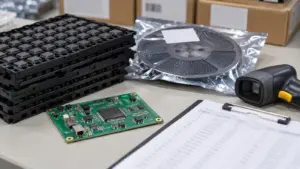
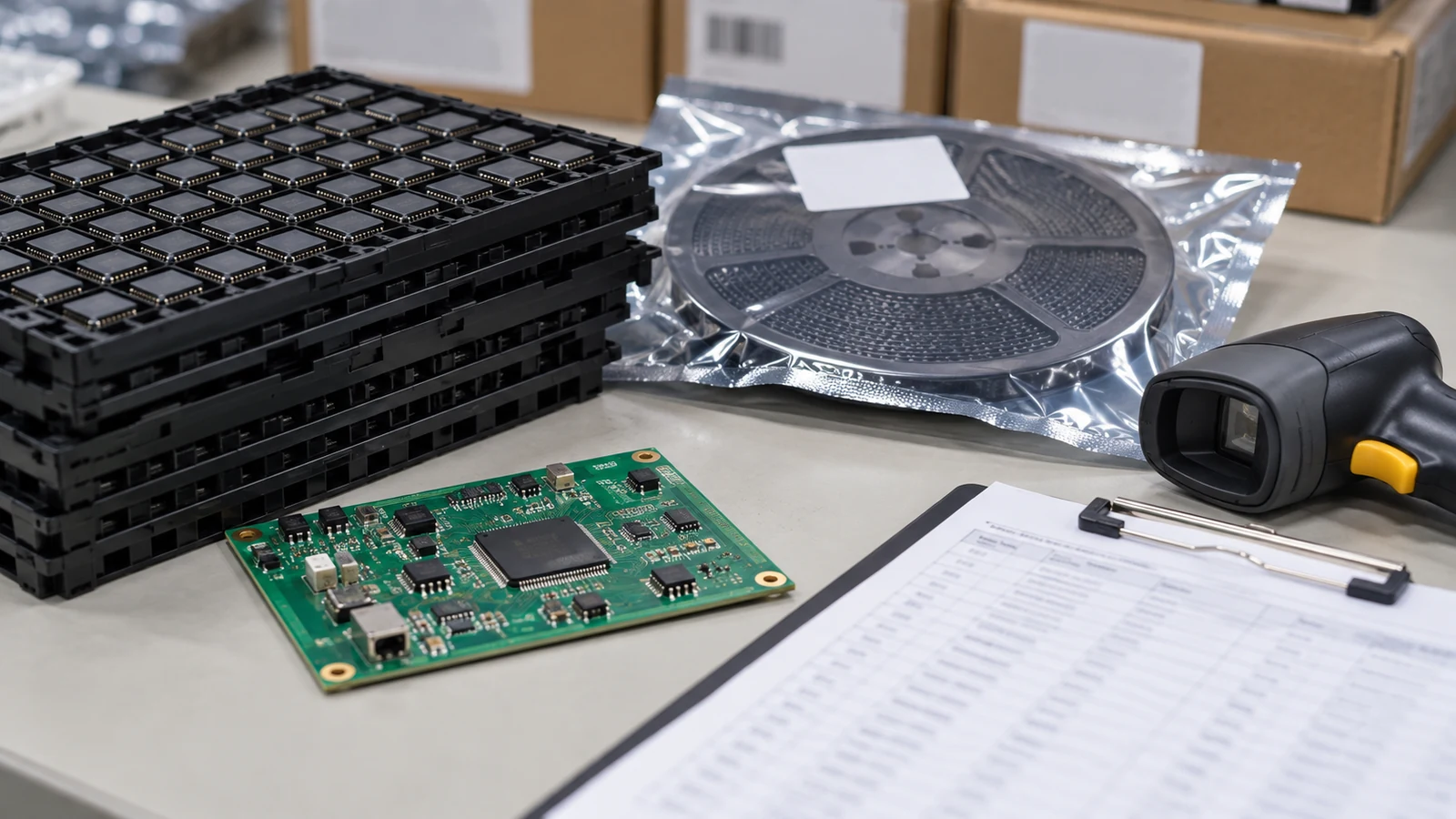
PCB assembly authorized component sourcing should be the default for available parts because it connects purchasing to a manufacturer-recognized supply route. Independent brokers can help with shortages and obsolete stock, but approval must follow the specific lot’s evidence. Neither a channel label nor a certificate settles every authenticity and condition question. For industrial OEM purchasing, use a 100% received-lot documentation review target, then select additional assessment according to provenance, storage history and the consequences of failure.
- Authorized Channels and Independent Brokers Serve Different Needs
- Compare the Evidence and the Responsibility
- Where Authorized Sources Win
- Where Independent Brokers Win
- Verify Authorization for the Manufacturer and Product Line
- Trace Ownership, Storage and Lot Information
- Storage Evidence Must Follow the Device
- Match Incoming Verification to the Purchase Risk
- Clarify Returns, Claims and Nonconforming-Material Handling
- A Channel Decision for Available, Shortage and Obsolete Parts
- Final Recommendation
Authorized Channels and Independent Brokers Serve Different Needs
Authorized sources provide a manufacturer-recognized route for the products covered by their appointment; independent brokers locate inventory outside that relationship. The first route usually fits repeat production. The second can address a supply gap. Compare both against the same requirement: the correct component, acceptable condition, usable evidence and enforceable purchase terms.
| Purchase Situation | Preferred Route | Condition for Approval |
|---|---|---|
| Current part available within the build schedule | Manufacturer direct or authorized distributor | Confirm the exact part, authorized inventory and delivery commitment |
| Shortage with no timely authorized stock | Independent broker exception | Project permits the source; the offered lot passes the approved evidence and assessment plan |
| Obsolete part needed for continuing service | Authorized remaining stock first; broker stock if necessary | Establish provenance, storage suitability and a support plan for the actual lot |
| Customer requires authorized sourcing without exceptions | Authorized source | A broker test report cannot replace the customer’s channel requirement |
These preferences concern purchase suitability. They do not assign a counterfeit rate to either channel.
Compare the Evidence and the Responsibility
| Purchase Dimension | Authorized Source | Independent Broker | Evidence Needed | Approval Decision |
|---|---|---|---|---|
| Channel relationship | Appointment applies to defined manufacturers, products and territories | No manufacturer appointment for the offered transaction | Manufacturer directory or confirmation; legal seller; product-line and territory scope | Purchasing confirms the actual transaction qualifies for the proposed route |
| Chain of custody | Request records connecting the shipment to the recognized supply chain | Request upstream ownership and custody records for the offered lot | Invoices, packing records and identifiers linking transfers and quantities | Quality reviews continuity; the OEM approves any permitted exception |
| Storage history | Confirm original packaging and any distributor repacking | Establish storage and handling across prior owners | Seal/opening dates, moisture records, repacking history and handling declaration | Quality accepts the evidence against the device’s handling requirements |
| Lot documentation | Match delivered identifiers to order and shipment records | Keep source populations and lot identifiers distinct | Manufacturer part number, lot/date codes, quantity, label images and certificate references | Release only the identified, reviewed lot; a replacement lot requires review |
| Verification plan | Apply normal receiving checks and investigate discrepancies | Add assessment targeted to unresolved provenance and condition risks | Approved methods, sampling basis, acceptance criteria and lot-linked results | Engineering and quality approve the plan and review the results |
| Return and claim terms | Manufacturer support and distributor terms depend on the transaction | Seller’s contractual remedy is especially important | Inspection window, test permissions, claim evidence, remedy and cost allocation | Purchasing closes the terms before commitment; quality confirms they support inspection |
The OEM’s designated approval authority owns the sourcing exception. The assembler controls receipt, identification and release under the agreed procedure. A laboratory reports the scope and results of its work; it does not decide whether the OEM’s remaining application risk is acceptable.
Where Authorized Sources Win
Authorized sources are the stronger starting point for repeatable replenishment, manufacturer support and projects with strict source requirements. A buyer can verify an appointment at its origin and retain the purchase records for that supply route. This reduces the number of unresolved upstream questions before assembly.
The advantage still needs a transaction check. A distributor’s recognized name does not show that a marketplace seller, acquired business or independently sourced offer falls within its appointment. Confirm the inventory stream. Authorized supply also needs receiving inspection and proper storage after delivery.
Where Independent Brokers Win
Independent brokers can be useful when they locate a specific shortage or obsolete lot that the authorized route cannot deliver in time. Legitimate surplus can exist outside a manufacturer’s distribution appointment. The opportunity is access to that inventory, rather than an automatic reduction in price or risk.
The advantage survives only if the buyer can evaluate the offered material. Verify physical availability: establish who holds the stock, which lot is reserved for the order, and whether another intermediary must supply it before the broker can ship. Add document review, testing, sample consumption and possible rejection to the schedule and cost comparison. A listing is not a reservation.
Verify Authorization for the Manufacturer and Product Line
An OEM should verify authorization with the component manufacturer, then match that authorization to the legal seller and the quoted products. A logo, line card or reseller certificate is supporting material, not the final authority. Authorization for one brand or territory does not establish authorization for every item on a supplier’s website.
Use four checks before issuing the purchase order. Check the transaction itself.
- Start at the manufacturer. Find the distributor in the manufacturer’s current directory or obtain confirmation through the manufacturer’s own contact route.
- Match the seller. Reconcile the quoted company, invoicing entity and fulfillment arrangement. Identify any marketplace partner or intermediary.
- Check the scope. Confirm the manufacturer, product line, territory and any customer or application restrictions that affect the purchase.
- Check the offered inventory. Ask whether this shipment is supplied through the authorized relationship, then retain the answer with the purchase record.
Check the manufacturer’s warranty and support policy before choosing a source. Coverage may be limited or unavailable for purchases outside an authorized channel. That commercial restriction is a separate question from authenticity; it does not, by itself, prove that every outside-channel component is counterfeit.
An authorized network can distinguish regional and specialist distribution, with support tied to the approved purchasing route. Verify the authorization, product line, applicable territory and support terms for the exact component being ordered instead of relying on a distributor’s name alone.
A practical PCB assembly authorized component sourcing record captures the checker, check date, manufacturer, product scope and approved offer. If a supplier presents a quality-system or AS6081A certificate, check its issuer, named company/site, scope and validity separately; that document does not replace confirmation of the manufacturer’s appointment for the transaction being proposed. Recheck changed conditions. An old screenshot should not silently approve a different seller or product line.
Trace Ownership, Storage and Lot Information
Component traceability should connect the received material to its declared origin and handling history. Ownership records show who sold it; custody records show who held, repacked or transported it. A date code alone establishes neither chain. Review both chains against the actual shipment before releasing material to the PCBA build.
Request a linked package containing the manufacturer part number, purchase order, seller, quantity, lot/date codes, packaging labels, origin records and any intervening transfer records. Keep the original identifiers. Do not substitute a shared date code for the manufacturer’s lot identifier, or treat the broker’s internal stock number as proof of a common manufacturing origin. Redacted prices may be acceptable; redactions that prevent matching identities, quantities or lots defeat the purpose of the review. A seller-issued Certificate of Conformity must identify what it certifies and the shipment it covers.
Apply the 100% received-lot documentation review target to every lot. It means reviewing each lot’s record and approval status, not inspecting every device or claiming that every historical document is available. Keep any accepted evidence gaps attached to the approved exception.
For example, an order delivered on three reels with two manufacturer lot codes needs a record that maps all three reels to their respective lots. Do not let a report on one reel silently cover the other population. If material is split or repacked, preserve the original identifiers and the relationship between the original and new containers.
Storage Evidence Must Follow the Device
Age and condition are different questions. Review the material, moisture-sensitivity level, packaging, desiccant and storage history against the device’s handling requirements. A recent reseal date does not erase earlier exposure, and an older manufacturing date does not by itself establish that a part is unusable.
For applicable nonhermetic surface-mount devices, the complete Moisture Sensitivity Level classification is:
| Classification | Floor Life After Opening | Ambient Limit |
|---|---|---|
| MSL 1 | Unlimited floor life | ≤30°C and ≤85% RH |
| MSL 2 | 1 year | ≤30°C and ≤60% RH |
| MSL 2a | 4 weeks | ≤30°C and ≤60% RH |
| MSL 3 | 168 hours | ≤30°C and ≤60% RH |
| MSL 4 | 72 hours | ≤30°C and ≤60% RH |
| MSL 5 | 48 hours | ≤30°C and ≤60% RH |
| MSL 5a | 24 hours | ≤30°C and ≤60% RH |
| MSL 6 | Mandatory bake before use; reflow within the label’s time limit afterward | ≤30°C and ≤60% RH |
These are handling classifications, not authenticity grades or sealed-package shelf-life limits. RH means relative humidity. Apply the actual device’s label and moisture-handling instructions, including the stated temperature, humidity and permitted exposure time.
For an MSL 3 device, the 168-hour allowance applies at the stated temperature and humidity; a broker’s generic “dry stored” declaration does not document exposure. Request opening and repacking dates, the applicable moisture-barrier-bag and humidity-indicator records, and any bake history. A humidity-indicator reading alone does not reconstruct the full exposure history. Engineering or quality should resolve handling suitability under the device instructions and applicable IPC/JEDEC J-STD-033 procedure, rather than selecting a universal bake cycle.
Match Incoming Verification to the Purchase Risk
Incoming verification should address the risks of the particular component, lot and application. Authorized-source receipts still need order, identity, quantity and packaging checks. Broker purchases need an explicit assessment of unresolved provenance and condition questions before the OEM decides what further inspection or testing is justified.
SAE AS6081A addresses independent-distribution counterfeit-risk controls. SAE AS6171A addresses inspection and testing selected in relation to risk. These serve different purposes; neither a supplier certificate nor a laboratory logo approves a particular received lot. SAE AS6081A scope, SAE AS6171A scope.
Use the following questions to define a test plan. The methods are complementary choices, not a universal sequence or a guarantee of authenticity.
| Purchase Risk Question | Useful Assessment | What It Can Establish | Limit to Record |
|---|---|---|---|
| Do order records, labels and material identifiers agree? | Document review and external visual inspection | Consistency, package condition and visible anomalies | Matching labels can be copied; appearance does not prove origin |
| Is internal construction consistent with the claimed device? | X-ray comparison with a suitable reference or controlled population | Internal structural differences requiring investigation | Similar construction does not establish electrical grade or full provenance |
| Are selected electrical characteristics correct? | Electrical testing against an approved specification | Performance at the measured conditions | A room-temperature check does not establish every temperature, voltage or timing limit |
| Do die markings and internal features support the claimed identity? | Delid or decapsulation analysis where justified | Direct observations of internal construction and markings | Destructive sample consumption; the finding covers the examined samples |
| Could storage or handling affect assembly suitability? | Moisture-history review and targeted condition or solderability assessment | Evidence relevant to the identified handling concern | A counterfeit screen alone does not establish storage reliability |
SAE’s radiological inspection scope explains comparison against an exemplar or a suitable population. Its delid/decapsulation scope also identifies the destructive nature of that assessment. Agree sample ownership and consumption before ordering.
Engineering and quality should specify the laboratory, methods, sampling basis, reference data, acceptance criteria and report contents. Control sample selection. Samples must represent the populations defined in the plan, including any differences in source, lot identifiers or markings; a seller’s convenient sample cannot be assumed to represent every reel subsequently delivered under the same part number. Link the report to the received lot, record deviations, and prevent substitution of a different lot after testing.
A passing result reduces uncertainty within the tested scope. It cannot recreate an absent chain of custody or establish lifetime reliability. AS6171A counterfeit assessment also does not replace evaluation of damage from improper storage or handling. Where the remaining risk exceeds the project’s acceptance rules, stop the purchase and use another supply or design route. More testing is not always the right answer.
Clarify Returns, Claims and Nonconforming-Material Handling
Return and claim terms should give the OEM enough time and authority to perform the agreed acceptance work. Both authorized and independent purchases need clear remedies. For a broker exception, the contract must also connect those remedies to the offered lot, the approved assessment and the seller’s representations.
Start with the inspection window. Agree when it begins, how laboratory lead time is accommodated, which evidence supports rejection, and who pays for testing, freight and consumed samples. A short return window can expire before meaningful assessment finishes. Obtain written test permissions: opening dry packaging, taking representative samples and performing destructive analysis must not leave the buyer discovering afterward that the seller treats those agreed acceptance activities as grounds to deny the negotiated remedy.
Distinguish cancellation of conforming material from claims involving incorrect identity, undisclosed condition or failure of agreed acceptance criteria. If an offer is noncancelable and nonreturnable, obtain written agreement on how those claims will be handled. Do not assume the acronym answers every question. The seller’s commitment and any manufacturer support entitlement are separate.
Require approval before a change of source, lot, date-code grouping or declared condition. Review replacement shipments too. Approval of one lot is not standing approval of all stock under that part number. Define whether the remedy is replacement, credit or refund and who decides between them.
Finally, name the parties responsible for reporting discrepancies and authorizing material disposition. The purchase terms should preserve the records and samples needed for review. Any actual suspect-material incident belongs in the OEM’s existing nonconforming-material procedure; a routine return instruction should not pre-empt that process. Purchasing owns the commercial agreement, while quality owns the acceptance and escalation decision.
A Channel Decision for Available, Shortage and Obsolete Parts
Choose the channel by combining availability with the project’s source restrictions and evidence requirements. Available components normally favor authorized supply. Shortage or obsolete components may justify a broker exception, but schedule pressure does not change the acceptance authority or make an unreviewed lot suitable for production.
| Project Constraint | Channel Decision | Evidence and Release Condition | Approval Owner |
|---|---|---|---|
| Authorized stock meets the required date | Use the confirmed authorized offer | Check appointment, transaction records and every received lot’s documentation | Purchasing confirms source; quality releases receipt |
| Authorized lead time misses the build, and exceptions are allowed | Compare the broker lot with rescheduling or engineering alternatives | Confirm stock, custody evidence, assessment duration, total cost and acceptance terms | Designated OEM authority approves exception with engineering and quality input |
| Obsolete device supports an installed product | Check authorized remaining stock, then assess identified broker inventory | Review exact device revision, storage, condition and lot-specific assessment | Engineering confirms suitability; quality approves material release |
| Safety consequences or customer rules impose strict sourcing limits | Follow the specified channel restriction | Testing does not substitute for a required source or written customer authorization | Required customer/OEM authority |
| Seller cannot identify the offered lot or agree to the necessary review | Do not approve that offer | Obtain a reviewable offer or change the supply plan | Purchasing closes the rejected offer; program owner selects the next route |
Keep two decisions separate: approval to buy from the proposed source, and permission to use the material actually received. Conditional purchasing approval should identify the lot, required evidence, assessment plan and acceptance conditions. Receipt is not release. The receiving record should keep that distinction visible until quality has reviewed the actual shipment against the approved conditions.
An illustrative shortage decision makes the distinction clear. A broker offers the exact approved part number, but its advertised delivery date excludes laboratory work. The OEM compares the complete path to accepted material with the authorized delivery date, including time to obtain origin records, select and send samples, review the laboratory report and resolve any discrepancies before the assembler can issue the lot to production. If that work cannot finish before the build, the broker offer has not solved the schedule problem.
Compare delivered-and-accepted cost on the same basis: component price, transport, assessment, consumed samples and required handling. Keep possible rejection and build-delay exposure visible beside those charges. The lower unit price is only one input.
For each exception, retain a short decision record: why the normal route is unavailable, which lot is proposed, what evidence was reviewed, what assessment remains, who accepts the residual risk and who releases the receipt. Any proposed substitute part goes through the separate engineering change process. Channel approval alone cannot authorize a BOM change.
Frequently Asked Questions
OEM buyers should evaluate authorization, provenance, condition and purchase terms as separate decisions. These answers apply to the specific component and lot being purchased; source approval should remain linked to the project’s requirements.
How can an OEM verify whether a distributor is authorized?
Check the component manufacturer’s current distributor directory or obtain confirmation from the manufacturer. Match the legal seller, product line, territory and quoted inventory route. Retain the dated result with the purchase record, and repeat the check when the seller or scope changes.
Are independent-broker components necessarily counterfeit?
No. Independent-broker components can include legitimate surplus or older inventory sold outside an authorized appointment. Evaluate the particular lot’s origin, ownership, custody, storage and condition. The channel label establishes the need for a different approval review, not a verdict about every component.
What evidence should be requested for a shortage purchase?
Request the exact manufacturer part number, offered quantity, lot/date codes, packaging photographs, origin and transfer records, storage history, verification plan and written acceptance terms. Confirm that the stock and test samples correspond to the offered lot. Obtain the OEM’s sourcing-exception approval before commitment.
Does a certificate alone establish component authenticity?
No. A certificate records a statement by its issuer; its value depends on the issuer, scope and connection to the shipment. Match it to the lot and supporting transaction records. A seller-issued certificate or generic quality-system certificate cannot independently establish the complete origin of the material.
When should broker-sourced parts require additional assessment?
Additional assessment is warranted when provenance is incomplete, storage or packaging raises questions, source populations are mixed, or application consequences demand stronger evidence. Engineering and quality should choose methods and sampling for those risks. If the remaining risk is unacceptable, reject the purchase instead of assuming more testing will resolve it.
Does an older date code make a component unacceptable?
An older date code alone does not determine usability. Review the applicable device instructions, storage and packaging history, condition and project requirements. Moisture floor life after opening is different from sealed-package shelf life. An MSL 3 device’s 168-hour allowance applies only under its stated ambient conditions.
Can one PCB assembly BOM use both authorized and broker sources?
Yes, when the project’s purchasing rules permit it and the broker-sourced lines receive the required approval. Identify the source and lot for each affected BOM line and preserve those records through assembly. Approval of a broker lot does not authorize substitutions or automatically approve later shipments.
Does passing laboratory testing prove that a broker lot is authentic?
No. Passing results establish findings within the approved methods, conditions and samples; they do not reconstruct missing custody records or establish lifetime reliability. Review the report against the received lot and acceptance criteria. The designated OEM authority must still accept the remaining risk before quality releases the material.
Final Recommendation
Use authorized sources for available parts and evaluate independent brokers through a documented, lot-specific exception when project rules permit it. Require 100% received-lot documentation review, verify the manufacturer’s channel scope, and agree the assessment and remedies before committing to an exceptional purchase.
For a JASPER project, prepare the controlled BOM, exact manufacturer part numbers, required quantities, build date, source restrictions and any proposed broker-lot evidence for discussion through PCB assembly services. Assign the sourcing-exception approver and material-release owner at the outset. The useful buying decision is the one that connects the approved source, the received lot and the finished assembly’s requirements.
Ready to Start Your Project?
Tell us about your membrane switch, keypad, or graphic overlay requirements. Our engineering team will review your specifications and provide a detailed quote.