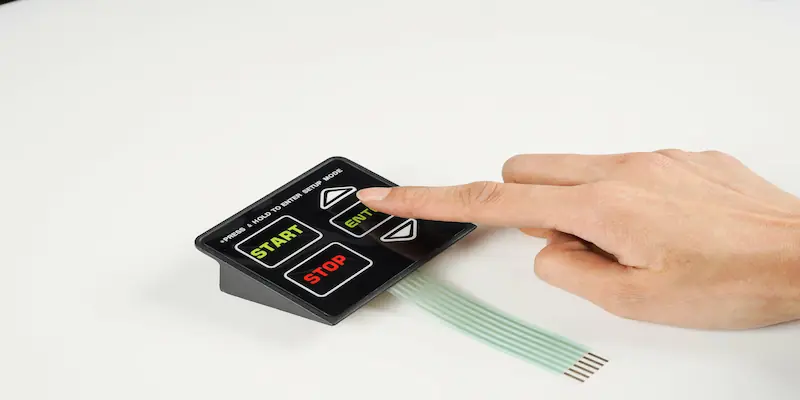
Pick metal dome force by matching three values to your application: actuation force (180–400 gf), required cycle life (300K–5M cycles), and operator press frequency. Medical keypads typically land at 220–280 gf with 1M cycle ratings under IEC 60601-1-6 usability; industrial numeric pads at 200–250 gf with 1M cycles; automotive HMIs at 250–300 gf under IATF 16949.
- 1. Why Force Is the Single Biggest Dome-Spec Decision
- 2. Four Force Terms Engineers Confuse: Actuation, Snap, Release, Tactile Ratio
- 3. Standard Metal Dome Force Tiers — 180g, 220g, 250g, 300g, 350g, 400g
- 4. Eight Criteria for Selecting Metal Dome Force
- 5. Metal Dome Force by Application: Medical, Industrial, Automotive
- 5.1 Medical device keypad
- 5.2 Industrial numeric pad
- 5.3 Automotive HMI
- 6. The Force × Cycle-Life Trade-off
- 7. Procurement Checklist
- 9. Vendor Shortlist — Snaptron, E2IP, LID, JASPER
- 10. Disclosure
1. Why Force Is the Single Biggest Dome-Spec Decision
Metal dome force decides three outcomes on a tactile membrane switch. Whether the press registers. How the keypad feels after 50,000 presses. The warranty-return rate six months out. Diameter errors give slightly different sizes that still work. Force errors are different — missed presses, finger fatigue, accidental triggers — and those failure modes surface as field returns long after the production batch closes.
Same OEM, same housing: swap a 250 gf dome for a 350 gf dome and the field-failure pattern flips. At 250 gf the complaints come in as “ghost presses” from shirt cuffs. At 350 gf they flip to “missed presses” from operators in nitrile exam gloves. Neither is a manufacturing defect. Both are force-selection mistakes baked in at design review. Metal dome force selection depends on eight criteria, six standard force tiers, and three application templates for revision-1.
2. Four Force Terms Engineers Confuse: Actuation, Snap, Release, Tactile Ratio
Pull up any dome datasheet — Snaptron, E2IP Technologies, LID — and you’ll see four force numbers attached to the same part. Engineers cite the wrong one in design reviews more often than anyone admits.
- Actuation force (Fa) — press force at which the dome closes the electrical contact underneath. The host firmware reads this as “pressed.” Snaptron, E2IP Technologies, and most catalog vendors headline this value.
- Snap force (Fs) — peak press force felt by the operator just before the dome inverts. On stainless-steel domes, Fs runs 1.4–1.8× Fa. This is the “click.”
- Release force (Fr) — force the dome pushes back to return to open state. Usually 30–50% of Fa. Too low feels mushy; too high feels springy.
- Tactile ratio — click sharpness, (Fs − Fa) / Fs × 100. Industry standard 0.55–0.70. Below 0.45 the click feels dead; above 0.75 it feels harsh and shortens life.
A datasheet headline reading “220 gf dome” means actuation force. Snap force runs closer to 340 gf; release force around 90 gf. None of the three numbers, on their own, predicts how the dome performs across a million cycles. The force-displacement curve does.
3. Standard Metal Dome Force Tiers — 180g, 220g, 250g, 300g, 350g, 400g
Six standard tiers anchor the metal-dome market between 180 and 400 grams. Drop below 180 gf and you’re really in polydome territory — printed silver dot, 50–200 gf range. Push above 400 gf and operators can no longer press reliably with one fingertip.
| Tier | Actuation Force | Snap Force (typical) | Standard Cycle Life | Best Fit | Operator Press Strength Used |
|---|---|---|---|---|---|
| Soft | 180 gf | ~280 gf | 1M (4-leg) | Compact handheld, low-frequency consumer | ~50% of 350 gf finger average |
| Light | 220 gf | ~340 gf | 1M (4-leg) | Industrial numeric pad, high-frequency keys | ~63% of 350 gf finger average |
| Standard | 250 gf | ~390 gf | 1M (4-leg) | Medical keypad with glove operation | ~71% of 350 gf finger average |
| Firm | 300 gf | ~470 gf | 2M (5-leg) | Mode-select, intentional-press keys | ~86% of 350 gf finger average |
| Heavy | 350 gf | ~540 gf | 2M (5-leg) | Safety-critical confirmation, E-stop | 100% of 350 gf finger average |
| Max | 400 gf | ~620 gf | 5M (5-leg, stacked) | Gloved heavy-industry, vibration-rich | 115% — requires deliberate two-finger or thumb press |
Between them, the 220 gf and 250 gf tiers cover about 70% of commercial membrane-switch builds. Snaptron’s GX series runs the widest catalog — 30 gf at the soft end up to 1,500 gf. LID/TactileMembrane publishes a tighter 150–350 gf range. JASPER Electronics keeps stock on all six tiers in 8, 10, 12, 14, and 16 mm diameters.
4. Eight Criteria for Selecting Metal Dome Force
The decision framework below weights eight criteria. Apply them in order — criteria 1 to 4 set the force tier; 5 to 8 tighten the spec and qualify the supplier.
| # | Criterion | Good signal | Red flag |
|---|---|---|---|
| 1 | Actuation force tier | Spec in 180–400 gf range, mapped to a specific use class | Vendor offers one force only; no application mapping |
| 2 | Required cycle life | Tested per IEC 60068-2-6 vibration + IEC 60068-2-1 cold cycle, 1M–5M at rated force | Cycle claim with no test method or sample size |
| 3 | Press frequency under workload | Force chosen so finger press ≈ ⅔ of operator’s natural strength | ≥ 300 gf specified for keys pressed > 100 times/shift |
| 4 | Operator demographics & gloves | Force accounts for ISO 9241-410 ergonomic ranges + glove press | Force tuned only to median male-adult press strength |
| 5 | Temperature & sealing | −40 to +85 °C with snap-force drift ≤ 10% | No temperature data on datasheet |
| 6 | Tactile ratio & audible click | Tactile ratio 0.55–0.70; click level 40–55 dB at 30 cm | Click described only as “crisp” or “premium” |
| 7 | Force tolerance & lot consistency | ±15% or tighter, 100% incoming inspection on force-displacement gauge | No tolerance value; “approximate” force |
| 8 | Cost-per-key & supply continuity | Catalog dome from ≥ 2 sources; lead time < 8 weeks | Custom-only dome locked to one supplier; lead time > 16 weeks |
Criterion 1 — Actuation force tier. Six standard tiers (§3). Off-tier values like 235 gf force custom tooling and 12-week lead times. Spec the nearest standard tier on revision-1; tighten only if first-article testing argues for it.
Criterion 2 — Required cycle life. Presses/shift × shifts/year × years. A bench instrument at 200 × 250 × 10 = 500K lifetime presses — inside a 1M cycle 4-leg rating. A handheld at 1,000 × 2 × 5 hits 3.6M, requiring a 5M cycle 5-leg dome.
Criterion 3 — Press frequency. Adult fingertip strength averages 350 gf with wide spread by hand size, gender, fatigue. A 220 gf dome at two-thirds of that feels almost effortless. A 350 gf dome under repeat use produces measurable fatigue inside 30 minutes, per ANSI/HFES 100.
Criterion 4 — Operator demographics & gloves. Nitrile gloves cut press accuracy 8–12%; thick winter or chemical-resistant gloves up to 25%. For glove operation, drop a force tier or step diameter up to 12 or 14 mm.
Criterion 5 — Temperature & sealing. Stainless-steel domes lose 3–7% snap force at −40 °C, gain 2–4% at +85 °C. IP65/IP67 builds per IEC 60529 add overlay tension that shifts actuation force upward by 5–15 gf. Spec at room temperature; verify drift across operating range.
Criterion 6 — Tactile ratio & audible click. Below 0.55 the press feels mushy. Above 0.70, the sharp force-back transition produces fatigue. Click level 40–55 dB at 30 cm is detectable in normal industrial noise without disturbing nearby operators.
Criterion 7 — Force tolerance & lot consistency. ±15% on 250 gf means 212–288 gf lot-to-lot. Tighter ±10% requires sampled incoming inspection on a force-displacement gauge — Mark-10, Imada, and Snaptron-recommended fixtures are standard. Without lot consistency, the same press feels different week to week.
Criterion 8 — Cost-per-key & supply continuity. Catalog parts (Snaptron GX, LID published series, E2IP standard parts) price $0.04–$0.18 per dome at MOQ 1,000. Custom domes cost 2–5× more and lock the BOM to one supplier. For ≥ 10,000-unit annual builds, catalog tooling wins on cost and supply risk.
5. Metal Dome Force by Application: Medical, Industrial, Automotive
5.1 Medical device keypad
Medical OEMs spec dome force under IEC 60601-1-6 (usability) and IEC 62366-1 (usability application). The dominant tier is 220–280 gf with tactile ratio 0.60–0.65 — clinicians confirm a press by feel, often without looking. Glove type sets the choice within that band: surgical gloves at 220 gf, nitrile exam gloves at 250 gf, thick reusable gloves at 280 gf. Cycle-life targets run 500K–2M by device type. Patient monitors and infusion pumps from Baxter, Medtronic, and Smiths Medical have settled into this 220–280 gf band over multiple product generations.
5.2 Industrial numeric pad
Bench instruments under IEC 61010-1 run 200–250 gf 4-leg domes at 1M cycle life. Press frequency is high — 50 to 300 per shift on numeric keys — so force sits at the low end of operator comfort. A common production spec: 220 gf actuation, 12.2 mm diameter, 4-leg, ±15% lot tolerance, tested per IEC 60068-2-6 for vibration. Process-control OEMs add UL 746C polymer ratings on the substrate for fire safety. Mode-select and start/stop keys on the same panel step to 300 gf so operators tell them apart by feel.
5.3 Automotive HMI
Tier-1 and Tier-2 automotive suppliers work under IATF 16949 with PPAP deliverables for every dome-force change. Cabin HMI buttons run 250–300 gf at 2M cycle life, conditioned per IEC 60068-2-27 for mechanical shock. Steering-wheel switches push to 300–350 gf — they have to resist accidental press through driving gloves and during hard cornering. Temperature qualification covers −40 °C to +85 °C across a 1,000-cycle thermal-shock profile, IEC 60068-2-14. Snap-force drift must stay inside ±10%. Failures here are the most common reason an automotive dome supplier loses PPAP on first attempt.
6. The Force × Cycle-Life Trade-off
The two specs are linked, and the link bites. Hold diameter and material thickness fixed, push actuation force up, and cycle life drops along a roughly logarithmic curve. A 4-leg stainless-steel dome at 220 gf delivers 1M cycles. At 350 gf, 500K–700K. At 400 gf it crashes below 300K unless the dome moves to 5-leg geometry or stacked construction. Snaptron publishes up to 10M cycles on selected GX/SQ 5-leg parts; LID lists 5M cycles on 16 mm 5-leg domes at 350 gf. When a build needs both ≥ 300 gf and ≥ 2M cycles, 5-leg geometry is required, at ~1.4× the per-dome cost of 4-leg. Record the force-displacement curve at cycle 1 and again at cycle 1,000,000; drift shows up directly. Most production specs allow up to 10–15% snap-force reduction across rated life.
7. Procurement Checklist
Attach this to every RFQ for metal-dome membrane switches. A vendor unable to answer items 1–7 on a first call should be eliminated before the RFQ goes out.
- Actuation force value (gf) and tolerance (±%).
- Snap force and release force values from the force-displacement curve.
- Tactile ratio target — e.g. 0.60.
- Dome diameter (mm) and leg count (3 / 4 / 5).
- Material and plating — stainless steel + gold contact is standard.
- Cycle life rating with test method (IEC 60068-2-6 or vendor’s documented procedure).
- Operating temperature range and snap-force drift across it.
- Lot tolerance and incoming inspection sample size — typically 30 pcs/lot on a force-displacement gauge.
- Mixed-force layout map if the panel has multiple zones (numeric / nav / mode-select / E-stop).
- Catalog part number or custom part number with tooling lead time.
8. Frequently Asked Questions
8.1 What metal dome force should I choose for a medical device keypad?
For most medical keypads, choose 220–280 gf actuation force, 4-leg metal dome, 10–12 mm diameter, 1M cycle life. Bare-finger use lands at 220 gf; nitrile gloves at 250 gf; thick reusable gloves at 280 gf. Spec under IEC 60601-1-6 usability and verify tactile ratio 0.60–0.65 so clinicians confirm presses by feel.
8.2 What’s the difference between 180g, 250g, and 400g metal domes?
A 180 gf dome registers at half the average adult finger strength — suited to low-frequency consumer remotes with soft click. A 250 gf dome registers at ~70% of finger strength and is the medical/industrial standard, balancing comfort against accidental press. A 400 gf dome requires near-full or deliberate thumb press; it fits gloved heavy-industry or vibration-rich environments and uses 5-leg geometry to keep cycle life above 1M.
8.3 How does dome force affect cycle life on a membrane switch?
Cycle life drops as force rises at fixed geometry. A 4-leg stainless-steel dome at 220 gf rates 1M cycles; at 350 gf it falls to 500K–700K; at 400 gf it drops below 300K. Upgrading to 5-leg geometry restores life — 5-leg domes deliver 2M–5M cycles at the same forces, with Snaptron publishing up to 10M on selected parts.
8.4 Can I mix metal dome forces in one keypad?
Yes — mixed-force layouts are common on HMI bezels. Numeric keys take 220 gf for comfort; navigation keys step up to 250 gf for tactile differentiation; mode-select at 300 gf signals intentional press; E-stop or safety keys at 350–400 gf resist accidental brushing. The drawing labels each key, the BOM maps labels to dome part numbers, and assembly picks from a multi-bin tray.
8.5 How is metal dome force verified at incoming inspection?
Sample-test 30 domes per lot on a force-displacement gauge (Mark-10, Imada, or vendor-supplied fixture). Record actuation force, snap force, and dome travel. The lot accepts when all 30 fall inside the rated value ±15%. At final 100% functional test, each key is pressed by an automated head recording actuation force, press-to-detect time, and contact resistance.
8.6 What’s the difference between snap force and actuation force?
Snap force is the peak press force the operator feels at the moment the dome inverts — the “click.” Actuation force is the press force at which the dome closes the electrical contact, which is what the host firmware reads. Snap force runs 1.4–1.8× actuation force on most stainless-steel domes. Datasheets headline actuation force; operators feel snap force.
9. Vendor Shortlist — Snaptron, E2IP, LID, JASPER
Four vendors worth shortlisting for North American and Western European OEMs:
- Snaptron Inc. (Windsor, Colorado, USA) — largest published standard dome catalog; GX, SQ, and PNP series; documented mechanical life up to 10M cycles on selected parts.
- E2IP Technologies (Saint-Laurent, Quebec, Canada) — aerospace and defense pedigree; specialist in dome customisation including force concentrators, controlled over-travel, and selective plating.
- LID CO., LIMITED / TactileMembrane (Hong Kong / China) — mixed-force production layouts; named OEM clients include Carrier Fire & Security, Continental, ABB, Honeywell, and Schneider Electric.
- JASPER Electronics (Shenzhen, China) — selection-framework support with 100% per-key functional test on the OQC report; stock on the six standard force tiers from 180 to 400 gf.
A revision-1 shortlist pulls two of these in parallel and benchmarks dome-force consistency over the first 250 units.
10. Disclosure
Disclosure: JASPER Electronics authored the technical reference as a membrane-switch and metal-dome keypad manufacturer in Shenzhen. JASPER is listed alongside Snaptron, E2IP Technologies, and LID as one of four vendors readers can compare during sourcing.
Ready to Start Your Project?
Tell us about your membrane switch, keypad, or graphic overlay requirements. Our engineering team will review your specifications and provide a detailed quote.