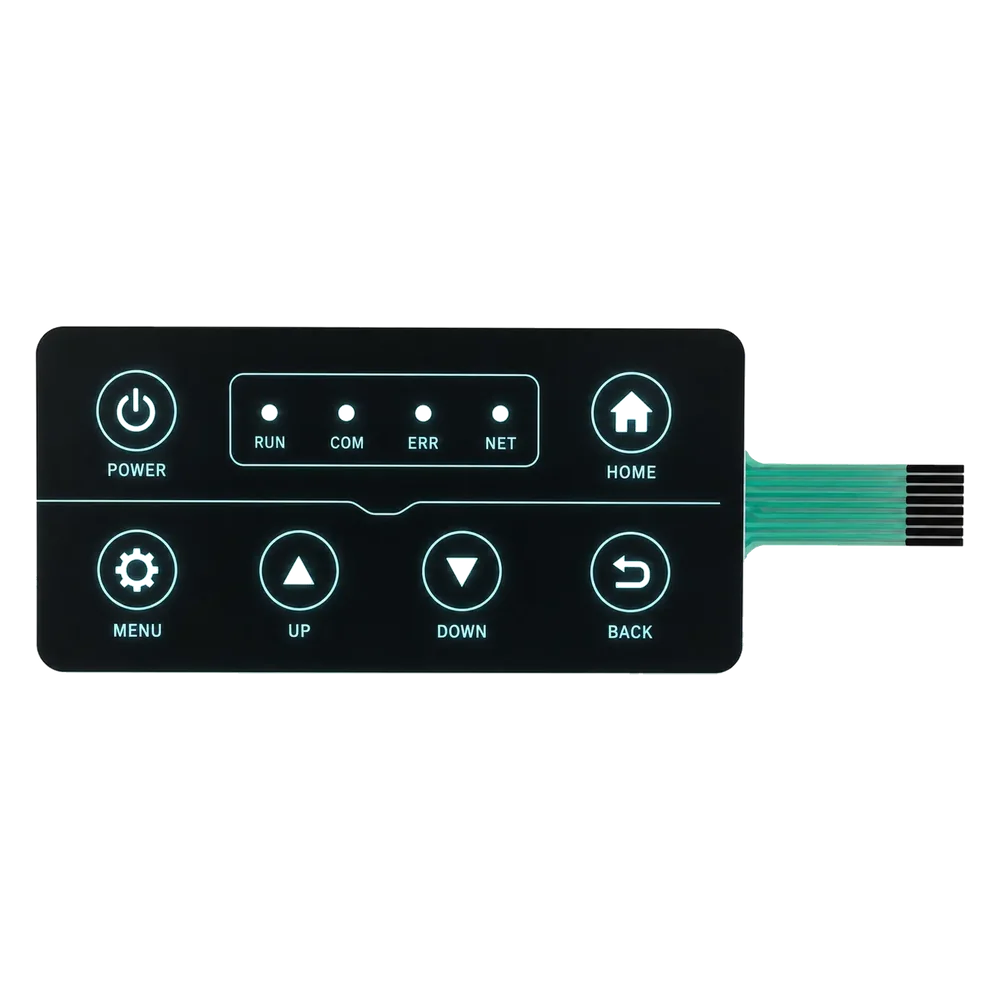
For status feedback alone—power LEDs, error alerts, key-press confirmation—discrete LED indicators cost 60–80% less per switch and draw under 20 mA total. For full-keypad visibility in darkness, such as medical devices governed by IEC 60601 or industrial panels used on night shifts, area-wide backlighting with a light guide film (LGF) delivers uniform illumination that indicators cannot match. The decision matrix in §6 maps seven common project profiles to the right choice.
- 1. Quick Verdict — At a Glance
- 2. Side-by-Side Specifications
- 3. Where LED Indicators Win
- 3.1 Lowest-Cost Status Feedback
- 3.2 Minimal Power Draw for Battery Devices
- 3.3 Simpler Assembly, Fewer Failure Points
- 4. Where Full Backlighting Wins
- 4.1 Uniform Visibility for Medical Devices
- 4.2 Premium Aesthetics for Consumer and Appliance Panels
- 4.3 Safety-Critical Night Operation
- 5. The Third Option: EL Backlighting
- 6. Decision Matrix — Which Should You Pick?
- 8. Methodology and Disclosure
1. Quick Verdict — At a Glance
| Dimension | LED Indicators win | Full Backlighting wins | Tie |
|---|---|---|---|
| Brightness uniformity | ✓ | ||
| Cost per key (at 10K units) | ✓ | ||
| Power consumption | ✓ | ||
| Lifespan (LED-based options) | ✓ | ||
| Assembly complexity | ✓ | ||
| Thermal profile | ✓ | ||
| Design flexibility | ✓ |
LED indicators take four of seven dimensions on cost and simplicity. Full backlighting wins on visual quality and design freedom. Lifespan ties when both use LED sources rated at 50,000–100,000 hours (JCF Technology, 2024 catalog).
2. Side-by-Side Specifications
The specifications draw on published catalog data from Butler Technologies (PA, USA), JCF Technology (Shenzhen, China), and IPC-2221B design guidelines for PCB-mounted LEDs.
| Specification | LED Indicators | Full Backlighting (LGF + LED array) |
|---|---|---|
| Brightness | 50–800 mcd per LED (point source) | 20–500 cd/m² (area luminance) |
| Power draw (typical 12-key panel) | 10–40 mW | 80–300 mW |
| Lifespan | 50,000–100,000 hrs | 50,000–100,000 hrs (LED+LGF); 3,000–10,000 hrs (EL) |
| Added thickness | 0.3–0.8 mm (SMD LED on flex) | 0.8–1.5 mm (LGF + diffuser + spacer) |
| BOM cost adder per unit (10K vol.) | $0.15–$0.60 | $1.50–$4.00 |
| Operating temperature | −40 °C to +85 °C | −40 °C to +80 °C |
| Color options | Single or bi-color per position | Full RGB; white; tunable via LED selection |
Three differences matter most to OEM design engineers selecting between these options for a new membrane keypad project:
Cost gap. At 10,000-unit annual volumes, adding six discrete indicator LEDs costs roughly $0.40 per switch assembly. Achieving uniform backlighting across the same six keys with an LGF panel adds $2.50–$3.50—a 6–8× multiplier. That gap narrows at 100K+ volumes because LGF tooling amortizes, but it never closes entirely.
Thickness budget. Indicators sit within the existing circuit layer, adding only the LED component height (0.3–0.8 mm depending on SMD package). Full backlighting inserts an LGF sheet, a diffuser layer, and often a reflective spacer, totaling 0.8–1.5 mm. For handheld devices where every tenth of a millimeter counts, this difference drives the decision.
Power envelope. A 12-key panel with six indicator LEDs (20 mA forward current, 2.1 V typical red) draws roughly 25 mW. The same panel with full LGF backlighting using a 12-LED array at matched brightness draws 150–250 mW. Battery-operated devices with a 500 mAh cell lose 3–5% runtime per hour of continuous backlight use.
3. Where LED Indicators Win
Discrete LED indicators remain the default choice for membrane switches where the lighting requirement is functional rather than aesthetic. Three scenarios illustrate why.
3.1 Lowest-Cost Status Feedback
Industrial control panels—think HVAC controllers, pump stations, CNC machine interfaces—need a green “power on” LED and a red “fault” LED. Nothing more. A single 0603-package SMD LED costs $0.02–$0.05 at volume (Digi-Key, 2025 pricing). The total lighting BOM for a 4-indicator panel stays under $0.30. No light guide, no diffuser, no inverter. For products shipping 50,000+ units annually, that saving compounds into six figures over a product lifecycle.
3.2 Minimal Power Draw for Battery Devices
Handheld gas detectors, portable medical monitors, and field-service test equipment run on coin cells or small Li-Po packs. IPC-2221B recommends keeping total LED current under 25 mA for battery-powered membrane circuits. A single indicator LED at 10 mA draws 21 mW (at 2.1 V forward). Four indicators cycling at 25% duty consume under 20 mW average—negligible against a 1,000 mAh battery budget.
3.3 Simpler Assembly, Fewer Failure Points
Each additional layer in a membrane switch stack-up introduces a potential delamination interface. LED indicators mount directly to the flex circuit (silver-ink printed or copper-flex PCB) with no extra optical layers. The assembly step count drops by 3–4 operations compared to LGF integration. For manufacturers targeting IPC Class 2 reliability, fewer layers mean fewer inspection points and higher first-pass yield.
4. Where Full Backlighting Wins
When the entire keypad surface must be readable in darkness—not just individual status icons—full backlighting is the only viable path. Three application categories demonstrate this.
4.1 Uniform Visibility for Medical Devices
Operating-room equipment governed by IEC 60601-1-6 (usability) requires that every key label remain legible at 5 lux ambient or below. Point-source indicators create bright spots surrounded by dark zones; clinicians cannot read adjacent key legends. An LGF panel distributes light from edge-mounted LEDs across the full overlay area, achieving ≥80 cd/m² uniformity ratio (min/max luminance ≥0.7). Philips Healthcare and GE HealthCare specify this uniformity threshold in their supplier design guides.
4.2 Premium Aesthetics for Consumer and Appliance Panels
High-end kitchen appliances (Miele, BSH Group), home automation panels, and automotive HVAC controls use full backlighting to signal product quality. The visual effect—a soft, even glow behind silk-screened graphics—cannot be replicated with point-source LEDs regardless of diffuser tricks. RGB LED arrays behind an LGF enable color-temperature tuning (2700 K warm white for residential, 6500 K cool white for commercial), adding a design dimension that indicators lack entirely.
4.3 Safety-Critical Night Operation
Offshore drilling consoles, aircraft ground-support equipment, and military C4I panels operate in near-total darkness. MIL-STD-3009 (formerly MIL-L-85762A) specifies NVIS-compatible backlighting with controlled spectral output. Full backlighting with filtered LGF meets NVIS Type A or B requirements. Discrete indicators cannot achieve the required area coverage or spectral filtering without adding a secondary light-management layer—at which point the cost advantage disappears.
5. The Third Option: EL Backlighting
Electroluminescent (EL) panels deserve mention as a legacy alternative to LGF-based LED backlighting. EL uses a phosphor layer excited by AC voltage (typically 100–400 Hz via a DC-AC inverter) to produce uniform area illumination at 0.5–0.7 mm thickness—thinner than most LGF assemblies.
The trade-off is lifespan. EL panels degrade to 50% initial brightness within 3,000–10,000 hours depending on drive frequency (Butler Technologies, 2025). At 8 hours/day operation, that equals 1–3.5 years before replacement. LGF + LED systems maintain >70% brightness past 50,000 hours (17+ years at the same duty). EL also requires an inverter circuit that adds $0.80–$1.50 to BOM and generates audible noise above 200 Hz in quiet environments.
EL remains viable for short-lifecycle consumer products (2–3 year replacement cycle) where its thin profile and low per-unit cost ($0.80–$1.20 for a 50 × 80 mm panel) outweigh longevity concerns. For medical, industrial, or automotive applications with 7–15 year service life expectations, LGF + LED has largely replaced EL since 2018.
6. Decision Matrix — Which Should You Pick?
| If your priority is … | Pick | Why |
|---|---|---|
| Status feedback only (power, fault, mode) | LED Indicators | 80% lower BOM; simplest assembly |
| Full-keypad night readability (medical) | Full Backlighting (LGF) | IEC 60601 uniformity; clinician safety |
| Battery life >8 hrs continuous | LED Indicators | 10× lower power draw |
| Premium appliance aesthetics | Full Backlighting (LGF) | Uniform glow; RGB color tuning |
| MIL-STD-3009 NVIS compliance | Full Backlighting (filtered LGF) | Spectral control across full area |
| Thinnest possible stack-up (<1 mm) | LED Indicators | 0.3–0.8 mm vs 0.8–1.5 mm |
| Short-lifecycle consumer (<3 yrs), uniform glow | EL Backlighting | Thinnest; lowest unit cost for area light |
When neither option fits cleanly—for example, a panel needing both per-key status colors and full-area night illumination—hybrid designs combine discrete RGB indicators for active feedback with a white LGF underlayer for passive legend lighting. This adds $1.00–$2.00 per unit over LGF-only but eliminates the need to choose.
7. Frequently Asked Questions
Should I use LED indicators or full backlighting in a membrane keypad?
Use LED indicators when you need only status feedback (on/off, error, mode) and want to minimize cost and power. Choose full backlighting when every key legend must be readable in darkness, such as medical or military panels operating below 5 lux ambient.
What is the cost difference between LED indicators and EL backlighting in membrane switches?
At 10,000-unit volumes, LED indicators add $0.15–$0.60 per switch. EL backlighting adds $0.80–$1.20 for the panel plus $0.80–$1.50 for the inverter, totaling $1.60–$2.70. LGF + LED full backlighting falls between $1.50–$4.00 depending on panel size and LED count.
Which lighting option is best for low-light medical device keypads?
Full backlighting using an LGF + LED array meets IEC 60601-1-6 usability requirements for uniform legend readability below 5 lux. EL is acceptable for short-lifecycle devices. LED indicators alone fail the uniformity requirement because they illuminate only discrete points, leaving key legends unreadable.
How long do LED indicators last in a membrane switch?
SMD LEDs rated for membrane switch applications typically last 50,000–100,000 hours at recommended forward current (10–20 mA). At 8 hours/day, that equals 17–34 years—well beyond the service life of most industrial equipment.
Can I combine LED indicators with full backlighting in one membrane switch?
Yes. Hybrid designs use a white LGF layer for passive legend illumination plus discrete RGB LEDs for active per-key status feedback. This adds approximately $1.00–$2.00 per unit over a standard LGF assembly but provides both functions without compromise.
Does full backlighting increase membrane switch thickness significantly?
An LGF + diffuser + spacer assembly adds 0.8–1.5 mm to the total stack-up. For comparison, a standard non-backlit membrane switch measures 0.5–1.0 mm. The combined thickness (1.3–2.5 mm) fits most enclosure designs but may require adjustment in ultra-thin handheld housings.
What power supply do I need for a backlit membrane keypad?
LED indicators run on 3.3 V or 5 V DC directly from the host PCB. LGF + LED backlighting typically requires 12 V DC at 50–150 mA. EL backlighting requires a DC-to-AC inverter outputting 100–200 VAC at 400–1000 Hz, adding circuit complexity.
Are backlit membrane switches suitable for outdoor use?
Both LED indicators and LGF backlighting operate from −40 °C to +80 °C (IPC-2221B rated). For direct-sunlight readability, high-intensity LED indicators (>500 mcd) outperform area backlighting because point sources maintain contrast against ambient light. Full backlighting is primarily beneficial for low-light or indoor environments.
8. Methodology and Disclosure
Methodology. Specifications were compiled from published product catalogs (Butler Technologies, JCF Technology, Telamco), IPC-2221B design guidelines, and IEC 60601-1-6 usability standards. Cost estimates reflect 2025 industry pricing at 10,000-unit annual volumes. Lifespan figures use manufacturer-rated L70 values.
Disclosure. This comparison was published by JASPER Electronics (jasperele.com), a membrane switch manufacturer offering both LED indicator and full backlighting options. No ranking or verdict was influenced by this affiliation.
Ready to Start Your Project?
Tell us about your membrane switch, keypad, or graphic overlay requirements. Our engineering team will review your specifications and provide a detailed quote.