
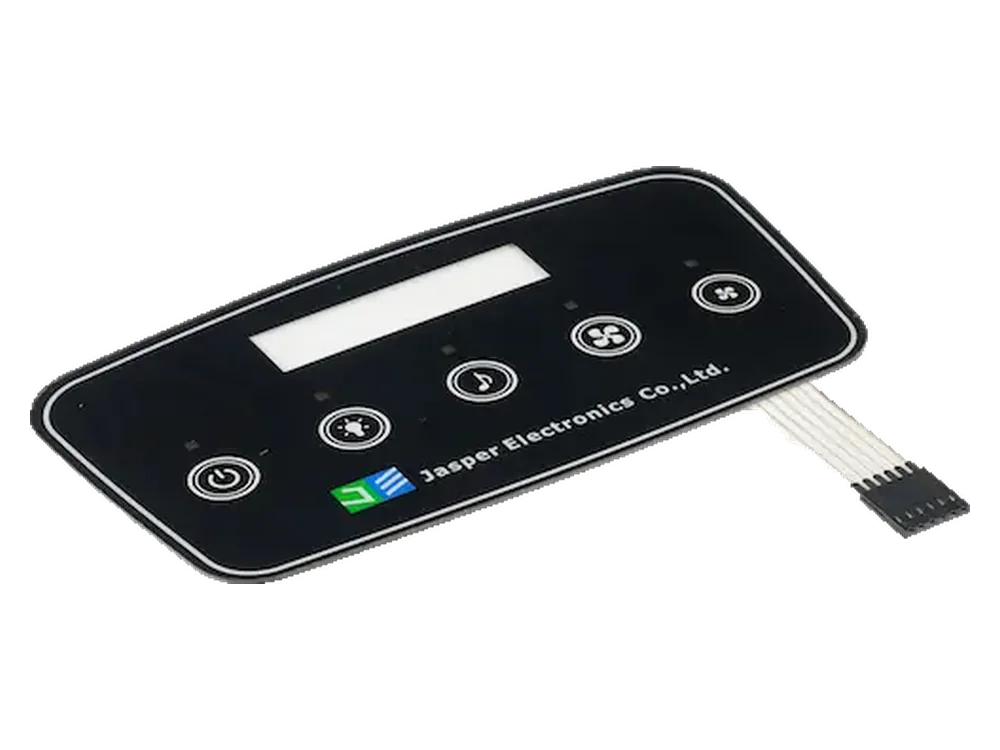
PCAP capacitive touch wins on aesthetics, mechanical lifetime, and multi-touch UX. Membrane switches still win on gloved-hand operation, EMC noise immunity, low-NRE prototyping economics, and safety-critical tactile feedback. For runs under 25,000 units in industrial settings, membrane is usually the right call; for premium consumer products with glass fronts, PCAP wins almost every time. The §5 decision matrix below maps eight common application archetypes to the technology that fits.
- 1. Quick Verdict — At a Glance
- 2. Side-by-Side Specifications
- 3. Where Capacitive Touch (PCAP) Wins
- 3.1 Premium aesthetic on glass and curved surfaces
- 3.2 Solid-state lifetime with no mechanical wear
- 3.3 Multi-touch, sliders, gestures
- 3.4 Hygienic, sterilizable wipe-down
- 4. Where Membrane Switch Still Wins
- 4.1 Gloved hands and wet fingers
- 4.2 EMI-noisy and wet-runoff environments
- 4.3 Low-NRE and small-batch economics
- 4.4 Mandatory tactile confirmation in safety-critical inputs
- 5. Decision Matrix — Which Should You Pick
- 7. Methodology and Disclosure
1. Quick Verdict — At a Glance
The argument over capacitive touch switch vs membrane switch is rarely won on a single dimension. Eight criteria decide it, and each technology owns four of them. Eight criteria shape the short answer and the comparison basis.
| Dimension | PCAP / Capacitive | Membrane | Tie |
|---|---|---|---|
| Aesthetics on glass or curved surfaces | ✓ | ||
| Per-unit cost at under-25K volume | ✓ | ||
| Gloved-hand operation | ✓ | ||
| Lifecycle under continuous public use | ✓ | ||
| Resistance to ghost touches from EMI or water runoff | ✓ | ||
| Multi-touch and gesture support | ✓ | ||
| Tooling NRE for first article | ✓ | ||
| Sterilizable wipe-down hygiene | ✓ |
Tied four-to-four on dimensions, but the right answer almost never weights them equally — application context decides which four matter for a given product.
2. Side-by-Side Specifications
Fourteen parameters come up in nearly every membrane-versus-PCAP RFQ. Ranges reflect North American and Western European HMI supplier datasheets, controller-vendor reference designs (Microchip, Infineon, Cypress / Renesas, Azoteq), and 2025–2026 RFQ responses across the 1K–25K-unit band. Standards references (IEC, UL, ISO) are cited inline where each row’s value is bounded by a published test method.
| Spec | PCAP (Projected Capacitive) | Membrane Switch |
|---|---|---|
| Actuation principle | Field-coupling capacitance change | Mechanical contact closure (polyester or metal dome) |
| Mechanical lifetime | Solid-state — no mechanical wear limit | 1 M to 10 M actuations (IEC 60947-5-1 reference) |
| Activation force | 0 g (proximity sensing) to ~25 g through cover glass | 100 g to 400 g (typical 150 g–250 g for snap dome) |
| Tactile feedback | None natively — requires haptic motor add-on | Yes — snap dome, 2 mm to 5 mm key travel |
| Cover material | Tempered glass, PMMA, polycarbonate | PET or PC graphic overlay (UL 969) |
| Stack thickness | 1.5 mm to 6 mm including cover glass | 0.8 mm to 2.5 mm total |
| Gloved-hand operation | Requires firmware tuning and thicker overlay | Native — works through any glove |
| Wet-finger or runoff behavior | Risk of ghost touches without filtering | Indifferent — pressure-based |
| EMC immunity | Sensitive to RF and ESD without shielding (IEC 61000-4-2 / -3) | Inherently immune — no active controller |
| Ingress protection achievable | IP67 with glass + gasket; IP69K possible | IP65 to IP67 standard; IP69K available |
| Operating temperature | -20 °C to +70 °C (controller-limited) | -40 °C to +85 °C (IEC 60068-2-1 / -2 verified) |
| Backlighting options | Light guide film with RGB possible | LED, electroluminescent, fiber-optic, light guide film |
| NRE tooling (prototype + first article) | $5,000 to $25,000 | $1,500 to $8,000 |
| Unit cost at 1,000-piece run | $8 to $60 | $4 to $25 |
Three differences drive most procurement decisions. Lifetime: a sealed PCAP front has no mechanical part to fatigue, while a metal-dome membrane switch carries a published 1-million-to-10-million-actuation budget per IEC 60947-5-1 — fine for a microwave used 3,000 times a year, marginal for a public kiosk used 50,000 times a year. EMC behavior: PCAP is a small radio receiver and reacts to nearby switching transients, motor brush noise, and electrostatic discharge events that membrane simply ignores. Cost ramp: PCAP’s higher NRE pays back only after roughly 20,000–25,000 units in most stacks, because the controller IC, firmware tuning, and EMC re-test eat the per-unit savings until then.
3. Where Capacitive Touch (PCAP) Wins
PCAP outperforms membrane in four areas that map cleanly onto premium consumer, public-access, and modern automotive HMIs. Each is rooted in PCAP’s solid-state, field-coupling operating principle — not in marketing.
3.1 Premium aesthetic on glass and curved surfaces
A PCAP sensor sits behind tempered glass, polycarbonate, or a chemically strengthened cover lens with no visible bezel, gasket, or graphic-overlay border. Curved surfaces — automotive center consoles, oven door fronts, smart-thermostat dials — are addressable because the sensor electrodes are printed on a flexible substrate or laminated directly to the glass via OCA (optical clear adhesive). Membrane switch graphic overlays are flat or shallow-domed and cannot match the flush look that consumer reviewers and Red Dot-class industrial design juries now expect on appliances priced above roughly $500 retail.
3.2 Solid-state lifetime with no mechanical wear
A PCAP keypad has no moving part to fatigue. Metal-dome membrane assemblies are rated 1 million to 10 million actuations under the IEC 60947-5-1 cycle test, depending on dome stainless steel grade, embossing pattern, and operating temperature. A self-service kiosk in a transit station, a hospital nurse-call panel pressed 200 times per shift, or a fuel-pump payment terminal pressed by every driver in a 24-hour window will exhaust the membrane budget in two to four years. PCAP, by contrast, is limited only by the cover-lens scratch resistance and the controller’s MTBF — typically a decade-plus.
3.3 Multi-touch, sliders, gestures
Pinch-to-zoom, two-finger rotate, edge swipes, and continuous-value sliders are PCAP-only territory. Mutual-capacitance scanning resolves multiple simultaneous touch points; self-capacitance handles proximity and hover. Membrane switches register one closure per key — there is no UX path to multi-touch through a snap dome. For a smart-thermostat ring, a kitchen-appliance touch slider for hob temperature, or a wearable’s swipe-to-dismiss interaction, PCAP is the only available answer.
3.4 Hygienic, sterilizable wipe-down
A flush glass or polycarbonate front meets ISO 13485 cleaning protocols and NSF food-contact wipe-down requirements without crevices for fluid entrapment. Embossed membrane switches collect dust and pathogens at the dome rim — controllable with proper cleaning, but operationally inferior in clinical imaging suites, food-service equipment, and high-throughput diagnostic carts. PCAP is the default for IVD instrument fronts above the $20,000 ASP threshold for the same reason.
4. Where Membrane Switch Still Wins
The “membrane is dead, PCAP has won” narrative is wrong. Four scenarios still tilt decisively toward membrane in 2026, and each is anchored in physics, not nostalgia.
4.1 Gloved hands and wet fingers
A pressure-based membrane closes a circuit regardless of what is between the operator’s hand and the dome. Heavy nitrile, double-layer cleanroom gloves, surgical sterile gloves, ski gloves, mechanic’s gloves at -10 °C — all work natively. PCAP can be tuned for gloved operation by raising sensor sensitivity, thickening the overlay, and adjusting the firmware threshold, but the tuning narrows the dynamic range and increases false-positive rates from incidental palm or sleeve contact. For an industrial press’s bi-manual start, a CNC operator’s E-stop, or a phlebotomy cart accessed by a gloved nurse, membrane wins on plain reliability.
4.2 EMI-noisy and wet-runoff environments
PCAP is a low-power RF receiver. IEC 61000-4-2 ESD events at 8 kV contact / 15 kV air, IEC 61000-4-3 radiated RF up to 10 V/m, and IEC 61000-4-6 conducted disturbances couple into capacitive sensor traces and trigger ghost touches unless extensively shielded and firmware-filtered. Water runoff across a PCAP front during a washdown — common in food processing, dairy, and medical sterilization — looks like a swiping finger and triggers spurious inputs. Membrane is passive: no electrode, no controller, no susceptibility. A wash-down floor scrubber, an outdoor agricultural sprayer keypad, or a near-VFD industrial panel will run on membrane and misbehave on PCAP.
4.3 Low-NRE and small-batch economics
The capacitive touch switch vs membrane switch cost question pivots on volume. Membrane NRE — graphic overlay artwork, screen-print stencils, dome retainer dies — runs $1,500 to $8,000 for a typical six-key panel. PCAP NRE — sensor PCB layout, controller programming, EMC pre-compliance testing, firmware tuning — runs $5,000 to $25,000 before the first part ships. At 1,000-piece volumes the unit-cost delta is also against PCAP ($8–$60 vs $4–$25). Break-even between the two technologies, in most 2025–2026 RFQs that include EMC re-test, lands between 15,000 and 25,000 units. For a medical OEM running an initial 2K cardiology cart batch or an industrial start-up shipping its first 500 units, the membrane switch alternative is $3,000 to $5,000 cheaper in NRE and four weeks faster to first article.
4.4 Mandatory tactile confirmation in safety-critical inputs
A snap dome delivers an unambiguous mechanical click that an operator can feel without looking at the panel. For a CNC E-stop, a surgical-suite “Confirm” press, an aviation transponder code-set, or a defense vehicle weapon-arm switch, that tactile signature is part of the user-error mitigation, not a UX preference. IEC 60601-1-8 (alarm systems for medical electrical equipment) and human-factors guidance under ANSI/AAMI HE75 favor distinct tactile feedback for confirmation actions. PCAP haptics motors approximate the feeling but cannot match a dome’s failure-mode visibility — if the dome stops snapping, the operator knows immediately.
5. Decision Matrix — Which Should You Pick
Use the matrix below to short-circuit the long debate. Each row represents an application archetype seen repeatedly in North American and Western European OEM RFQs.
| If the priority is … | Pick |
|---|---|
| Premium consumer appliance with a glass front | PCAP capacitive |
| 24/7 unattended public kiosk or fare gate | PCAP capacitive |
| Industrial CNC, hydraulic press, or heavy machinery with gloves | Membrane |
| Surgical or dental cart needing sterilization plus tactile confirmation | Membrane |
| Outdoor handheld in wet, cold, or muddy field conditions | Membrane |
| Wearable or sleek IoT consumer product | PCAP capacitive |
| First production batch under 5,000 units with NRE-constrained budget | Membrane |
| Automotive infotainment and HVAC console | PCAP capacitive (often hybrid with membrane HVAC keys) |
Hybrid designs are a legitimate third path: a glass PCAP touch slider for menu navigation paired with two or three membrane-domed buttons for hazard, defrost, or volume mute. Premium automotive interiors from BMW, Mercedes, and Ford have shipped this exact pattern since 2022. The hybrid resolves the safety/aesthetic trade-off at the cost of a slightly more complex assembly.
6. Frequently Asked Questions
Should I switch from membrane switches to capacitive touch?
Switch only if the product hits at least two of these: glass front aesthetics, annual volume above 25,000 units, multi-touch or gesture UX, or 24/7 unattended public use. Stay on membrane if any of these apply: gloved operators, EMI-heavy environment, runs under 5,000 units per year, or tactile feedback is a safety requirement.
What is the typical lifetime difference between PCAP and membrane?
A metal-dome membrane switch is rated 1 million to 10 million actuations under IEC 60947-5-1 cycling, depending on dome material and operating temperature. PCAP keypads are solid-state with no documented mechanical wear limit — lifetime is bounded by cover-lens scratch resistance and controller MTBF, typically a decade or more in indoor service.
What’s the cost difference between PCAP touch and membrane keypads?
Membrane NRE runs $1,500 to $8,000 for a small panel; PCAP NRE runs $5,000 to $25,000 once controller programming and EMC pre-compliance are counted. Unit cost at a 1,000-piece run is $4–$25 for membrane vs $8–$60 for PCAP. Crossover usually happens between 15,000 and 25,000 annual units.
Where does a membrane switch still beat capacitive touch?
Four scenarios. First, gloved or wet-finger operation, where membrane is glove-agnostic. Second, EMI-noisy or washdown environments, where PCAP triggers ghost touches under IEC 61000-4-2 ESD events. Third, low-volume runs under 5,000 units, where NRE economics tilt toward membrane. Fourth, safety-critical tactile confirmation per IEC 60601-1-8 and ANSI/AAMI HE75 human-factors guidance.
Can capacitive sensors work through gloves?
Yes, with firmware tuning and a thicker overlay, but with caveats. Raising sensitivity widens false-positive rates from sleeve and palm contact; thick overlays reduce signal-to-noise on standard touches. Tuned glove-mode PCAP is acceptable for consumer outdoor wearables. It is not acceptable for industrial gloved-hand operation where a missed touch creates a safety event.
Which is better for medical devices?
Depends on the device. Imaging carts, IVD analyzers, and patient-monitor fronts trend PCAP for ISO 13485 cleanability and hygiene. Surgical-suite control panels, defibrillator confirmation pads, and any input where tactile certainty matters under glove typically trend membrane. Roughly 30%–40% of mid-sized medical OEMs ship hybrid HMIs: PCAP for menu navigation, membrane for critical confirmation keys.
What IP rating can each technology reach?
Both can reach IP67 per IEC 60529. PCAP achieves it through cover glass with a perimeter gasket; membrane achieves it through perimeter sealing of the polyester or polycarbonate overlay. For IP69K (high-pressure, high-temperature washdown), membrane has the simpler path because the sealing geometry is well-understood across the industry — washdown food-grade equipment defaults to membrane for that reason.
Is a hybrid HMI a viable middle path?
Yes — and increasingly common. Premium automotive consoles pair a PCAP touch slider for infotainment with membrane-domed hazard, defrost, and volume keys. High-end medical carts use PCAP for menu navigation and membrane for “Confirm” or “E-stop” inputs. The hybrid keeps the aesthetic and gesture wins of PCAP while preserving the tactile-feedback safety case of membrane for the actions that matter.
7. Methodology and Disclosure
Methodology: Spec ranges in §2 come from publicly available North American and Western European HMI supplier datasheets, controller-vendor reference designs (Azoteq, Microchip, Infineon, Renesas), and a 2025–2026 sample of OEM RFQ responses in the 1,000-to-25,000-unit band. Standards references (IEC 60529, IEC 60068-2, IEC 60947-5-1, IEC 61000-4-2, UL 969, ISO 13485, IEC 60601-1-8) were cross-checked against current published editions. Figures move with FX and raw material cycles — last verified 2026-05-22.
Disclosure: JASPER Electronics authored the technical reference as a custom membrane switch and PCAP touch keypad manufacturer for OEMs in medical, industrial, and consumer electronics. JASPER builds both technologies and calls the verdict honestly, including the four scenarios where capacitive touch beats membrane.
Ready to Start Your Project?
Tell us about your membrane switch, keypad, or graphic overlay requirements. Our engineering team will review your specifications and provide a detailed quote.


Related engineering paths
Continue with product specifications, supplier checks, or a project RFQ.