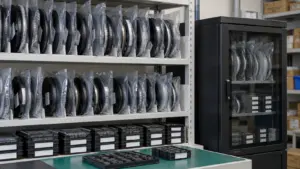
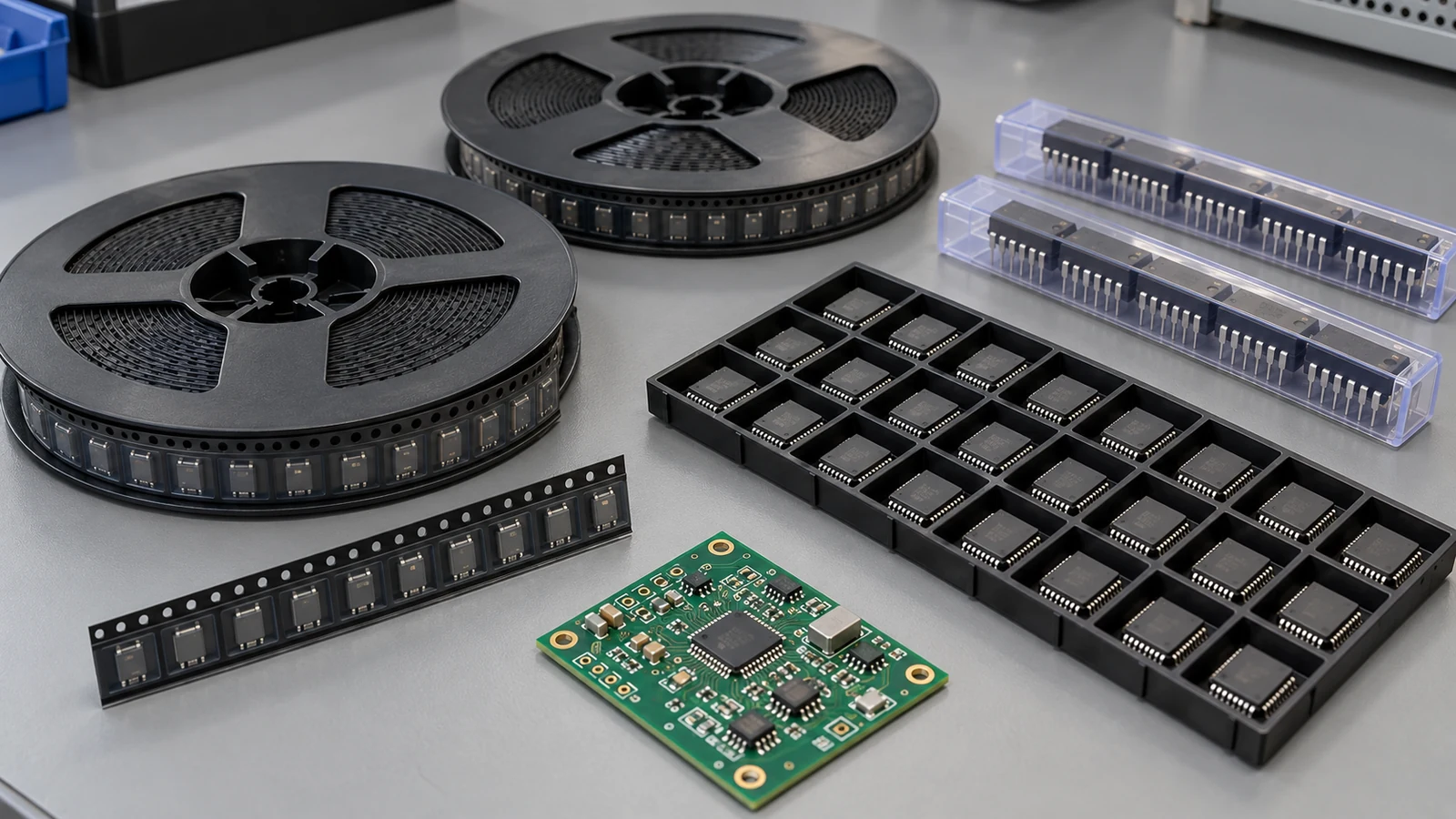
A consigned PCB assembly parts checklist connects each customer-supplied component to the released BOM, its physical container, verified quantity and acceptance status. Release the kit only when identities, usable quantities, packaging and moisture conditions support the scheduled build. Use a reference target of 100% of fitted consigned BOM lines reconciled, with zero unresolved identity or substitution holds for that build. Calculate extra parts by BOM line and feeding method. Keep shortages, receiving damage and actual assembly losses in separate records so every discrepancy has an owner.
- Why Incomplete Consigned Kits Delay Assembly
- Create a Consigned-Kit Manifest from the Released BOM
- Criterion 1: One released configuration
- Criterion 2: A manifest that reaches the container
- Label Part Numbers, Lots and Approved Substitutions
- Criterion 3: Exact identity and approved alternatives
- Criterion 4: Lot and date-code separation
- Check Packaging, Moisture Status and Physical Condition
- Criterion 5: Packaging matches the feeding method
- Criterion 6: Moisture status supports the production schedule
- Criterion 7: Physical and ESD condition is acceptable
- Reconcile Received Quantities and Planned Attrition
- Criterion 8: The counting method can support the receipt
- Criterion 9: Extra parts are justified by BOM line
- Resolve Shortages and Unidentified Parts Before Line Release
- Criterion 10: Exceptions have a documented closing decision
- Record Consumption, Losses and Returned Material
- Run a Six-Step Kit Review and Handoff
- Eight Conditions That Stop or Escalate Kit Release
- Prepare Your Consigned Kit for JASPER Review
Why Incomplete Consigned Kits Delay Assembly
An incomplete consigned kit delays assembly when the count is wrong, identity is unclear or handling history prevents use. Check usability before scheduling. A packing list records what the sender declared; production needs a verified balance of accepted components tied to the released build.
One missing bag can disrupt several operations. A feeder may need another setup, a moisture-sensitive pack may require controlled drying, and an unidentified component can stop a job already queued for placement. Preserve the receiving evidence. Without it, the teams must investigate whether an expedite covers a shipment shortage or a loss during setup.
Plan from accepted quantities. The OEM needs enough usable stock for each required part, allocated to a defined production lot. Receiving can acknowledge custody while keeping a suspect lot on hold; the warehouse receipt alone does not authorize production to use it.
Use the following ten criteria to review a kit in the order material moves from the released design into production. Each criterion pairs an acceptance signal with a reason to intervene.
Create a Consigned-Kit Manifest from the Released BOM
A consigned-kit manifest should translate the released bill of materials into a list of physical supplies for one build revision and quantity. Give each fitted BOM line a material source, required piece count and linked container records. Keep do-not-populate positions out of the fitted requirement.
Criterion 1: One released configuration
Identify the assembly number, revision, build quantity and applicable BOM release. Check that reference designators agree with the assembly drawing and component placement list. A BOM identifies the required components; a CPL supplies their position, rotation and board side. Those files have different jobs, as The referenced supplier’s BOM and CPL guidance explains.
Count the authorized assembly starts. For panelized boards, convert panels into populated assemblies before multiplying by pieces per assembly. Include separately authorized test builds or extra starts in the material plan. The finished-unit order quantity alone may not cover those additional starts.
Good signal: The kit header names a released revision and every fitted reference designator maps to one BOM line.
Red flag: A shipping spreadsheet uses an older revision or includes optional placements without a build decision.
Criterion 2: A manifest that reaches the container
Use a parent record for each BOM line and a child record for each reel, strip group, tray or tube. The parent holds the OEM part number, manufacturer, full manufacturer part number (MPN), reference designators, pieces per assembly and required quantity. Each child holds its container ID, lot/date code, shipped quantity, received quantity, packaging form and inspection status.
For example, one BOM line supplied on three partial reels needs three container records. Count each reel separately. Sum only accepted stock, retaining the individual records so a later recount or lot hold can be applied to the correct container. Mark assembler-purchased lines with their own supply source.
Good signal: Every physical container can be found from the BOM line, and every container points back to that line.
Red flag: One combined quantity covers several untraceable bags or material allocated to different jobs.
Label Part Numbers, Lots and Approved Substitutions
Label consigned parts with the OEM part number, full MPN, manufacturer, container ID, quantity and traceability information while preserving the original supplier label. A barcode should retrieve the same record as the human-readable text. A value or package description alone cannot establish identity.
Criterion 3: Exact identity and approved alternatives
Retain every ordering suffix. It can distinguish a package, grade, finish or shipping configuration. SN74LVC1G14DBVR is listed in a 3,000-piece large tape-and-reel configuration, while SN74LVC1G14DBVT is a 250-piece small tape-and-reel option. Both codes belong to the same device family, but the receiving record needs the delivered code and actual quantity, especially after a reel has been divided.
Compare the delivered code with the released BOM or approved alternative list. Add a job number and container ID without covering manufacturer information. For split containers, preserve the parent label image, link each new ID to the original lot and record its actual count. Keep that link readable after repacking.
Good signal: The delivered MPN is an exact match or has an engineering approval tied to the affected BOM revision and reference designators.
Red flag: A bag marked only with a resistance value or a handwritten device family is treated as interchangeable stock.
Criterion 4: Lot and date-code separation
Keep lot and date-code fields distinct. Interpret each code using the manufacturer’s coding system; a date code alone may cover more than one manufacturing lot. When several lots supply a BOM line, preserve the quantity of each lot. Do not merge their identities.
Mixed lots can be accepted when the order permits them and traceability survives. Record which lot entered each production batch, extending the link to board serials when the project requires it. Review older date codes against the order and documented storage conditions. Apply the actual acceptance policy.
Good signal: Split quantities retain their original lot identifiers and any required production-batch allocation.
Red flag: Two lots are poured into one container and replaced with a single new date label.
Check Packaging, Moisture Status and Physical Condition
Accept consigned packaging only when it protects the components, preserves identification and supports the intended loading method. Check moisture history independently of appearance: an undamaged reel can contain parts with an expired exposure window. The actual component instructions and chosen assembly process control the disposition.
Criterion 5: Packaging matches the feeding method
For full or partial reels, confirm tape width, component pitch, winding direction and feeder compatibility. For cut tape, check segment lengths and whether the agreed feeder or carrier can load them. Trays need suitable pockets, orientation and retention; tubes need the correct profile, end protection and an accepted loading method.
Equipment limits are specific. One Auto Loading Feeder specification lists 8 mm tape, feed-pitch settings of 2 mm and 4 mm, and a minimum loadable tape length of 400 mm. These values apply to that feeder; the last is a loading requirement, not a universal empty-leader length or spare-parts allowance. Have the assembler confirm the actual equipment configuration before shipping.
Good signal: The packaging record names a compatible loading method for every supplied form.
Red flag: Several short strips are declared equivalent to one continuous reel without a feeding review.
Criterion 6: Moisture status supports the production schedule
Record the moisture sensitivity level (MSL), bag seal date, first opening time and controlled-storage or drying history. Log each exposure interval. Keep the moisture barrier bag (MBB) intact until a planned inspection or loading operation; at opening, read the humidity indicator card (HIC) promptly and apply the device’s handling instructions.
The full MSL classification contains eight levels. This table summarizes general floor-life conditions; the actual part label and applicable process remain controlling.
| Classification | Floor life after opening | Ambient condition for this reference |
|---|---|---|
| MSL 1 | Unlimited for this moisture classification | At or below 30 °C and 85% RH |
| MSL 2 | 1 year | At or below 30 °C and 60% RH |
| MSL 2a | 4 weeks | At or below 30 °C and 60% RH |
| MSL 3 | 168 hours | At or below 30 °C and 60% RH |
| MSL 4 | 72 hours | At or below 30 °C and 60% RH |
| MSL 5 | 48 hours | At or below 30 °C and 60% RH |
| MSL 5a | 24 hours | At or below 30 °C and 60% RH |
| MSL 6 | Mandatory bake; reflow within the time on the label | Follow the labeled conditions and handling procedure |
MSL describes sensitivity. Use the assigned class. Keep the unopened-package shelf-life check separate from the floor-life calculation, and preserve earlier exposure when parts return to storage; closing a bag does not itself restart the clock.
Schedule the remaining exposure budget through the final relevant reflow, including any wait between board sides. Hold parts with unknown history. Before release, a process engineer must select and document the recovery route, checking component limits and carrier temperature capability. IPC/JEDEC J-STD-020 addresses moisture/reflow classification; J-STD-033 addresses handling. For QFN and SON packages, check these controls against package labeling and carrier limits. A blanket bake recipe cannot cover every reel, tray and component.
Good signal: The exposure record demonstrates enough remaining floor life for the planned process.
Red flag: An opened moisture-sensitive pack has no exposure history and is released because it looks dry.
Criterion 7: Physical and ESD condition is acceptable
Inspect protective packaging, accessible leads or balls, tape pockets, cover tape, tray retention and signs of contamination. Use an ESD-protected handling area for exposed sensitive parts. Record affected container IDs and photographs before repacking changes the evidence. Include dry-bag integrity and seal information in the receiving check.
Good signal: Inspection separates accepted stock from damaged or suspect material with a recorded quantity.
Red flag: Bent leads, torn dry bags or displaced parts are counted as usable without disposition.
Reconcile Received Quantities and Planned Attrition
Reconcile consigned quantities in pieces at BOM-line and container level, separating the packing-list declaration, verified receipt, held stock and usable balance. Determine build coverage from usable parts after agreed setup and process allowances. A shipping discrepancy and a production shortage are different findings.
Criterion 8: The counting method can support the receipt
Record the method, operator, date and result, plus the equipment or image reference when relevant. Check occupied pockets. An intact factory pack can be received against its label under an agreed plan, while a partially used reel needs a current quantity record linked to the remaining material.
| Counting approach | Suitable application | Evidence to retain | Limitation to resolve |
|---|---|---|---|
| Manual or visual count | Small quantities, trays, tubes and short strips | Occupied positions or piece tally, container ID and checker | Hidden layers and handling can create errors; independently check disputed counts |
| Optical reel counter | Compatible paper or embossed tape | Feed pitch, count result and empty-pocket handling | A pitch setting or pocket count alone may not establish actual occupied quantity |
| Qualified X-ray count | Compatible reels or protected packs | Saved result, container identity and approved counting recipe | Validate component recognition and package/device compatibility; investigate ambiguous images |
| Weight-based estimate | Preliminary screening of uniform material | Tare, unit-mass basis and stated estimate | Carrier variation and small mass differences can hide shortages; do not call an unqualified estimate a verified count |
The AXC-800 III provides an example of X-ray counting with barcode-linked results. Equipment availability does not remove the need to qualify the counting method. Avoid opening a sealed dry pack solely for an unplanned recount when an approved non-opening method can resolve the quantity.
Good signal: A second check reproduces a disputed count, with the same container identity and appropriate method settings.
Red flag: The receiver copies the packing-list quantity into the verified-count field without checking its basis.
Criterion 9: Extra parts are justified by BOM line
Calculate the required usable quantity as build quantity multiplied by pieces per assembly, plus setup consumption, expected process attrition and an approved rework reserve. The assembler proposes allowances from the package, feeding method, setup count and relevant operating experience; the OEM approves the resulting material plan.
Explain each allowance. A manually loaded connector and small passives on several tape segments have different consumption patterns, so their setup and process budgets need separate justification. Empty leader material does not automatically consume components. Record actual losses against the plan.
The following example is illustrative, not a factory performance claim. One BOM line serves 250 assemblies with 4 pieces per assembly.
| Quantity field | Pieces | Calculation or meaning |
|---|---|---|
| Fitted demand | 1,000 | 250 × 4 |
| Setup allowance | 12 | Agreed for this setup |
| Expected process attrition | 6 | Agreed for this line |
| Rework reserve | 5 | Separately approved |
| Required usable kit | 1,023 | 1,000 + 12 + 6 + 5 |
| Packing-list quantity | 1,040 | Sender’s declaration |
| Verified received quantity | 1,028 | Physical receipt |
| Held quantity | 5 | Excluded pending disposition |
| Usable received quantity | 1,023 | 1,028 − 5 |
| Shipping discrepancy | 12 short | 1,040 − 1,028 |
| Planned usable shortfall | 0 | Required usable kit equals accepted balance |
This kit covers the plan. The 12-piece shipping discrepancy still needs closure under receiving, without being booked as assembly attrition. Calculate replenishment as the greater of zero or required usable quantity minus usable stock. Recalculate coverage if actual setup losses increase before consuming the rework reserve.
Good signal: Each allowance has a reason, an approver and a separate actual-consumption field.
Red flag: One spare percentage is applied to every BOM line, or missing incoming pieces are booked as line losses.
Resolve Shortages and Unidentified Parts Before Line Release
Resolve a consigned-kit exception by recording the affected material, the evidence needed to release it and the person responsible for obtaining that evidence. Separate physical receipt from acceptance in the inventory system. A production date does not authorize an unidentified part or an unapproved substitute.
Criterion 10: Exceptions have a documented closing decision
Use the incoming-check matrix below to connect the manifest to acceptance. Resolution owners coordinate the listed action; contractual liability remains governed by the order agreement.
| Incoming Check | Manifest Field | Acceptance Evidence | Hold Condition | Resolution Owner |
|---|---|---|---|---|
| Part identification | OEM part number, manufacturer, full MPN, container ID | Original label and procurement trail match the released BOM | Missing identity, conflicting labels or unexplained remarking | OEM component engineer, supported by receiving |
| Received quantity | Declared, counted, held and usable pieces; count method | Recorded count reconciled to each container | Unexplained discrepancy or insufficient usable quantity | Receiving lead and OEM material planner |
| Lot and date code | Separate lot/date fields and quantity per lot | Manufacturer identifiers retained and permitted by the order | Lost lot mapping or prohibited mixing | Quality engineer |
| Packaging condition | Carrier form, feeder compatibility and inspection result | Intact carrier, accepted loading method and protected parts | Damaged pockets, unsupported strips or exposed sensitive parts | Manufacturing engineer and receiving quality |
| Moisture handling | MSL, bag seal/opening records and exposure history | Intact dry pack or documented handling route supporting reflow | Unknown/exceeded exposure or unacceptable HIC result | Process engineer and quality engineer |
| Shortage reconciliation | Required usable quantity, available balance and replenishment record | Recount, accepted replenishment or authorized smaller build | Required quantity exceeds accepted available stock | OEM planner and assembler planner |
| Substitution approval | Delivered MPN and approval reference | Engineering approval covers the revision and placements | Similar-looking part without approval | OEM design authority |
An unlabeled component stays on hold even if its appearance matches familiar stock. Recover identity through reliable source records linked to that physical material. A photograph, resistance measurement or top-mark lookup can assist investigation; none automatically proves the entire specification or origin.
For shortages, recalculate the feasible build quantity across all constrained BOM lines after their allowances. A partial build needs a documented quantity, lot allocation and remaining-material plan. Keep unresolved stock segregated. Release only the defined build when 100% of its fitted consigned BOM lines are reconciled and it has zero unresolved identity or substitution holds.
Good signal: A hold closes with evidence, an authorized disposition, affected quantity, reviewer and date.
Red flag: A verbal instruction changes inventory to accepted while the underlying discrepancy remains unexplained.
Record Consumption, Losses and Returned Material
Record consigned consumption as movements between identified inventory states, then reconcile the balance at build closure. Preserve opening receipts and later replenishments. Separate installed parts, confirmed losses, samples, work in progress, usable remainder and held material so a return quantity has a clear explanation.
During production, record issues and returns against the job, MPN, container and lot. Describe actual losses by reason, such as setup discard, pickup reject or rework removal. Record when a removed component is discarded or retained; do not count the same item as both installed and lost at final reconciliation.
At a completed-build cutoff with no remaining work in progress or assembler-held stock, an illustrative balance is:
1,030 received pieces = 1,000 installed + 16 confirmed losses + 2 consumed samples + 7 usable returns + 5 held returns.
The categories are mutually exclusive. A remaining difference is an unresolved variance, not an automatic scrap adjustment. Planned allowances do not replace actual counts.
Unused material should travel with the job and BOM revision, full MPN, lot/date code, container ID, returned count and counting method, usability status, and any applicable MSL exposure, drying or resealing records. Include the issue/return ledger and disposition references for held material. Keep damaged parts separate from usable stock. These records establish what came back; later reuse, storage or disposal is a separate decision.
Run a Six-Step Kit Review and Handoff
A consigned-kit review should move through six recorded handoffs before production and preserve the same identifiers through closure. Use the following sequence to make the consigned PCB assembly parts checklist an operating record.
- Freeze the build inputs. The OEM releases the BOM, placement data, assembly revision and build quantity. Identify fitted variants, approved substitutions and the split between consigned and purchased material.
- Agree the kit plan. The assembler reviews packaging and feeding methods, counting arrangements, MSL handling and line-specific allowances. The OEM confirms the supply quantities and approves the plan before dispatch.
- Dispatch identified containers. The OEM sends a manifest that maps each container to the BOM. Retain original labels, shipment quantities and the handling history for opened packs.
- Receive and segregate. Receiving logs custody, checks identity and condition, verifies quantities using the agreed method and separates held stock. Photograph exceptions before altering their packaging.
- Close exceptions and authorize the build. Engineering, quality and planning resolve their assigned actions. Publish the accepted quantity, authorized build quantity and any replenishment or partial-build decision before release.
- Track use and close the ledger. Production records actual movements and losses. At closure, compare all receipts with installed, consumed, returned and still-held quantities, then attach the supporting records to residual material.
The decision flow is:
Released BOM → container manifest → receipt and inspection → acceptance decision → approved build → consumption reconciliation.
Any failed incoming check → segregated hold → evidence and authorized disposition → repeat acceptance decision.
Eight Conditions That Stop or Escalate Kit Release
Stop release of the affected material when a consigned kit cannot support identity, condition or quantity. These eight signals require a recorded decision; they do not automatically disqualify all other accepted stock in the shipment.
| Signal | Immediate action | Evidence needed to proceed |
|---|---|---|
| No reliable MPN-to-container match | Quarantine the container | Source trail establishes identity or replacement arrives |
| Conflicting labels or possible remarking | Escalate to quality and sourcing | Investigation and authorized disposition |
| Unapproved alternative | Hold the affected BOM line | Design authority approves the actual delivered MPN |
| Insufficient usable quantity | Replan the release | Accepted replenishment or approved smaller build |
| Unknown or exceeded moisture exposure | Stop use pending process review | Valid recovery route and updated handling record |
| Damaged carrier or component | Segregate affected pieces | Inspection, repacking or replacement disposition |
| Lost lot traceability | Block allocation requiring that traceability | Recoverable lot mapping or authorized replacement |
| Unexplained ledger variance | Freeze closure of the affected balance | Recount and documented movement or loss evidence |
Keep escalation proportionate. A packing-list discrepancy may need a commercial correction while an accepted quantity still supports production. An identity failure remains a material hold regardless of how many pieces are available.
Frequently Asked Questions
Consigned-part acceptance depends on traceable identity, verified usable quantity and a handling record suitable for the planned build. These answers address the decisions an OEM and assembler need to close before releasing or returning material.
How should an OEM label consigned parts for PCB assembly?
Label each container with the OEM part number, manufacturer, full MPN, container ID, quantity, lot and date code, while preserving original supplier information. Add the job and BOM revision through a linked receiving record. Split containers must retain a connection to the original material and their individual counts.
What happens if the received count differs from the packing list?
Receiving should record the discrepancy, recount with a suitable method and reconcile the result with the OEM. Keep the declared and verified quantities separate. Determine usable build coverage independently, excluding held parts and allowing for the approved material plan; a shipping shortage does not automatically mean production is short.
Can an assembler use an unlabeled but familiar-looking part?
No. Keep the part on hold until reliable records establish its identity and connect it to the released BOM or an approved alternative. Appearance, a top marking or a simple electrical measurement can support investigation, but cannot by itself confirm every required specification or the material’s origin.
Who decides how many spare parts the kit needs?
The assembler proposes line-specific allowances, and the OEM approves the material plan. Base the proposal on package type, feeding method, setup count, process experience and agreed rework needs. Keep setup consumption, expected attrition and rework reserve separate; a single spare percentage cannot represent every BOM line.
Which records should accompany unused consigned material returned after a build?
Return the job and BOM revision, full MPN, lot/date code, container ID, verified count, counting method and usability status with the unused material. Include the consumption ledger, loss and hold dispositions, and applicable moisture exposure, drying and resealing records. Keep usable and held returns separately identified.
Must a sealed reel be opened to verify its quantity?
No. An agreed receiving plan can use intact supplier packaging records or a qualified non-opening counting method where appropriate. Record the basis of acceptance, and investigate discrepancies rather than treating the printed quantity as an independent count. When opening is necessary, control ESD handling and log moisture exposure.
Can an opened moisture-sensitive pack still be accepted?
Yes, if its identity, condition and documented handling history support the intended process. Check the actual MSL and remaining exposure budget through the final relevant reflow. Unknown or exceeded exposure requires a hold and an approved recovery decision; resealing alone does not reset the accumulated exposure.
Can multiple lots of the same part be supplied together?
Yes, when the order permits mixed lots and each lot remains identifiable with its own quantity. Keep container records separate and preserve the required link to production batches or board serials. Mixing loose parts so that lot identity disappears prevents any release that depends on that traceability.
Can assembly start with a partially complete consigned kit?
Yes, for a specifically authorized smaller build whose fitted BOM lines are fully covered by accepted material and approved allowances. Recalculate the quantity across all constrained parts, document the lot allocation and retain the outstanding supply plan. Missing identity or substitution approval still blocks the affected material.
Prepare Your Consigned Kit for JASPER Review
For a JASPER assembly review, prepare the released BOM, placement data, build quantity, container manifest, original label images, moisture records and an exception list. Ask for a review of feeding compatibility, counting methods and per-line allowances before dispatch.
Use JASPER’s PCB assembly services page to start that discussion. Agree the accepted material plan and the evidence required to close each hold. The release target remains 100% of fitted consigned BOM lines reconciled, with zero unresolved identity or substitution holds for the authorized build. Keep those same identifiers through consumption and material return.
Ready to Start Your Project?
Tell us about your membrane switch, keypad, or graphic overlay requirements. Our engineering team will review your specifications and provide a detailed quote.