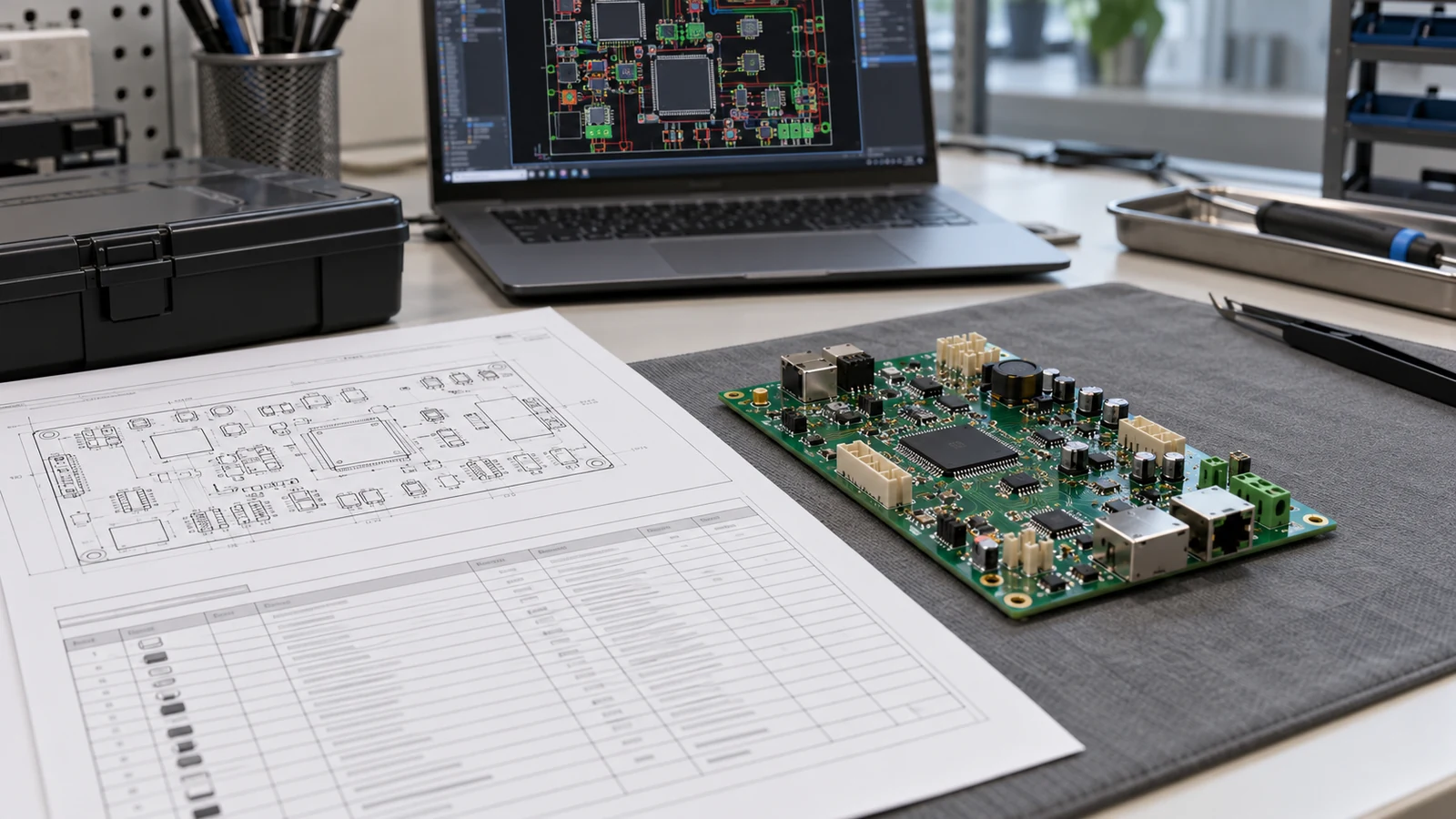
PCB assembly cost includes materials, assembly operations, engineering and setup, testing, extra processes, and delivery-related charges. OEM buyers should separate reusable investment from costs that recur per lot, per board and per shipment before judging a unit price. For repeat production requiring functional release, use a reference target of testing 100% of shipped boards to agreed limits, with serial-linked results. Request the first-order total and the unchanged-repeat total separately: their difference reveals which development work and tooling the next order can reuse.
- Why a Low Assembly Price Can Increase the Order Cost
- Separate Materials, Assembly Labor and One-Time Charges
- 1. Material Scope and Purchasing Responsibility
- 2. Reusable Engineering Versus Recurring Setup
- How BOM Complexity Changes Procurement Cost
- 3. Part Identity, Alternatives and Distinct BOM Lines
- 4. Purchase Quantity, Attrition and Excess Inventory
- Setup, Placement and Special-Process Cost Drivers
- 5. Placement Count and the Billing Denominator
- 6. Extra Operations and Their Acceptance Requirements
- Test Development Versus Per-Board Verification
- 7. Test Development and Fixture Readiness
- 8. Execution Time, Records and Retesting
- Yield, Packaging and Commercial Assumptions in a Quote
- 9. Accepted Quantity, Rework and Material Loss
- 10. Packaging, Freight, Tax and Price Validity
- A Cost Breakdown Buyers Can Reconcile with Scope
- How Quantity Changes the Fixed-Cost Allocation
- Review a PCBA Quote in Six Steps
- Eight Reasons to Escalate or Reject a Cost Breakdown
- Turn the Breakdown into a Costed Build Scope
Why a Low Assembly Price Can Increase the Order Cost
A low assembly price becomes expensive when it excludes work needed to deliver an accepted PCBA. A placement-only offer may omit bare boards, component purchasing, firmware loading, electrical testing or protective packaging. Those costs still belong to the project, even if another department pays them.
Consider a control board that must be programmed before an enclosure closes. If programming is absent from the quote, the OEM must add a production operation or reopen finished units. The relevant saving is the cost of an accepted, usable board delivered to the agreed location.
Keep three figures visible: the initial cash commitment, the recurring cost of an unchanged repeat build, and the landed cost per accepted board. They answer different questions. This guide uses ten review criteria to make those figures explainable and to identify changes that lower cost without quietly removing necessary work.
Separate Materials, Assembly Labor and One-Time Charges
A usable PCB assembly cost breakdown separates what the supplier buys, what production performs and what engineering creates for reuse. Classify charges as one-time, per-lot, per-board or per-shipment. A fixed charge can recur: restarting a production line is different from creating its original program.
1. Material Scope and Purchasing Responsibility
Start with ownership. In full turnkey, the assembler sources bare boards and components. In partial turnkey, the OEM supplies an agreed subset and the assembler buys the rest. In consigned assembly, the OEM supplies the build materials. These responsibility splits appear in The referenced supplier’s sourcing options.
Materials still cost money. When the OEM supplies them, include purchasing, inbound freight, receiving and surplus-material exposure in the project view, even though those costs sit outside the assembler’s invoice and may be recorded against another department’s budget. Name the bare-board owner separately. The word “turnkey” alone is insufficient.
Good signal: The quote identifies the sourcing owner for bare boards and every BOM line, with purchased material separated from assembly operations.
Red flag: A turnkey headline is followed by unspecified customer-supplied parts or a material allowance that cannot be reconciled with the BOM.
2. Reusable Engineering Versus Recurring Setup
Non-recurring engineering, or NRE, can include initial manufacturing-data preparation, test-software development and custom tooling design. Physical stencils and fixtures may appear as separate tooling lines. Their reuse depends on revision compatibility, condition and the agreed retention arrangement.
Line setup covers a different task: loading feeders, preparing equipment, checking the first output and releasing that production lot. Setup can recur. Ask the supplier to divide a combined “setup/NRE” line into reusable work and repeat-lot preparation, so that procurement can see why a saved machine program does not remove the labor required to restart the line.
Payment timing also matters. An engineering charge can be invoiced upfront or recovered through board prices; if it is amortized, identify the recovery quantity and what happens when orders stop, the design changes or the supplier has already recovered the investment. Count it once.
Good signal: An unchanged-repeat quote names which charges disappear and which restart charges remain.
Red flag: “One-time setup” has no stated reuse condition, or prepaid tooling is also recovered through an unexplained unit-price surcharge.
How BOM Complexity Changes Procurement Cost
BOM complexity increases procurement cost through the number of distinct purchasing decisions, component availability and the quantity that must be bought. Placement count alone cannot describe that work. Separate the parts consumed by the build from the inventory purchased to make the build possible.
3. Part Identity, Alternatives and Distinct BOM Lines
A Bill of Materials should identify the manufacturer part number, reference designators, quantity per board and package. The referenced supplier’s BOM guidance uses these fields to remove ambiguity. A value-only description leaves the supplier to interpret tolerance, voltage rating, package and sourcing options.
Quote the bare PCB against its stack-up, material, copper specification, hole structure, finish and required electrical checks. The same outline can hide different fabrication work. If fabrication tooling and assembly tooling are charged separately, identify the deliverable purchased by each fee.
Count purchasing decisions separately. Twenty identical resistors create twenty placements but can belong to one purchasing line, whereas twenty different components create twenty sourcing decisions as well as twenty placements. Consolidation needs engineering approval. Two parts sharing a package or nominal value are not automatically interchangeable when tolerance, voltage rating or circuit behavior differs.
Good signal: The quote uses an approved BOM revision and identifies alternatives by exact manufacturer part number.
Red flag: A lower material total depends on substitutions that procurement has accepted without engineering approval.
4. Purchase Quantity, Attrition and Excess Inventory
Check the quantity basis. Minimum order quantities, pack multiples and the agreed attrition allowance can increase the material buy beyond the installed demand, so a per-board BOM extension may not equal the material payment required to release the order. Attrition is a separate allowance. It covers parts lost or damaged during handling and assembly, rather than completed-board yield.
As a hypothetical inventory example with no component loss, a build needs 300 installed pieces of one component. If its agreed purchase pack is 500 pieces, the remaining 200 pieces need an owner and a disposition. Surplus is not automatically scrap. Nor is it a fresh purchase to invoice again on the next build.
Request a separate material record for installed demand, approved allowance, purchased quantity and remaining stock. Check minimum order quantity (MOQ) and non-cancellable, non-returnable (NCNR) commitments before approving a larger purchase just to obtain a component price break.
Good signal: Surplus material is identified by part number and quantity, with ownership, storage and future credit agreed.
Red flag: All purchased material is described as consumed, or the same remaining stock is charged as a fresh purchase on repeat orders.
Setup, Placement and Special-Process Cost Drivers
Assembly cost follows the manufacturing route: equipment preparation, component handling, soldering operations and manual work. Board area is only one input. A small mixed-technology board can require more operations than a larger board populated on one side by a repeatable SMT process.
5. Placement Count and the Billing Denominator
Check the billing denominator. A component placement, a solder joint, a through-hole pin and a machine cycle are different quantities: a connector with many pins is one component, but its soldering work can involve many joints. Require a counted quantity. Then verify that the rate includes the operations needed to complete it.
For example, The referenced supplier’s published fee definitions separate setup, stencil, solder-joint-based assembly and feeder-related charges. That illustrates why two “assembly” subtotals may represent different work; it does not establish a universal rate.
The route should identify surface-mount technology (SMT), through-hole technology (THT) or mixed assembly, populated sides and separate soldering passes. Handling also consumes time. Before changing a layout to reduce placement count, ask whether the proposed change actually removes a process, improves panel utilization or makes depaneling easier without creating new manual work or compromising the assembly.
Good signal: The supplier states the counted units and reconciles them with the released assembly data.
Red flag: A per-placement rate is multiplied by an unexplained pin or joint count, or both sides are charged without showing the routing basis.
6. Extra Operations and Their Acceptance Requirements
Cleaning, conformal coating, masking, potting, selective soldering, cable attachment and enclosure installation add distinct work. Each needs a defined boundary. “Coating included” does not explain whether connector masking, curing and coating inspection are included.
Name the actual operation. For each required process, identify its drawing or process requirement, charging basis and acceptance evidence, so that a blanket percentage labelled “special process” can be replaced by a scope the buyer understands and engineering can approve.
Good signal: Every required extra operation appears as an included line or a clearly priced option with defined acceptance.
Red flag: The quote assumes an uncoated board although the released assembly drawing calls for coating, or manual work remains outside the total.
Test Development Versus Per-Board Verification
Test cost has two separate parts: creating a usable test system and running it on production boards. A first order can carry substantial software, fixture and validation work even when the eventual test cycle is short. Repeat-order pricing should preserve execution cost while identifying reusable development.
7. Test Development and Fixture Readiness
Price the development deliverable. Test development translates product requirements into stimulus, measurements, limits, software and operator instructions; the quote also needs to cover validation of the complete method and approval of its release before production results can support an acceptance decision. Fixture hardware is only part of that work. Its contacts must connect reliably without damaging the assembly.
Common inspection and test lines address different questions:
| Quote Line | Development or Setup Work | Recurring Driver | Scope to Confirm |
|---|---|---|---|
| Automated optical inspection (AOI) | Program creation and tuning | Inspection cycle and review time | Visible component and solder features; not a functional release test |
| X-ray inspection | Inspection recipe and acceptance criteria | Images, selected locations and interpretation | Hidden joints examined and sampling or full inspection basis |
| In-circuit test (ICT) | Test program, access strategy and often a dedicated fixture | Contact, measurement and diagnostic time | Electrical structural coverage and inaccessible nodes |
| Functional test and programming | Software, interfaces, firmware sequence and limits | Loading, programming, measurements and result logging | Product functions, firmware revision and release record |
Flying-probe testing can reduce dedicated fixture investment, while fixture-based ICT can support shorter production cycles. Keysight’s ICT and flying-probe explanation describes that tradeoff. Select the method using access, coverage and credible build volume, rather than an invented universal crossover quantity.
Good signal: Development deliverables, fixture validation and change-control responsibilities are separate from execution pricing.
Red flag: A fixture is priced, but nobody owns test limits, software release or proof that known failures are detected.
8. Execution Time, Records and Retesting
For repeat production requiring functional release, use 100% of shipped boards tested to agreed limits, with serial-linked results, as a procurement reference target. This defines which units receive the agreed checks. It does not mean 100% defect coverage, and it does not replace product qualification or safety validation.
Measure the complete cycle. Loading, connection, firmware download, measurements, result recording and unloading all occupy the station, even when the actual electrical measurements take only a small part of the time quoted for each board. Define diagnosis and retest separately. Changing firmware or test limits can trigger engineering work on a repeat order.
For a hypothetical single-station cycle of 30 s, testing 100 boards occupies 50 min; at 120 s per board, it occupies 200 min. Both calculations exclude downtime and retest. They illustrate workload, not labor rates or a recommended test duration.
Reducing connection time or automating repetitive measurements can lower recurring cost without deleting a necessary test. NI’s functional-test guidance identifies test-station ownership, parallel execution and reusable software as relevant cost considerations.
Good signal: The per-board test charge has an agreed cycle, limits, result format and retest policy.
Red flag: “Tested” means only visual inspection, or the quote omits firmware loading needed for the agreed functional checks.
Yield, Packaging and Commercial Assumptions in a Quote
Yield and commercial assumptions determine how much the OEM pays to receive usable boards. Define the accepted delivery quantity, responsibility for manufacturing losses and the shipping boundary before dividing the total by a board count. A production start quantity is not an accepted output quantity.
9. Accepted Quantity, Rework and Material Loss
Keep component attrition, first-pass yield and final accepted output separate. First-pass yield describes boards passing the defined checks without repair or retest. Final accepted output can include successfully reworked boards, subject to the agreed acceptance rules.
Assign loss responsibility explicitly. Replacement components, replacement bare boards and extra labor after a manufacturing defect need a cost owner, while a design change or an OEM-supplied defective component may fall under a different agreed responsibility. Avoid a blanket scrap percentage. It can double-count a contingency already included in the supplier’s price.
Good signal: The order commits to an accepted quantity and explains permitted rework, short delivery and responsibility for loss.
Red flag: The headline unit price uses boards started, while the OEM bears an undefined reduction in delivered good boards.
10. Packaging, Freight, Tax and Price Validity
Separate board protection from transportation. Individual protective packs, trays, labels, cartons and export packing can have different charging bases. Identify electrostatic-discharge protection and mechanical support appropriate to the shipped assembly, including fitted connectors or cable tails.
For an international order, specify the delivery rule, named place and version, together with who pays freight, insurance, customs clearance, duties and applicable tax. ICC’s Incoterms 2020 overview explains the rules’ allocation of cost, risk and obligations. A freight line alone does not resolve the full commercial boundary.
Record currency and validity. Include payment milestones and any material-price adjustment mechanism, and distinguish tax-inclusive from tax-exclusive totals before approving a payment or treating the quoted unit figure as the cost of receiving an accepted board. Track recoverable tax separately where applicable. Cash paid and economic cost are not necessarily identical.
Good signal: Packaging, shipment count and included or excluded commercial charges are explicit, with a dated validity period.
Red flag: “Delivered price” has no named destination or tax boundary, or an attractive unit price requires an undisclosed inventory commitment.
A Cost Breakdown Buyers Can Reconcile with Scope
A reconciled quote maps each charge to a deliverable, a charging basis and a reuse condition. Use the following fields to explain a supplier’s total. The entries describe what buyers should check; they are not market prices.
| Cost Element | Charging Basis | Main Driver | Reusable Across Orders | Buyer Check |
|---|---|---|---|---|
| Components and bare boards | Purchased quantities; procurement fees if separate | BOM, PCB construction, availability, pack multiples | Owned remaining inventory may support later builds | Match purchased, consumed and remaining quantities; confirm sourcing owner |
| Assembly setup | Per-lot preparation; initial programming if separate | Feeders, populated sides, routing and first-output checks | Programs may be reused; physical setup can recur | Separate initial data work from repeat-lot setup |
| Placement and soldering | Per-board, per-placement, per-joint or quoted operation | Component mix, counted units and soldering route | Work repeats for each build | Confirm denominator and included passes |
| NRE and tooling | Defined development or tooling deliverable | Revision, stencil, fixture and engineering scope | Conditional on compatibility and retention | Identify reuse conditions and avoid duplicate recovery |
| Testing and programming | Development plus execution per board or test cycle | Coverage, firmware, fixture and cycle time | Released software and fixture may be reused | Separate creation, validation, execution and retest |
| Extra processes | Per operation, lot or board | Cleaning, coating, masking, potting or mechanical work | Process instructions may be reused; operations recur | Tie each requirement to acceptance and an included charge |
| Packaging and logistics | Per-board pack, carton, shipment and freight service | Protection, destination and shipment count | Returnable packaging only by agreement | Separate packing, freight, insurance and clearance |
| Duties, taxes and adjustments | Applicable transaction basis or agreed adjustment | Jurisdiction, delivery scope, currency and validity | Reassessed for the actual transaction | Identify exclusions; avoid counting included charges twice |
Reconcile every line extension. Add the included charges, apply documented discounts or adjustments, and add only excluded costs that the OEM must pay, while maintaining an all-in cash view alongside the recurring manufacturing view. Then choose the denominator. Use the accepted delivery quantity for the cost per accepted board.
How Quantity Changes the Fixed-Cost Allocation
The following is a hypothetical allocation model, not a supplier quotation. Let F be the same combined initial reusable charge and single-lot setup charge at every scenario quantity. Assume one unchanged revision, one production lot and no short delivery. Each board carries F ÷ accepted quantity of that fixed charge.
| Accepted Boards | Production Lots | Fixed Charge Allocated to Each Board | What the Scenario Demonstrates |
|---|---|---|---|
| 25 | 1 | F/25 = 4% of F | Small quantity carries more fixed cost per board |
| 100 | 1 | F/100 = 1% of F | More boards share the same fixed charge |
| 250 | 1 | F/250 = 0.4% of F | Allocation falls without assuming a material discount |
| 500 | 1 | F/500 = 0.2% of F | Fixed allocation is smaller; total cash still includes F |
These quantities are review scenarios, not standard supplier price breaks. A repeat build may omit the reusable part of F but retain setup. Splitting the same quantity across several production lots can add setup charges. Several deliveries from one completed lot can instead add freight and storage without necessarily repeating assembly setup. Ask for quantity options based on credible demand, including excess inventory exposure before deciding that a larger order saves money.
Review a PCBA Quote in Six Steps
A PCBA cost review should turn a price document into an agreed build scope. Follow these six steps with procurement and engineering using the same revision and quantity basis.
Freeze the costing baseline. Record the PCB revision, BOM revision, populated variant, accepted quantity and delivery destination. Keep the prototype and repeat-production assumptions distinct. Changes to the baseline need a visible cost update.
Assign purchasing responsibility. Mark which bare boards and components are supplier-purchased or OEM-supplied. Record required purchase quantities, approved alternatives and excess-stock ownership. Make the material subtotal explainable before challenging the assembly rate.
Classify every charge. Mark one-time, per-lot, per-board and per-shipment items. Split mixed lines. Identify included charges so that tooling, test setup, packing or freight are not added twice in the OEM’s estimate.
Confirm the production and acceptance route. Have engineering approve soldering, special processes, inspection, programming and electrical-test scope. Connect each required operation to a quote line. Remove an operation only when its underlying requirement has been resolved.
Reconcile the quantity options. Request the initial total, unchanged-repeat total and credible alternative quantities. Recalculate fixed allocation and inventory commitments. Separate a lower recurring rate from a lower first-order payment; either can improve while the other gets worse.
Release a controlled commercial record. Attach the accepted breakdown and exceptions to the purchase order. Record validity, payment milestones, quantity, delivery boundary and change-approval responsibility. Use this record when a revision change or repeat order triggers a new quote.
The review is complete when every required operation has an owner and every invoiced category has an agreed basis. A short exception list is more useful than an unexplained “all inclusive” statement.
Eight Reasons to Escalate or Reject a Cost Breakdown
Escalate a PCBA quote when its exclusions, arithmetic or responsibilities prevent a reliable order total. Correctable ambiguity needs a revised quote; refusal to resolve an essential scope or acceptance issue is a reason to reject it.
| Signal | Why It Matters | Required Resolution |
|---|---|---|
| Material total cannot match the released BOM | Scope or sourcing may have changed | Obtain a reconciled material basis |
| Unapproved component substitution | Savings may change circuit performance | Obtain engineering approval or restore the specified part |
| Setup/NRE cannot be separated | Repeat-order cost cannot be explained | Identify reusable and recurring work |
| Tooling appears upfront and inside a surcharge | The same investment may be recovered twice | Document the recovery arrangement |
| “Tested” has no method or limits | Acceptance is undefined | Agree tests, limits and records |
| Good-board quantity is not committed | Yield exposure transfers without a defined boundary | Agree accepted quantity and loss responsibility |
| Excess stock has no owner | Future cost or duplicate billing remains possible | Identify ownership and disposition |
| Freight or tax exclusions are open-ended | The delivered total remains unresolved | Define location, inclusions and adjustment rules |
Frequently Asked Questions
PCB assembly cost questions become easier to answer when materials, recurring operations and reusable development remain separate. These answers use that same scope throughout.
Why is the first PCBA order more expensive than a repeat order?
The first order can include initial engineering, manufacturing programs, stencils, test development and fixtures. An unchanged repeat order may reuse those assets, while material purchases, line setup and per-board operations remain. Confirm which charges disappear and which recur before using the repeat price in a budget.
Are component costs included in turnkey assembly prices?
Full turnkey normally includes supplier sourcing of components and bare boards, but the quote must define its actual inclusions. Partial turnkey assigns some materials to the OEM. Check procurement fees, minimum purchases, attrition and excess-stock ownership separately; a sourcing label does not explain every material charge.
Which assembly charges are fixed rather than per board?
Initial engineering, tooling creation and test development can be fixed for a defined revision and scope. Production setup can be fixed per lot while still recurring. A supplier may bundle or amortize those charges, so ask for their basis rather than assuming that every fixed charge is one-time.
Can testing cost more than assembly on a small order?
Yes. Test software, fixtures and validation can outweigh placement and soldering charges when only a few boards share that development cost. Separate development from execution, then assess reuse and the required coverage. Removing necessary verification changes the delivered scope rather than simply lowering the same cost.
How should an OEM compare quotes without a standard unit price?
Use the same released revision, accepted quantity and required work as the baseline, then reconcile each quote’s inclusions. Separate material, NRE, lot setup, board operations and delivery charges. Compare the initial total and unchanged-repeat total independently; investigate any unexplained difference before treating it as a saving.
Does ordering more boards always reduce PCB assembly cost?
A larger lot reduces the allocation of an unchanged fixed charge per board, but it does not guarantee lower total spending. Material commitments, unused inventory, extra fixtures or different routing can change the result. Request project-specific quantity options using credible demand rather than assuming universal price breaks.
What testing should the cost breakdown include?
Include the inspection, programming and electrical or functional checks needed for the agreed release decision. For repeat production requiring functional release, use 100% of shipped boards tested to agreed limits, with serial-linked results, as a reference target. This describes unit participation, not complete defect coverage.
Who pays for unused components after a build?
The agreed purchasing and inventory arrangement determines who pays for and owns unused components. Identify remaining quantities, non-cancellable commitments, storage and future use before ordering. A purchased surplus is different from consumed attrition, and previously paid stock should be reconciled when it supports a repeat build.
Should freight and tax be included in the PCBA unit cost?
Include applicable freight, duties, tax and handling in the cash budget needed to receive the boards, while keeping them separately visible. State destination and delivery scope. For economic cost analysis, distinguish recoverable tax where applicable and avoid adding charges already included in the supplier’s total.
Turn the Breakdown into a Costed Build Scope
The next step is a quote that procurement can reconcile and engineering can accept. Prepare the released BOM and PCB data, expected order quantities, sourcing split, required extra operations, test requirements and delivery destination. Request separate first-order and unchanged-repeat totals with explicit reuse conditions.
For a JASPER enquiry, use the PCB assembly services page to frame the board, component and interface scope. Ask for the cost breakdown against those requirements. The useful outcome is a documented path from purchased materials to accepted boards, with controllable costs and clear ownership of every required operation.
Ready to Start Your Project?
Tell us about your membrane switch, keypad, or graphic overlay requirements. Our engineering team will review your specifications and provide a detailed quote.