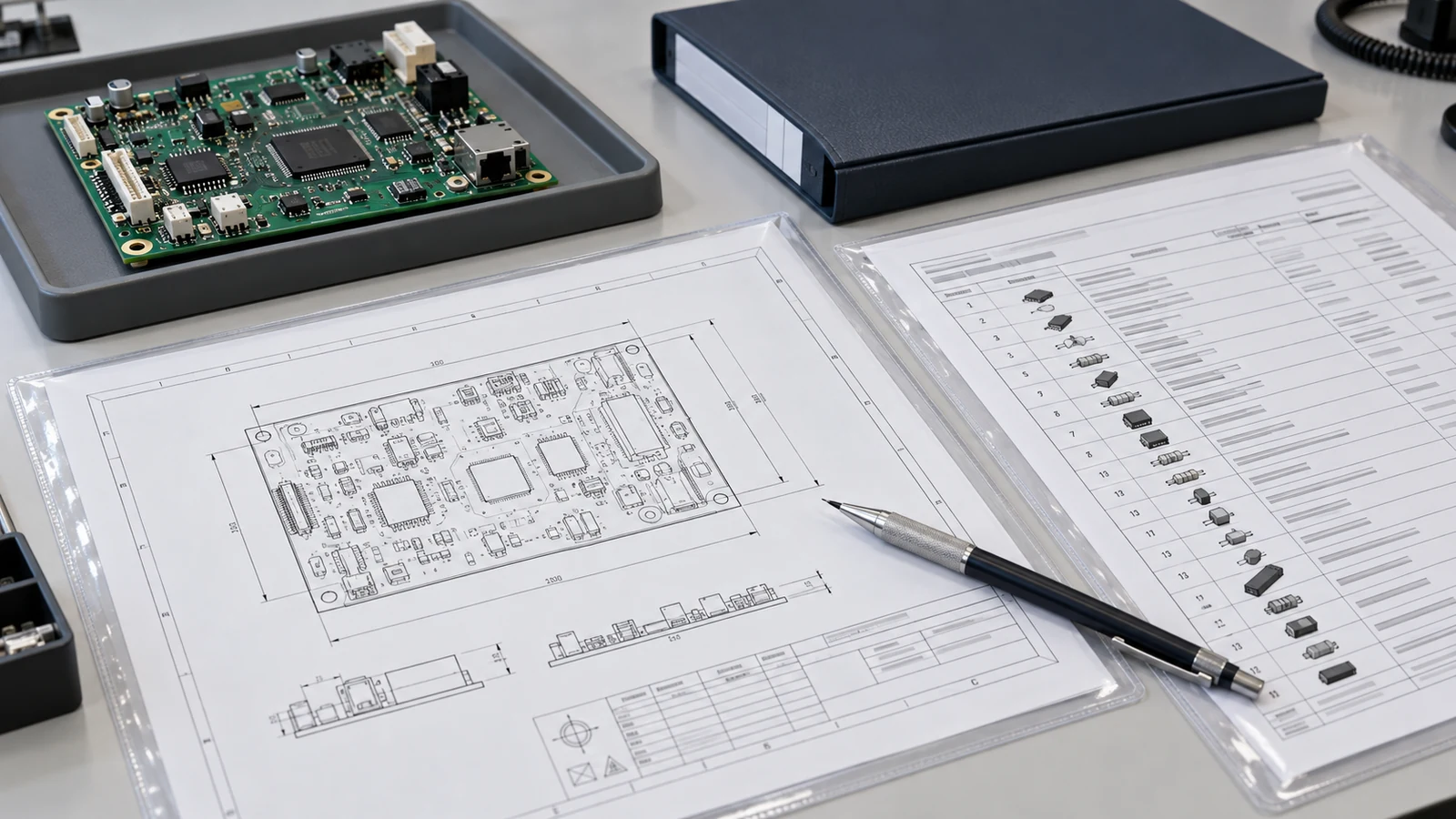
PCB assembly delivery documentation should identify what shipped, which configuration was built, which inspections and tests were completed, and which exceptions were approved. Agree the document index before production, then reconcile it against the actual shipment. For serviceable industrial assemblies, use a reference target of 100% of shipped serial numbers linked to their approved configuration and final inspection/test disposition. Supply a readable summary and the agreed supporting records; individual test PDFs and unlimited data retention are not universal requirements.
- Why Missing Delivery Records Delay Usable Inventory
- Build a Shipment Document Index Before Production Starts
- Criterion 1: Define the document set and its owner
- Criterion 2: Reconcile the shipped population
- Identify Board, BOM, Firmware and Order Revisions
- Criterion 3: Match the physical build to an approved baseline
- Criterion 4: Identify programmed content and variants
- Summarize Inspection and Test Results at the Required Level
- Criterion 5: State coverage and acceptance criteria
- Criterion 6: Separate first-pass results from final shipment status
- Link Serial Numbers, Lots and Material Traceability
- Criterion 7: Select useful record granularity
- Criterion 8: Make retained records retrievable
- Include Approved Deviations and Outstanding Dispositions
- Criterion 9: Tie exceptions to the affected boards
- Criterion 10: Keep conformance and first-article records in scope
- Check the Delivery Package Before Receiving the Boards
- Step 1: Agree the index with the order
- Step 2: Check a completed example
- Step 3: Reconcile the actual shipment
- Step 4: Review exceptions and final dispositions
- Step 5: Issue the controlled delivery package
- Step 6: Match the arrival and record discrepancies
- Hold or Escalate These Eight Documentation Problems
- Agree the Delivery Package with the Next PCBA Order
Why Missing Delivery Records Delay Usable Inventory
Missing PCBA delivery records can turn physically delivered boards into inventory that receiving cannot accept. A packing list proves a quantity was dispatched. It does not establish the installed firmware, the test limits used, or whether an approved exception covers the boards inside the carton.
Consider an illustrative controller shipment with two firmware variants. The boards look identical, but only one variant supports the receiving factory’s equipment. If the carton labels and test summary cannot identify the installed variant, the OEM must segregate the delivery while engineering reconstructs the configuration. Expedited freight has not solved that delay.
Weak documentation also expands a later investigation. If a suspect material lot cannot be associated with particular boards, the OEM may need to examine a larger population. An overwritten test history can hide whether a returned unit originally failed and was repaired.
The purchasing decision is therefore about usable evidence. Specify the records that allow receiving, engineering and quality to identify the delivered product without reconstructing the build from emails.
Build a Shipment Document Index Before Production Starts
A shipment document index should name each required record, its identifier, its scope, its owner and the receiving check it supports. Agree this index with the purchase order or quality agreement before production so the supplier can capture the required data while the boards are built.
Criterion 1: Define the document set and its owner
Use the following matrix as the starting scope for PCB assembly delivery documentation. Capitalized identifiers are suggested field labels; map the supplier’s equivalent labels once. An approved combined report can satisfy several rows if each record remains identifiable, its scope matches the delivered population, and receiving can locate the supporting evidence without asking the supplier to reconstruct it.
| Delivery Record | Required Identifier | Scope or Granularity | Document Owner | Receiving Check |
|---|---|---|---|---|
| Packing list | Shipment ID, Order Number, Order Line, Assembly Part Number, Carton ID | This dispatch; Shipped Quantity by part, variant and carton | Supplier shipping team | Match Shipped Quantity, labels and destination to the order; identify partial shipments |
| Revision summary | Assembly Revision, Board Revision, BOM Revision, Firmware Version, Configuration Revision, Order Change | Each distinct as-built configuration in the shipment | Supplier configuration owner, using OEM-approved releases | Cross-check each Configuration ID against the ordered baseline and approved changes |
| Test summary | Report ID, Assembly Lot, Serial Number where specified, Procedure Revision, Program Revision, Test Date | Lot results plus board or measurement detail where agreed | Supplier test/quality team | Reconcile Tested Quantity, Passed Quantity and Held Quantity; verify coverage and retest history |
| Traceability record | Shipment ID, Work Order, Assembly Lot, Serial Number where specified, Material Lot | Lot or board level under the agreed traceability scope | Supplier manufacturing/quality team | Resolve Carton ID to the required serial/lot records; check for duplicate or missing serials |
| Deviation approval | Approval ID, Approval Revision, Approval Authority, Affected Population, Validity Limit | Only the approved exception and affected population | Authorized OEM approver; supplier quality links implementation evidence | Verify Approval Date precedes dispatch and all Approval Conditions apply to delivered units |
| Conformance statement | Statement ID, Supplier Name, Order Number, Order Line, Assembly Part Number, Part Revision, Shipped Quantity, Requirements Reference, Exception Reference | Defined shipment or lot, where contractually required | Supplier authorized quality representative | Check Statement Scope and Authorized Signatory against the index, results and exceptions |
Give the index a Package Revision and Issue Date. For each Document ID, include its File Name, Record Revision, Document Owner and Delivery Method. State whether the item is enclosed, delivered electronically before dispatch, or retained with an agreed retrieval commitment. Test access before dispatch.
Good signal: Each index row has an accountable owner and a delivery method accepted by OEM receiving.
Red flag: The order says only “standard quality documents,” leaving both parties to assume what that includes.
Criterion 2: Reconcile the shipped population
The packing list should describe this dispatch, including split lots, mixed variants and carton quantities. Keep Ordered Quantity, Built Quantity and Shipped Quantity distinct. They answer different questions. A held board belongs in the production reconciliation, not in the shipped serial manifest.
For a partial shipment, preserve Order Number and Order Line while assigning a unique Shipment ID, then list each Carton ID with its contents so receiving can identify the delivered subset even when two dispatches share one Assembly Lot. The next dispatch needs a new manifest.
Good signal: Carton counts sum to the packing-list quantity, and that quantity matches the shipped manifest.
Red flag: A full-batch report accompanies a partial delivery without identifying which boards actually shipped.
Identify Board, BOM, Firmware and Order Revisions
The revision summary should identify the configuration actually delivered, including separate board, assembly, BOM and firmware identifiers where they differ. A single “Rev C” on a packing list cannot describe several independently controlled files unless the approved configuration system explicitly maps them together.
Criterion 3: Match the physical build to an approved baseline
Use a crosswalk between the ordered configuration and the as-built configuration. The following identifiers are fictional examples of a completed record, not JASPER production data.
| Configuration Item | Example Delivered Identifier | Check Against |
|---|---|---|
| Purchase order | Order Number PO-6842; Order Change 02; Order Line 10 | Accepted Order and applicable Change Notice |
| Assembly | Assembly Part Number CTRL-210; Assembly Revision C | Released Assembly Drawing and Variant Definition |
| Bare PCB | Board Part Number PCB-210; Board Revision B | Approved Fabrication Dataset |
| Bill of materials | BOM Identifier BOM-210; BOM Revision D | Approved parts, alternatives and do-not-fit positions |
| Firmware | Firmware Identifier FW-210; Firmware Version 2.4.1 | Programming Release and Target Hardware |
| Configuration dataset | Configuration ID CFG-210; Configuration Revision 03 | Approved Product Variant and Parameter Set |
| Test definition | Procedure ID TP-210; Procedure Revision F; Program Revision 5.2 | Accepted Test Procedure, limits and deployed program |
Different revision letters are not automatically a mismatch. Check the combination. The Change Notice should identify its Effective Lot or Effective Serial boundary, the previous Configuration ID and the replacement Configuration ID so receiving can distinguish an authorized transition from an accidental mixture without treating every changed filename as a new product release.
Good signal: The shipment identifies each delivered configuration and the approval that permits it.
Red flag: The supplier copies the latest design revision into the report even though some boards were built to an earlier release.
Criterion 4: Identify programmed content and variants
Firmware Version, Bootloader Version and Configuration Revision can change independently. Record the applicable fields. Where the programming plan uses an image digest, retain the Digest Algorithm and complete Approved Digest with the Programming Release; a filename alone can be renamed without changing its content.
Distinguish the authorized image from the Programming Result for each specified Serial Number. If programming is outside the assembly scope, record Programming Status as unprogrammed and identify the later programming owner. An image supplied with the RFQ does not prove installation.
Good signal: Board serials resolve to the installed firmware/configuration variant and the agreed verification result.
Red flag: The package lists a software folder but does not identify what was loaded into the shipped boards.
Summarize Inspection and Test Results at the Required Level
A PCBA test summary should identify the tested population, the approved test definition and the final disposition of the boards being delivered. Separate inspection from electrical testing. A green result is useful only when receiving can establish what was checked, which acceptance criteria applied, whether any required step was skipped, and how the reported results map to the boards in this dispatch.
Criterion 5: State coverage and acceptance criteria
Name the methods actually required and performed, such as automated optical inspection (AOI), X-ray inspection, in-circuit test (ICT) or functional test. These methods answer different questions. An AOI result does not establish that every electrical function was tested, and a functional pass does not document every hidden solder joint.
Include Procedure Revision, Program Revision, Acceptance Criteria, Test Date and Sampling Scope. Measurements need context. For an illustrative 3.3 V rail reading of 3.31 V, preserve Measured Value, Measurement Unit, Lower Limit, Upper Limit and Test Condition so the recipient can interpret the result against the approved product limits and the supply/load conditions used during that run.
Record skipped, aborted and not-required checks distinctly from passed checks. Report configuration can include or filter measurement values and limits, so agreeing the export fields matters as much as agreeing the report format.
Good signal: The report names the methods, revisions and inspected population, with a clear explanation of any permitted exclusions.
Red flag: “100% tested” appears without a test definition, serial/lot scope or explanation of coverage.
Criterion 6: Separate first-pass results from final shipment status
Use distinct counts for initially passed, initially failed, repaired/retested, finally accepted and held boards. Count each board once per category. Distinguish Serial Number from Run ID: several test attempts can belong to one physical board, so summing result rows without that distinction can inflate Tested Quantity or Shipped Quantity.
In an illustrative 100-board lot, 97 boards pass the first run and 3 fail. Two failed boards are repaired and pass the required retest; one remains held. The shipment contains 99 accepted boards. First-pass yield is 97%, even though all 99 shipped boards have an accepted final disposition. The held board must be excluded from the manifest.
Preserve the original failure. Link its Run ID to the Repair Record and Retest Result instead of replacing the history. Keep the serial-number history, earlier failures and the test-limit revision with each result so that an investigation can distinguish a repaired fault from a change in the acceptance criteria.
Good signal: The 99 shipped serials reconcile to final accepted results, while the history still shows the initial failures.
Red flag: A rerun replaces the original failure record, making the lot appear to have passed first time.
Link Serial Numbers, Lots and Material Traceability
Shipment traceability should connect the delivered boards to the manufacturing and material records required by the order. Choose the granularity according to the investigation the OEM may need to perform. A batch identifier can support batch containment; a board serial can narrow the inquiry to an individual assembly.
Criterion 7: Select useful record granularity
Use these four practical record views when defining the package. They can coexist; they are not IPC traceability grades.
| Record View | Identifier and Typical Contents | Appropriate Use | Limitation to Resolve |
|---|---|---|---|
| Shipment-level | Shipment ID, Order Line, Carton ID, Shipped Quantity, Document Index | Receiving and dispatch reconciliation | Does not by itself identify an individual board’s history |
| Lot-level | Assembly Lot, Work Order, Build Date, Aggregate Result, Material Lot | Homogeneous batches where lot containment is acceptable | A problem may require holding the whole associated population |
| Board-level | Serial Number, Configuration ID, Final Disposition, Assembly Lot, Material Lot | Serviceable assemblies, mixed variants and unit-specific investigation | Requires reliable marking and capture through rework and packing |
| Measurement-level | Serial Number, Test Step, Run ID, Measured Value, Measurement Unit, Lower Limit, Upper Limit, Test Condition | Reviewing critical measurements, retests and field-return trends | Produces more data; needs a readable definition of each field |
For serviceable industrial boards, use Board-level linkage with a 100% completeness target across the shipped serial population. Add Measurement-level results for characteristics needed for acceptance or later diagnosis. The target does not claim complete fault coverage or require every possible measurement to be exported.
Map Panel ID and Panel Position to Serial Number after separation, retaining both relationships where the process needs them. Work Order and Date Code are not automatically unique board identifiers. If IPC-1782 is specified, identify the agreed edition and required material/process scope in the contract.
The shipment manifest should resolve required material-lot references, including multiple material lots used within one assembly lot. It need not reproduce every upstream purchasing document. Component provenance review is a separate task from linking the delivered board to the agreed material record.
Good signal: A scanned carton label leads to the correct board list, and any listed serial retrieves its applicable configuration, disposition and lot links.
Red flag: The supplier offers a folder of component certificates with no association to the shipped assemblies.
Criterion 8: Make retained records retrievable
Define Retention Period, Start Event, Record Class, Record Custodian, Authorized Recipient and Retrieval Time, together with end-of-term transfer or disposition. Check the start event carefully. A period measured from the last delivery of a product can extend much longer than the same period measured from each board’s shipment.
Retention is a project decision. For an illustrative industrial contract, 7 years of planned field use plus 3 years of investigation support gives a 10-year retention period from shipment. Use that number only for that agreed scenario; apply the actual product, customer and applicable obligations to other orders.
Separate delivered documents from retained source records. A readable PDF summary and structured serial manifest can support receiving while detailed measurement histories remain in an agreed repository, provided the package identifies the Record Location, Export Revision, Field Definition, Measurement Unit and Time Zone needed to interpret a later CSV, JSON or XML export.
Check retrieval with a real example before the first delivery. Also agree access after a supplier system migration or the end of the commercial relationship.
Good signal: The contract defines retention and retrieval, and a sample record can be opened using its shipment or serial identifier.
Red flag: An expiring portal link is the only route to records that the OEM must retain for years.
Include Approved Deviations and Outstanding Dispositions
Shipment documents should show every applicable approved exception and identify any unresolved disposition that prevents affected boards from being included. An approval must cover the actual requirement, affected population and validity period. A pending request is not an accepted deviation.
Criterion 9: Tie exceptions to the affected boards
Record the deviation identifier and revision, the requirement affected, the authorized approver, the approved condition, the serial/lot scope, the allowed quantity and any expiry or shipment limit. Link evidence that required actions were completed. The supplier’s internal acceptance does not replace OEM approval where the contract reserves that authority to the OEM.
For example, a concession for a connector substitution on one lot does not authorize the same substitution on the next order. A standing approved alternative belongs in the controlled configuration; a temporary exception needs its own applicability record.
Keep open corrective actions separate from open product dispositions. A longer-term process action may remain open after an authorized product disposition permits shipment. A board awaiting acceptance of its nonconformance remains outside the accepted shipment population.
Good signal: Receiving can match each affected serial or lot to a valid approval and completed shipment conditions.
Red flag: The package includes an email saying “engineering is reviewing” in place of an approval.
Criterion 10: Keep conformance and first-article records in scope
A certificate of conformity or conformance statement declares conformity for an identified product population against stated requirements. Include authorized exception references where applicable. The statement does not supply missing measurements, prove unspecified test coverage or confer product certification.
First-article approval serves a different purpose: it records verification of a defined initial build or changed configuration/process scope. Shipment records identify what was delivered on this order. IAQG’s 9102 overview describes a standardized FAI process developed for aviation, space and defense; it is not a universal PCBA shipment-document requirement. IAQG 9102 scope.
Reference an applicable first-article record when required, but provide the current shipment’s identities, results and exception approvals separately.
Good signal: The conformance statement matches the delivered part/revision and quantity and references applicable approved exceptions.
Red flag: An old first-article sign-off is offered as acceptance evidence for a later lot with an unapproved change.
Check the Delivery Package Before Receiving the Boards
Review the electronic delivery package before dispatch, then confirm the physical shipment against the same identifiers at receiving. This separates document reconciliation from carton inspection while keeping both tied to one shipment record. Use the following six-step handover process.
Step 1: Agree the index with the order
Purchasing and quality define the required records, owners, delivery timing and acceptance rules before the build. Identify which records accompany every shipment and which remain retrievable. Send the supplier the receiving requirements early enough to price and configure the data capture. A requirement added after production may demand manual reconstruction.
Step 2: Check a completed example
Open a completed example. Starting with one Shipment ID, follow a Carton ID to a Serial Number, then retrieve its Configuration ID, Final Disposition and applicable Approval ID; this checks whether the records answer a receiving question rather than merely showing that the template contains the expected headings. Confirm that the OEM can read the export.
Step 3: Reconcile the actual shipment
Before dispatch, compare the packing list and carton totals with the actual shipped manifest. Resolve duplicate serials, variant mismatches and held units. For a partial shipment, verify the subset explicitly. Confirm that the test summary covers the delivered boards even when its source data describes a larger production lot.
Step 4: Review exceptions and final dispositions
Quality checks Approval Conditions and implementation evidence. Engineering resolves configuration questions within its assigned authority. When an Approval ID covers only a defined Affected Population or Validity Limit, the reviewer must establish that the shipped units fall inside that scope before recording the document check as complete. A review cannot override a product hold.
Step 5: Issue the controlled delivery package
The supplier issues the final Document Index and records through the agreed channel. Freeze the Package Revision. Keep readable reports linked to their structured data, and identify any corrected issue. The OEM saves the delivery records in its controlled location instead of relying solely on a temporary download.
Step 6: Match the arrival and record discrepancies
Receiving checks carton identifiers, part/revision labels, quantities and the agreed serial or lot identification. Route discrepancies to the assigned owner before the affected stock becomes available for use. Preserve the original package and the corrected issue so the resolution remains traceable.
The handover sequence is:
Agreed index → completed example → actual shipment reconciliation → exception review → controlled package issue → receiving match and discrepancy closure.
Hold or Escalate These Eight Documentation Problems
Hold the affected stock when documentation cannot establish its identity, required acceptance status or authorized exception. Other document defects may be corrected through a controlled reissue. Assign the response according to the receiving plan instead of treating every clerical error as a failed board.
| Trigger | Required Response |
|---|---|
| Unexplained assembly, BOM or firmware mismatch | Hold affected boards; obtain the approved configuration mapping or a valid disposition |
| Manifest includes a held or failed board | Stop dispatch or segregate the unit; reconcile the physical population and records |
| Duplicate serials or missing required board records | Contain affected units; restore unique identification and the required record links |
| “Passed” report omits required tests or uses unapproved limits | Escalate to test engineering and quality; establish whether valid acceptance evidence exists |
| Deviation is pending, expired or outside its quantity/serial scope | Exclude affected boards until authorized disposition is available |
| Conformance statement conflicts with approved exceptions | Request an authorized corrected statement; resolve acceptance ambiguity before use |
| Required files are unreadable or inaccessible | Restore usable access or provide an agreed export before document acceptance |
| Records are silently replaced after issue | Require a controlled correction history and identify which issue supports the shipment |
A document correction cannot retrospectively prove that a missing test occurred. Distinguish a reporting error from missing acceptance evidence, and involve the responsible quality owner when that distinction is unclear.
Frequently Asked Questions
PCBA shipment documentation should be scaled to the agreed product, inspection and traceability requirements. These answers address the decisions OEM teams should settle before accepting the delivery package.
Should every PCBA shipment include individual board test results?
No. Agree individual results when unit-level acceptance, service or investigation requires them. A lot summary can be suitable for other orders. For serviceable serialized industrial boards, use a 100% record-linkage target, but the evidence can be a structured manifest linked to results rather than a separate PDF for every board.
Which revision identifiers belong on delivery documents?
Include the assembly, bare-board, BOM, firmware and configuration revisions that define the delivered product, plus the applicable order/change reference. Identify test procedure and program revisions in the test records. Different revision letters are acceptable when an approved crosswalk establishes that the combination is correct.
How should approved deviations be shown at shipment?
Show each deviation’s identifier, revision, approving authority, affected requirement, serial/lot scope, quantity limits and validity conditions. Link any required implementation evidence. Reference the exception in the shipment index and relevant conformance statement. A pending request does not authorize shipment of the affected boards.
Does a certificate of conformity replace test records?
No. A certificate states conformity for its identified scope; test records describe the checks performed and their results. If the order requires both, deliver both. The certificate should reference applicable approved exceptions and must not imply that unperformed tests or unspecified certifications are included.
How do shipment documents differ from first-article approval records?
Shipment documents identify the actual delivered population, configuration, results and approved exceptions. First-article records address the defined initial or changed-build verification scope. An applicable first-article reference can support the package, but it does not replace evidence for a later shipment or approve a new deviation.
How long should PCBA delivery records be retained?
Set the period and its starting event in the contract, using the product lifecycle and applicable obligations. Also define retrieval, ownership and end-of-term handling. The 10-year example in this guide assumes 7 years of field use plus 3 years of investigation support; it is not a universal minimum.
Can delivery records be supplied electronically?
Yes, when the order permits electronic delivery and the recipient can access, read and retain the files. Use a readable summary and an agreed structured export where serial matching is needed. Preserve identifiers and revisions across both, and avoid making an expiring portal link the only retained record.
What should accompany a partial shipment?
Provide a dispatch-specific packing list, manifest and index identifying exactly which units shipped. A parent-lot test summary may be referenced if the delivered subset maps unambiguously to its results. Exclude held units, identify mixed variants and retain the parent purchase-order and manufacturing-lot relationships.
What happens if a record is corrected after dispatch?
Issue a controlled correction that identifies the superseded document, the change and the affected shipment. Preserve the original issue and notify the designated recipient. If the correction changes acceptance status or reveals missing evidence, apply the agreed containment and disposition process before the affected boards are used.
Agree the Delivery Package with the Next PCBA Order
Attach the completed shipment document matrix to the next PCBA enquiry and review it with purchasing, engineering and quality. State the required record granularity, revision identifiers, test-summary fields, deviation handling, delivery timing and retention terms. Ask for a completed example before accepting the reporting format.
For a JASPER enquiry, include these documentation requirements with the board files, BOM, quantities and test scope when discussing PCB assembly services. Agree the package before production, then use the same index to reconcile the shipment and receive the boards.
Ready to Start Your Project?
Tell us about your membrane switch, keypad, or graphic overlay requirements. Our engineering team will review your specifications and provide a detailed quote.