
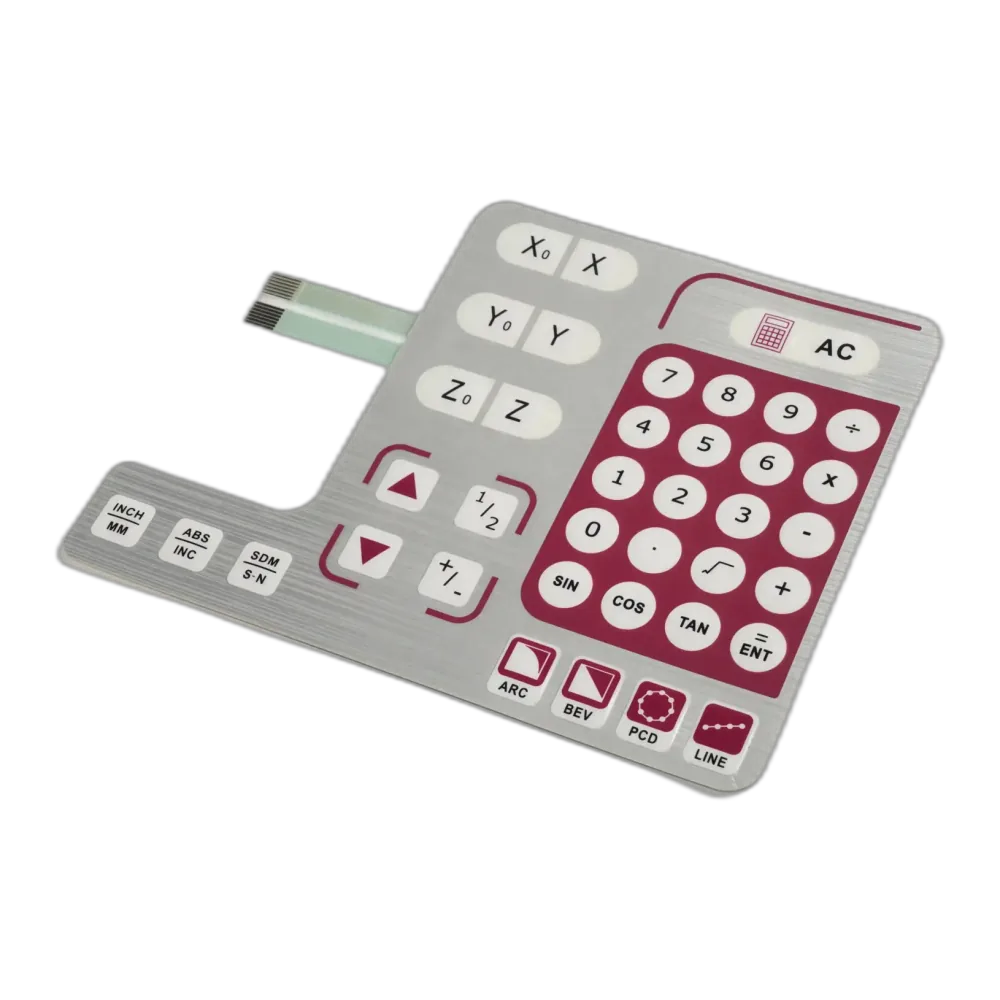
Industrial Control Membrane Keypad for Machine Interface
Industrial control membrane keypads need clear legends, durable surface materials, practical tactile feedback, connector reliability, and a structure that matches the enclosure and operating environment.
JASPER supports similar equipment-panel projects with key structure review, overlay printing, connector planning, circuit production, and quality inspection.
What the project needed to solve
The snapshot keeps the case practical: application, part type, design risks, and review scope.
| Item | Project direction |
|---|---|
| Application | Machine control, industrial equipment, or instrumentation panel |
| Product type | Membrane keypad with tactile keys and printed front overlay |
| Key concerns | Gloved operation, legend durability, tail direction, connector matching, adhesive bonding |
| JASPER review scope | Key structure review, connector review, overlay printing, circuit production, testing |
| Project reference | JASPER project example |
The keypad has to work for the operator and fit the enclosure
Industrial operators need an interface that is easy to read and use. The keypad may be mounted on metal or plastic housings, used with gloves, exposed to dust or light splashing, and handled repeatedly during normal equipment operation.
Common design risks include cramped key spacing, weak tactile feel, poor color contrast, tail exits that conflict with the enclosure, and adhesive mismatch with the mounting surface.
Buyer note: Send the housing drawing, connector specification, mounting surface, key layout, and operator environment before confirming the sample structure.

Design decisions JASPER would review before sampling
The response focuses on structure and production controls, not unsupported performance promises.
Key and dome review
Review key size, spacing, dome force, embossing, spacer height, and whether the operator may use gloves.
Overlay durability
Review surface finish, color contrast, legend size, abrasion expectations, and cleaning or dust exposure.
Tail and connector planning
Confirm tail exit, length, bend radius, stiffener, contact side, pitch, pin count, and mating connector orientation.
Adhesive and enclosure fit
Match adhesive to metal, plastic, powder-coated, or textured surfaces and verify available bonding area.
Inspection criteria
Define visual review, electrical testing, key function, dimension checks, and packing protection before production.
Inspection points that should be defined before approval
The sample should be judged against agreed visual, functional, dimensional, and documentation criteria.
| Area | Review point | Why it matters |
|---|---|---|
| Tactile feel | Dome force, key size, embossing, spacer height, user environment | Supports operator feedback and repeat sample approval |
| Overlay | Surface finish, color contrast, legend durability, cleaning exposure | Protects readability and appearance |
| Circuit | Trace design, tail routing, connector pitch, bend radius, stiffener needs | Prevents assembly and electronics mismatch |
| Adhesive | Bonding surface, housing material, powder coating, gasket needs | Reduces installation failure risk |
| Inspection | Visual review, electrical testing, key function, dimension check | Confirms production matches the approved sample |
Information JASPER needs for a similar project
Better RFQ inputs reduce quotation back-and-forth and prevent late structural changes.
| Input needed | Useful detail | Why it matters |
|---|---|---|
| Operator use | Gloves, vibration, lighting, key frequency, service environment | Defines key size, force, color, and surface needs |
| Connector data | Pitch, pin count, contact side, mating connector, tail exit direction | Prevents wrong connector or tail orientation |
| Housing details | Material, surface finish, available adhesive area, screw bosses, cutouts | Affects adhesive and mechanical fit |
| Circuit requirements | Matrix, pinout, LED needs, shielding or grounding if any | Connects keypad to customer electronics |
| Approval criteria | Key feel, color tolerance, visual limits, test records, packing | Makes sample approval repeatable |
Buyer takeaway
Industrial membrane keypad projects should not be treated as only a printed sticker with buttons. The enclosure, user environment, connector, adhesive, and tactile feel should be reviewed together before tooling.
Continue planning this type of project
Related resources connect the case example with product options, resource guides, quality planning, and quotation preparation.
Questions buyers ask before sharing a similar project
Can JASPER make industrial membrane keypads for equipment panels?
Yes. JASPER manufactures custom membrane keypads and control panel interfaces for industrial equipment and related OEM applications.
Can the keypad be designed for gloved operation?
Yes. Key size, spacing, tactile force, embossing, and graphics should be reviewed for gloved use.
Can JASPER match a connector requirement?
Connector and tail requirements can be reviewed when the buyer provides pitch, pin count, orientation, contact side, and mating connector information.
Can the keypad be sealed against dust or splash?
Sealing can be reviewed with the enclosure, adhesive surface, tail exit, gasket path, and target exposure. It should not be assumed from the keypad alone.
What makes industrial keypad approval easier?
Clear drawings, connector data, enclosure information, expected use environment, and defined sample approval criteria reduce revisions.
Need an industrial membrane keypad for a machine interface?
Send your panel drawing, enclosure information, connector requirement, operator environment, and target quantity for design review.
Request Project Review