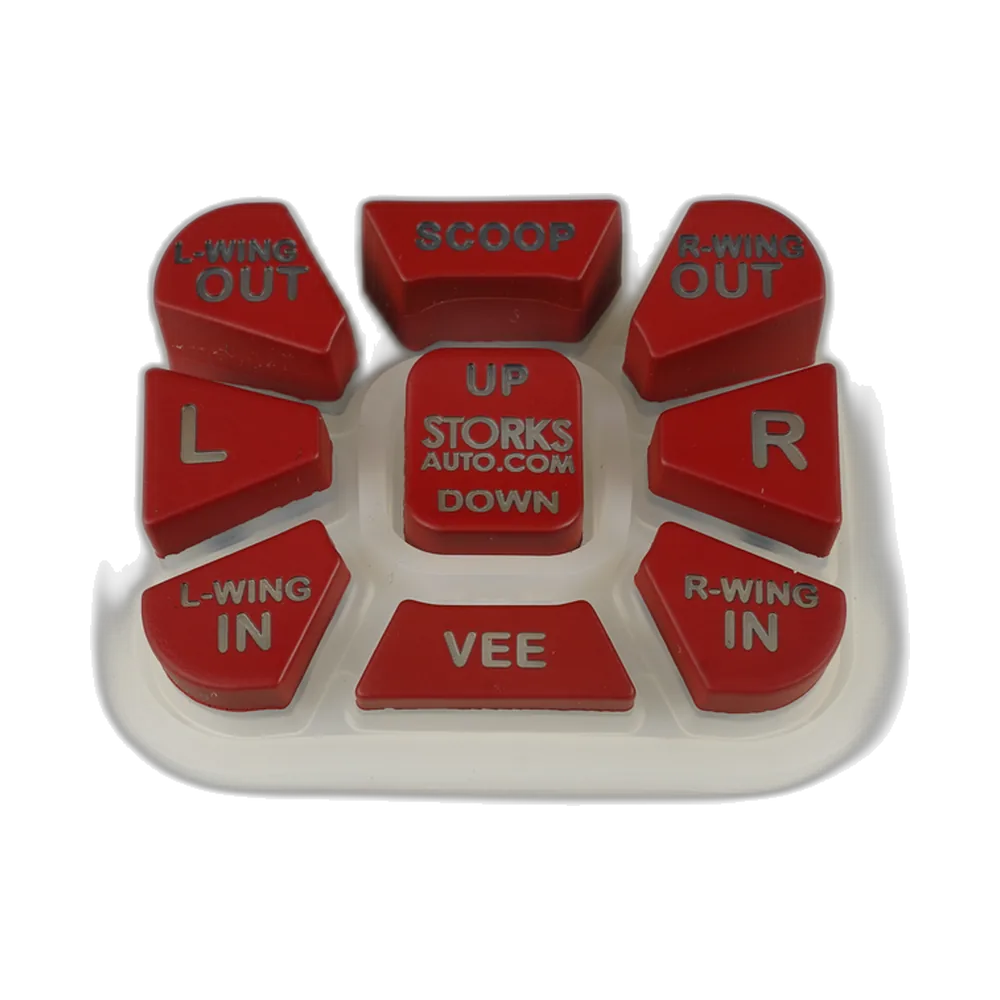
Raised and recessed molded legends can identify silicone keypad functions without depending on a surface-applied printed mark. A raised legend stands above the key surface; a recessed legend is formed below it. Either can add tactile information and preserve physical identification when surface appearance changes, but neither automatically creates high visual contrast, backlighting, accessibility compliance, or easy cleaning.
Choose between them by defining the operator need, tooling route, cleaning exposure, color requirement, and likelihood of future artwork changes.
JASPER’s existing laser legend and coating guide treats molded or recessed legends as one alternative to a coated and laser-opened surface. This article focuses on the artwork, tooling, cleaning, wear, and approval questions that belong specifically to molded geometry.
- Define the Visual and Tactile Identification Goal
- Review Symbol Geometry as a Mold Feature
- Concept Figure 1: Raised vs. Recessed Tool Relationship
- Check Cleanability and Surface Transitions
- Concept Figure 2: Cleaning and Wear Zones
- Consider Optional Color and Decoration Separately
- Plan Approval and Future Symbol Changes
- Molded Legend Engineering Review Checklist
- Accessibility and Braille Need a Separate Review
- What Should the OEM Send for Review?
- Review Your Keypad Artwork and Finish
Define the Visual and Tactile Identification Goal
Do not begin with “embossed or debossed?” Begin with the job the symbol must perform. A molded feature may help a user locate a key without looking, distinguish a navigation or safety function by touch, avoid dependence on surface ink, or provide geometry that is later combined with print, color fill, coating, or laser processing.
A tactile locator and a visual legend are not the same requirement. A shape that feels obvious through a glove may have poor visual contrast. Raised and recessed forms can aid orientation, while smoother surrounding surfaces can support wipe cleaning. Approve the final geometry on molded samples for the intended use.
| Decision factor | Raised molded legend | Recessed molded legend | What to verify |
|---|---|---|---|
| Tactile identification | Exposed edge or top feature can be felt | Groove or depressed outline can be felt | Intended finger, glove, posture, and movement |
| Visual effect | Highlights and shadows around an exposed feature | Shadow can emphasize the recess but may vary with angle | Actual ambient light and viewing angle |
| Cleaning | Base transition interrupts the wipe path | Narrow or deep recess can retain residue | Real cleaner, wipe/brush, and contaminant |
| Wear | Tops and edges receive direct rubbing | Deepest region may see less direct finger contact | Rounding, polishing, cuts, residue, loss of definition |
| Tooling | Raised part geometry requires recessed tool features | Recessed part geometry requires projecting tool features | Tool access, finish, release, repair, and inspection |
| Optional color | Flat exposed tops may be printable | Recesses may be candidates for controlled color filling | Adhesion, coverage, cure, cleaner resistance |
Review Symbol Geometry as a Mold Feature
A vector file does not fully define a molded legend. Once the symbol becomes three-dimensional, it affects both the silicone part and the tool.
The positive/negative relationship is fundamental: a raised symbol on the part requires a recessed feature in the mold, while a recessed symbol on the part requires a projecting tool feature. This changes tool access, finishing, release, repair, and measurement.
Molded text is often among a part’s smallest features, and choosing raised or recessed geometry changes machining access. Dimensions from plastic-molding guidance should not be copied into a silicone keypad drawing as universal values.
Ask the keypad supplier to review the actual symbol for:
- minimum manufacturable stroke and gap for the chosen molding route;
- required draft or release allowance;
- root radius and edge transition;
- fragile standing tool steel on recessed part features;
- curvature, texture, parting-line, trim, and key-edge conflicts;
- flash or incomplete-fill inspection around the symbol;
- finished height/depth inspection; and
- whether a replaceable tool insert is appropriate if the symbol may change.
Keep the legend tied to product datums and key IDs, not only to the visual center of the key.
Concept Figure 1: Raised vs. Recessed Tool Relationship
Show the same simple symbol in section. On the left, show a raised silicone symbol and the corresponding cavity cut into the tool. On the right, show a recessed silicone symbol and the corresponding projecting tool feature. Label mold opening direction, symbol wall, root transition, and part surface. State that actual draft, radius, height, and depth are project-specific.
Check Cleanability and Surface Transitions
Without surface ink, a molded symbol removes an ink-loss failure mode but adds geometry that changes how fingers, wipes, liquids, and particles move across the key.
JASPER’s current legend guide specifically warns that deep recesses can collect contamination and make coating coverage harder to inspect. Narrow valleys, sharp internal corners, and small closed shapes therefore deserve extra attention when the product sees dust, food residue, oils, disinfectants, or repeated wipe-down.
Raised legends need a different review. Their tops, edges, and bases can receive sliding finger contact, fingernail contact, cloth drag, or trapped grit. A feature that feels clear on a first sample may not be the easiest surface to clean repeatedly.
Use a project-specific cleaning check:
- contaminate representative molded samples with the expected soil;
- clean them with the specified wipe, brush, cleaner, and sequence;
- inspect the legend base, recess bottom, corners, and nearby texture after drying; and
- repeat after mechanical cycling when cleaning and use interact.
Record staining, trapped residue, gloss change, swelling, edge damage, or loss of tactile definition. If cleanability dominates, simplify the symbol and avoid unnecessary pockets.
Concept Figure 2: Cleaning and Wear Zones
Show a wipe path across raised and recessed cross-sections. Mark likely soil-retention zones at a raised feature base and inside a recess, plus direct rub zones on exposed tops and edges. Label the drawing as a conceptual inspection aid, not a universal failure prediction.
Consider Optional Color and Decoration Separately
A molded legend is geometry. If the symbol and surrounding key use the same silicone color, the visual effect depends mainly on shape, shadow, texture, and lighting. Do not describe it as high contrast without actual visual evidence.
A raised symbol or key top may accept printing when the printable area is flat and accessible. Screen printing is best suited to flat button surfaces; it cannot be assumed to wrap around curved or angled sides. Adding print requires controls for surface preparation, ink, cure, registration, cleaner exposure, and wear.
Recessed symbols can also be paired with color filling in some keypad processes. Treat this as a secondary process that must be qualified for fill coverage, edge cleanliness, cure, adhesion, cleaner compatibility, and flexing.
When the product also needs backlighting, multiple colors, or day/night graphics, compare molded geometry with the JASPER laser legend and coating guide and the laser-etched silicone keypad product route. A molded feature can be easy to feel and still be difficult to see in low light.
Plan Approval and Future Symbol Changes
Molded legends are tied to tool geometry, so later language, branding, regulatory, or key-function changes can require tooling work.
Before release, classify each symbol as stable, market-specific, customer-specific, regulated/safety-related, or still TBD. If change is likely, ask whether the symbol region can be localized in a replaceable tool insert. Do not assume this is always practical; confirm it during DFM review. If many variants are expected, printing or laser marking may provide a cleaner change path.
Approve the legend through separate evidence for geometry, tactile identification, visual readability, cleaning, wear, and any added decoration.
Molded Legend Engineering Review Checklist
| Review area | Questions before release | Evidence to retain |
|---|---|---|
| Readability | Is the symbol recognizable at the intended distance, angle, and lighting? Where does contrast come from? | Approved molded sample and viewing condition |
| Tactile identification | Can the intended user identify it without sight? Does a glove change the result? | User/glove evaluation and sample revision |
| Tooling | Can the feature be machined, released, finished, measured, repaired, and changed? | Supplier DFM mark-up and tool revision |
| Cleanability | Do bases, recesses, corners, or texture retain residue? | Before/after photos and cleaner record |
| Wear | Do edges round, polish, cut, tear, or lose tactile definition? | Periodic inspection and retained samples |
| Optional color | Is print/fill/coating controlled on the real geometry? | Process revision and adhesion/cleaner results |
| Change control | What happens if the icon or language changes? | Tool/insert plan and controlled artwork history |
Accessibility and Braille Need a Separate Review
A raised dot pattern or character is not automatically Braille or accessibility compliant. Applicable standards can define form, spacing, dot geometry, placement, contrast, and covered use cases.
For example, the U.S. 2010 ADA Standards include specific requirements for raised characters and Braille in covered signage and control contexts. Those requirements should not be generalized into every silicone keypad design. If accessibility is required, identify the applicable regulation or customer standard first, then validate the molded geometry against it.
What Should the OEM Send for Review?
Send the 2D drawing and 3D model, controlled vector artwork, key IDs and orientation, which symbols must be visual or tactile, intended user and gloves, base color and texture, cleaner/contamination exposure, high-use keys, backlighting requirements, enclosure geometry near the key surface, quantity, and any market-specific or regulated symbols. Mark unresolved items TBD instead of guessing.
For the broader construction, start with custom silicone rubber keypads. For engineering and quotation review, submit the keypad drawing and requirements.
Frequently Asked Questions
Are molded legends always more durable than printed legends?
No universal lifetime claim should be made. A same-material molded symbol cannot lose an ink layer that was never applied, but its geometry can still polish, round, cut, tear, trap contamination, or become harder to identify. Added print, fill, paint, or coating needs separate validation.
Is raised or recessed better for tactile identification?
Either can work. Raised geometry often gives an exposed boundary, while recessed zones and grooves can also help orientation. Approve the actual scale with the intended finger or glove.
Can a molded legend replace laser etching?
Sometimes, when physical identification without backlighting or strong color contrast is the main goal. For illuminated graphics, sharp color separation, or dead-front behavior, a laser or printed architecture may be more appropriate.
Can recessed legends be color filled?
They can be considered for color filling, but coverage, edge cleanliness, cure, adhesion, cleaner exposure, flexing, and visual acceptance must be qualified on the molded part.
Does a raised dot pattern count as Braille?
Not automatically. Braille and tactile-character requirements come from the applicable accessibility standard and use context.
Can the legend be changed after the mold is built?
Usually only through a tooling change. A planned replaceable insert may reduce the scope, but that must be agreed before tooling. Frequent artwork variants may favor printing or laser marking instead.
Review Your Keypad Artwork and Finish
If you are deciding whether a function should be raised, recessed, printed, laser-etched, or combined, send the current keypad model, artwork, use environment, cleaning method, lighting requirement, quantities, and symbols that are still TBD. The review should resolve the identification goal, mold feature, surface process, validation method, and future change path before production tooling is locked.
Ready to Start Your Project?
Tell us about your membrane switch, keypad, or graphic overlay requirements. Our engineering team will review your specifications and provide a detailed quote.