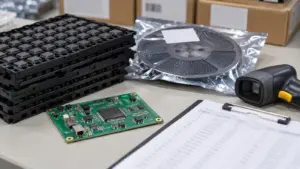
PCB assembly excess component management means reconciling leftover parts, confirming their owner and approving what happens next. Return stock when the OEM needs custody; retain it at the assembler when storage controls and future demand justify the cost. Reserve parts for another build only after checking the released BOM and their condition. For opened moisture-sensitive semiconductor stock, use below 5% RH as a dry-storage reference target where compatible with device requirements. Preserve exposure history: resealing a bag does not make its contents automatically ready for reflow.
- Why the Wrong Disposition Costs More Than Storage
- Reconcile Purchased, Consumed and Remaining Components
- Confirm Ownership Before Choosing a Disposition
- Compare Return, Supplier Storage and Future Reuse
- Preserve Labels, Lots and Moisture-Handling History
- Track moisture floor life separately from shelf life
- Preserve the condition while the decision is pending
- Approve Carryover Stock Against the Next Released BOM
- Ten Criteria for PCB Assembly Excess Component Management
- Close the Build with an Excess-Material Record
- Step 1 — Freeze the closeout scope
- Step 2 — Count and classify the residual stock
- Step 3 — Confirm ownership and choose disposition
- Step 4 — Preserve and transfer the material
- Step 5 — Complete any reuse release
- Step 6 — Confirm receipt and close the balance
- Eight Signals That Require Escalation Before Release
- Prepare the Next Material Decision
Why the Wrong Disposition Costs More Than Storage
A poor excess-material decision leaves the next build relying on stock that may be unavailable for use. The costs accumulate. Recounting, repacking, engineering review and replacement purchases can all arise after purchasing has already deducted the leftover quantity from the next order’s requirements and production has scheduled work around its availability.
Consider a partial reel labeled “available” whose exposure record is missing. Its quantity is correct. Production still needs a moisture-handling assessment before reflow, and the apparent stock saving becomes a shortage if that assessment prevents issue at the scheduled time.
Ownership needs equal attention. If an assembler holds customer-funded material beside its own stock while the OEM expects the entire unused balance back, an undocumented custody arrangement can become a dispute over both the asset and its return charges.
Treat disposition as a controlled handover. Each residual quantity needs an owner, a physical location, a condition status and a named decision authority. A storage reservation protects access to parts; a production release authorizes their use. Keep those decisions separate.
Reconcile Purchased, Consumed and Remaining Components
Reconcile excess components by manufacturer part number, owner and lot or container before classifying them for reuse. Start with physical stock. Compare that count with receipts and recorded movements, because an order quantity proves neither what arrived nor what remains.
Bring together accepted receipts, earlier carryover and the final production record. Check unfinished work too. A balance based only on shipped boards misses parts fitted to retained samples, rejected assemblies and boards still at rework, even though those components have already left the loose-stock inventory.
Use mutually exclusive accounts:
Expected residual = opening stock + accepted receipts − net installed quantity − recorded process losses − separately recorded rework removals − transfers already completed.
“Net installed” includes components currently fitted to all accounted assemblies, including retained or rejected boards. Rework removals belong in a separate deduction only when they are no longer included in net installed quantity or another loss account. Recoverable removed parts require a separate condition assessment.
For an illustrative control-board build, opening stock is zero and accepted receipts are 2,200 pieces. The records show 2,000 pieces still installed, 40 lost during setup or placement, and 20 removed during rework and recorded as nonrecoverable. No earlier transfers occurred. The expected residual is 140 pieces.
The count finds 130 candidate pieces and 10 damaged pieces in quarantine. All 140 are accounted for, but only 130 can enter the reuse review. Recorded nonrecoverable losses still need disposition authority if they remain physically held; accounting does not authorize disposal.
Count each partial reel, strip, tray or tube with a method suited to its packaging. Log the date and method. When a count is disputed, isolate the affected containers and repeat the measurement, keeping the original label relationship and resolving any handling movements between the two counts.
Assign each unexplained difference an owner and resolution record. Never force the balance.
Confirm Ownership Before Choosing a Disposition
The purchase terms and excess-material agreement determine who controls leftover components. Check the agreed terms. “Turnkey” describes a purchasing arrangement; it does not resolve the ownership of every unused part or authorize its transfer, allocation or disposal.
Distinguish customer-supplied components, material bought specifically for the order and assembler stock sold into the build. One order can contain all three. A minimum-order purchase charged to the OEM also needs an explicit rule for the unused balance; the invoice line should connect to the material record.
Separate title, custody, costs and approval authority. Possession is not permission. An assembler holding OEM-owned material needs the agreed authority to use it elsewhere, while an OEM requesting return may still owe the packing and transport charges specified in the order terms.
Record reuse charges explicitly. The next quotation should distinguish already-paid carryover material from new component purchases, assembly and agreed handling services, so the OEM can check the material credit without assuming that storage or repacking is free.
A practical agreement names the owner, permitted storage location, review date, access or return procedure, loss responsibility and authorized approvers. It also addresses project cancellation and an unanswered disposition request. Silence is not approval to consume, transfer or destroy assets.
If ownership remains disputed, preserve the stock and block its release while the commercial owners resolve the record.
Compare Return, Supplier Storage and Future Reuse
Choose return when OEM custody or a change of assembler matters most. Choose assembler storage when a credible future requirement and suitable preservation controls justify retaining the stock. Reserve material for a repeat build or approved variant only with a defined allocation and a separate reuse gate.
The first two options describe custody. The next two describe intended use, so a reservation can coexist with either custody arrangement. Authorized disposal is an exceptional disposition after the owner has reviewed the alternatives.
| Disposition Option | Ownership Check | Storage Requirement | Reuse Approval | Cost or Risk Driver |
|---|---|---|---|---|
| Return to OEM | Confirm owner, recipient and return authorization against the order | Preserve ESD protection, lot separation and applicable moisture protection during packing and transit | OEM receiving and quality functions reassess before a later issue | Freight, repacking, transit damage and receiving effort |
| Store at assembler | Record whose asset is held and restrict access or cross-customer allocation | Named location, monitored conditions, container identity and an agreed review date | Separate release against the next job and current BOM | Storage fees, retrieval effort, condition deterioration and uncertain demand |
| Reserve for repeat build | Assign owner, quantity and intended order without transferring title | Preserve the same material controls and prevent double allocation | Confirm released BOM, approved part and remaining usable quantity before issue | Forecast changes, tied-up stock and revision mismatch |
| Use in an approved variant | Confirm owner permission for transfer to the named variant | Retain lot lineage, packaging status and exposure record during movement | Engineering approves the variant; quality releases condition; purchasing authorizes allocation | Qualification effort, firmware or grade mismatch and documentation changes |
| Request authorized disposal | Obtain written owner authorization for identified lots and quantities | Keep controlled segregation until authorized collection or processing | No production reuse; retain disposition and completion evidence | Asset write-off, handling charges and unauthorized removal |
Obtain comparable cost quotations. Use the same planning period and include packing, return freight and OEM receiving work for the return option, versus storage, periodic review, retrieval and required repacking for the retained-stock option. Include the consequences of failed release. If the stock cannot pass its future condition check, the budget still needs a replacement purchase and the schedule may need recovery time.
Return is often sensible when repeat demand is uncertain or the OEM is moving production. Storage needs a purpose. A named future order, a retrieval process and preserved material history make retention useful; a low storage price cannot compensate for a reel that cannot pass its next release check.
Preserve Labels, Lots and Moisture-Handling History
Preserve each residual container’s original identity and handling history. A cut-tape strip or partial reel needs its full part number, lot, quantity and condition, together with the records that let the recipient decide whether it can enter assembly. Keep the record with the material.
Keep the manufacturer, full orderable part number, OEM cross-reference, original lot/date codes and source-document reference. Add quantity, container ID, owner, order, count date and condition. Retain original reel and bag labels or accessible images; an internal barcode supplements them.
Give split material child IDs tied to the original reel and lot. Count the remainder. Keep different lots separated even when part numbers match; a label photograph cannot recover lot identity after components have been mixed.
Track moisture floor life separately from shelf life
Moisture sensitivity level, or MSL, describes a handling limit before reflow. IPC/JEDEC J-STD-020 addresses moisture/reflow classification; J-STD-033 addresses handling, packing, shipping and use. The table below shows the complete class sequence. Higher is not better.
| Moisture class | Floor-life allowance | Reference ambient condition |
|---|---|---|
| MSL 1 | Unlimited moisture floor life | ≤30°C and ≤85% RH |
| MSL 2 | 1 year | ≤30°C and ≤60% RH |
| MSL 2a | 4 weeks | ≤30°C and ≤60% RH |
| MSL 3 | 168 hours | ≤30°C and ≤60% RH |
| MSL 4 | 72 hours | ≤30°C and ≤60% RH |
| MSL 5 | 48 hours | ≤30°C and ≤60% RH |
| MSL 5a | 24 hours | ≤30°C and ≤60% RH |
| MSL 6 | Mandatory bake, then reflow within the time on the label | ≤30°C and ≤60% RH; follow the label |
MSL 6 requires baking and observance of the labeled exposure time. These limits concern moisture exposure before mounting and reflow. They do not promise unlimited solderability, electrical integrity or warehouse life, including for MSL 1.
Record bag opening, cumulative exposure, resealing, entry into dry storage, temperature/humidity conditions and approved drying. An illustrative MSL 3 lot exposed for 36 hours under the reference conditions has 168 − 36 = 132 hours remaining. Count through reflow. The next operation must fit that balance, including inspection, staging and any line delay before soldering.
Unknown exposure is not zero. If conditions exceeded the reference limits or the history is incomplete, assess the lot under the applicable procedure before assigning a remaining allowance.
Preserve the condition while the decision is pending
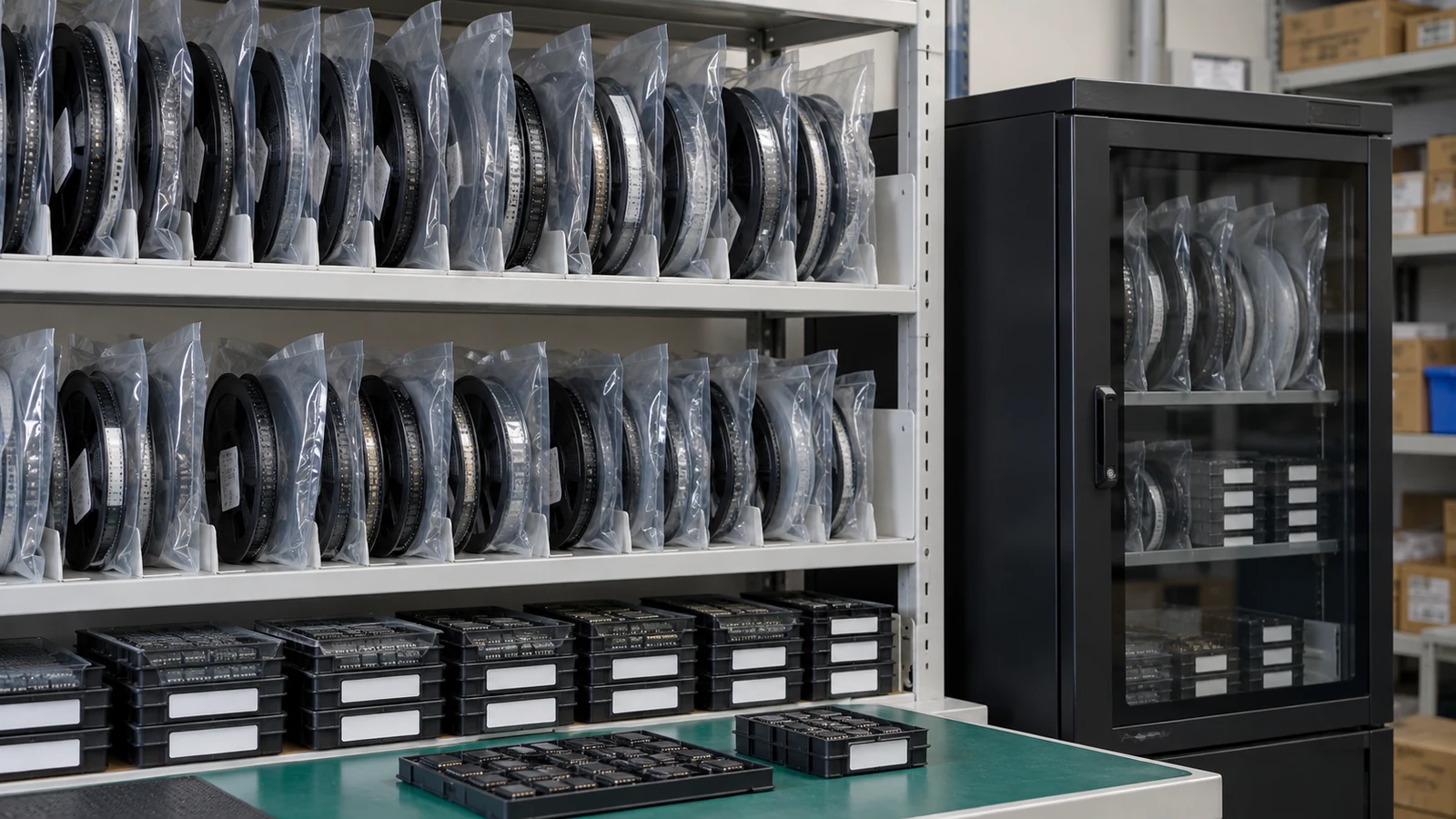
For opened moisture-sensitive semiconductor carryover, specify below 5% RH as a dry-storage reference target where the device requirements permit it, with monitored conditions and ESD protection. For the TLA handling example, in-process storage uses dry nitrogen or air below 5% RH. Apply the target through a qualified procedure; it is not a universal material limit.
A suitable moisture barrier bag with the required desiccant, humidity indicator card and effective seal is another preservation route. Inspect the bag and interpret the indicator using its applicable instructions. An ordinary antistatic bag does not automatically provide a moisture barrier.
Keep the exposure ledger after resealing. Any storage credit or restored allowance needs the applicable documented process. A cabinet is not a reset button.
Excessive moisture exposure can cause reflow damage. When exposure or packaging condition requires drying assessment, use the component-specific procedure and verify carrier temperature and packing limits. Do not apply one bake recipe to every reel, tray, connector or sensor.
Approve Carryover Stock Against the Next Released BOM
Approve carryover only when the exact component, condition and allocation match the next released build. Board names are insufficient. Review the BOM revision, approved manufacturer list and engineering changes before making the stock available to production, even when the purchasing system recognizes the same internal part number.
Match the full manufacturer part number, package, rating, tolerance, temperature grade, finish and required qualification. Check configuration where applicable. A shared footprint does not establish variant approval if a changed firmware image, device grade or electrical requirement makes the stored component unsuitable.
Keep document responsibilities clear. The BOM identifies the required parts and reference designators; the component placement list specifies position, rotation and board side. The referenced supplier’s BOM and CPL guidance makes this distinction explicit. Neither file alone records permission to use a particular leftover lot.
Review stored material for label continuity, seal condition, corrosion or contamination, physical damage, exposure history and any manufacturer storage or inspection conditions. Determine whether additional solderability evaluation or other testing is warranted by the actual risk and project requirements. A date code alone does not settle the decision; assess material, packaging and storage together.
Engineering approves BOM or variant suitability. Quality approves condition and any recovery route. Purchasing confirms ownership and allocation; production then issues the released quantity, preserving the lot and container references so the next build’s consumption can be reconciled against the same stock record.
In the 140-piece closeout example, 10 quarantined pieces stay unavailable. A repeat order for 100 boards requiring one part per board has a 100-piece net requirement before any separately justified process allowance. Reserving 100 of the 130 candidate pieces leaves 30 unallocated. Production approval still depends on the lot passing its release checks.
Ten Criteria for PCB Assembly Excess Component Management
Evaluate excess-component handling against ten controls that connect the physical stock to its next authorized action. Use the framework during closeout and before accepting a storage arrangement. A strong result in one row cannot compensate for a failed ownership or condition check.
| Evaluation criterion | Good signal | Red flag |
|---|---|---|
| 1. Quantity reconciliation | Receipts, fitted parts, losses and residual containers reconcile without double counting | Remaining stock is calculated only from ordered quantity and shipped boards |
| 2. Ownership and custody | Order terms identify the owner, custodian and authorized decision maker | Parts are assumed to belong to whoever holds the reel |
| 3. Identity and traceability | Full part number and each child container link to original lot/source records | Generic description or mixed-lot bag is the only identification |
| 4. Packaging and ESD protection | Tape, trays, tubes and protective packaging remain suitable for transfer and later feeding | Loose components, damaged pockets or unverified replacement packaging |
| 5. Moisture-history continuity | MSL, cumulative exposure and permitted storage treatment travel with the material | A new bag or fresh label erases previous exposure |
| 6. Storage control | Actual location and monitored conditions match the applicable device requirements | Cabinet ownership is offered as proof without material or condition records |
| 7. Revision suitability | Engineering checks exact parts against the released BOM and approved variant | Same value or footprint is treated as sufficient approval |
| 8. Inspection and recovery | Quality sets inspection or recovery scope from history, condition and requirements | Every old lot is accepted, rejected or baked using one blanket rule |
| 9. Commercial accountability | Carryover value, fees and future purchase deductions are explicit | Already paid stock is bought again or storage charges are undefined |
| 10. Release and closure | Owner-approved disposition is separate from production release and confirmed by a receipt | Verbal permission, unanswered emails or a forecast is treated as authorization |
Apply these criteria to the actual material, not just the assembler’s general procedure. Ask for a representative residual-stock line showing how a split reel retains its lot, quantity and exposure balance. The example should make it possible to locate the physical container and identify who may change its status.
Weight the consequences in the project context. A small count discrepancy in inexpensive passives and a missing identity record for a programmed device require different investigations. Neither should disappear into an unexplained adjustment. The closeout record must show what was resolved and what remains on hold.
Close the Build with an Excess-Material Record
Close a PCBA build with a controlled excess-material record linking each container to its owner, quantity, condition, disposition and next approval. Make revisions identifiable. The receiving custodian must be able to match the physical package to that record without reconstructing the build from email.
Step 1 — Freeze the closeout scope
Name the order, BOM revision and accounting cutoff. Collect receipts, consumption, losses, rework records and transfers, including material still at machines or inspection benches.
Step 2 — Count and classify the residual stock
Count by container and lot; separate candidates from quarantine. Record packaging condition and count method. Resolve variances from actual movements.
Step 3 — Confirm ownership and choose disposition
Purchasing and the owner’s representative select the disposition. Attach approval to the material line, identifying quantity, custody location, review date and cost treatment.
Step 4 — Preserve and transfer the material
Preserve labels, ESD protection and moisture controls. Log packing, storage and exposure events. Send the itemized record with returned containers and retain dispatch evidence.
Step 5 — Complete any reuse release
Engineering and quality review the released BOM and material history. Record permitted quantities, restrictions and inspection or recovery actions. Reservation can precede release.
Step 6 — Confirm receipt and close the balance
The receiving custodian acknowledges quantity, identity and condition. Resolve dispatch/receipt differences and update inventory. Held stock retains its decision owner and next action.
This fictional partial-reel record illustrates the fields an OEM can use. CC1101RGPR is identified as an MSL 3 device; the lot, order, quantities and handling events below are invented examples, not JASPER production data.
| Record field | Information to record | Illustrative completed entry |
|---|---|---|
| Build identity | Order, assembly and released BOM revision | Order EX-104; control board CB-17; BOM revision C |
| Material identity | Manufacturer, full part number, OEM cross-reference and source reference | CC1101RGPR; OEM item IC-014; receipt REC-104-07 |
| Lot and container | Original lot/date code and child container identifier | Illustrative lot EXLOT-01; date code 2601; label image LAB-104-07; partial reel PR-104-01; quarantine bag Q-104-01 |
| Quantity balance | Received, net installed, losses, rework removals and physical residual | 2,200 received; 2,000 fitted; 40 process losses; 20 rework removals; 140 residual pieces |
| Condition split | Candidate and held quantities with reason | 130 candidate pieces; 10 pieces in quarantine for damaged packaging/parts |
| Moisture record | MSL, exposure balance and preservation event | MSL 3; 36 hours accumulated at ≤30°C / ≤60% RH; 132 hours calculated remaining; qualified dry storage below 5% RH |
| Ownership and custody | Owner, location and controlled-storage reference | OEM owns stock; assembler holds PR-104-01 in controlled location DC-02; quarantine remains separate |
| Allocation and authorization | Intended job, permitted quantity and production-release status | 100 pieces reserved for repeat order EX-105; 30 unallocated; OEM purchasing approval DISP-104; production release pending engineering/quality checks |
| Review and acknowledgment | Next review date, responsible roles and custodian acceptance | Agreed review September 30, 2026; material controller accepts custody; OEM buyer owns the decision |
For an actual handover, enter the real values and retain accessible original labels. Do not copy illustrative lot IDs into a production record.
Keep condition separate from disposition. “Stored” identifies custody; “reserved” identifies demand. Neither proves production release. The review date triggers a decision, not automatic expiry or disposal.
Eight Signals That Require Escalation Before Release
Stop the affected material’s release when identity, ownership, condition or approval cannot support the intended action. Escalate the specific line or lot and preserve the evidence; one problem does not require an unsupported verdict on every remaining component.
| Escalation signal | Required response |
|---|---|
| Physical and recorded quantities disagree without an explained movement | Recount affected containers and assign the variance investigation |
| Owner or disposal authority is disputed | Hold the asset while authorized commercial representatives resolve control |
| Labels cannot connect the part to its source or original lot | Segregate material and investigate identity before reuse |
| Exposure history is missing or the applicable allowance was exceeded | Block release for moisture-handling assessment under the device procedure |
| Packaging, indicator or storage records suggest loss of protection | Quarantine and let quality define inspection or recovery |
| The new BOM changes part number, grade or approved variant | Require engineering review before allocation becomes a production issue |
| Storage or handling charges differ from the agreed basis | Resolve the commercial instruction before committing the disposition |
| A disposal request has no written owner approval | Preserve controlled custody and obtain a specific authorization |
A label discrepancy or unusual appearance warrants investigation. It is not, by itself, proof of counterfeit material. Preserve photographs, packaging and source records for qualified assessment.
Frequently Asked Questions
Excess-component decisions turn on ownership, identity, preservation and explicit release. These answers apply the same controls to common OEM purchasing and handover questions.
Who owns excess components from a turnkey PCBA order?
Ownership follows the agreed purchase and excess-material terms. Turnkey service alone does not assign every leftover part to the OEM or assembler. Check customer-funded purchases, assembler stock, minimum-order quantities and any excess charges, then record the owner and who may authorize return, reuse or disposal.
Can leftover parts be used automatically on the next order?
No. Leftover parts need approval against the next released BOM, an acceptable condition assessment and an authorized allocation. A repeat board name or forecast does not release inventory. Keep quarantined quantities excluded, and show carryover separately from new component purchases in the next quotation.
What labels should stay with returned cut tape or partial reels?
Keep the manufacturer, full part number, original lot/date codes and source reference with each identified container. Add the remaining count, owner, order reference, condition and applicable MSL/exposure record. Split containers need traceable child IDs; preserve original labels or accessible linked images without mixing lots.
How should stored excess components be checked after a revision change?
Compare the exact parts with the newly released BOM and approved manufacturer list, then review condition and handling history. Engineering checks electrical, package, grade and configuration suitability. Quality determines any inspection or recovery needed before production release, including moisture or solderability concerns.
When should an OEM choose return instead of supplier storage?
Choose return when the OEM needs custody, intends to move assembly, lacks credible repeat demand or cannot accept the proposed storage controls and costs. Include return packaging, freight and receiving work in the comparison. The receiving OEM must still preserve and review the material before later use.
Does resealing a moisture barrier bag reset floor life?
No. Resealing alone does not reset accumulated exposure. For an MSL 3 lot with 36 hours of exposure under the reference conditions, the calculated balance is 132 hours. Any credit for drying or dry storage must follow the applicable documented process and preserve the prior history.
How long can excess components remain in storage?
Use the component manufacturer’s storage requirements, packaging condition and actual handling history to set the decision. There is no universal shelf life for all excess components. An agreed review date prompts reassessment; it is not an automatic expiration date or permission to discard stock.
Should every leftover reel be baked before reuse?
No. Baking requires a device-specific reason and an approved procedure compatible with both components and carriers. Assess exposure, packaging and any recovery requirement first. Proper preservation can avoid unnecessary treatment, while a blanket bake can damage unsuitable packaging or parts and still leave identity problems unresolved.
Who should approve disposal of excess components?
The material owner or an explicitly delegated authority should approve disposal in writing for the identified lots and quantities. The custodian retains segregation, authorization and completion records. A canceled build, storage invoice or unanswered email does not independently authorize removal or destruction of the asset.
Prepare the Next Material Decision
Prepare the next PCBA material decision with the released BOM, closeout quantity balance, container and lot list, handling history, ownership terms and proposed disposition. Ask the assembler to return one consolidated response showing what can be returned, stored, reserved or submitted for further assessment.
For a JASPER enquiry, include that package alongside the assembly requirements and use the PCB assembly services page as the product reference. Identify the repeat order or approved variant if one exists, and request explicit storage, return and reuse terms.
The next authorization should name the owner, material, quantity, action and responsible approver. That makes the leftover stock actionable without losing control of its condition or commercial treatment.
Ready to Start Your Project?
Tell us about your membrane switch, keypad, or graphic overlay requirements. Our engineering team will review your specifications and provide a detailed quote.