For an OEM comparing PCB assembly in house vs outsource, in-house production wins when repeatable demand, complete process capability and available staff justify the fixed cost. Outsourcing wins when demand or technology requirements outgrow that operating base. For a demanding reference build—double-sided, lead-free SMT with 0.4 mm-pitch BGAs—budget inspection, hidden-joint X-ray access and execution of the agreed electrical acceptance test on 100% of production boards. Compare both routes against that same scope. Calculate break-even from accepted output and actual quotes, not machine prices alone.
- In-House or Outsourced Assembly: Compare the Full Operating Scope
- Calculate PCB assembly in house vs outsource costs on one basis
- Equipment, Facilities and Skills Required for the Product Mix
- Read machine specifications in their operating context
- Utilization, Changeovers and Demand Uncertainty
- A monthly capacity example
- Quality Control, Maintenance and Process Ownership
- Inventory, Scheduling and Supplier-Management Overhead
- Where In-House PCB Assembly Wins
- Control of Engineering Changes
- Repeatable Production Loading
- Access to Critical Processes
- Where Outsourced PCB Assembly Wins
- Control of Engineering Changes
- Repeatable Production Loading
- Access to Critical Processes
- A Make-or-Buy Decision for Prototype and Production Needs
- Keep the hybrid boundary clear
- Final Recommendation: Compare One Build Package
In-House or Outsourced Assembly: Compare the Full Operating Scope
In-house PCB assembly puts execution, capacity and daily process management inside the OEM. Outsourced assembly buys a defined manufacturing result while the OEM retains product requirements and supplier oversight. Match the deliverable first. A populated PCB without required programming or test cannot be priced as equivalent to an accepted, ready-to-integrate board.
Use this at-a-glance comparison before requesting equipment proposals or assembly quotations.
| Decision Dimension | In-House Build | Outsourced Build | Data Needed | Decision Implication |
|---|---|---|---|---|
| Capital and facilities | OEM funds installed equipment, utilities, space and tooling | Infrastructure in unit price; dedicated tooling may be extra | Installed cost, service, useful life, tooling/NRE | Uncertain demand favors outsourcing; sustained use supports in-house |
| Process coverage | Internal resources or managed subcontracts for every operation | Contracted operations and acceptance results | BOM, board geometry, soldering, inspection, test | Require complete product coverage |
| Capacity utilization | OEM carries idle assets and staff | Shared capacity with agreed availability | SKU forecast, setups, net output, peaks | Repeat work favors in-house; variable demand favors outsourcing |
| Quality ownership | OEM manages execution and acceptance | Supplier executes; OEM defines requirements and acceptance | Class, test coverage, records, failure ownership | Compare controls and assigned responsibilities |
| Inventory exposure | OEM carries components, WIP and excess stock | Material and cancellation terms allocate ownership | Commitments, packaging, ownership, liability | Verify which inventory risk transfers |
| Management workload | Operators, maintenance, planning, process engineering | Forecasts, changes, supplier performance, exceptions | Loaded staff-hours and escalation frequency | Cost retained OEM work in both routes |
Calculate PCB assembly in house vs outsource costs on one basis
Separate recurring fixed cost, variable cost per accepted board and transition cost. For one evaluation period:
C_make = F_make + Q × v_make
C_buy = F_buy + Q × v_buy
Q means accepted boards delivered. F_make covers fixed operations and the period’s capital allowance; v_make covers variable labor, consumables and material losses. F_buy covers attributable tooling, setup and program charges; v_buy covers the quoted build, transport and retained variable OEM costs. Match currency, period and material scope.
If v_buy exceeds v_make, the cost intersection is Q* = (F_make − F_buy) / (v_buy − v_make). Check its operating limits. A positive Q* supports in-house only if the volume fits demonstrated capacity, remains in the quoted price band and avoids staffing or equipment steps that change fixed cost. Recalculate for batch fees. A zero or negative variable-cost difference establishes no conventional volume-driven in-house crossover.
Evaluate new-line investment cash flows separately over the product’s expected life; the cost intersection is not a payback period. Existing equipment needs a different decision. Compare avoidable spending and displaced work, while excluding sunk purchase cost from a short-term incremental choice. Never charge the entire purchase and depreciation to the same operating period.
Equipment, Facilities and Skills Required for the Product Mix
In-house PCB assembly needs a complete process for the BOM and board; outsourcing needs that coverage in the purchase. The reference 0.4 mm-pitch BGA build exposes costs beyond placement and reflow: printing control, inspection, electrical test and troubleshooting. One missing operation can prevent delivery.
| Process Requirement | In-House Provision | Outsourced Scope to Match | Product Input |
|---|---|---|---|
| Paste printing and placement | Printer, stencils, feeders, nozzles, programs, setup checks | Approved material, program and setup controls | Package size, pitch, polarity, packaging |
| Reflow and through-hole work | Thermal profiling and selected soldering processes | Defined route and profile control | Alloy, thermal limits, board mass, connectors |
| Inspection | Solder-paste inspection (SPI), automated optical inspection (AOI), X-ray access | Inspection stages, defect disposition, results | Hidden joints and acceptance criteria |
| Electrical test and programming | Engineering, fixtures, instruments, software, maintenance | Matching coverage, limits, firmware, records | Test points, loads, interfaces, outputs |
| Supporting operations | ESD controls, moisture handling, storage, rework, finishing | Assigned handling and finishing responsibilities | Component handling and end-use environment |
Use 100% execution of the agreed production electrical test as the reference target, alongside SPI, AOI and suitable X-ray access. Test coverage remains circuit-specific. A board can pass its specified test while retaining an undetected fault, so inspection and test planning must address the actual package risks, accessible nodes and failure modes together.
Read machine specifications in their operating context
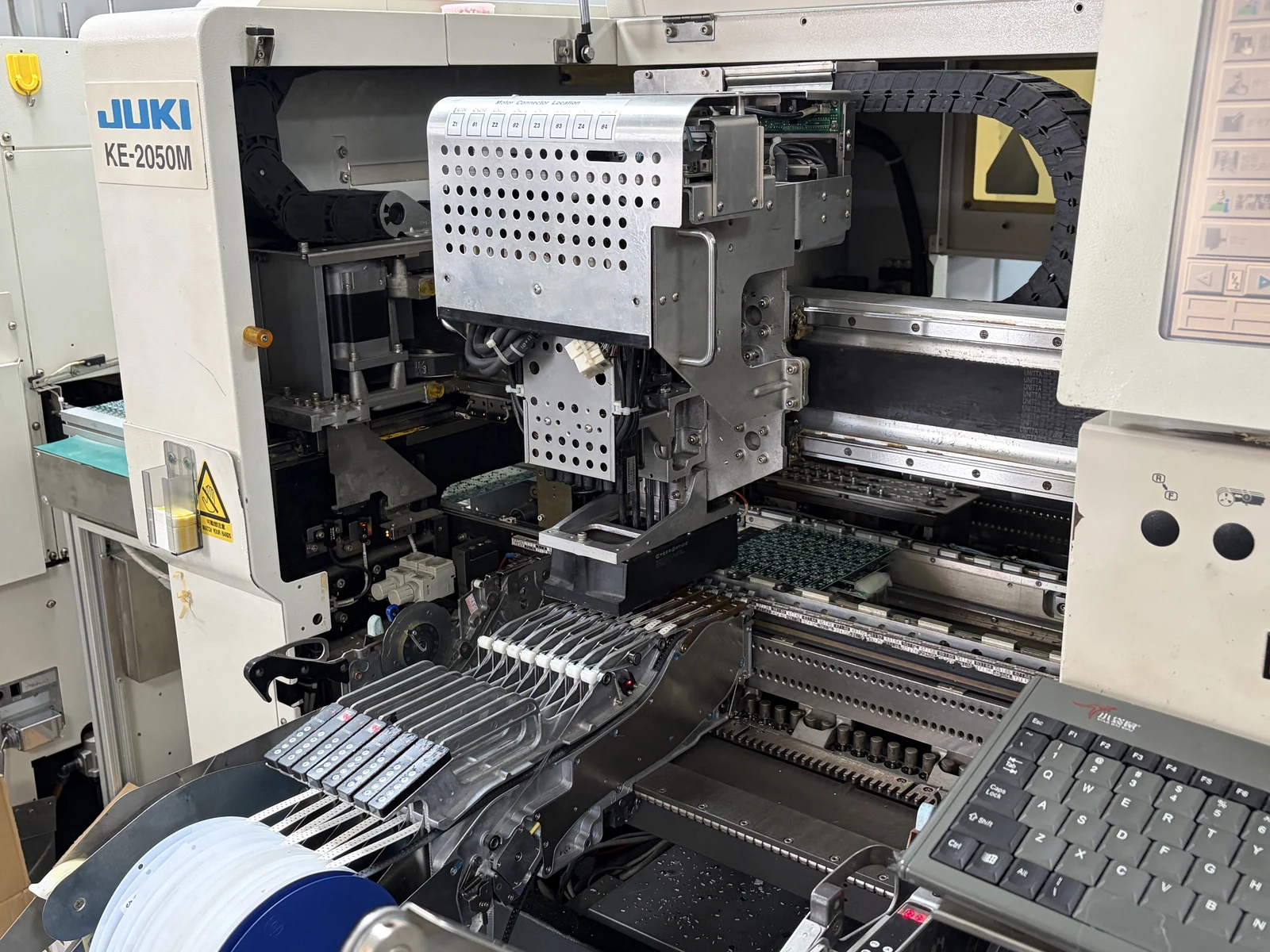
One catalog example specifies 115,000 components/hour for a two-beam placement configuration with RM heads under optimum conditions in high-production mode. Its RM/HM accuracy of ±0.025 mm at Cpk ≥ 1.0 is specified separately in high-accuracy mode. The listed component-height limits are 6.5 mm for RM, 15 mm for HM and 30 mm for FM. These figures describe particular configurations and modes; they must not be combined into one guaranteed production condition.
Another placement-head example lists a CP20 component envelope up to 8.2 mm × 8.2 mm, a CPP envelope up to 50 mm × 40 mm and 15.5 mm high, and a TWIN height limit of 25 mm. Price the actual head, feeder and nozzle combination required by the BOM. These are configuration-specific component envelopes, not guarantees of finished-board output.
For a 0.4 mm-pitch package-on-package assembly, review board design, paste deposition and reflow together. Develop settings from the instructions for the actual component and verify them on the intended board. A package-specific process recipe is not universal.
Obtain installed-cost inputs for electrical supply, clean dry air, extraction, floor loading, storage and service access. Name the support owners. When the only person able to restore a feeder, revise a program or diagnose a fixture failure is unavailable, the line’s theoretical capacity has little scheduling value.
Utilization, Changeovers and Demand Uncertainty
PCB assembly utilization must use available run time and accepted output for the actual product mix. Measure the complete route. A placement machine may have spare capacity while a missing kit, repeated setup or slow electrical test prevents boards from shipping.
Measure changeover from the previous job’s last accepted board to the next job’s first accepted board, including stencil and feeder work, program checks, necessary profile changes and first-piece release. Record offline preparation as labor. It may avoid line downtime while still consuming staff capacity.
A suitably equipped stencil printer can automate mask and backup-tool exchanges after the materials for the next job have been prepared. Confirm which options and offline preparation are required. Moving work away from the line does not eliminate its labor cost or justify assuming zero preparation effort across the factory.
A monthly capacity example
Consider an illustrative schedule of 160 h/month, 20 changeovers at 45 min each, and 8 h/month of planned maintenance. Changeovers consume 15 h, leaving 137 h before additional outages. At an illustrative net rate of 100 accepted boards per run-hour, that window provides 13,700 accepted boards/month.
| Demand Scenario | Accepted Boards/Month | Required Run Time | Loading of 137 h Run Window | Remaining Run Window |
|---|---|---|---|---|
| Lower demand | 4,000 | 40 h | 29.2% | 97 h |
| Base demand | 8,000 | 80 h | 58.4% | 57 h |
| Higher demand | 12,000 | 120 h | 87.6% | 17 h |
The base case uses 50.0% of the 160 h schedule, or 58.4% of the 137 h run window. Neither fraction is OEE. Overall equipment effectiveness combines availability, performance and quality under a defined time basis; demand loading answers a different planning question.
The net rate already includes running-speed and yield effects. Avoid double deductions. Reserve time only for interruptions absent from the measurement. One extra 60 min setup removes 100 accepted-board opportunities at the example rate.
Validate test capacity separately. For illustration, a 60 s test occupies one station for 1 min per board, limiting ideal output to 60 boards/hour before loading or retest. It cannot support a 100-board/hour assembly route alone. Two parallel stations offer 120 boards/hour before those losses, but require duplicate fixtures and suitable staffing. This sensitivity is separate from the table’s assumed complete-route rate.
Run low, base and high demand through the cost model, allowing for fixed-cost dilution at low demand and the overtime, recovery time or added stations needed when the limiting process approaches its available capacity. There is no universal utilization cutoff.
Quality Control, Maintenance and Process Ownership
Outsourcing PCB assembly assigns process execution to the supplier while the OEM defines product requirements and verifies acceptance. In-house access is more direct. It has value only when qualified people maintain settings, investigate defects and control changes.
IPC J-STD-001 addresses soldered-assembly materials and processes; IPC-A-610 addresses assembly acceptance. Match the required revision, product class and additions across both baselines. IPC’s J-revision announcement.
The complete set is IPC Class 1, IPC Class 2 and IPC Class 3: general-function products, extended-service products, and products requiring critical high performance or operation in demanding environments, respectively. Select by intended use and contract. A class number does not replace validation or testing. IPC J-STD-001J public scope and classification.
For the reference 0.4 mm BGA build, agree hidden-joint inspection and electrical testing before comparing prices. The 100% target measures test execution, not fault coverage. AOI, X-ray and electrical test answer different questions.
Assign owners for program approval, calibration, maintenance, containment and corrective action. Budget internal spares and backup skills; contract external change notification, failure analysis and rework responsibility. First-build success can disappear when stencils, feeders, profiles or fixtures drift.
Keep yield definitions consistent. First-pass yield excludes repaired boards; final yield includes successful recovery. Mixing them hides rework cost.
Inventory, Scheduling and Supplier-Management Overhead
Outsourced PCB assembly reduces internal coordination when the contract assigns material, scheduling and exception handling clearly. Inventory risk follows ownership. Stock at a supplier can remain an OEM liability.
Consigned assembly generally leaves kitting and procurement with the OEM. Turnkey assembly assigns sourcing to the supplier, although excess stock, non-cancellable orders and engineering-change liability may remain with the OEM under the contract. Mixed procurement divides responsibility by item.
Cost staff-hours for BOM maintenance, substitutions, shortages, rescheduling and discrepancy resolution. Apply loaded labor rates. Add internal supervision, training and maintenance coordination to the in-house case; add forecast communication, shipping coordination and supplier review to the outsourced case.
Evaluate kit readiness, release timing, confirmed capacity and transport separately: an internal line cannot run without parts or qualified operators, and an external purchase order does not establish immediate line access unless that availability has been agreed.
Compare cash timing too. Component buys, WIP, supplier deposits and finished-board buffers affect working capital. Model the downside-demand exposure before committing.
Where In-House PCB Assembly Wins
In-house PCB assembly wins when direct process access has measurable product value and the OEM can sustain the complete operating system. Stable demand helps, but existing skills, product fit and time-sensitive engineering work are equally relevant.
Control of Engineering Changes
An internal team can stop a job, inspect a failure and test a controlled revision without an external production handoff. This advantage is strongest when engineers regularly learn from assembly. It disappears if urgent experiments repeatedly disrupt committed production.
Repeatable Production Loading
A stable family of assemblies can reuse feeders, fixtures, recipes and trained staff. Repeated work reduces setup variation and makes cost estimates more dependable. Select in-house when the downside forecast still supports the fixed resources and the upside forecast fits qualified capacity.
Access to Critical Processes
Keeping a proprietary process or sensitive debugging activity inside the OEM can justify direct ownership. Budget the necessary expertise and access controls. Confidentiality alone does not prove that every soldering, inspection and test operation should also be internal.
Where Outsourced PCB Assembly Wins
Outsourced PCB assembly wins when a supplier’s relevant process coverage and shared operating base avoid underused internal resources. The benefit must survive the addition of OEM oversight, material commitments and logistics to the quoted assembly price.
Control of Engineering Changes
An external manufacturing team can turn a stable design package into repeatable production while the OEM concentrates on design. Define how BOM revisions, firmware and test changes enter the schedule. Outsourcing works better when releases are controlled than when engineering changes arrive during every build.
Repeatable Production Loading
Variable or fragmented demand can fit a supplier’s shared capacity more economically than a dedicated internal line. Price the actual batch pattern, including setup and handling. Confirm capacity for the required delivery windows instead of assuming the supplier’s total capacity is reserved for one customer.
Access to Critical Processes
Outsourcing can provide access to inspection, selective soldering, rework or test engineering that an OEM needs too infrequently to sustain internally. Purchase the required process result explicitly. A supplier’s equipment list matters only when the proposed route covers the specific product and acceptance plan.
A Make-or-Buy Decision for Prototype and Production Needs
Prototype and production PCB assembly should have separate make-or-buy decisions when their objectives differ. A prototype may optimize engineering learning; production must deliver repeatable accepted output at the required schedule and cost. Carry the lessons forward without assuming the first build location must own the product for its entire life.
| Project Constraint | Preferred Starting Route | Evidence Required Before Commitment |
|---|---|---|
| Frequent experiments with an available internal lab | In-house prototypes | Suitable process coverage, safe handling and engineer access |
| Stable repeat demand within an existing qualified line | In-house production | Accepted-output history and positive avoidable-cost comparison |
| Uncertain demand requiring a new line investment | Outsourced production | Comparable full-scope quote and manageable material commitments |
| 0.4 mm BGA build needing inspection or test resources the OEM lacks | Outsourced build or funded internal capability expansion | Complete inspection route and execution of agreed electrical test on 100% of production boards |
| Engineering learning is internal; recurring volume exceeds internal capacity | Hybrid allocation | Transfer package, production qualification and clear change ownership |
| Neither route covers required processes or delivery windows | Resolve the constraint before release | A feasible process/capacity plan, then a refreshed cost comparison |
Keep the hybrid boundary clear
A practical hybrid model keeps debugging and early prototypes internal while an external team builds production. Another sends specialist operations outside while retaining final integration. Each boundary adds transport, records and coordination; include those costs.
Before transferring production, release the BOM, assembly data, acceptance criteria, approved firmware and test method together. Confirm the external route with a controlled pilot. Production tooling, panelization or thermal behavior can differ from the prototype process, so prototype success alone does not validate the production route.
Use this decision sequence:
- Define product mix and acceptance scope
- Does the internal route cover every required process?
No: → Compare outsourced scope with the cost of closing internal gaps
Yes: → Model accepted output and total cost at low, base and high demand
- Compare outsourced scope with the cost of closing internal gaps
→ Model accepted output and total cost at low, base and high demand
- Model accepted output and total cost at low, base and high demand
- Does in-house meet cost, schedule and staffing needs?
Yes: → Qualify the internal route and retain a recovery plan
- Qualify the internal route and retain a recovery plan
- Qualify the outsourced route and assign OEM oversight
- Review prototype and production allocation separately
Frequently Asked Questions
PCB assembly make-or-buy decisions become actionable when cost, capacity and responsibility use the same scope. These answers apply that principle to recurring OEM procurement questions.
When does in-house PCB assembly make economic sense?
In-house assembly makes economic sense when repeat demand supports its complete operating cost. Compare accepted-board output using realistic setup losses and loaded staffing costs, then require a total-cost advantage over a matching external quote after accounting for any existing work the new product displaces.
Should prototype and production builds use the same make-or-buy decision?
Prototype and production need separate reviews when their objectives differ. Internal prototypes may accelerate learning while external production provides suitable recurring capacity, but a functioning prototype does not validate different production tooling, panelization or thermal behavior. Qualify the production route with a controlled pilot.
Which costs are missed when comparing only machine prices?
Machine prices omit installation and ongoing operating support. Count utilities, feeders, stencils, fixtures, inspection, test development, maintenance, calibration and training, together with idle capacity, working capital, scrap, rework and management time. Include equivalent supplier charges and retained OEM costs in the outsourced baseline.
Does outsourcing remove the OEM’s quality responsibility?
No; the OEM still defines requirements and verifies product acceptance. Before release, assign revision approval, inspection and test scope, deviation decisions, failure investigation and corrective action so that the supplier’s manufacturing obligations and the OEM’s retained decisions are clear to both teams.
Can a hybrid model keep prototyping internal and production external?
Yes, with a controlled production transfer. Release the BOM, assembly data, firmware and acceptance intent together, qualify the production process, and include duplicate tooling, transfer engineering, logistics and ongoing change coordination when comparing the hybrid model with either fully internal or outsourced assembly.
What utilization level justifies buying an SMT line?
No universal utilization percentage justifies an SMT line. Calculate the cost intersection from actual fixed costs, variable costs and comparable quotes, then confirm that the required volume fits demonstrated capacity. The example’s 58.4% run-window loading describes a scenario, not an investment threshold.
Is catalog placement speed enough to estimate PCB output?
No; placement speed alone cannot predict accepted PCB output. Translate components per hour through the actual placement program and board sides, then account for printing, soldering, inspection, test, changeovers and yield to identify the constraint that limits delivered boards across the complete route.
How should test scope affect the make-or-buy comparison?
Use identical test scope in both cost baselines. The demanding reference build budgets the agreed electrical acceptance test on 100% of production boards alongside the defined inspection plan; that percentage measures test execution and does not promise complete fault coverage or represent a universal IPC requirement.
Final Recommendation: Compare One Build Package
Choose in-house PCB assembly when qualified internal processes and total cost withstand demand variation. Choose outsourcing when shared capacity and relevant expertise meet the same acceptance requirements with less operating burden. Use hybrid allocation when engineering learning and production economics favor different locations.
Prepare one package: released PCB and assembly files, BOM with approved alternatives, forecasts, inspection and test requirements, material ownership, delivery windows and change-control rules. Obtain both estimates against it. Resolve scope differences first.
For the external comparison, start a scoped enquiry through JASPER’s PCB assembly services. Bring the build package and identify the procurement, programming, test and integration tasks the OEM will retain. Compare the cost and control of an accepted build supported by a feasible operating plan.
Ready to Start Your Project?
Tell us about your membrane switch, keypad, or graphic overlay requirements. Our engineering team will review your specifications and provide a detailed quote.