The choice in turnkey vs consigned PCB assembly is who purchases and supplies production material. Choose turnkey when the assembler should coordinate approved component sourcing; choose consigned when the OEM already controls the required stock and can deliver a complete, usable kit. In both arrangements, the OEM retains design and substitution authority. For a controlled build, set a procurement reference target of 100% BOM-line ownership allocation and zero unapproved part or source changes. Agree packaging-specific spare quantities and loss responsibility before releasing the order.
- Quick Verdict: Choose by Material Control
- Turnkey and Consigned Assembly: Who Owns Each Input?
- Component Purchasing and Approved-Source Control
- Incoming Inspection and Shortage Resolution
- Attrition, Excess Stock and Replacement Charges
- Calculate allowances by BOM line
- Keep the arithmetic visible
- Separate the cost decisions
- Revision Changes and Nonconforming Material Decisions
- Where Turnkey Assembly Wins
- Purchasing workload
- Material control
- Schedule readiness
- Where Consigned Assembly Wins
- Purchasing workload
- Material control
- Schedule readiness
- Choose the Supply Model by Project Constraint
- A Responsibility Matrix to Attach to the Purchase Order
- Final Recommendation: Release Responsibilities with the BOM
Quick Verdict: Choose by Material Control
Turnkey assembly wins when purchasing coordination is the main burden; consigned assembly wins when the OEM has controlled inventory and the resources to manage replenishment. Compare both against the same released bill of materials (BOM), board quantity, inspection scope and delivery requirement.
| Project priority | Preferred arrangement | Condition that makes it work |
|---|---|---|
| Reduce OEM component-order administration | Turnkey | Assembler follows approved parts and source rules |
| Use existing, traceable OEM inventory | Consigned | Kit quantity and packaging meet the agreed build requirement |
| Retain proprietary or programmed parts | Consigned for those parts | Identity, programming version and replacement ownership are defined |
| Delegate shortage purchasing | Turnkey | Replacement authority and extra-charge approval are explicit |
| Minimize total delivered cost | Compare both | Include procurement, handling, inventory and exception costs |
Neither supply label determines assembly workmanship or test coverage. Those requirements belong in the manufacturing scope.
Turnkey and Consigned Assembly: Who Owns Each Input?
Turnkey assembly assigns purchasing of the agreed materials to the assembler; consigned assembly assigns supply of the designated materials to the OEM. Bare PCB supply must be stated separately. The OEM still releases the design package, while the assembler supplies the agreed assembly labor, process consumables and manufacturing resources.
The sourcing options are turnkey, consigned and partial turnkey. Partial turnkey splits responsibility by BOM line: the OEM might supply a programmed microcontroller while the assembler purchases connectors and passive components. These arrangements are reflected in Screaming Circuits’ materials sourcing options.
For this comparison, consigned means an OEM-supplied component kit. Assign boards separately. An OEM can consign all components while asking the assembler to buy bare boards, just as an assembler can quote component procurement without accepting responsibility for board fabrication, programming or a finished enclosure.
Separate purchasing, ownership, custody and exception approval. They can differ. For example, a device can remain OEM property while the assembler stores it, reports a shortage and places a replacement order using the source and spending authority that OEM purchasing has already approved.
Release a matching BOM revision, component placement list (CPL), assembly drawing and applicable test requirements for either arrangement. Identify do-not-populate positions explicitly. Firmware development, programming, functional testing and enclosure assembly require their own scope; a sourcing label does not include them automatically.
Component Purchasing and Approved-Source Control
The assembler purchases approved components under turnkey assembly; the OEM purchases the components it consigns. Both routes need the same definition of an acceptable part and an acceptable source. Moving the purchase order does not transfer authority to redesign the circuit.
Use the manufacturer part number (MPN), including the necessary ordering suffix, to identify each controlled device. Preserve the suffix. A purchasing record that drops a packaging or device-grade suffix can describe a different orderable item, even when the abbreviated part number looks familiar. Link each approved alternative to its BOM line; for permitted generic passives, define electrical, package and qualification requirements.
Keep an approved manufacturer list (AML) separate from an approved vendor list (AVL). The AML controls the part/manufacturer choice; the AVL controls the purchasing channel. Buying the specified MPN from an unapproved broker is a source exception even though the part number has not changed.
For example, Texas Instruments’ anti-counterfeit guidance recommends buying through its authorized sources and explains that counterfeit markings can resemble genuine labels. A receiving photograph cannot replace source control.
Separate technical approval from spending authority. OEM engineering approves a changed MPN against design requirements; OEM quality approves relevant source and traceability exceptions. Purchasing approves the commercial commitment. If a proposed change involves a new part, a new source and expedited freight, obtain the applicable approvals before buying or using it. Record selections from the preapproved list, too.
Before either party commits to a minimum order quantity (MOQ) or non-cancellable, non-returnable (NCNR) purchase, agree the quantity, cancellation exposure and owner of unused stock. A lower component price can still create a larger inventory bill.
Incoming Inspection and Shortage Resolution
The assembler should perform the agreed incoming verification on both turnkey and consigned material. The party that bought or supplied a disputed item then coordinates correction with its source. Receiving acceptance, technical disposition and responsibility for replacement cost are separate decisions.
Define incoming verification as a documented match between the released requirement and the received material: MPN, quantity, identification, packaging condition and required traceability records. Eurocircuits’ receipt process illustrates checks of part identity, quantity and markings, followed by supplier escalation for mismatches.
Agree the count method and inspection coverage before shipment. Count usable parts. Verification of every BOM line does not mean electrically testing every component, and a label check cannot establish a device’s internal construction, electrical limits or storage history. Authentication, solderability testing and other specialized evaluations require their own acceptance criteria and quotation.
When a mismatch appears, record the affected BOM line, ordered quantity, accepted usable quantity, rejected or held quantity, and the date material is needed. Exclude quarantined parts from available stock.
For turnkey material, the assembler should obtain replacement availability and propose recovery options. For consigned material, the OEM should supply replacements or authorize the assembler to purchase them. Neither party should silently substitute an available device.
Use this replenishment trigger: accepted usable stock falls below remaining placements plus the agreed remaining setup, process-loss and test allowances. An open replacement order is a recovery plan, not received stock.
Give the exception record a decision and an owner. Replenish, approve an alternative, release a reduced quantity, or reschedule. When releasing fewer boards or leaving a component unpopulated, identify the affected assemblies, their test limitations and the engineering acceptance that permits delivery. Agree who can stop the affected work and approve restart.
Attrition, Excess Stock and Replacement Charges
Component attrition is material lost or damaged during setup and assembly; excess stock is usable material remaining beyond current requirements. Both turnkey and consigned orders need a quantity allowance, but a planned allowance is not evidence that those parts were consumed. Agree each separately.
Calculate allowances by BOM line
For one component line, use:
Required usable kit = boards to build × placements per board + setup allowance + process-loss allowance + separately consumed test samples.
Keep the terms nonoverlapping. If the assembler provides one combined allowance, do not add a second setup allowance to it. Base the review on the selected placement equipment, package, presentation, number of setups and expected handling. Eurocircuits’ sourcing guidance identifies package size, packaging type, tape pitch and supplier minimum quantities as relevant inputs.
| Material presentation | What to agree before shipment | Quantity or cost implication |
|---|---|---|
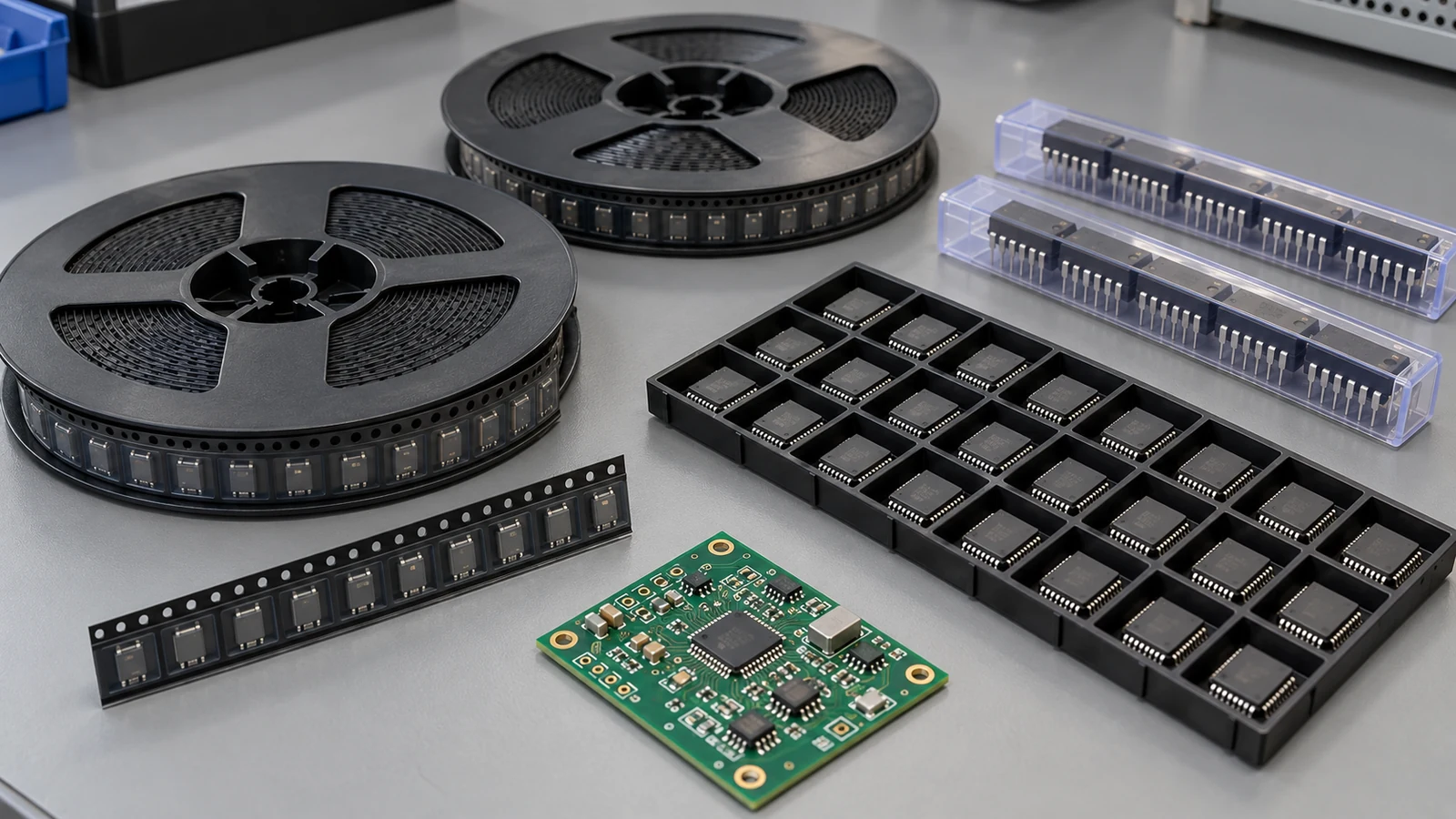
| Tape and reel | Feeder compatibility and required leader/trailer | Separate empty tape requirements from components consumed |
| Cut tape | Minimum usable strip length and acceptable fragmentation | Short strips can require extra preparation or an agreed handling charge |
| Trays | Tray compatibility, orientation and usable component count | Tray capacity is not the delivered component quantity |
| Tubes | Tube compatibility, orientation and loading method | Review losses against the actual feeding or manual process |
There is no universal spare percentage for these formats. Empty tape is packaging. Its required leader length may affect feeder preparation, but blank pockets must not automatically become a component-loss charge. Review scarce or expensive devices separately, including the permitted loading method and the recovery plan if an exact-quantity build loses a part.
Keep the arithmetic visible
Consider an illustrative order for 250 boards, each using eight identical resistors. Assume this job’s agreed allowances are 20 setup pieces, 10 further process-loss pieces and zero separate test pieces.
The kit target is 250 × 8 + 20 + 10 = 2,030 pieces. If only 1,950 usable pieces are accepted, the replenishment requirement is 80 pieces. These example allowances describe one agreed planning scenario, not a default loss rate. The 30-piece allowance is planned reserve, not an automatic scrap entry.
Now consider purchasing the same requirement with no available stock. If the supplier sells in 500-piece multiples with no higher MOQ, order 2,500 pieces. The 470 pieces above the planned kit target are procurement excess. They are not assembly attrition.
Separate the cost decisions
For PO negotiation, allocate agreed routine consumption to the OEM’s material budget and assembler-caused damage or unexplained custody losses to the assembler. Confirm that allocation in the accepted terms. Under turnkey, identify whether routine attrition is already included in the price; under consigned, record the allowance the OEM supplies.
Defective incoming material follows the purchaser’s source-claim route; a receiving discrepancy alone does not prove who caused it. Assign replacement action immediately and document the cause. Separate replacement components from rework, retest and expedited-freight charges. Approving replenishment does not approve every recovery cost or excuse an assembler-caused loss.
At closeout, reconcile received stock against installed pieces, documented losses, consumed samples and remaining material. Include components installed on work in progress or rejected boards; counting only shipped assemblies would misstate consumption. Unused spares remain stock. Record who owns them and authorizes return, retention or disposal; the inventory agreement can hold the detailed procedures.
Revision Changes and Nonconforming Material Decisions
The OEM controls the released design revision and approves design-affecting material changes; the assembler identifies affected stock, purchases and work in progress. That division applies to both supply models. A revision change must identify its effective build or lot before material is substituted or discarded.
When an engineering change order (ECO) replaces a component, the turnkey assembler reports open orders, cancellation limits and on-hand exposure. In a consigned build, the OEM reports replacement availability and disposition of the old material. Both parties then agree rework, inventory and schedule consequences.
Distinguish an assembler’s failure to follow the released BOM from an OEM-requested design change. They require different cost decisions. Supplier selection alone should not decide who pays.
For nonconforming material, the assembler contains the affected stock and records the discrepancy. OEM engineering and quality decide whether a proposed deviation is technically acceptable; purchasing approves any commercial settlement. Use-as-is, rework, replacement, return and scrap decisions must identify the affected quantity and lot. Some nonconformities permit no acceptable deviation.
Do not treat delivery urgency as approval. An engineer’s approval of a replacement part also does not automatically authorize extra freight, a larger buy or a change in unused-stock ownership. Record those commercial decisions separately, then update the released build package and material record.
Where Turnkey Assembly Wins
Turnkey assembly is the stronger choice when the OEM has a released BOM but needs the assembler to coordinate material purchasing and recovery. Keep sourcing visible.
Purchasing workload
For an OEM with a small buying team, turnkey can remove the work of raising separate orders, chasing distributor deliveries, reconciling shortages and arranging replacements, provided the quotation assigns those duties to the assembler. Request BOM-level status.
Material control
Approve the purchasing boundaries. When parts, alternatives and source requirements are already released, the assembler can buy within them without returning every routine selection to the OEM, while engineering and quality retain authority over exceptions.
Schedule readiness
Use one material coordinator. If several component deliveries must converge before a booked production slot, assigning procurement and assembly coordination to the same supplier gives the OEM a clear owner for the recovery plan. Long-lead constraints still apply.
Where Consigned Assembly Wins
Consigned assembly is the stronger choice when the OEM controls usable stock or supply arrangements that the assembler cannot readily reproduce. Keep replenishment ownership clear.
Purchasing workload
For an OEM with an established buying team and shared inventory across products, consignment can use existing purchasing arrangements without duplicating stock purchases at the assembler, provided the team also owns kit preparation and shortage follow-up. Include those costs.
Material control
Preserve the material identity. When the OEM holds proprietary, preprogrammed or specifically allocated devices, consignment keeps those sourcing decisions under its control while the assembler works to the supplied identity and programming-version records. Confirm kit acceptance first.
Schedule readiness
Check readiness before booking. Stock already held by the OEM can support the build only when the accepted quantity, presentation and spare allowance meet the assembler’s requirement by the agreed material-ready date. A shipment notification is insufficient.
Choose the Supply Model by Project Constraint
Choose the assembly supply model around the constraint that could stop the build: purchasing capacity, controlled inventory, approved-source access or material readiness. Apply the same assembly and test scope to both quotations before comparing price.
| Project constraint | Choose | Required control |
|---|---|---|
| Limited OEM procurement staff; released BOM | Turnkey | BOM-line sourcing status and defined exception approval |
| Complete OEM stock already available | Consigned | Verified usable kit and agreed spare quantities |
| Proprietary ICs; ordinary parts otherwise available | Partial turnkey | One supply owner per line and one combined shortage record |
| OEM-controlled supplier allocation | Consigned for allocated parts | Traceability, delivery commitment and replacement owner |
| Many likely design changes | Limited material commitment in either model | ECO approval before additional buying or consuming affected stock |
| Critical parts unavailable through approved channels | Resolve availability before committing either model | Approved source/part decision or revised build schedule |
For total-cost comparison, include components, procurement fees, receiving and kit preparation, setup, assembly, testing, logistics and agreed inventory exposure. Separate included charges from conditional charges. Compare the same quantities and delivery basis; neither a lower labor charge nor a lower component unit price establishes the cheaper finished order.
A Responsibility Matrix to Attach to the Purchase Order
A PCB assembly responsibility matrix should assign the work, the approval and the commercial boundary for each material event. Use the completed model below during PO review, then reconcile it with the accepted quotation. It proposes an allocation for agreement; it does not describe an already accepted supplier contract.
| Responsibility | Turnkey Arrangement | Consigned Arrangement | Approval Owner | Contract Clarification |
|---|---|---|---|---|
| Component purchasing | Assembler buys released BOM parts through approved sources | OEM supplies designated BOM parts | OEM purchasing; engineering controls part selection | Record MPN, source, quantity, price basis and NCNR exposure before purchase |
| Bare PCB supply | Assembler purchases boards when included in scope | OEM supplies boards only when assigned that duty | OEM purchasing and engineering | Identify board revision, quantity and who resolves bare-board defects |
| Incoming verification | Assembler checks purchased material against agreed requirements | Assembler checks OEM-supplied material against the same requirements | OEM quality approves scope; assembler quality releases conforming stock | Specify count method, records and inspections included in the price |
| Material attrition | Assembler plans and accounts for the priced routine allowance | OEM supplies the agreed allowance; assembler accounts for consumption | Both parties approve allowance and loss allocation | OEM budgets routine consumption; assembler bears its process damage and unexplained custody loss under the agreed model |
| Shortage replacement | Assembler coordinates replacement procurement | OEM replenishes or authorizes an assembler purchase | Supply owner initiates; OEM engineering approves changes; purchasing approves extras | Trigger action below remaining usable need; confirm recovery date, freight and cost allocation |
| Excess-stock disposition | Assembler records MOQ excess and unconsumed material | Assembler accounts for remaining OEM stock | Agreed stock owner, with OEM purchasing for OEM-owned material | Record title, return/retention decision and approved disposal or storage charges |
| Source exceptions | Assembler proposes the alternate source before ordering | OEM discloses source exceptions before shipping | OEM quality and purchasing; engineering where product risk changes | Require written approval and traceability requirements; prohibit silent channel changes |
| Substitute approval | Assembler proposes alternatives outside the approved list | OEM proposes replacements for unavailable consigned parts | OEM engineering and quality | Record approved MPN, applicable revision and required validation before use |
| Revision changes | Assembler reports affected inventory, orders and work in progress | OEM identifies replacement stock; assembler reports affected work | OEM engineering releases ECO; purchasing approves cost effects | Set effectivity and document cancellation, obsolete-stock and rework exposure |
| Nonconforming material | Assembler contains material and coordinates its supplier claim | Assembler contains material; OEM coordinates its source claim | OEM engineering and quality approve disposition | Separate cause, replacement action and final cost; require permission before consuming rejected stock |
Add the agreed material-custody boundary to the order: shipment receipt, accepted quantity, storage responsibility and the point at which risk transfers. Keep that boundary separate from stock ownership.
Name the people authorized to make engineering, quality and purchasing decisions, including a backup for urgent shortages. Set notification and response times. For a consigned version of the 250-board example, assign OEM purchasing to supply 80 further approved pieces and the assembler to verify receipt before releasing the affected work. Record the agreed recovery date.
The procurement reference target remains 100% BOM-line allocation and zero unapproved MPN or source changes. Apply it to mixed orders, too.
Frequently Asked Questions
Turnkey and consigned PCB assembly change the supply responsibilities, while the released design and accepted purchasing terms govern approvals and exceptions. These answers apply the same allocation used in the responsibility matrix.
Who pays for components lost during consigned assembly?
Under the proposed allocation, the OEM budgets agreed routine consumption and the assembler bears its process damage or unexplained custody losses. Confirm that division in the accepted order terms. The assembler records actual consumption; a spare allowance does not automatically become a charge for lost parts.
Can one PCBA order combine turnkey and consigned parts?
Yes. Partial turnkey assigns selected BOM lines to the OEM and the remainder to the assembler. Confirm that the supplier accepts the arrangement, then name one supply owner per line. Use a combined shortage record so neither party omits a purchase or buys the same requirement twice.
Who approves a substitute under turnkey assembly?
OEM engineering approves a substitute outside the released approved-parts list, with quality approval where required. The assembler may select a preapproved alternative within delegated authority and record that choice. Approval of an alternate part does not automatically approve a new source, extra cost or changed delivery terms.
Must a consigned kit include spare components?
A consigned kit must meet the agreed usable quantity, including any approved setup, process-loss and test allowances. There is no universal spare percentage. Review each component’s packaging and handling requirements; exact-quantity supply for expensive or scarce parts needs an explicitly accepted build and recovery plan.
Who owns leftover components after the build?
Ownership follows the agreed material terms. Specify that unused consigned components remain OEM property, and separately assign ownership of assembler-purchased MOQ excess and spare stock. Agree who authorizes return, retention or disposal and who pays associated charges. Physical storage at the assembler does not answer the ownership question.
Who performs incoming inspection on customer-supplied components?
The assembler performs the incoming verification included in the order, while the OEM supplies the required source and traceability information. Define inspection coverage and count methods before shipment. Routine identity and condition checks do not establish complete electrical performance or replace an agreed authentication plan.
Is consigned PCB assembly cheaper than turnkey?
Consigned assembly can cost less when existing OEM stock and purchasing arrangements offset kit preparation, logistics and shortage-management costs. Compare total delivered cost for the same BOM, quantity and test scope. An assembly-only price is not directly comparable with a quote that includes purchased components.
When does the assembly lead time start?
The accepted quotation must define the schedule-start conditions. Agree whether the quoted assembly period begins after files are released, material is accepted and exceptions are resolved, and distinguish that period from procurement and transit. A purchase-order date or component shipment date alone does not establish production readiness.
Final Recommendation: Release Responsibilities with the BOM
Choose turnkey for delegated procurement and consigned for OEM-controlled material that can arrive as an accepted, usable kit. Use partial turnkey when those conditions differ across BOM lines. Release the responsibility matrix with the same discipline as the technical package.
Before requesting a comparable quotation, assemble the released BOM and placement data, bare-board supply assignment, build quantity, approved parts and sources, packaging information, available stock and required test scope. Ask for the line-specific spare requirement, shortage trigger, exception approvals and unused-stock allocation in the commercial response.
For a JASPER enquiry, use the PCB assembly services page with this package and identify every customer-supplied item. Compare the returned scope against the matrix before placing the order. The useful outcome is a named owner and an agreed decision path for every material issue that could stop the build.
Ready to Start Your Project?
Tell us about your membrane switch, keypad, or graphic overlay requirements. Our engineering team will review your specifications and provide a detailed quote.