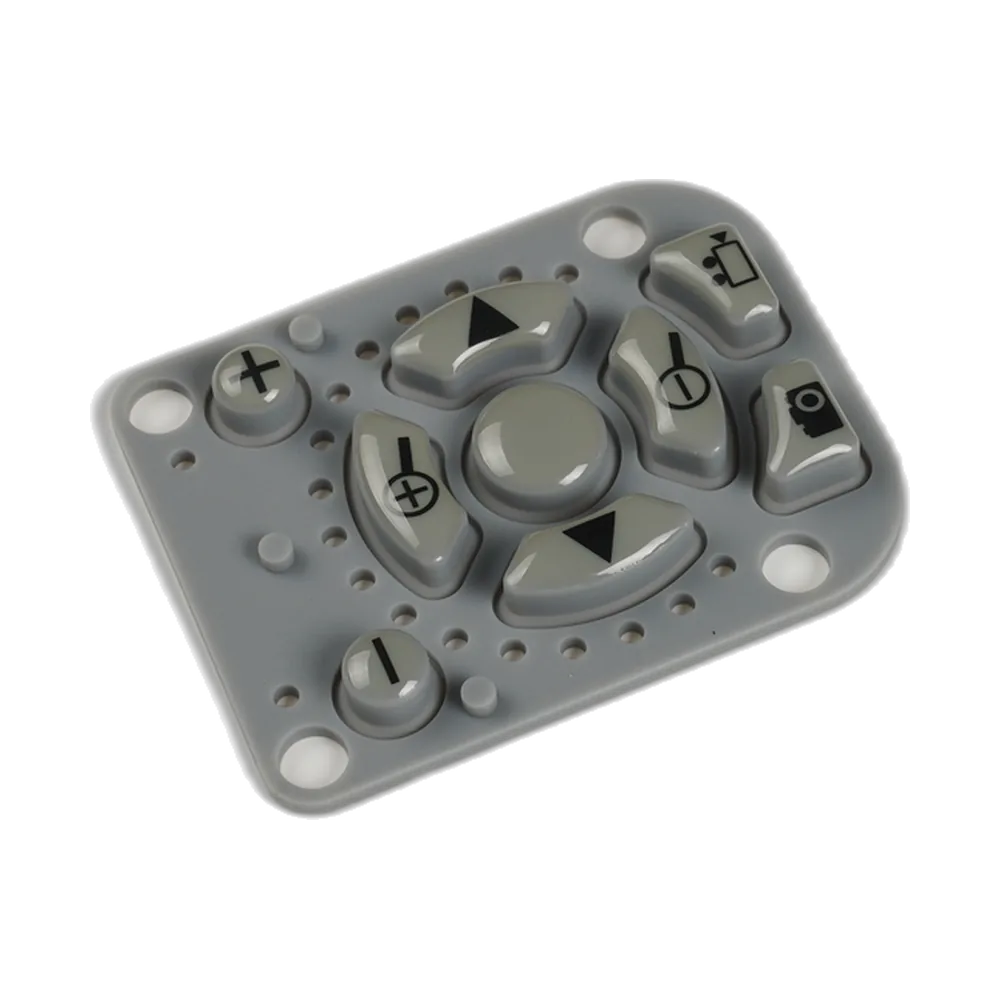
Carbon pills and metal domes can both sit behind a silicone keypad, but they create different complete actuation structures. A carbon-pill key normally uses the molded silicone web as the main spring and tactile element, then brings a conductive elastomer contact onto circuit pads. A metal-dome design can keep the same molded silicone user surface while a separate dome provides the main snap and electrical closure.
The useful OEM question is therefore not “Which contact is better?” It is: Which architecture meets the required feel, circuit margin, support, package height, sealing strategy, assembly control, and validation plan in the actual device? A conductive rubber keypad is a natural starting point for an integrated molded contact. If a sharper snap is required behind raised silicone keys, a silicone-rubber hybrid keypad with an actuator over a metal dome may be more appropriate.
- Compare the Complete Actuation and Contact Structures
- Review Force, Travel, and Tactile Targets as Curves
- Evaluate Electrical Closure and Circuit Limits
- Compare Support, Sealing, Space, and Assembly
- Side-by-Side Selection Matrix Under the Same Requirements
- Build Two Comparable Force–Displacement and Closure Tests
- Test A — Carbon-pill key
- Test B — Silicone actuator over metal dome
- Choose the Architecture by the Risk You Need to Control
- Review Your Contact and Circuit Requirements
Compare the Complete Actuation and Contact Structures
Compare a section from the operator’s finger to the supporting structure, not a loose carbon pill to a loose dome.
| Design question | Carbon-pill silicone key | Silicone actuator over metal dome |
|---|---|---|
| User surface | Molded silicone keytop | Molded silicone keytop can remain |
| Primary tactile source | Mainly silicone web and key geometry | Dome gives the main snap; silicone still changes the finished feel |
| Electrical closure | Conductive elastomer bridges defined circuit pads | Dome closes against its mating contact pattern |
| Critical alignment | Pill-to-pad overlap | Actuator-to-dome centering plus dome-to-pad location |
| Support | Stable PCB/FPC/backer | Hard, controlled reaction surface plus dome seating |
| Extra controls | Rest gap, pad geometry, contact load, overtravel | Dome retention, venting, actuator geometry, clearance, pad finish |
A metal dome does not require abandoning a silicone front surface. Silicone can still provide raised keys, legends, light control, guiding features, and part of the enclosure interface. Conversely, a carbon-pill keypad is not only a molded-rubber part: its switching result depends on the mating circuit and installed support.
Review Force, Travel, and Tactile Targets as Curves
A single actuation-force value is not enough for either architecture. Record the full press and release force-displacement curve and mark the electrical make and break points on that curve.
For a carbon-pill key, the silicone web controls much of the force build-up, collapse, travel, return, and off-center behavior. The pill must then land with sufficient overlap and contact load before uncontrolled bottoming. The important sequence is peak force, electrical closure, controlled overtravel, bottoming, and release. A key can feel acceptable yet close too late, or close early but have too little overtravel to tolerate normal finger-force variation.
For a metal dome under silicone, the dome contributes the distinct snap, but the operator presses through the keytop, web, actuator, clearances, and any preload. The finished-key curve can therefore differ from a loose-dome datasheet. Snaptron’s component test method controls probe geometry, centering, hard support, speed, and contact make/break. Use that as a component reference, then repeat the measurement on the production-intent silicone-over-dome stack.
In both cases, check credible off-center presses. A wide carbon-pill key can tilt and lose effective pad overlap; a dome actuator can load the dome away from its intended center.
Evaluate Electrical Closure and Circuit Limits
For a carbon-pill key, do not treat conductive-silicone volume resistivity as the installed switch resistance. Shin-Etsu defines volume resistivity on a homogeneous specimen with its own geometry and test method. The keypad path additionally includes the pill shape, two pill-to-pad interfaces, pad geometry and finish, contact force, support, contamination, traces, and measurement points. Derive the allowable closed condition from the host input circuit, then measure the assembled key under the specified force and travel state.
A metal dome uses metallic contact, but the complete result still depends on mating surfaces, pad finish, contamination, seating, force, and support. Measure at the same electrical boundary used by the product rather than substituting a component-level value for the assembled switch path.
Do not claim that metal domes eliminate switch bounce. Texas Instruments notes that physical switches can produce multiple transitions after a press while digital logic responds much faster. Capture the actual host-input waveform and define hardware or firmware debounce when required. Carbon-pill contacts should also be observed dynamically for intermittent closure, changing resistance around first contact, and release behavior instead of being judged from one static resistance reading.
Compare Support, Sealing, Space, and Assembly
Both architectures need a controlled reaction surface. PCB or flex movement changes apparent travel and contact load, so the support plate, housing rib, standoff, adhesive-backed region, or other backing feature belongs in the switch design.
Metal domes add specific seating and venting requirements. Snaptron recommends providing an air path because trapped air under the dome can change tactile response. That vent does not have to be an open path to the outside environment; it can be managed inside the switch construction. The key point is to engineer dome venting and enclosure sealing together.
Neither contact type creates an enclosure IP rating by itself. IEC 60529 classifies protection provided by enclosures, so qualification must include the relevant housing, compression lands, fasteners, material joints, tails or connector exits, vents, and openings.
Do not assume one route is always thinner. A flat metal-dome membrane switch can be thin, but a raised silicone-over-dome stack also includes the key, actuator clearance, dome, retention layers, circuit, and support. A carbon-pill key needs its own rest gap, travel, overtravel, and support. Compare actual section drawings. If the supply includes PCB/FPC, LEDs, connector, spacer, or housing interfaces, review it as a silicone keypad assembly rather than as a loose keymat.
Side-by-Side Selection Matrix Under the Same Requirements
Use the same operator, housing envelope, circuit input, environment, and validation duty for both options.
| Decision factor | Carbon pill | Metal dome under silicone | Verify |
|---|---|---|---|
| Tactile character | Mainly silicone-web controlled | Dome can add a sharper snap | Installed press/release curves |
| Electrical design | Qualified closed-contact behavior on real pads | Metallic closure still depends on interface condition | Host-input margin and waveform |
| Alignment | Pill-to-pad overlap | Actuator-to-dome centering | Full tolerance stack and off-center press |
| Support | Stable board/flex backing | Hard support and controlled dome seating | Installed deflection |
| Venting | No dome-cavity requirement | Deliberate dome air path needed | Spacer/adhesive/PCB vent path |
| Assembly | Contact can be integrated in molded keymat | Adds dome placement/retention interfaces | Process and inspection boundary |
| Sealing | Enclosure-dependent | Same; coordinate venting with seal design | Complete installed seal test |
| Lifecycle | Project-specific | Project-specific | Cycling with electrical and tactile criteria |
| Procurement | Compare complete keypad/circuit scope | Include dome, placement, retention, circuit | Same-scope BOM, tooling, test, MOQ, lead time |
This matrix is intentionally conditional. It is not a claim that one architecture always has lower cost, longer life, lower resistance, or better sealing.
Build Two Comparable Force–Displacement and Closure Tests
Keep as much of the boundary identical as possible: housing or support representation, press location, fixture alignment, environmental conditioning, host input, sampling method, and acceptance logic.
Test A — Carbon-pill key
Use the production-intent keypad, PCB/FPC or contact coupon, backing support, and enclosure compression. Record force and displacement through press and release while simultaneously capturing the defined electrical result. Identify peak force, closure force/travel, overtravel, bottoming region, release point, and any intermittent transitions near make/break. Repeat credible off-center presses and the project-specific post-conditioning or post-cycle check.
Test B — Silicone actuator over metal dome
Install the production-intent silicone key, actuator, selected dome, circuit, retention layer, vent path, backing support, and enclosure features. Record the same mechanical curve and electrical make/break at the defined host boundary. Check actuator centering, dome seating, preload, overtravel, venting, off-center operation, and any multiple transitions at the input. Repeat after the same project-specific conditioning or cycling sequence.
For both tests, retain sample, material/contact, circuit, housing and fixture revisions; press rate; conditioning; test points; and acceptance limits. The purpose is not to force the two mechanisms to behave alike. It is to compare them under equivalent product requirements.
Choose the Architecture by the Risk You Need to Control
Choose carbon pills when an integrated molded contact and silicone-defined feel fit the product and the real circuit can be validated with adequate margin. Choose silicone over metal domes when distinct dome snap is important and the design can control support, actuator alignment, retention, venting, and the additional assembly interfaces.
If the decision remains open, prototype both within the same mechanical envelope and apply the same validation matrix. The finished keypad—not the loose contact component—is the approval article.
Frequently Asked Questions
Is a metal dome always lower resistance than a carbon pill?
No. Do not select the architecture from that assumption alone. Define the host-circuit requirement and measure the complete assembly; neither material resistivity nor a component value substitutes for the installed switch path.
Can a silicone keypad use metal domes without becoming a membrane-only keypad?
Yes. A molded silicone key can remain the user surface and actuator while a metal dome underneath provides the main snap and electrical closure.
Which architecture lasts longer?
There is no universal answer. Contact wear, silicone-web behavior, contamination, dome stress, actuator loading, surface finish, environment, and duty cycle all affect the result. Use project-specific cycle tests with electrical and tactile failure criteria.
Which option is easier to seal?
Neither contact type guarantees a sealed product. Sealing depends on the installed enclosure and all interfaces. Dome-cavity venting must be coordinated with that seal design.
Do metal domes eliminate the need for debounce?
No. Mechanical contacts can bounce. Capture what the real host input sees and define hardware or software debounce where required.
Review Your Contact and Circuit Requirements
For an engineering and quotation review, send the key layout or 3D model, enclosure section, PCB/FPC or pad drawing, host input requirements, target force/travel or reference sample, gloves and environment, sealing target, validation duty, prototype quantity, and annual volume. Mark unresolved items TBD rather than forcing an unsupported value.
Use JASPER’s request a keypad engineering review route and ask the quotation to state the proposed contact architecture, supplied assembly boundary, prototype evidence, and production acceptance method.
Ready to Start Your Project?
Tell us about your membrane switch, keypad, or graphic overlay requirements. Our engineering team will review your specifications and provide a detailed quote.