
DOMED LABEL MATERIAL AND DURABILITY RESOURCE
Epoxy vs Polyurethane Domed Labels: Qualify the Cured Stack, Not the Resin Name
Choose between epoxy and polyurethane domed labels by qualifying the exact cured formulation on the real printed label, adhesive, mounting surface, shape, and exposure. The resin family alone does not prove clarity, yellowing resistance, hardness, flexibility, chemical resistance, or outdoor life. A light-stable aliphatic polyurethane can behave differently from an aromatic polyurethane, while optical epoxies can be formulated for low yellowing or UV resistance. Compare the complete stack from dispensing through cure, curved installation, weathering, cleaning, and field handling. The winning route is the one that meets declared optical, mechanical, adhesion, and appearance limits after the required exposure.
JASPER’s custom epoxy or polyurethane domed labels are the commercial route after the dome formulation, print carrier, ink, adhesive, shape, mounting surface, curvature, environment, and acceptance evidence are defined. This Resource explains how to compare candidate resin systems. It does not confirm which chemistry JASPER currently processes or promise a universal yellowing result, hardness, flexibility, dome profile, chemical resistance, outdoor duration, cost, MOQ, or lead time.
The Dome Is an Optical-Mechanical Laminate
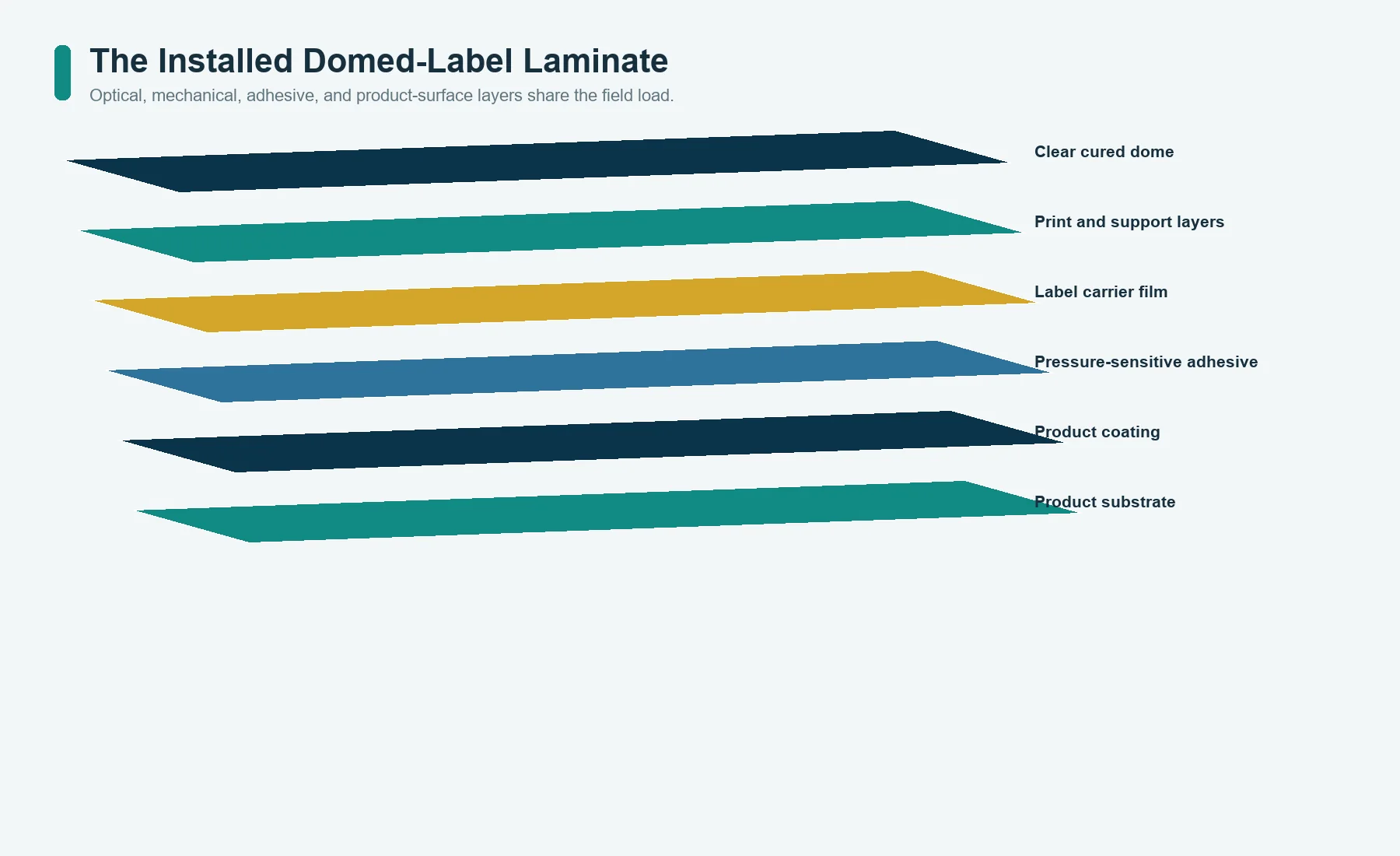
A domed label is not a drop of clear resin evaluated by itself. It is an installed laminate:
LIGHT AND OPERATOR CONTACT
            |
            v
CURED CLEAR DOME
            |
            v
PRINT / WHITE / METALLIC / PROTECTIVE INK LAYERS
            |
            v
LABEL FILM OR FOIL
            |
            v
PRESSURE-SENSITIVE ADHESIVE
            |
            v
PAINT / POWDER COAT / PLASTIC / METAL / GLASS
            |
            v
CURVATURE, HEAT, MOISTURE, CLEANER, UV, AND SERVICE LOAD
The dome can remain clear while the ink shifts, the film shrinks, the adhesive lifts, or the mounting coating loses adhesion. It can also yellow while the label remains firmly bonded. A hard dome can resist a fingernail yet crack when the installed surface bends. A soft dome can recover from indentation but collect scratches or show edge damage.
Define the function of each layer before comparing resin names.
| Layer | Primary job | Failure that can be mistaken for resin failure |
|---|---|---|
| clear dome | lens, depth, surface protection, tactile profile | yellowing, haze, gloss loss, cracking, denting, edge damage |
| print stack | color, logo, text, metallic or white background | color shift, bleed, solvent attack, poor cure, dome interaction |
| label carrier | supports print, die cut, dome, and handling | shrinkage, curl, split, poor dimensional stability |
| label adhesive | transfers the assembly to the product | edge lift, shear movement, peel, contamination sensitivity |
| mounting surface | receives and supports the label | coating failure, texture, low surface energy, curvature, contamination |
The correct comparison is epoxy stack A versus polyurethane stack B, not two unlabeled cups of resin.
Compare Cured Formulations, Not Resin Family Nicknames
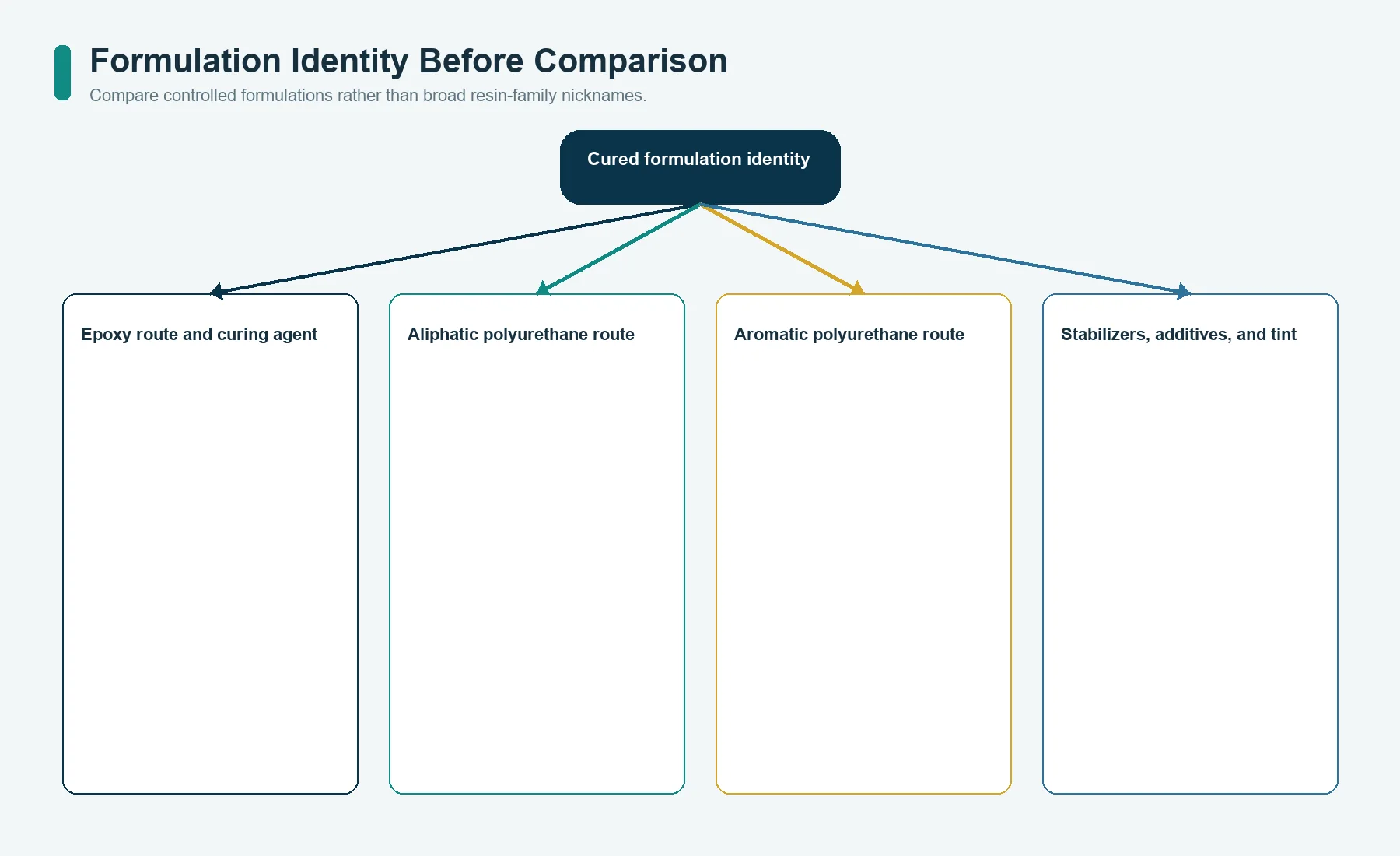
Epoxy and polyurethane describe broad chemistry families. Formulators can change backbone, curing agent, functionality, additives, stabilizers, pigments, catalysts, plasticizers, fillers, and cure conditions. Those choices alter optical and mechanical behavior.
The polyurethane branch matters. Covestro describes aliphatic polyisocyanate systems for lightfast and weather-resistant coatings. That supports a narrow conclusion: some polyurethane systems are deliberately built around light stability. It does not support polyurethane never yellows, because aromatic versus aliphatic chemistry, formulation, thickness, cure, exposure, and other layers remain relevant.
The epoxy branch is also broader than the usual slogan. Huntsman’s EPALLOY 5001 N is presented as a low-yellowing epoxy resin for UV-stable systems, and optical epoxy suppliers publish specialized low-yellowing formulations. Those records do not prove that a generic doming epoxy will remain clear outdoors. They show why all epoxy yellows quickly is not an acceptable engineering rule.
Compare supplier-controlled formulations using:
- complete resin and hardener identity;
- revision and lot;
- aliphatic or aromatic route where relevant;
- clear, tinted, pigmented, or filled system;
- mix ratio and dispensing method;
- moisture and temperature controls;
- target cure and post-cure;
- optical reference after cure;
- hardness, recovery, and bend behavior;
- compatibility with ink, film, and adhesive;
- exposure evidence on a representative specimen;
- storage life and change-control route.
Do not substitute one supplier’s datasheet value for another formulation.
The First Failure Can Begin During Dispensing
Doming quality can be decided before environmental exposure begins. Mixing and dispensing affect stoichiometry, bubbles, surface, edge formation, cure, and residual stress.
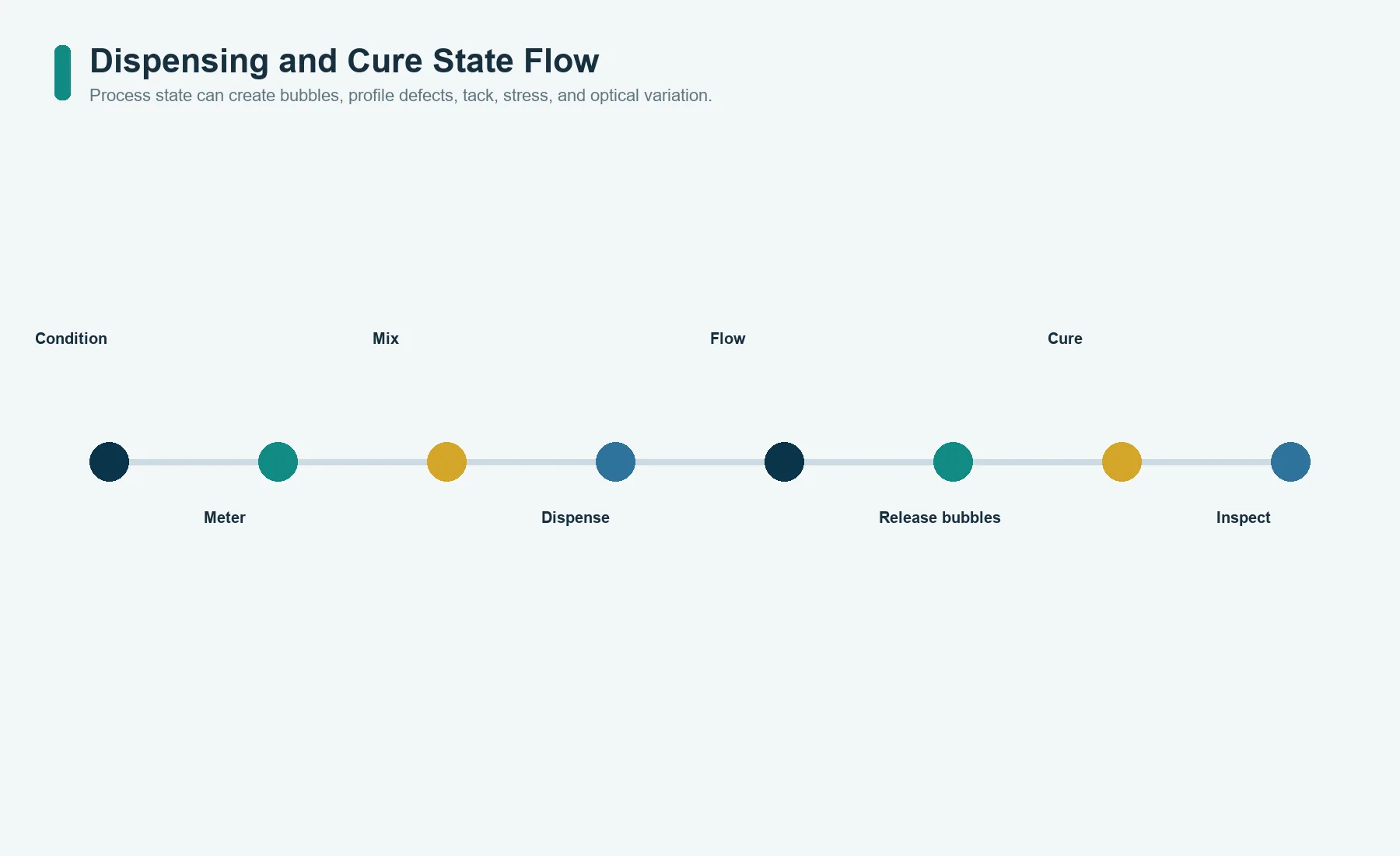
Map the process state:
CONDITION MATERIAL
  > METER
  > MIX
  > DISPENSE
  > FLOW TO PROFILE
  > RELEASE BUBBLES
  > GEL
  > CURE
  > CONDITION
  > INSPECT
For both epoxy and polyurethane candidates, confirm:
- component storage and conditioning;
- permitted moisture exposure;
- meter and mix control;
- purge and start-up disposition;
- air entrainment and bubble-control method;
- working time under actual production conditions;
- flow over the selected ink and film;
- edge stop and dome-shape repeatability;
- contamination and dust control;
- gel movement before the label is level;
- cure temperature, time, humidity, and handling point;
- acceptance of tack, ripple, void, crater, inclusion, and overflow.
A yellowed field sample can begin with off-ratio mixing or incomplete cure rather than resin-family chemistry. A cracked dome can begin with excessive cure stress, trapped bubbles, or an incompatible carrier. Root-cause records must retain process state, not only material name.
Cure Locks In Shape, Stress, and Optical State
The dome profile forms while the liquid wets the printed surface and stops at the label edge. Cure converts that profile into a solid lens and can lock in shrinkage, stress, optical defects, and interfacial weakness.
Inspect the cured state before mounting:
- profile symmetry and edge shape;
- overflow, underfill, retreat, or exposed print;
- bubbles, voids, dust, fibers, craters, and surface ripple;
- color neutrality against a controlled background;
- haze and internal scattering;
- gloss and orange-peel appearance;
- surface tack or print transfer;
- hardness and indentation recovery;
- bend response on the actual carrier;
- adhesion to the printed surface;
- carrier curl or distortion;
- cut-edge integrity after handling.
Do not call a dome cured because it can be touched. The approved cure state must support packaging, application, installation, and later exposure. If the product is packed too early, stacked pressure can mark the surface. If the cure continues after installation, the resin, carrier, and adhesive can change while constrained on the product.
The cure record should state the measurable release condition and the retained reference, not rely on elapsed time alone.
Yellowing Is One Optical Failure, Not the Whole Outdoor Decision
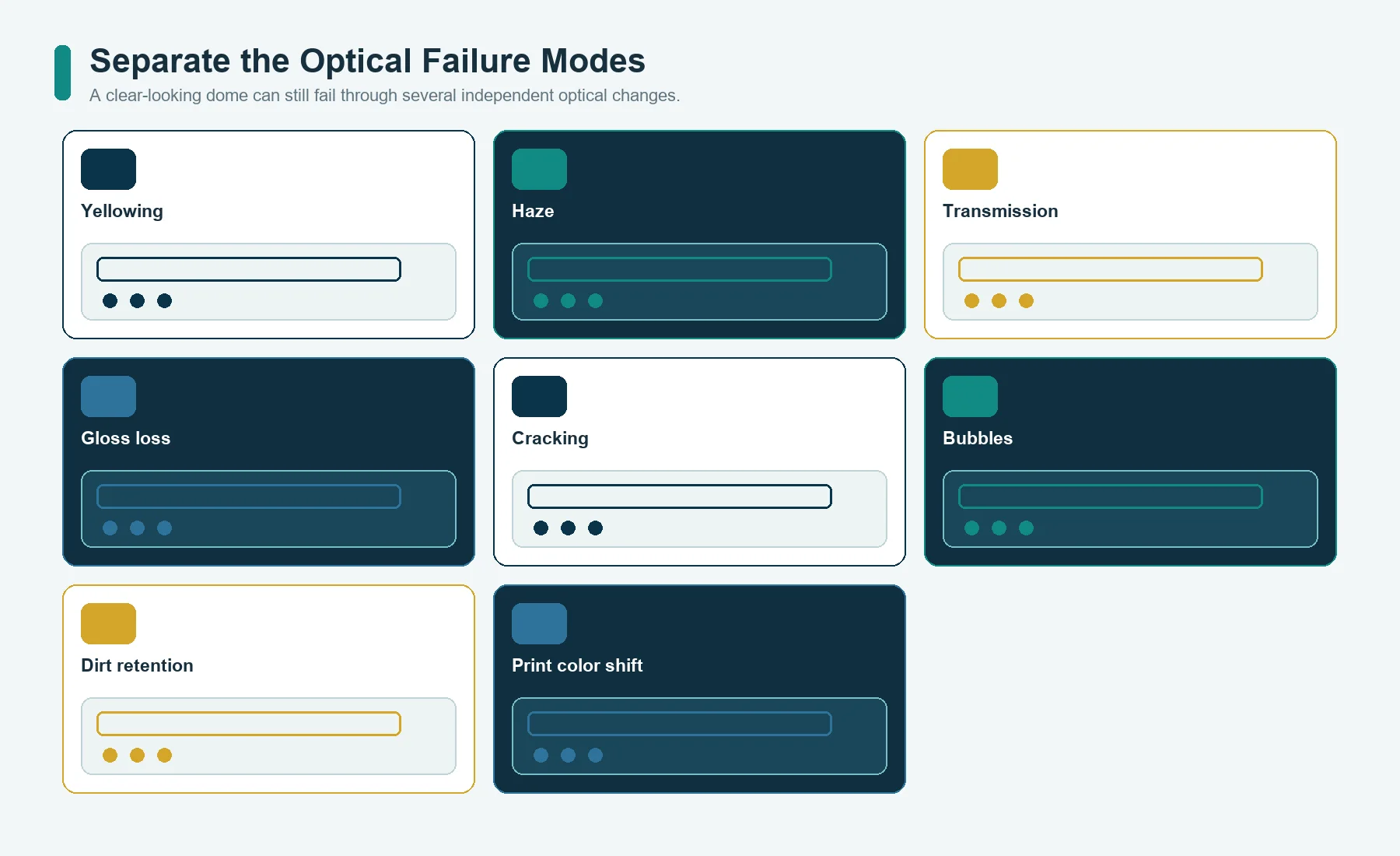
Yellowing matters because a clear dome is a lens over artwork. Even a small color change can alter white, silver, blue, or brand-critical graphics. Yet a dome can fail optically without obvious yellowing.
Separate:
- yellowness or color shift;
- total luminous transmittance;
- haze or light scattering;
- gloss loss;
- surface chalking;
- cracking or crazing;
- bubbles or internal void growth;
- dirt retention;
- loss of magnification or visual depth;
- print color change beneath the dome.
ASTM E313 addresses yellowness and whiteness indices calculated from instrumentally measured color coordinates for near-white or near-colorless materials. It does not create a universal pass limit for a domed label.
ASTM D1003 covers haze and luminous transmittance of transparent plastics. A flat specimen or a curved dome can present different measurement geometry, so the validation plan must define the specimen, instrument, orientation, background, and calculation.
For outdoor simulation, ISO 4892-2 addresses xenon-arc exposure of plastics. The method does not promise a fixed number of outdoor years. The project must define the cycle, irradiance control, moisture, specimen temperature, duration, measured attributes, and acceptance criteria.
An optical record should show before-and-after values and images against the same background. Still clear is not an inspection method.
Haze, Gloss, and Magnification Can Fail Before Color
The dome changes how the artwork is viewed. Its curved surface, refractive behavior, thickness profile, and finish create depth and highlight. A formulation that remains colorless can still lose the intended appearance through micro-scratches, haze, surface texture, or edge distortion.
Review:
- center and edge clarity;
- text and line distortion through the profile;
- metallic and white-field appearance;
- highlight shape under controlled lighting;
- gloss uniformity;
- trapped air near fine artwork;
- edge lensing over narrow borders;
- readability at the actual angle and distance;
- appearance after wiping and handling;
- appearance after the declared exposure.
Use the actual label geometry. A bulk cast plaque does not reproduce the thin carrier, printed interface, dome edge, or optical path of the production label. A flat plaque may hide edge lensing that dominates a small logo.
The artwork also matters. A dark background can hide mild yellowing while a white field exposes it. Metallic ink can exaggerate haze or gloss variation. A fine outline near the edge can appear displaced by the lens. Optical qualification must use representative art, not only clear resin.
Hardness, Scratch Resistance, and Flexibility Are Different Properties
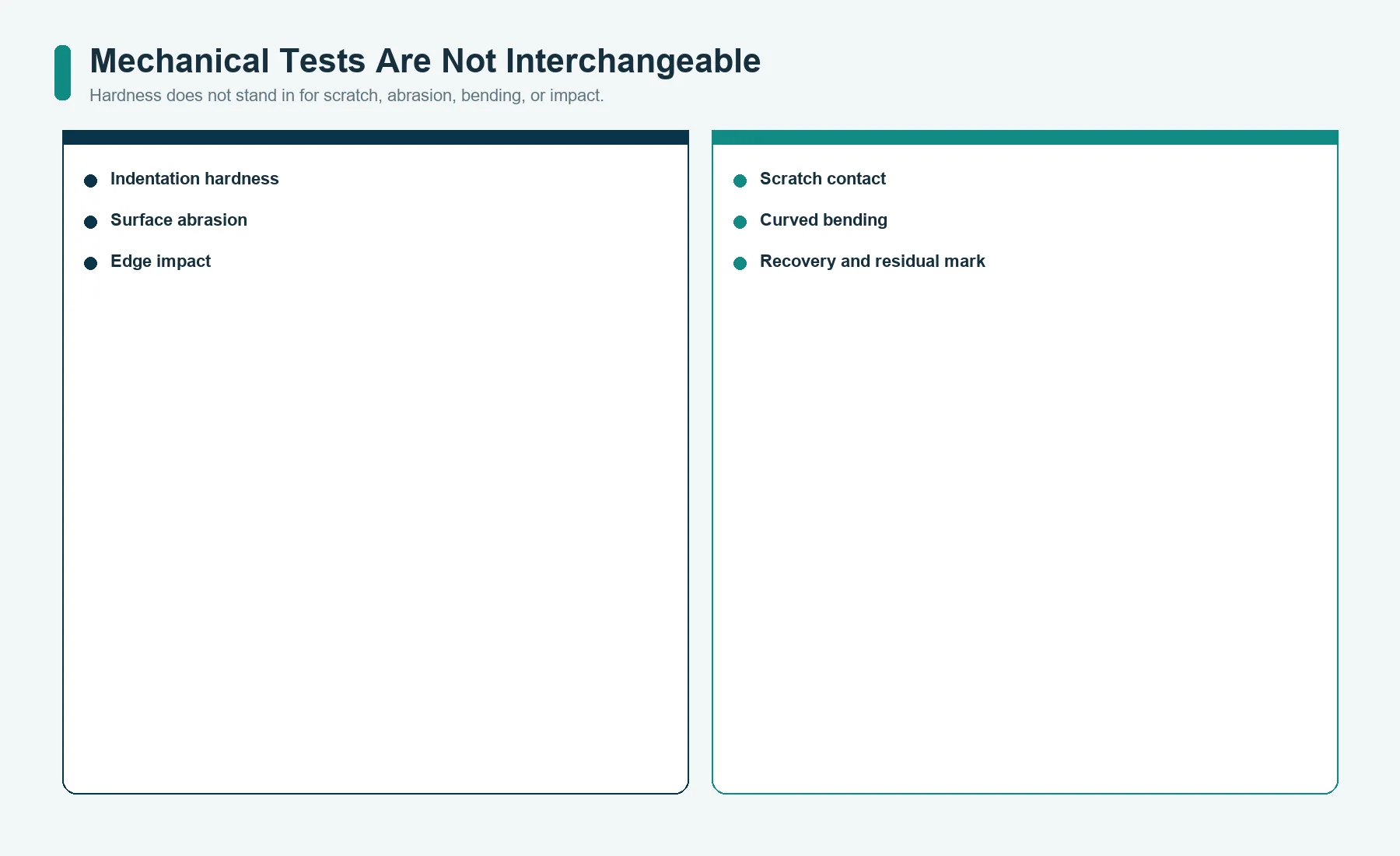
Hardness is resistance to a defined indentation under defined conditions. Scratch resistance depends on contact shape, load, speed, abrasive, coating, friction, and surface recovery. Flexibility concerns deformation without unacceptable cracking, whitening, delamination, or permanent shape change. These properties are related but not interchangeable.
ASTM D2240 provides durometer hardness methods for rubber and plastics. A hardness number does not prove scratch resistance or suitability for a curved emblem.
ASTM D1044 covers resistance of transparent plastics to surface abrasion by the Taber abraser. The method can compare declared specimens, but a flat test piece does not automatically reproduce a domed edge, compound curve, wiping cloth, grit, fingernail, tool contact, or field cleaning.
Build a property map:
| Requirement | What to evaluate | Avoid substituting |
|---|---|---|
| indentation | depth, recovery, visible mark, temperature | generic soft or hard |
| scratch | contact, load, surface damage, optical effect | hardness alone |
| abrasion | material loss, haze, gloss, image readability | one cycle count as field life |
| bending | crack, whitening, lift, recovery, residual set | elongation from a bulk specimen alone |
| impact | dent, split, edge chip, delamination | scratch result |
| tactile feel | initial and conditioned response | supplier marketing adjective |
An epoxy formulation can be toughened. A polyurethane formulation can be rigid. The selected cured system must be tested at the dome profile and temperature that matter.
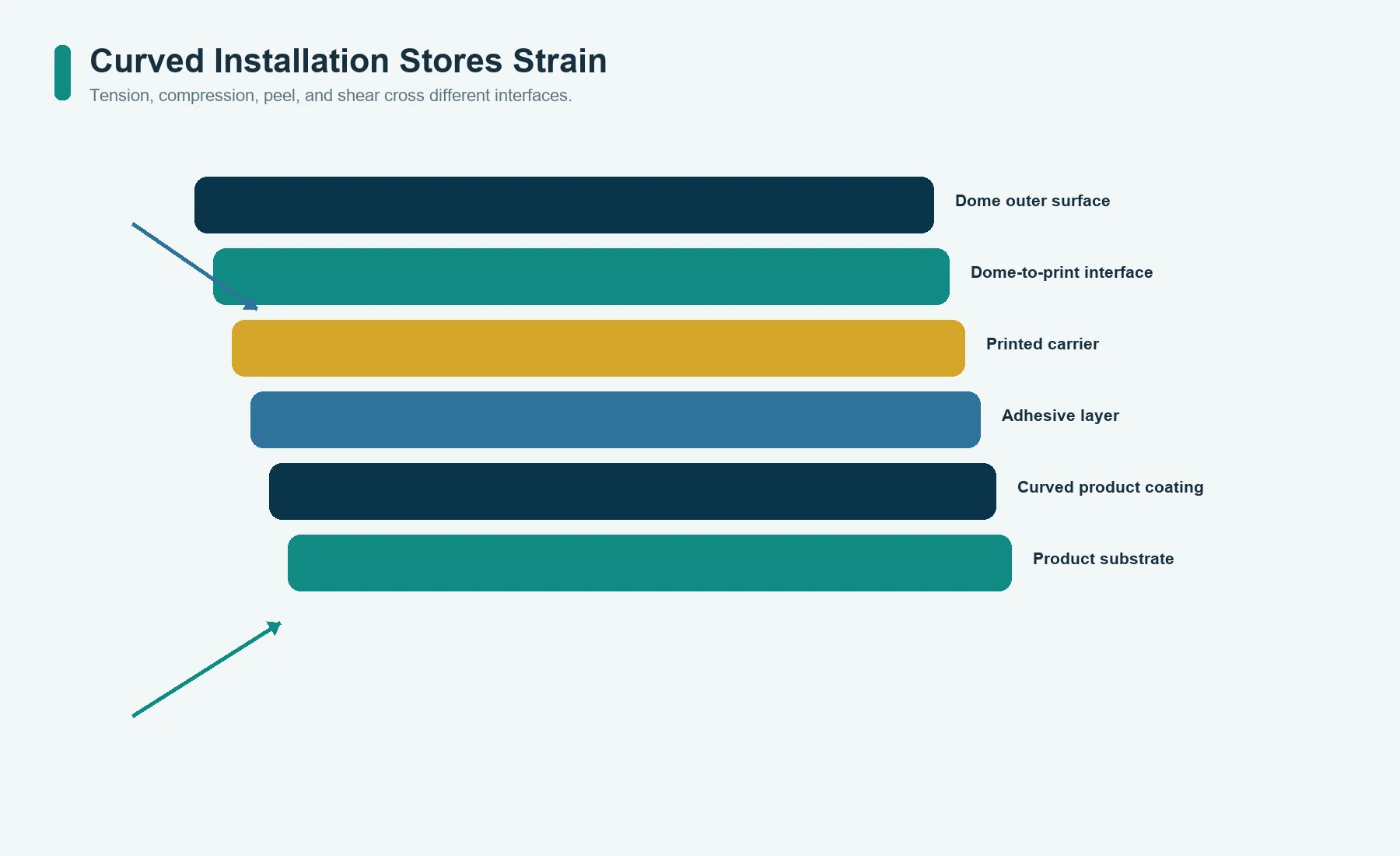
Curved Installation Stores Strain in Every Layer
A flat domed label applied to a curved surface stores strain in the dome, ink, carrier, and adhesive. The outer surface may be in tension while the adhesive side sees compression or shear. Small edge lift can let cleaner or moisture enter.
Map the installed curve:
OUTER DOME SURFACE: TENSION OR COMPRESSION
PRINT INTERFACE: DIFFERENTIAL STRAIN
LABEL CARRIER: BENDING AND RECOVERY
ADHESIVE: PEEL AT EDGE + SHEAR THROUGH FIELD
PRODUCT SURFACE: CURVATURE + TEXTURE + COATING
Record:
- single or compound curvature;
- curve direction relative to the label shape;
- application method and pressure;
- installation temperature;
- minimum edge distance from a step or corner;
- time before handling or loading;
- substrate material and coating;
- expected temperature cycling;
- whether the product flexes in service;
- acceptable edge lift, dome whitening, cracking, and shape change.
A more flexible dome can reduce one stress while the carrier or adhesive remains the limit. A stiffer dome can flatten a thin label edge and increase peel. The materials and adhesives capability is the relevant JASPER context for reviewing the mating surface and adhesive, but the real substrate and installation conditions are still required.
Do not qualify curvature by bending a cured resin bar. Use the complete domed label on the intended or representative surface.
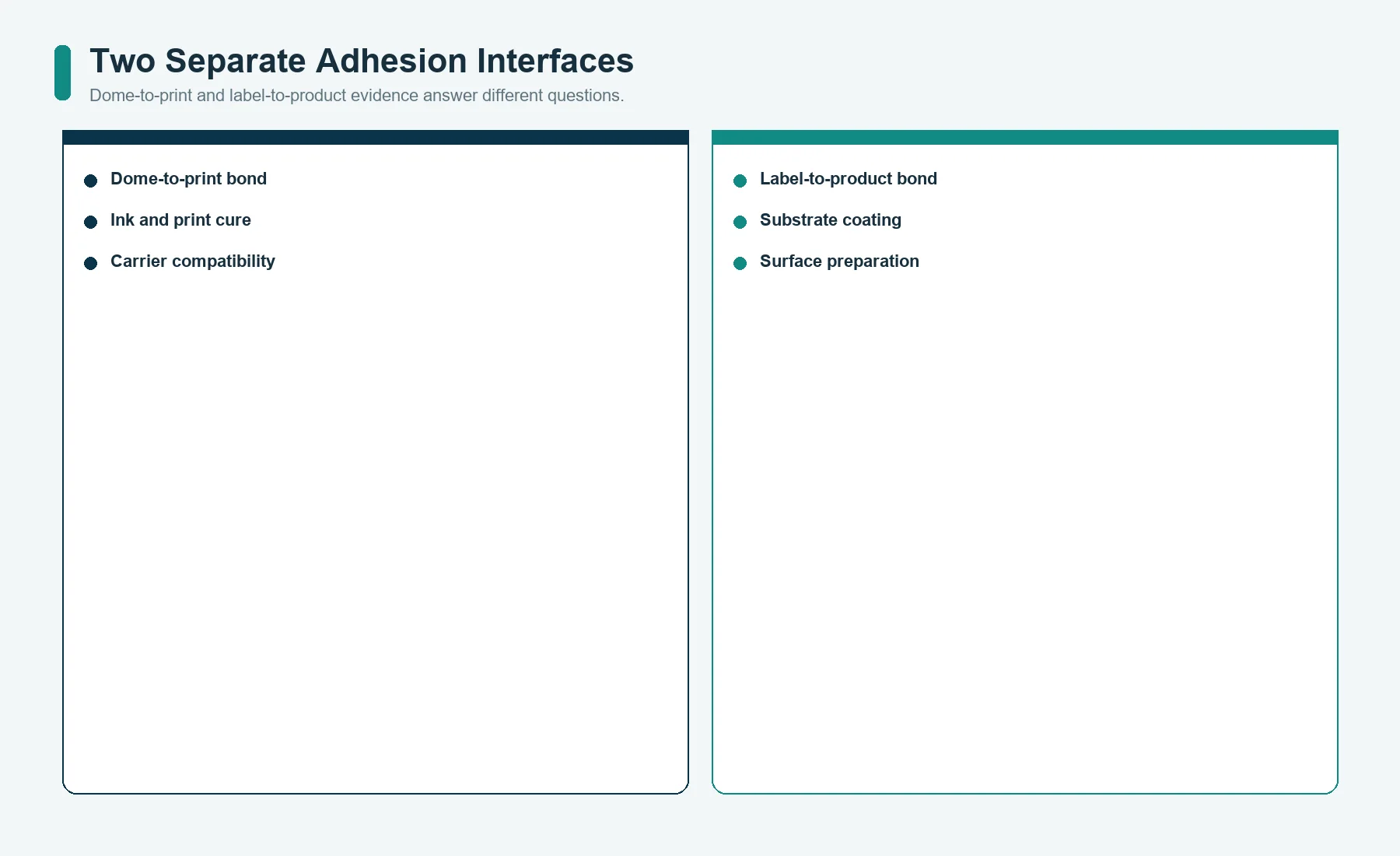
The Resin Can Protect the Print and Still Lose the Assembly
The clear dome may shield the printed face from direct rubbing and liquid contact. It does not protect every interface:
- cleaner can enter at the dome edge;
- water can reach the adhesive edge from the product surface;
- a printed layer can lose adhesion beneath an intact dome;
- the carrier can split outside the resin footprint;
- the product coating can detach with the label;
- thermal movement can load the adhesive;
- edge impact can start a crack or peel;
- a rigid dome can bridge over surface texture.
Separate dome-to-print adhesion from label-to-product adhesion. A peel result for the pressure-sensitive adhesive says nothing about dome bonding to ink. A resin pull-off from one ink color may not represent another ink, white layer, metallic layer, varnish, or print cure.
Use witness patterns that include:
- the lightest and darkest color fields;
- white and metallic layers where used;
- solid and fine-detail areas;
- dome edge over printed and unprinted zones;
- carrier edge outside the dome;
- adhesive edge on the product;
- holes, cutouts, narrow necks, and sharp corners if present.
The printed label is a component of the resin qualification.
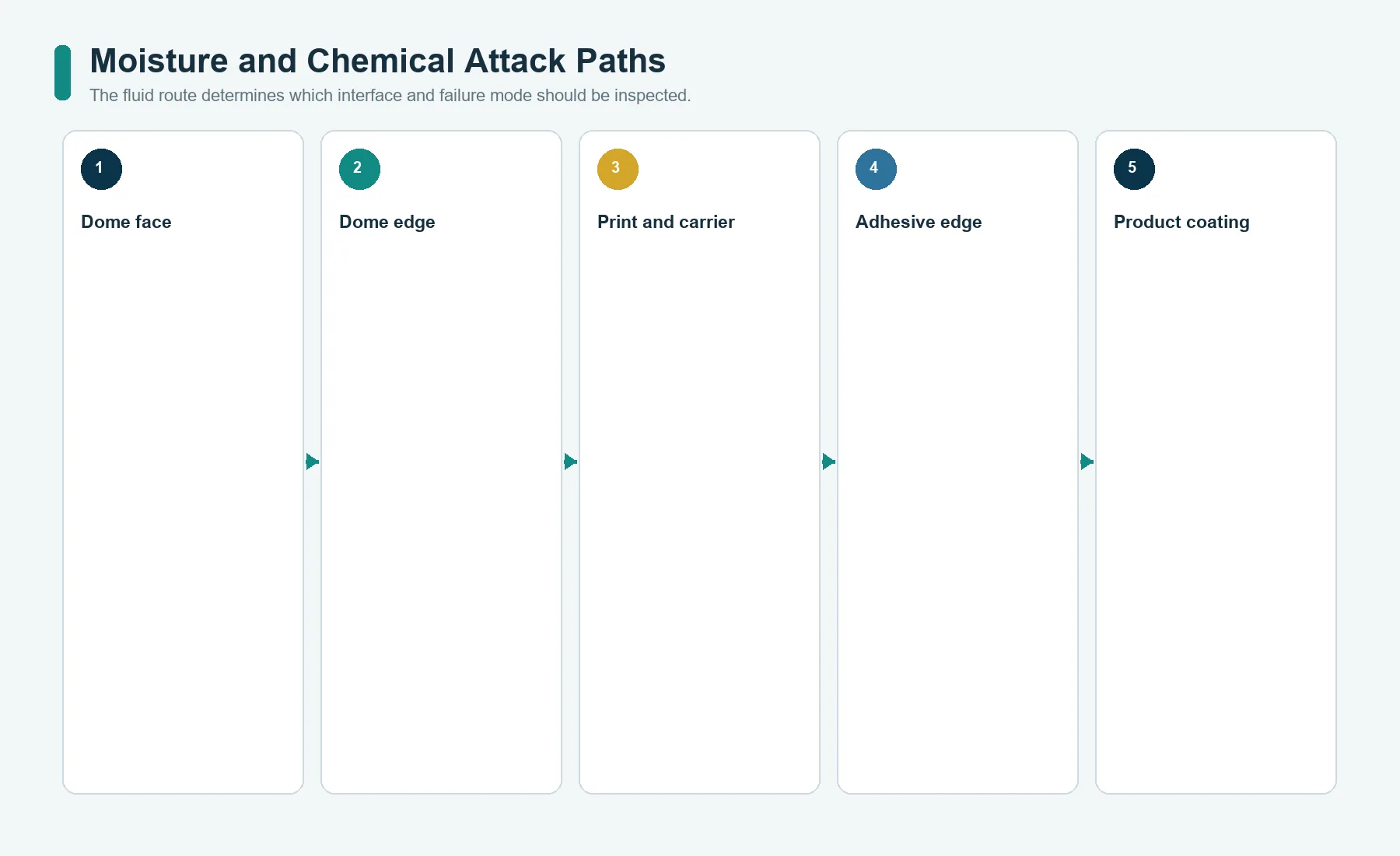
Moisture and Chemicals Attack Different Interfaces
Chemical resistant is meaningless without the fluid and failure mode. Water, detergent, disinfectant, oil, fuel, sunscreen, plasticizer, solvent, alkaline cleaner, acid cleaner, and salt deposit can affect different layers.
ASTM D543 provides practices for evaluating plastic resistance to chemical reagents. It does not list a universal pass result for epoxy or polyurethane domes.
Define:
- chemical identity and supplier;
- concentration and contamination;
- liquid or vapor contact;
- temperature;
- dwell and drying;
- wipe, splash, immersion, pooling, or repeated cycle;
- rinse and recovery period;
- mechanical load during or after exposure;
- dome, print, film, adhesive, and substrate attributes to inspect;
- functional and cosmetic limits.
Possible failures include:
- swelling or softening;
- hardening or embrittlement;
- tack or surface transfer;
- haze, color, or gloss change;
- cracks and crazing;
- dome-to-print delamination;
- ink bleed or color migration;
- film curl;
- adhesive edge lift;
- substrate-coating damage.
For rain, salt, UV, cleaner, and enclosure context, use the marine and outdoor equipment page as an application reference, not proof that a candidate dome stack is qualified.
Edge Geometry Controls More Than Appearance
The dome edge is where the liquid profile ends, the carrier continues, the adhesive may be exposed, and handling begins. Edge geometry influences optical appearance, dirt retention, impact, peel, and moisture entry.
Review:
- label outline and corner radius;
- narrow extensions and internal corners;
- clearance between artwork and dome edge;
- consistency of dome stop;
- resin overflow onto the adhesive liner;
- exposed carrier margin;
- edge height and tactile transition;
- parting, trimming, or die-cut sequence;
- application tools and installer finger path;
- nearby recess, boss, seam, or housing edge;
- packaging contact.
Do not define one universal dome height or edge radius. The stable profile depends on formulation flow, dispensed volume, surface energy, artwork, label outline, cure state, and equipment control. A high dome may increase visual depth while increasing edge exposure and stored strain. A low dome may reduce profile but fail to create the desired lens effect.
Approve a dimensioned cross-section or a controlled sample with explicit inspection points.
Build a Specimen Set That Represents the Installed Label
One clear casting is not enough. Build a specimen family:
| Specimen | Purpose |
|---|---|
| bulk or plaque specimen | screens resin color, haze, cure, and base mechanical behavior |
| printed flat label | checks dome-to-print compatibility, optical effect, edge, and carrier |
| curved installed label | checks stored strain, whitening, cracking, edge lift, and recovery |
| product-surface label | checks adhesive and coating interaction |
| edge-feature coupon | checks narrow sections, corners, fine art, and dome stop |
| exposure witness | reserves a controlled before-and-after comparison |
| retained production sample | supports repeat-order and change review |
Each specimen should trace to resin lot, hardener lot, mix record, print revision, ink system, carrier, adhesive, dome program, cure, date, and operator or equipment record as applicable.
The specimen must also match orientation. A label mounted vertically can drain cleaner differently from a horizontal badge. A curved vehicle or tool surface can receive sunlight and impact at different angles. A small emblem can have a much larger edge-to-area ratio than a laboratory plaque.
Use Test Methods as Instruments, Not Marketing Badges
An ASTM or ISO reference is a method, practice, or specification with defined scope. It is not a standalone claim that a resin is automotive grade, weatherproof, or suitable for every outdoor product.
Build a test definition:
Failure | Specimen | Conditioning | Method | Exposure | Measurement | Limit | Inspection Time | Owner
Examples:
- yellowing: instrument, background, specimen geometry, initial value, post-exposure value, and limit;
- haze: optical method, orientation, center or edge region, and allowed change;
- abrasion: apparatus settings, specimen support, endpoint, cleaning, and measured optical or material effect;
- bend: installed radius, temperature, dwell, cycles if required, and crack or lift limit;
- chemical: fluid, concentration, temperature, contact mode, rinse, recovery, and every layer inspected;
- adhesion: dome-to-print and label-to-product interfaces tested separately;
- weathering: lamp, filter, irradiance, moisture, temperature, cycle, duration, and before-and-after attributes.
JASPER’s quality and testing page provides the right framework for requirement, specimen, method, result, acceptance, and record. It does not prove that a domed label has passed a named test.
Compare Cost Through Yield, Rework, and Field Risk
Resin price does not equal finished domed-label cost. Compare:
- component storage and conditioning;
- meter-mix and dispensing control;
- purge, start-up, and end-of-pot-life waste;
- bubble, dust, overflow, underfill, and profile yield;
- cure time, rack space, handling, and work in process;
- inspection of clarity, surface, edge, and printed art;
- label film, print, adhesive, liner, and die cut;
- curved-surface sampling and test specimens;
- packaging that avoids blocking or surface marks;
- sorting and rework after resin defects;
- scrap when a dome cannot be removed without destroying the print;
- field replacement and brand impact;
- formulation change and requalification.
An inexpensive resin can produce an expensive label if the process window is narrow or defects are found after printing and die cutting. A higher material price can still be economical if it reduces scrap, inspection burden, or field risk. Those outcomes must be shown with actual production and quality records, not assumed from chemistry.
Compare only candidates that already meet the optical, mechanical, adhesion, and exposure requirements.
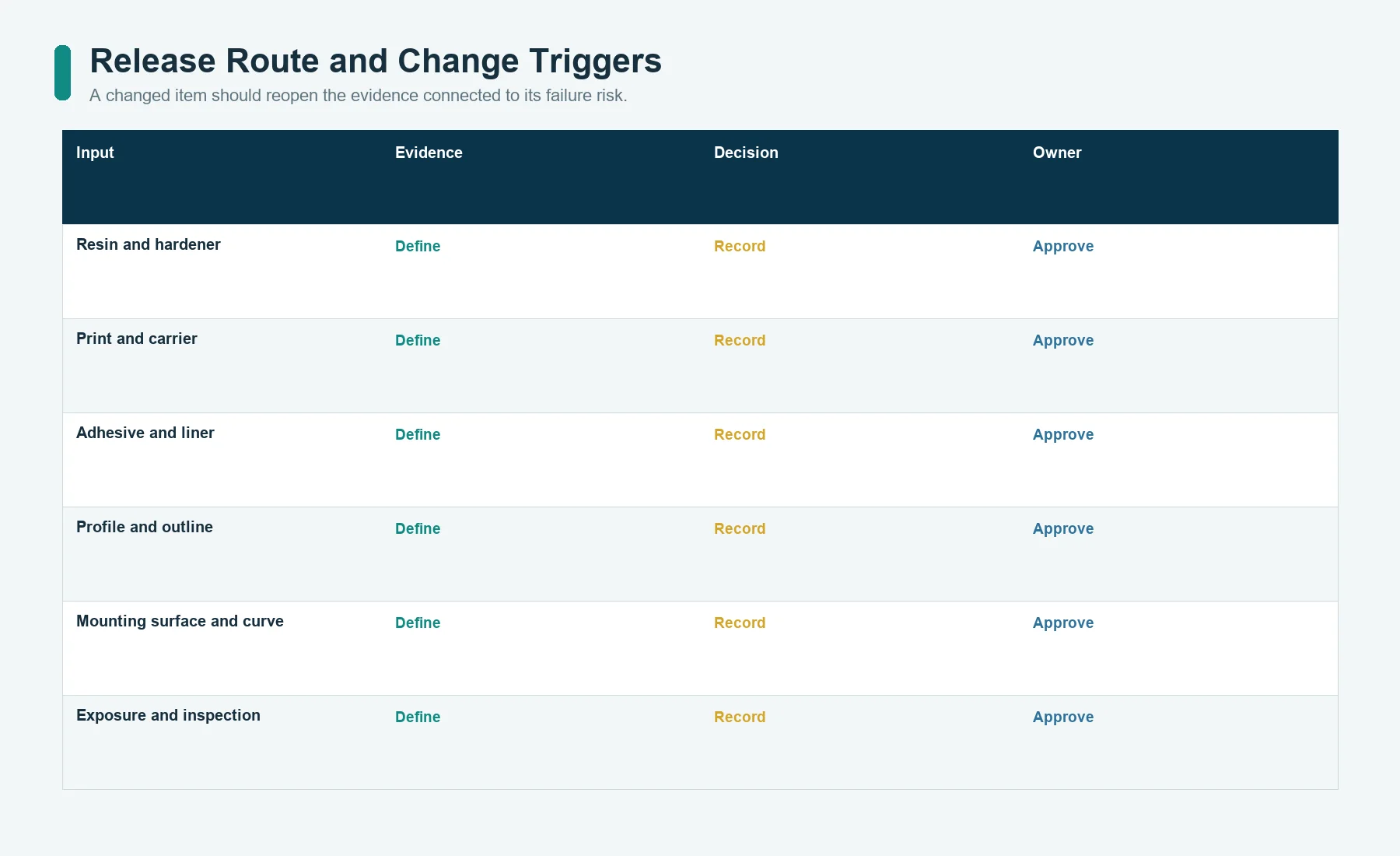
Release a Resin Route With Change Triggers
The approved route should identify:
- resin, hardener, and supplier revision;
- permitted source and substitution rule;
- mix, dispensing, and cure controls;
- print, ink, carrier, adhesive, and liner;
- dome profile and dimensional reference;
- mounting surface and curvature;
- cosmetic and optical reference;
- hardness, recovery, bend, edge, and adhesion criteria;
- exposure methods and acceptance;
- packaging and shelf conditions;
- first-article and lot records;
- retained sample;
- rework and replacement policy.
Use this change record:
Changed Item | Affected Layer | Failure Risk | Required Evidence | Approval Owner
Triggers can include resin component, catalyst, stabilizer, pigment, mix equipment, dispense program, cure, ink, film, adhesive, die cut, artwork, mounting coating, curvature, cleaner, UV exposure, packaging, or supplier.
A resin declared equivalent by family name is not an approved substitution.
Review the affected layer and rerun the evidence needed for its failure risk.
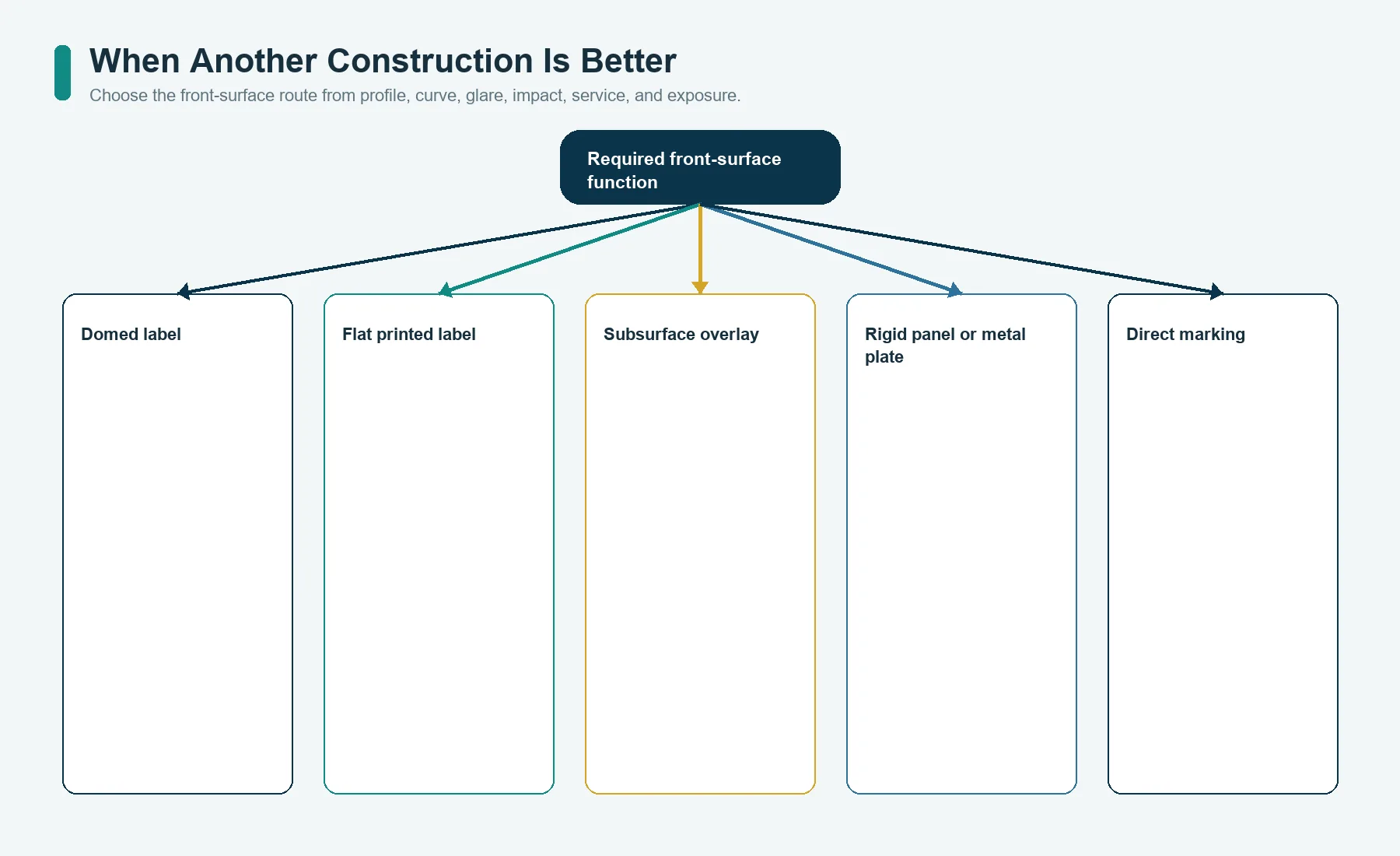
When a Domed Label Is the Wrong Construction
A dome may be the wrong route when:
- the product needs a low-profile or flush surface;
- the label must wrap a tight or compound curve that the complete stack cannot tolerate;
- optical gloss creates glare or conflicts with the product finish;
- frequent scraping or sharp impact is expected at the edge;
- the information changes often and replacement without residue is required;
- a rigid plate, protected subsurface graphic, molded emblem, or direct mark better carries the duty;
- the mounting surface is too textured, contaminated, flexible, or low-energy for the available adhesive system;
- the exposure cannot be qualified with a viable resin, print, film, adhesive, and substrate combination.
Before adding a dome, compare the flat polymer label, overlay, acrylic, glass, metal, and other front-surface routes in JASPER’s graphic overlay materials guide.
Choosing no dome is a valid engineering result. The comparison should protect the installed product, not defend a preferred process.
Frequently Asked Questions
Is resin family enough to choose between epoxy and polyurethane domed labels?
No. Qualify the exact cured formulation on the real print, carrier, adhesive, mounting surface, shape, curvature, process, and exposure.
Does polyurethane doming resin never yellow?
No universal statement is valid. Aliphatic or aromatic chemistry, additives, cure, thickness, exposure, and the other label layers all affect the optical result.
Does a harder dome automatically resist scratches better?
No. Hardness, scratch, abrasion, bending, and impact use different loads and failure criteria, so each required property needs its own evidence.
How should a domed label for a curved surface be validated?
Use the complete printed, domed, adhesive-backed label on the intended or representative curved surface and inspect strain, cracking, whitening, edge lift, and recovery.
What should an OEM send for a domed-label resin review?
Send the artwork, outline, dome profile, print colors, carrier, adhesive, mounting material and coating, curvature, installation, exposures, appearance limits, validation needs, and quantities.
Sources
- Covestro, Desmodur ultra N 3386 BA/SN
- Covestro, Polyisocyanates and Prepolymers
- Huntsman, EPALLOY 5001 N
- Master Bond, Optically Clear Polymer Adhesives
- ASTM E313, Yellowness and Whiteness Indices
- ASTM D1003, Haze and Luminous Transmittance of Transparent Plastics
- ASTM D2240, Rubber Property – Durometer Hardness
- ASTM D1044, Surface Abrasion of Transparent Plastics
- ASTM D543, Resistance of Plastics to Chemical Reagents
- ISO 4892-2, Plastics – Xenon-Arc Exposure
Source records define formulation examples and test methods. They do not prove JASPER resin chemistry, compliance, process capability, or finished domed-label performance.
Send the Installed Stack for Resin Review
Send the artwork, label outline, dome profile, printed colors, carrier film, adhesive, mounting material and coating, curvature, installation process, sunlight, moisture, chemicals, temperature, handling, appearance limits, validation needs, prototype quantity, and annual demand through JASPER’s contact page. JASPER can then review epoxy, polyurethane, or another construction as a complete cured and installed stack instead of selecting from resin-family claims.