PCB assembly component sourcing turns a BOM into permission to buy specific parts, from approved sources, in quantities that meet the build schedule. An OEM should define the manufacturer and full part number, purchasing channel, material-ready date, substitution authority and excess-stock owner before purchase authorization. Use a strict release benchmark: 100% of fitted BOM lines have a sourcing rule and a responsible buyer, with zero unapproved substitutions. Treat availability as a dated, quantity-specific commitment; an inventory listing alone does not secure a production kit.
- Why Sourcing Rules Belong in the RFQ
- Turn the BOM into a Component-Sourcing Requirement
- 1. Specify exact manufacturer and part identity
- 2. Assign revision, population and buying ownership
- Specify Approved Channels and Traceability Expectations
- 3. Make the channel rule explicit
- 4. Define traceability through receipt and assembly
- Check Availability Against the Build and Forecast Dates
- 5. Measure quantity coverage by date
- 6. Match lifecycle status to the program horizon
- Define Substitution Authority Before a Shortage Appears
- 7. Separate technical and commercial permission
- 8. Limit each approval to its intended use
- Control Purchase Commitments and Excess-Stock Exposure
- 9. Check packing and commitment before ordering
- 10. Agree ownership and disposition of residual material
- Use a Sourcing Checklist at RFQ and Order Release
- Step 1: Release the sourcing inputs
- Step 2: Require a line-level supplier response
- Step 3: Close technical and source exceptions
- Step 4: Bound the commercial commitment
- Step 5: Refresh and authorize the purchase
- Step 6: Reconcile receipt and release the build
- Eight Signals That Require a Hold or Escalation
- Prepare the Next Sourcing Review
Why Sourcing Rules Belong in the RFQ
Poor component-sourcing rules expose an OEM to late builds, unauthorized design changes and inventory costs that the quoted assembly price does not explain. The RFQ must establish what the assembler may purchase and which decisions remain with the OEM.
One missing connector can hold a build. Most material has arrived and assembly capacity is booked, but the proposed replacement still needs its mating fit checked against the released product configuration. Who owns that decision? Name the authority before purchasing faces a choice between delaying the order and committing to the replacement. A salesperson’s informal assurance cannot release a design change.
A reel can create another problem. The build finishes with unused components, neither party has accepted ownership, and a later BOM change removes their intended use. The unit price looked attractive. The purchase commitment was incomplete.
The practical objective is a sourcing requirement that connects each BOM line to an allowed buying action, evidence and an escalation owner. Evaluate the ten criteria below before comparing quotations. A low price cannot compensate for an unresolved part identity or an open-ended purchase commitment.
Turn the BOM into a Component-Sourcing Requirement
A sourcing-ready BOM identifies the approved component and the rules for buying it. Keep the BOM revision, populated variant, orderable manufacturer part number (MPN), quantity per board and purchasing responsibility together so a supplier can quote the intended build without interpreting design intent.
1. Specify exact manufacturer and part identity
Do not shorten the MPN. Use the manufacturer name and complete orderable part number, including relevant package, temperature-grade and packing suffixes. An internal part number can group qualified alternatives, but it must resolve to an approved manufacturer-parts list. A distributor stock code helps purchasing locate an offer; it does not replace the MPN.
For example, “10 kΩ resistor” leaves the package, tolerance, power rating and other design requirements unresolved. If generic passive sourcing is permitted, engineering must release a controlled specification and approved selection rule.
Good signal: Every fitted line resolves to an exact MPN or a controlled, explicitly authorized specification.
Red flag: A quotation substitutes a description or distributor link for the released part identity.
2. Assign revision, population and buying ownership
Mark do-not-populate positions and identify customer-supplied material separately from assembler-purchased material. A hybrid order needs one buyer for each line. Otherwise, two parties can purchase the same part while both assume the other will supply another.
Keep placement information in the correct file. The BOM defines component identity; the component placement list (CPL) supplies position, rotation and board side, as explained in The referenced supplier’s BOM and CPL guidance. Matching revisions connect these different responsibilities.
Good signal: The RFQ states the BOM revision, board variant, fitted quantity and material owner.
Red flag: Purchasing uses an earlier BOM because the latest file arrived after the quotation.
Use this completed control matrix as the basis for the purchasing notes:
| Sourcing Requirement | BOM-Level Input | Buyer Rule | Supplier Evidence | Escalation Trigger |
|---|---|---|---|---|
| Approved manufacturer | Manufacturer and complete MPN | Buy the released identity or listed approved alternative | Quoted and ordered MPN match the release | Manufacturer or suffix differs |
| Approved purchasing channel | Permitted manufacturer-direct or authorized source | Use the allowed channel; approve exceptions before commitment | Seller identity and manufacturer authorization check | Seller falls outside the rule |
| Required availability | Pieces required and material-ready date | Confirm coverage for each dated requirement | Dated offer, allocation or order acknowledgment | Quantity or arrival misses the requirement |
| Alternative approval | Approved list and design authority | Obtain technical release before buying an unlisted alternative | Approval ID tied to MPN and BOM revision | Approval is verbal or outside scope |
| Traceability depth | Required lot, receipt and build links | Preserve the specified identity chain | Labels and receiving records linked to assembly lot | A required link cannot be produced |
| Excess-stock ownership | Approved purchase quantity and residual owner | Agree liability before reel or MOQ uplift | Written disposition and ownership terms | Additional quantity has no owner |
| Purchase commitment | Quantity ceiling and cancellation restrictions | Obtain commercial approval before commitment | Accepted terms and authorized quantity | Supplier terms exceed authorization |
| Lifecycle requirement | Manufacturer status and program horizon | Escalate status incompatible with intended production | Dated status check and applicable notices | Discontinuance conflicts with the plan |
Specify Approved Channels and Traceability Expectations
An OEM should define both the permitted seller and the records required with the supplied components. Manufacturer approval identifies the part; purchasing-channel approval identifies where that part may be bought. Neither instruction replaces the other.
3. Make the channel rule explicit
For routine production, specify manufacturer-direct supply or distributors authorized for the relevant manufacturer and applicable market. A recognized distributor name alone is insufficient: authorization is product-line-specific and can change. Check the manufacturer’s current directory when approving the source.
The OEM can permit any source within that defined class or name particular sellers when an agreement requires them. Avoid unnecessarily restricting every BOM line to one distributor. Preserve qualified buying options while keeping the rule enforceable.
An independent source is not automatically counterfeit. It is a different sourcing decision. If that route is allowed, require a documented exception covering the seller, offered lot, evidence, inspection needs and approval owner before purchasing. Testing alone does not reconstruct a missing supply history.
Good signal: The supplier identifies the proposed seller and flags every channel exception before ordering.
Red flag: “Original parts” is offered as the complete answer to a source-authorization question.
4. Define traceability through receipt and assembly
Ask for records that connect the received MPN and quantity to supplier documentation, package labels, available manufacturer lot/date identifiers and the assembly batch that consumes them. Specify whether traceability stops at the PCBA lot or continues to individual board serial numbers. The required depth should follow the product’s investigation and recall needs.
Identify the CoC issuer. A certificate of conformity from a reseller does not automatically provide the manufacturer’s certification or document every transfer in the supply history. Define the required records, their retention period and retrieval method. Test the request with an example receiving record before the first production order, while missing fields can still be added to the agreed documentation scope.
Include material condition in the sourcing requirement. Identify moisture sensitivity level (MSL), packaging integrity and handling obligations from the device-specific instructions. Storage conditions and protective packaging affect suitability for use. Do not replace that assessment or the manufacturer’s requirements with an arbitrary date-code age limit.
Good signal: A receiving record links the delivered lot to labels, source documents and the relevant build.
Red flag: Components are repacked or mixed without preserving the identification required by the OEM.
Check Availability Against the Build and Forecast Dates
Component availability must answer how many usable pieces of an approved MPN can reach the assembly location by its material-ready date. A catalogue stock count, manufacturer lead time and accepted delivery commitment describe different things. Record them separately.
5. Measure quantity coverage by date
Identify the full MPN and seller. Record offered pieces, check timestamp and time zone, stock location, shipment basis and arrival at the named destination. Ask whether the quantity is reserved for this order. Price validity and stock reservation are separate terms; neither establishes that incoming material has passed receiving inspection.
Read each quotation field according to the seller’s definition. AVAIL may indicate stock at quote creation; incoming inventory and estimated replenishment lead time describe different supply events. None of these fields alone establishes when the material will reach the assembler and pass receiving checks.
Back-plan from material readiness using shipping, receiving and preparation allowances. Define the calendar and starting event for each lead time. Refresh the offer at purchase authorization. Count distinct supply only: several websites may offer the same lot, and the same open order must not appear as both incoming supply and accepted warehouse stock.
For purchase planning, calculate the uncovered balance as required pieces minus accepted stock allocated to the build, minus distinct confirmed receipts due by material readiness; floor the result at zero. Exclude quarantined stock and material reserved elsewhere. Track future receipts separately until acceptance. A zero planning shortfall does not prove that a physical kit is ready.
For full-kit assembly release, require 100% of the required usable quantity for every fitted BOM line, accepted and available by its material-ready date. Excess resistors cannot cover a missing microcontroller. Staged work needs its own approved sequence, population and quantities.
Good signal: The seller confirms quantity and timing for the exact order, with exceptions separated from committed supply.
Red flag: A large headline stock figure conceals insufficient quantity in the approved package or delivery window.
6. Match lifecycle status to the program horizon
Use the manufacturer’s status for the specified product and review orderable-part notices where applicable. Keep the status check date and assign responsibility for product change notifications (PCNs) and discontinuance notices. A prototype purchase and a multi-year production commitment need different decisions.
The following example uses five lifecycle status labels. Manufacturers may use different terminology or definitions, so confirm the meaning for the exact part. The purchasing actions are recommended OEM controls, not additional manufacturer status definitions.
| Lifecycle status in this example | Meaning for sourcing | Recommended OEM action |
|---|---|---|
| PREVIEW | Product is not yet in normal production | Limit use to an explicitly approved development plan |
| ACTIVE | Released for sale; status alone does not establish stock | Default choice for new production; confirm quantity and dates separately |
| NOT RECOMMENDED FOR NEW DESIGNS (NRND) | Existing-design supply remains possible | Require a program decision before introducing it into a new design |
| LAST TIME BUY | Discontinuance is underway | Review the actual notice, deadlines and demand before authorizing a final buy |
| OBSOLETE | Production has ended | Escalate continuity planning and any proposed remaining-stock purchase |
Keep forecast demand separate from released build demand. The forecast helps identify when long-lead procurement must start, but it becomes purchasing authority only through an agreed release or commitment. If one critical part needs an early order, authorize that MPN, quantity and liability specifically rather than treating the whole forecast as firm.
Good signal: The sourcing response states the lifecycle status, check date and owner for subsequent notices.
Red flag: “ACTIVE” is presented as proof that the required build quantity is available now.
Define Substitution Authority Before a Shortage Appears
An OEM should name who can approve a component change before the assembler encounters a shortage. Purchasing may propose an alternative and negotiate supply, but it must not infer technical approval from a matching footprint, nominal value or distributor cross-reference.
7. Separate technical and commercial permission
Choose an explicit substitution policy for each BOM line: no substitution, selection from a released alternatives list, or approval required for each proposed alternative. These are purchasing-policy choices, not device classifications. The approved alternatives list must identify actual MPNs and the applicable product configuration.
A different manufacturer, grade or device can affect electrical behavior, firmware, qualification and assembly requirements. Even a packing-only change needs the agreed check for device identity, feeder compatibility and handling. Do not treat all suffix differences alike.
Assign authority in the purchase package:
| Decision | Responsible authority | Required release record |
|---|---|---|
| Device or design substitution | OEM-designated engineering authority | Approved MPN, configuration and technical approval reference |
| Source or traceability exception | OEM-designated quality authority, with purchasing | Approved seller/lot, evidence requirements and disposition |
| Price, quantity or cancellation exposure | Authorized commercial buyer | Accepted commitment and financial authorization |
| Material use in the build | Assembly/materials team under the released instructions | Receipt and issue records matching approved material |
Good signal: Technical approval and commercial authorization are both visible before commitment.
Red flag: A buyer’s acceptance of a revised price is treated as engineering approval.
8. Limit each approval to its intended use
Record the original and replacement MPNs, affected BOM revision, permitted quantity or lot, approval reference and whether the change is temporary or permanent. A temporary deviation may expire after a specified build; a permanent change belongs in the controlled product record.
Silence is not approval. Name an escalation contact and a response deadline matched to the offer’s expiry, then hold the affected commitment if permission does not arrive. This establishes the purchasing boundary without replacing the engineering validation needed for the alternative.
Good signal: The purchase order and production release reference the same approved change.
Red flag: A prototype-only approval is reused for production or another product variant.
Control Purchase Commitments and Excess-Stock Exposure
An OEM should authorize the quantity and liability of a component purchase separately from approving the assembly price. Minimum order quantity (MOQ), standard pack quantity (SPQ), order multiples and cancellation terms can create costs beyond the components fitted to shipped boards.
9. Check packing and commitment before ordering
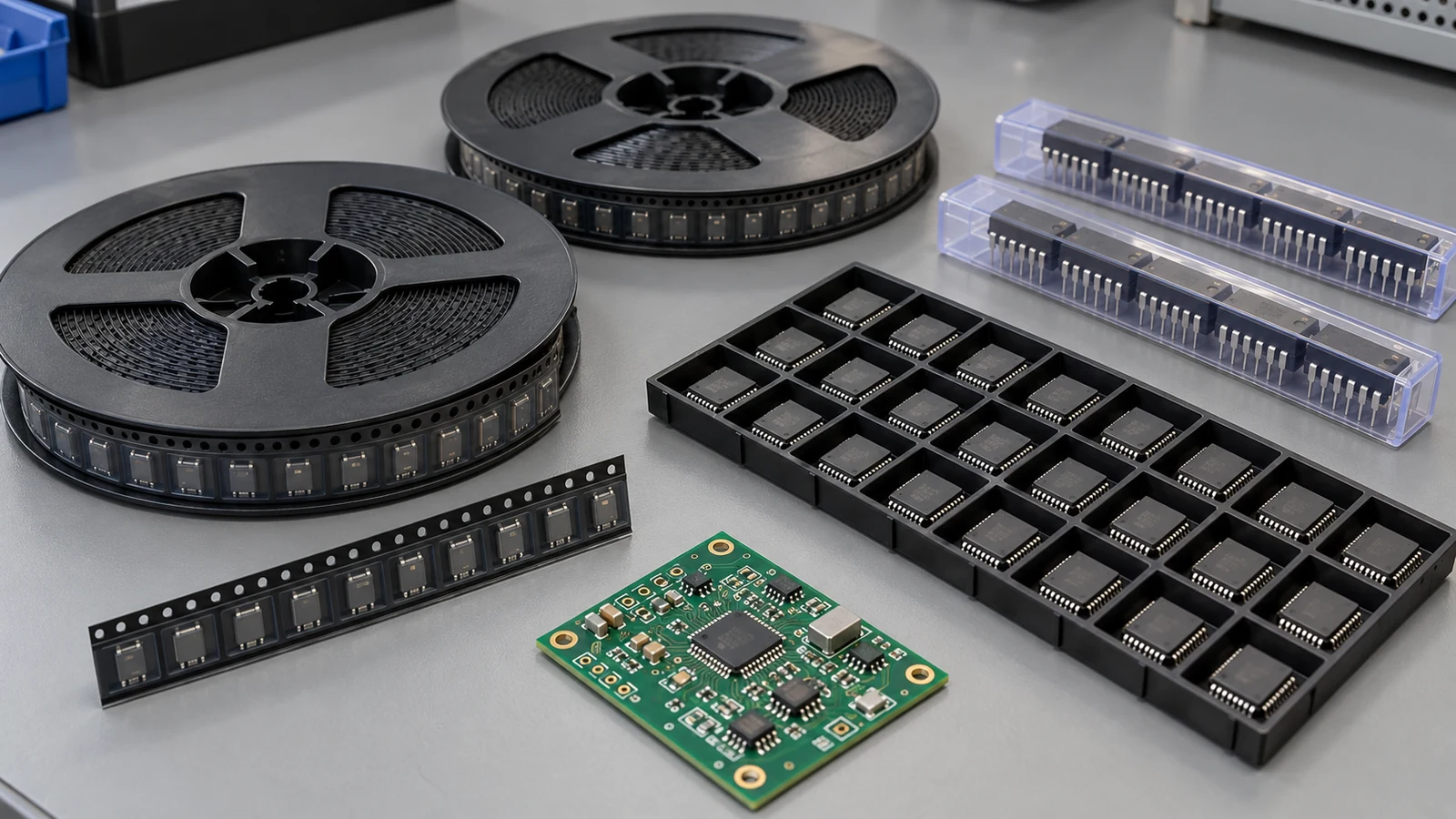
Read the packing terms. MOQ is the smallest accepted order; SPQ describes a manufacturer’s standard package. A purchasing multiple defines the allowed quantity increments for the quoted offer. They need not be identical. Available formats can include full reel, custom reel, cut tape, tube and tray, subject to the specific part and seller’s offer.
In the packaging example documented on 22 September 2026, OPA197IDBVT uses a 250-piece small tape-and-reel pack and OPA197IDBVR a 3,000-piece large tape-and-reel pack. Both codes use the 5-pin SOT-23 DBV package. These quantities do not establish today’s sellable stock or a distributor’s minimum order; confirm the current offer for the exact code.
An illustrative build makes the exposure concrete. Assume 1,000 boards need two pieces each, plus 40 project-approved pieces for setup and attrition. With 120 accepted pieces already on hand, the net new requirement is:
1,000 × 2 + 40 − 120 = 1,920 pieces.
If the approved offer requires complete 250-piece reels, eight reels supply 2,000 new pieces, leaving 80 beyond the stated requirement. One 3,000-piece reel leaves 1,080. A qualified cut-tape or custom-reel offer may change that result. The 40-piece allowance is specific to this example; it is not a universal attrition percentage.
For this example, authorize 2,000 pieces only with accepted source, packing and commercial terms. An offer requiring 3,000 pieces needs revised quantity approval; the lower quoted unit price cannot authorize the extra stock.
Good signal: The quote distinguishes required pieces, purchased pieces, packing charges and non-cancellable/non-returnable (NCNR) commitments.
Red flag: A full-reel purchase or NCNR condition appears only after the order is placed.
10. Agree ownership and disposition of residual material
Assign the residual owner and purchase ceiling. Record who pays for authorized overbuy, where material is stored and whether future releases may consume it. Require further approval before purchasing above that ceiling. A forecast reduction must trigger review of both unused stock and outstanding supplier commitments.
Physical surplus and cancellation exposure are different balances. Reconcile opening stock, receipts, material issues, returns and documented losses to the closing quantity without counting a loss twice. List unreceived NCNR orders separately. Agree applicable return credits, transfer or reuse before settling the residual liability; a warehouse count alone misses those commitments.
An early-material authorization must carry those same limits, even before the PCBA order. Name the MPNs, quantities, liability owner and trigger for cancellation or schedule review. Retained stock still needs agreed storage, reporting and disposition instructions. Urgency does not assign ownership.
Good signal: Purchase authorization and residual-stock terms identify the same quantities and responsible parties.
Red flag: “Customer owns excess” appears without an agreed purchase quantity or approval limit.
Use a Sourcing Checklist at RFQ and Order Release
An OEM sourcing checklist should turn the BOM rules into six review steps with a recorded output at each handoff. The RFQ establishes the proposed supply plan; purchase authorization accepts defined commitments; assembly release confirms usable material. Keep those decisions distinct.
Step 1: Release the sourcing inputs
Issue a dated file list identifying the BOM revision, board variant and matching assembly data. Include build quantities, material-ready dates, purchasing owners and sourcing rules. Mark customer-supplied lines. The RFQ response must name that release so later attachments cannot silently change what the supplier quoted.
Step 2: Require a line-level supplier response
Obtain the offered MPN, seller, required and purchased pieces, packing, dated availability and delivery basis for every fitted line. Separate NCNR conditions and early-buy proposals. Require explicit acceptance or an exception against each sourcing rule; an empty cell must not be interpreted as agreement.
Step 3: Close technical and source exceptions
Engineering releases unlisted alternatives; the designated quality owner decides source and traceability exceptions. Record the approval reference, affected revision, MPN and permitted quantity or lot in the exception register. Close the exception before buying. A quotation that assumes future approval remains on hold for that line.
Step 4: Bound the commercial commitment
Sign off the purchase ceiling, permitted price changes, cancellation restrictions and residual owner against firm demand. Give any early buy its own bounded authorization. Reference the accepted terms in the order so neither party has to reconstruct liability from a quotation email after material is committed.
Step 5: Refresh and authorize the purchase
Recheck before commitment. Require sourcing rules and buyers for 100% of fitted BOM lines, with zero unapproved substitutions. Compare the supplier’s acknowledgment with authorized MPNs, quantities, dates and terms; resolve differences before representing supply as secured. Hold unresolved commitments or record a bounded exception and its owner.
Step 6: Reconcile receipt and release the build
Count accepted material. Match identity, condition and records to the approved order before issue. Full-kit release requires every fitted line’s usable quantity; staged work needs separate approval. Reconcile consumption and remaining stock to the same purchase records. Return those balances to the buyer before the next release is calculated.
The handoff sequence is simple: controlled BOM → supplier sourcing response → exception decisions → bounded purchase authorization → accepted material → build release. An approval reference should travel with the affected line throughout that sequence.
Eight Signals That Require a Hold or Escalation
An OEM should stop the affected purchase or material release when identity, source permission, quantity coverage or liability falls outside the agreed rule. These eight signals override a favorable price. They call for a defined decision, not automatic rejection of every supplier involved.
| Signal | Required action | Decision owner |
|---|---|---|
| Quoted MPN differs from the released BOM | Hold the line until the difference is corrected or approved | Design authority and buyer |
| Seller is outside the approved channel | Obtain the specified source exception before commitment | Quality authority and buyer |
| Stock evidence lacks a date, seller or exact MPN | Obtain a traceable, current offer | Buyer |
| Confirmed supply misses the material-ready date | Revise the supply plan or approve a staged-build decision | Program owner and production |
| Alternative approval is verbal, expired or for another variant | Obtain an applicable written release | Design authority |
| Required lot identification is lost or mixed | Segregate material and decide its disposition | Quality authority |
| Reel uplift or NCNR exposure exceeds authorization | Stop additional commitment until its cost and ownership are accepted | Commercial buyer |
| Lifecycle notice conflicts with future demand | Review redesign, continuity or a bounded final-buy decision | Engineering and program owner |
A hold should identify the BOM line, unresolved condition, responsible person and next decision date. Avoid a blanket “sourcing pending” status: it conceals whether the problem is technical permission, commercial authority or physical supply. Releasing unaffected purchases may be reasonable when the program owner accepts the resulting inventory exposure.
Frequently Asked Questions
OEM component-sourcing decisions should resolve part identity, source permission, timing, approval authority and inventory responsibility before commitment. These answers summarize the rules to carry into an RFQ or purchase release.
Should an OEM specify a distributor or only a manufacturer part number?
Specify the exact manufacturer part number and the allowed purchasing channel; name a particular distributor only when the project requires it. An MPN defines the component, while the channel rule controls where it may be purchased. Allowing any appropriately authorized distributor can preserve buying flexibility.
Who may approve an alternative during component sourcing?
The OEM-designated engineering authority approves technical alternatives within the agreed change process. Purchasing authorizes commercial exposure, and the designated quality owner handles applicable source or traceability exceptions. Record the approved MPN, BOM revision, quantity or lot, and whether the approval is temporary or permanent before commitment.
How should long-lead components be handled before a PCBA order?
Use a limited early-material authorization for the named MPNs and quantities that must be secured before the assembly order. Confirm timing, cancellation restrictions, ownership and the commitment ceiling. A forecast helps plan the purchase but becomes buying authority only through the agreed release or commitment.
What traceability should be requested for sourced components?
Request the records needed to connect the received MPN and quantity to the seller, package labels, available manufacturer lot identifiers and consuming assembly batch. Specify any board-serial traceability separately. Define document retention and retrieval, and distinguish a reseller CoC from manufacturer-issued documentation and supply-history records.
How can a sourcing rule avoid unexpected excess inventory?
Require approval of purchased quantity, MOQ or reel uplift, cancellation exposure and residual-stock ownership before the order is placed. Subtract usable stock already allocated to the program, and separate firm demand from forecasts. Agree how remaining material will be stored, reported, reused, transferred or otherwise disposed of.
Does an ACTIVE lifecycle status mean the required quantity is in stock?
No. ACTIVE describes a manufacturer’s product lifecycle status, not available inventory for a particular order. Confirm the exact MPN, seller, quantity, check date and destination-specific delivery commitment. Recheck these details at purchasing authorization, and verify accepted usable quantity separately before a full-kit assembly release.
Are standard pack quantity and minimum order quantity the same?
No. Standard pack quantity describes the manufacturer’s usual package, while minimum order quantity is the smallest order accepted for the offer. The seller may permit smaller quantities or impose a separate order multiple. Confirm the actual packing format, charges and assembler acceptance before calculating purchase quantity.
What is a useful release benchmark for component sourcing?
Before purchase authorization, require sourcing rules and a responsible buyer for 100% of fitted BOM lines, with zero unapproved substitutions. Before full-kit assembly release, require 100% of the usable quantity needed for every fitted line. Treat staged builds as separately approved plans with defined material requirements.
Can the assembler source some parts while the OEM supplies others?
Yes, provided the purchasing responsibility is assigned line by line and accepted in the order scope. Identify customer-supplied quantities, arrival dates, handling requirements and shortage responsibility. Apply the same identity and traceability rules at receipt, and agree how both parties will reconcile unused material after the build.
Prepare the Next Sourcing Review
Prepare a controlled BOM and one purchasing instruction set that answers five questions: what may be bought, where it may be bought, when it must be usable, who may approve a change and who owns the resulting commitment. Attach build quantities, forecast assumptions, material-ready dates, approved alternatives and customer-supplied-part details.
For a JASPER enquiry, use the PCB assembly services page with that package and the matching board and assembly data. Request a line-level sourcing response and a separate list of exceptions before authorizing material. Close technical approvals, source decisions and excess-stock responsibility while the purchase is still controllable.
Ready to Start Your Project?
Tell us about your membrane switch, keypad, or graphic overlay requirements. Our engineering team will review your specifications and provide a detailed quote.