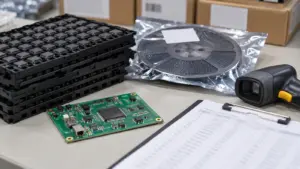
PCB assembly minimum order quantity (MOQ) is the smallest finished-board order an assembler accepts for a defined design, revision and process. It is separate from a component seller’s minimum buy, a packaging order multiple and the bare-board purchase quantity. Evaluate the requested build by reconciling these quantities, then assign every excess item an owner and a disposition. A supplier may assemble a small batch while buying more parts or boards; the quotation should make that difference explicit.
- Assembly MOQ Is Not the Same as a Component Minimum Buy
- How Setup Economics Shape the Assembly Minimum
- Separate first-build work from repeat setup
- Request an alternative at the required quantity
- Reel Quantities, Order Multiples and Cut-Tape Options
- Compare the actual fulfilment routes
- Calculate purchase quantity before approving excess
- Bare-Board Panels and Fabrication Purchase Quantities
- Who Owns Material Left After Meeting a Minimum Buy?
- Agree disposition before material is ordered
- Questions to Ask Before Accepting a Minimum Order
- Specifications and Standards That Belong in the RFQ
- Five Procurement Scenarios
- 1. A sensor-board pilot before design freeze
- 2. A repeat industrial-controller release
- 3. A service build using consigned components
- 4. A panel quantity above the delivery requirement
- 5. A build requiring a specialist downstream operation
- Prepare a Quantity-Specific Assembly Enquiry
Assembly MOQ Is Not the Same as a Component Minimum Buy
An assembly MOQ controls the number of finished assemblies the manufacturer will accept for a build. A component minimum buy controls how many pieces of one manufacturer part number must be purchased from a particular seller. Neither quantity automatically determines the other.
Keep the units visible. An MOQ of boards, a minimum of component pieces and a minimum invoice value describe different commitments. A quoted minimum can also apply per revision, per assembly variant, per shipment or across an agreed purchase schedule. Establish which one before comparing offers.
Standard pack quantity (SPQ) describes how many items a defined package contains. An order multiple is the increment a seller permits. A distributor may split a factory pack, while another offer requires whole packs. A price break changes the unit price at a quantity; it does not, by itself, make that quantity compulsory.
| Quantity Constraint | Who Sets It | Physical or Commercial Basis | Possible Alternative | Excess-Stock Effect |
|---|---|---|---|---|
| Assembly order minimum | Assembler for the quoted build | Setup recovery, scheduling and service policy | Separate setup charge, another production slot or a prototype service | Can create extra finished assemblies if the OEM increases the build |
| Component minimum buy | Manufacturer, distributor or contracted source | Minimum sales lot, dedicated procurement or custom manufacture | Approved stocked source, consigned material or an engineering-approved alternative | Creates unused component stock even when assembly quantity stays fixed |
| Packaging order multiple | Seller for the selected order code | Whole reels, trays, tubes or other sales packs | Cut tape, custom reel or another accepted pack code | Rounds purchases above net component demand |
| Bare-board panel quantity | PCB fabricator, with assembler input | Fabrication lot, customer panel layout or delivery unit | Pooled fabrication, a different panel layout or separate bare-board purchase | Can leave unassembled boards or unused panel positions |
| Special-process minimum | Assembler or specialist subcontractor | Batch setup, masking, programming, coating or process-lot charge | Separate batch charge or a compatible scheduled run | May increase work in process or add a charge without adding boards |
Use this sequence to locate the constraint:
Requested finished boards and revision
  -> Agreed assembly quantity and process
  -> BOM demand plus approved process allowance
  -> Deduct usable allocated component stock
  -> Apply each seller's minimum and order multiple
  -> Reconcile bare-board quantity and panel format
  -> Agree excess ownership, charges and final delivery quantity
How Setup Economics Shape the Assembly Minimum
An assembly minimum often reflects the work required to start and control a production run. Preparation remains necessary. Stencil preparation, machine programming, feeder loading, first-article checks and test preparation still have to suit the design, even when the production order contains only a few boards. Suppliers recover that work through unit pricing, separate charges or an order floor.
A small build can therefore be feasible even when its unit price is high. The referenced supplier, for example, states that its platform has no minimum order quantity and can accept a single prototype. That is a specific service policy, not evidence that setup work disappears. The referenced supplier’s platform FAQ.
Separate first-build work from repeat setup
Distinguish new engineering work from activities repeated whenever a job returns to the line. Reusing approved programs or tooling may reduce preparation, but feeders still need loading and the production configuration still needs verification. A revision change can invalidate part of the earlier preparation.
Identify the quoted floor. A minimum order value may permit the requested board count with a higher invoice, whereas a minimum build quantity requires more assemblies. Also check whether the minimum applies to the initial order or every scheduled release; a blanket material order does not automatically satisfy a later assembly-release minimum.
Request an alternative at the required quantity
Ask for two comparable offers: the requested quantity with setup shown separately, and the proposed larger build. Keep the scope identical. If one offer omits functional testing, changes the assembly variant or substitutes a different component, its lower minimum does not answer the original procurement question.
A paid setup charge can resolve a commercial floor only if the assembler accepts that arrangement. It cannot make a custom component available in smaller lots or remove a subcontractor’s process restriction. Review each constraint independently before increasing finished inventory.
Reel Quantities, Order Multiples and Cut-Tape Options
A full reel is a packaging and purchasing choice, not a universal condition for automated PCB assembly. The relevant questions are whether the exact component is available in a smaller sale quantity and whether the assembler accepts the supplied carrier for its feeding process.
For a concrete packaging example, OPA333AIDBVT is specified in 250-device packs and OPA333AIDBVR in 3000-device packs, both in the five-pin SOT-23 DBV package. These are two discrete factory-pack quantities for those ordering codes, not a continuous range of reel sizes. Confirm the current packing details for the exact code being ordered.
A distributor’s purchasing options for OPA333AIDBVR can include a full 3000-device reel, cut tape and a custom reel made for a smaller order. Small-quantity options may start at one device, subject to the listing and service terms. A smaller distributor purchase can therefore coexist with the larger factory pack; confirm availability and packaging before ordering.
Compare the actual fulfilment routes
The common routes below describe component presentation, not electrical substitutes. Availability depends on the part. Distinguish the manufacturer’s incoming pack from the packaging used for a smaller customer shipment, and confirm that the latter is suitable for the assembly process.
| Packaging Route | Quantity Basis | Assembly Acceptance Question | Inventory Implication |
|---|---|---|---|
| Full factory reel | The exact ordering code’s factory quantity | Is the tape and reel configuration accepted? | Can leave substantial unused components |
| Cut tape | A smaller purchased length of component tape | Can the line feed the supplied strip lengths and continuity? | Reduces purchased excess; preparation may still be needed |
| Custom reel | A selected component quantity rewound with suitable leaders and trailers | Does the assembler accept the service’s reel construction? | Adds a packaging service charge without necessarily buying a factory pack |
| Tube | Full or partial tube quantity, according to the seller | Is a compatible tube-feeding or approved placement method available? | A tube label alone does not establish the purchasing minimum |
| Tray | Full or partial tray purchase, subject to fulfilment format | Will the parts arrive in a usable tray or require another carrier? | Partial purchases may reduce excess but change presentation |
| Bulk | Loose or bagged sale quantity | Is the proposed handling and placement route accepted? | A small buy can introduce handling work |
A custom reel can be made from component tape with added leader and trailer sections for feeder loading. Not every product or tape format is eligible. Obtain acceptance for the exact part, packaging service and machine-loading requirements before treating re-reeling as the solution.
Calculate purchase quantity before approving excess
Start with component demand, not board count:
Net demand = max(0, boards to assemble × pieces per board + agreed allowance − usable allocated stock).
When net demand is positive and the seller permits multiples counted from zero:
Purchase quantity = order multiple × ceiling(max(net demand, seller MOQ) ÷ order multiple).
If stock covers demand, no new purchase is required. The calculation must also respect any offer-specific rules.
Consider an illustrative 50-board build with four OPA333 devices per board: 200 fitted devices, with no stock available. The table isolates packaging effects before process-loss or spare allowances; it is not a production kit recommendation.
| Procurement Route | Purchase Quantity, Devices | Nominal Excess Above 200, Devices | Decision |
|---|---|---|---|
| OPA333AIDBVT factory pack | 250 | 50 | Evaluate the approved smaller factory-pack code |
| OPA333AIDBVR factory pack | 3000 | 2800 | Justify the balance against credible future demand |
| OPA333AIDBVR cut tape | 200 | 0 | Confirm accepted strip presentation |
| OPA333AIDBVR custom reel | 200 | 0 | Compare packaging service charges with excess-stock exposure |
Add the assembler’s agreed part-specific allowance before placing the purchase. It may change the rounding result. Do not turn an arbitrary loss percentage into another supposed industry MOQ.
Bare-Board Panels and Fabrication Purchase Quantities
Bare-board procurement can require more PCB positions than the finished assembly order, but panelization alone does not decide how many completed boards the OEM must buy. The quotation must distinguish the fabrication purchase, the assembly panel and the delivery unit.
A fabrication production panel is the fabricator’s processing format. An assembly panel holds board positions for assembly and separation. They need not have the same layout or quantity. The referenced supplier, for example, distinguishes single-PCB delivery from customer-panel delivery in its ordering interface. The referenced supplier PCB delivery-format guidance.
For an illustrative requirement of 50 boards on a six-position assembly panel, nine complete panels contain 54 board positions. That arithmetic identifies four positions above the requested quantity. It does not establish that four extra assembled boards must be invoiced.
Resolve those four positions explicitly. Ask whether the assembly route can leave them unpopulated, whether they form an approved process allowance, or whether the offer requires assembly of every usable position and delivery of the additional boards. Selective population requires process approval.
Define the delivery unit. A nominal six-up panel may have fewer usable positions if the agreed acceptance policy permits marked-out defects. If the purchase order requires 50 accepted assemblies, the quotation must explain how any shortfall is resolved; 54 nominal positions are not a yield guarantee. Keep rejected positions separate from purchased excess.
A fabricator may also quote a minimum lot charge while delivering only the contracted board quantity. Paying for manufacturing capacity and receiving additional inventory are separate outcomes. Request both the charge basis and the physical delivery count.
Who Owns Material Left After Meeting a Minimum Buy?
Excess-material ownership must be stated in the accepted purchasing terms. Do not infer ownership, return rights or future-use credits from a turnkey label or from the fact that an excess-material charge appears on an invoice. Specify who buys the material, who owns it and who holds it.
Name the owner before purchasing. For OEM-owned stock held at the assembler, the inventory record should identify the manufacturer part number, lot, received quantity, actual consumption and remaining usable balance, with any transfers to other approved builds recorded separately. Reconcile it after each build.
Distinguish purchased excess from process consumption. In the 250-device example, the initial difference above 200 fitted devices is 50. The final remaining quantity changes with actual losses, approved spares, returns and any unused allowance. A planned allowance is not automatically a quantity that was consumed.
Agree disposition before material is ordered
Agree how stock exits the job. Return, retention for the next release, transfer to another approved build and disposal each need an authorized route. Include counting, handling, repacking, storage and return-freight charges, and specify who authorizes disposal and how the OEM receives the final inventory record.
Give cancellation its own line. For a non-cancellable/non-returnable (NCNR) purchase, establish when the commitment begins, which quantities it covers and whether a board revision leaves the OEM paying for parts it can no longer use. Keep forecasts separate from purchase authorizations.
For supplier-owned common stock, confirm whether the OEM pays only for agreed consumption or also bears a dedicated buy. For consigned stock, confirm the usable quantity accepted into the job and the reconciliation method. Neither arrangement removes the need to account for parts that leave the store.
Questions to Ask Before Accepting a Minimum Order
A useful MOQ review identifies the constrained item, its counting unit and the alternative at the requested build quantity. Tie every response to the actual BOM and PCB revision. Otherwise, quotes can appear comparable while committing the OEM to different material purchases.
Use this completed review matrix as an RFQ checklist. The evidence column describes the response to request; the example decisions are purchasing actions, not supplier promises.
| Review Question | Evidence to Request | Resulting Decision |
|---|---|---|
| Does the assembly floor apply per order, revision or release? | Quoted build count, scope and minimum invoice value | Keep the intended release quantity if a separate charge is acceptable |
| Which component lines create a minimum buy? | Exact part number, seller, MOQ, order multiple and packaging code | Compare eligible sources without changing the approved component silently |
| Can the line accept the smaller packaging option? | Written acceptance of cut tape, custom reel, tube or tray for that part | Select the smallest practical buy after approved allowances |
| How many bare boards are purchased and assembled? | Panel drawing, usable-position policy and delivery unit | Separate unassembled excess from finished-board quantity |
| Does any downstream process impose a minimum? | Named operation, subcontractor or internal batch basis, and charge | Compare a batch charge with an increased processing quantity |
| What happens to the balance? | Ownership, itemized excess cost, NCNR terms and disposition rules | Approve the material commitment with a usable inventory record |
Compare the whole commitment. A quote for fewer assemblies can still require a large component purchase, while a setup charge may avoid carrying finished boards that a design change will make unusable. The approval should identify both the finished-board order and the separate material liability.
Require explicit approval before the supplier increases quantities, substitutes parts or buys against a forecast. A quantity reconciliation agreed at purchase prevents an attractive headline MOQ from becoming an unexpected inventory obligation.
Specifications and Standards That Belong in the RFQ
Assembly and handling standards define product and process controls, while the supplier’s offer defines the commercial minimum. Put both in the RFQ. A smaller order still needs the inspection, testing, traceability and material controls specified for the accepted product.
IPC J-STD-001 addresses soldered-assembly processes and materials, while IPC-A-610 addresses post-assembly acceptance. Identify the contracted edition. State the applicable product class, inspection coverage and functional-test requirements so a change in order quantity can be priced without changing what the OEM will accept. These are build-scope requirements, not a commercial board-count rule. IPC’s assembly-standards scope announcement.
Retained components also need handling requirements appropriate to the device. IPC/JEDEC J-STD-033D concerns moisture-, reflow- and process-sensitive devices. Apply the relevant device and contract requirements when stock is opened, retained or returned; packaging quantity alone says nothing about its subsequent usability. IPC/JEDEC J-STD-033D public contents.
At the purchasing interface, record the exact manufacturer part number, approved alternatives, package code, quantity unit and usable-stock status. At the manufacturing interface, identify the PCB revision, panel drawing, assembly variant, programming requirement and acceptance plan. A change to any of these can alter the quoted work or material requirement, even when the requested board count stays unchanged.
Five Procurement Scenarios
The best response to an MOQ follows the source of the constraint. These illustrative procurement situations use the same rule: protect the required build, expose upstream purchases and approve the resulting inventory deliberately.
1. A sensor-board pilot before design freeze
A sensor-board pilot requires 50 boards with four OPA333 devices each, but the material offer uses a 3000-device factory pack. Compare cut tape and custom reels for OPA333AIDBVR, then ask engineering to approve OPA333AIDBVT if the 250-device ordering code is suitable. Keep the pilot at its required quantity. A speculative future revision is a poor reason to populate surplus boards now.
2. A repeat industrial-controller release
A stable controller is ordered in recurring releases. Retaining dedicated components may make sense when the schedule is credible and the stored parts remain usable. Separate the material commitment from each assembly release, and confirm whether a release minimum still applies. Record ownership and stock consumption so the same material is not charged again on the next order.
3. A service build using consigned components
An OEM already holds the required ICs and sends them to an assembler. Count usable stock first. Confirm identity, condition and packaging acceptance before deducting those parts from procurement demand; a recorded warehouse balance that cannot feed the line does not fully cover the job. Consignment can remove a new component buy. It leaves setup, special-process charges and any shortfall to be resolved.
4. A panel quantity above the delivery requirement
An OEM requests 50 assemblies while the proposed six-up layout offers 54 positions across nine panels. Review selective population, approved allowance and delivery options before ordering. The panel drawing establishes the physical layout; the agreed quotation establishes which boards are assembled, paid for and shipped.
5. A build requiring a specialist downstream operation
A board needs selective coating or another operation with its own batch charge. Identify whether the restriction is a monetary minimum, a processing lot or a scheduling policy. Ask for the required assembly count with that operation priced separately. Keep the specified coverage and acceptance requirements intact while negotiating the commercial arrangement.
Frequently Asked Questions
PCB assembly MOQ questions are resolved by separating accepted build quantity from material purchases and process charges. The answers below apply that distinction to the purchasing decisions most likely to affect a small order.
Why can a supplier assemble fewer boards than the component MOQ?
The supplier can purchase the required component lot and use only part of it in the agreed assembly build. The remaining devices stay in stock, are returned under agreed terms or receive another approved disposition. The quotation should show who pays for and owns that balance.
Is a full reel always required for automated assembly?
No. The line needs an accepted feeding format. Cut tape, custom reels, tubes or trays can serve that purpose when the component and equipment support them. Confirm the supplied format before ordering, because a small sales quantity does not automatically arrive ready for the line.
Can an OEM pay a setup fee instead of meeting an assembly MOQ?
Yes, if the assembler accepts that arrangement. Request the required board quantity with setup priced separately and the same inspection and test scope. The fee changes how setup is recovered; it does not remove an independent component minimum buy or a special-process restriction.
Does PCB panelization determine the finished-board order quantity?
Panelization determines the arrangement and available board positions, while the accepted quotation determines the finished-board order. A six-up layout supplying 54 positions for a 50-board requirement needs an explicit excess-position policy. Selective population, allowances and delivery quantities must be agreed for the actual process.
Who owns parts bought only to satisfy a minimum order?
Ownership follows the agreed purchasing terms and should be recorded before the order is released. Specify ownership separately from storage location, then define consumption records, return rights, storage charges and cancellation treatment. A turnkey description alone does not answer those questions.
Is standard pack quantity the same as MOQ?
No. Standard pack quantity describes the contents of a defined package; MOQ describes a seller’s smallest accepted purchase. An order multiple is a separate increment. A distributor that splits a factory reel can offer smaller quantities without changing the manufacturer’s original pack size.
Can multiple PCB revisions share one assembly minimum?
Only if the supplier explicitly accepts the combined order on that basis. Different revisions can require separate programs, tooling, BOMs or verification. Keep each revision’s finished quantity and material demand visible, even when the commercial quotation combines their value into one order.
Does turnkey assembly eliminate component minimum buys?
No. Turnkey assembly changes who sources the components; it does not erase the seller’s purchasing rules. The assembler may use stock, buy smaller distributor quantities or purchase a dedicated lot. Require the quote to identify excess-material charges, ownership and any NCNR commitment.
Prepare a Quantity-Specific Assembly Enquiry
A clear assembly enquiry states the required finished quantity and asks for every upstream quantity commitment to be identified separately. Send the BOM with exact part numbers, fabrication files, placement data, assembly revision, test requirements and any usable consigned-stock list.
For a JASPER enquiry, use the PCB assembly services page and request separate confirmation of assembly minimums, component buys, packaging multiples, bare-board purchases and special-process charges. Ask for an alternative at the required build quantity where feasible. Approve the order after the extra quantities, their costs, ownership and disposition are explicit.
Ready to Start Your Project?
Tell us about your membrane switch, keypad, or graphic overlay requirements. Our engineering team will review your specifications and provide a detailed quote.