
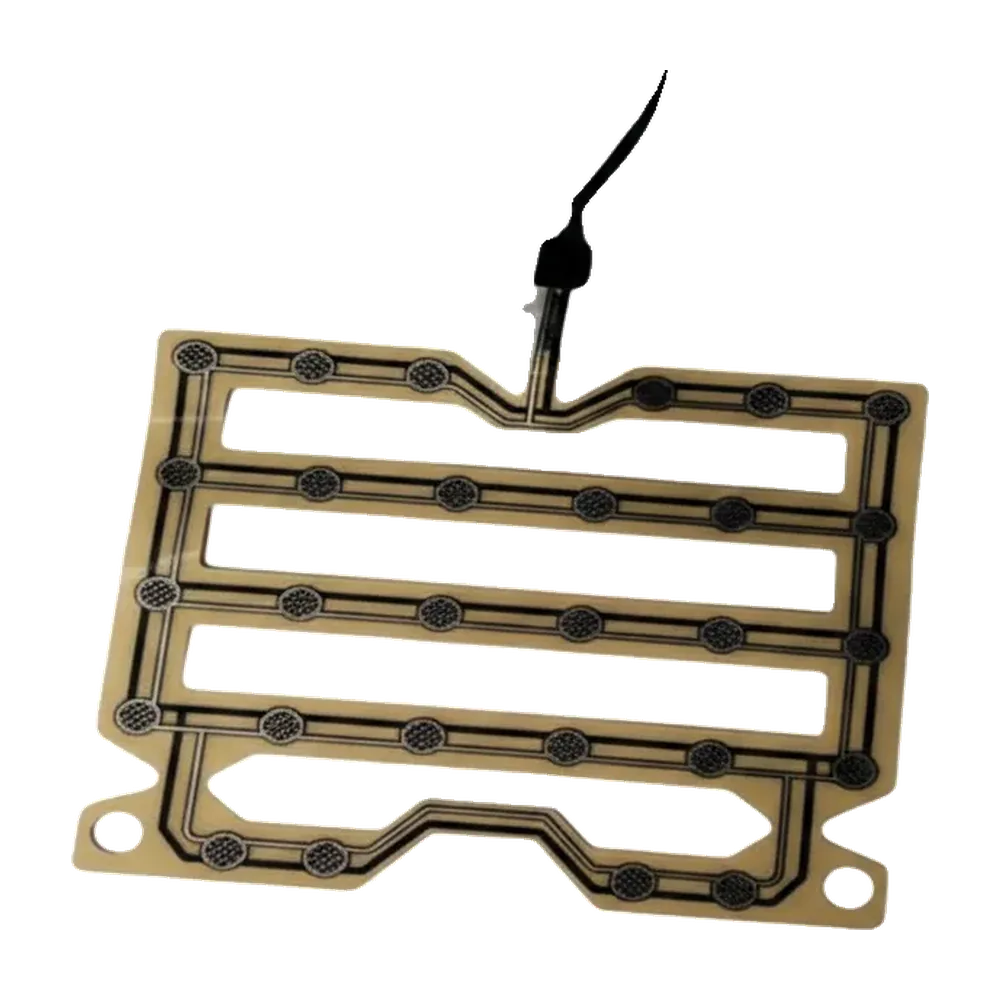
Personalizado automotive seat sensing
Sensor de presion de asiento
Personalizado sensor de presion de asiento assemblies for OEM seat systems, matched to your cushion stack, electronics, and validation plan.
OEMs que integran nuestras piezas de interfaz





Respuesta rapida
A sensor de presion de asiento is a thin seat-integrated sensor pad used to detect pressure or load change on an automotive seat cushion. En proyectos de asiento OEM, puede ayudar al sistema del vehiculo a identificar si una posicion de pasajero esta ocupada, apoyar la logica de recordatorio de cinturon y entregar una senal de presion/contacto segun el circuito confirmado. En JASPER Electronics fabricamos mats personalizados de sensor de presion de asiento automotriz para espuma, cojin, tapiceria y modulos de asiento personalizados. Podemos adaptar el area sensible, presion de disparo, ruta de cable, conector y ajuste al asiento despues de revisar el plano o muestra.
Personalizado Sensor de presion de asiento Manufacturer
JASPER Electronics fabrica soluciones personalizadas de sensor de presion de asiento para proyectos OEM de asiento automotriz, sistemas de deteccion de pasajero y aplicaciones de recordatorio de cinturon. JASPER supports buyers sourcing a sensor de presion de asiento, seat pressure sensor, automotive seat pressure sensor, or pressure sensor pad for car seat rather than the broader term “seat occupancy sensor.”
In practice, these terms often point to the same design discussion: a thin sensor mat or pressure-sensitive pad placed in the seat structure to detect an occupied seat condition. Mantenemos el alcance ligado a asientos de vehiculo, no a medicion industrial de presion. Our work starts with the seat structure, the expected detection condition, and the customer’s confirmed electrical interface.
Our Dongguan team can support custom shape, sensing zone layout, cable exit direction, connector selection, and sample validation. We do not publish unconfirmed values for material stack, resistance curve, operating temperature, cycle life, IP rating, or automotive certification. Those details must be confirmed during the project review.
Sensor de presion de asiento vs Seat Occupancy Sensor
A sensor de presion de asiento and a seat occupancy sensor often describe related products, but the wording tells us what the buyer is trying to solve. Engineers usually use “pressure sensor” when they are focused on load, cushion compression, or activation pressure; sourcing teams may use “occupancy sensor” when the target signal is occupied versus empty.
| Term | Buyer intent | Typical seat use | Output / detection language | When to use the term |
|---|---|---|---|---|
| Sensor de presion de asiento | Detect pressure or load change on a vehicle seat | Seat cushion, seat foam, upholstery, custom module | Pressure/contact behavior depending on confirmed circuit design | Use when the project needs a sensor pad tuned to seat pressure or trigger condition |
| Seat occupancy sensor | Identify whether a seat position is occupied | Passenger seat, rear seat, bus seat, custom automotive seat | Occupied/empty condition or system input depending on OEM design | Use when the page or RFQ focuses on passenger presence detection |
| Seat pressure mat sensor | Describe the physical mat or pad format | Under foam, inside cushion, below upholstery | Mat-based pressure/contact sensing | Use when the buyer needs a flat, flexible sensor mat format |
| Sensor recordatorio de cinturon | Support SBR logic with seat occupancy input | Front passenger seat, rear seat, commercial vehicle seat | Occupied seat condition used with belt status input | Use when the application is seat belt reminder support |
The key point for OEM buyers is simple: do not split the project too early by search term. Send us the seat drawing, the installation position, and the target detection condition. We can then help decide whether the correct wording is sensor de presion de asiento, manta sensora de ocupacion de asiento, or sensor recordatorio de cinturon mat for the quotation package.
How a Sensor de presion de asiento Supports Occupant Detection
A sensor de presion de asiento supports occupant detection by responding to load or compression in the seat cushion area. In a typical OEM discussion, the sensor is placed where the seat structure can apply repeatable pressure to the sensing area when a passenger sits down.
The sensor does not work alone as a complete vehicle system. It supplies a seat condition input according to the confirmed design. The vehicle system, seat belt buckle sensor, warning device, and control logic are defined by the OEM program. JASPER manufactures the custom sensor component and helps adapt it to the seat structure.
For a seat belt reminder project, the seat pressure sensor can provide the occupied-seat condition. A separate buckle signal can provide belt status. The vehicle system decides how to handle those inputs. OEM teams should validate the complete system against their own program requirements and applicable references such as FMVSS No. 208 in the United States or UNECE Regulation No. 16 in Europe.
OEM Reference Context for Seat Pressure Sensor Projects
OEM engineers usually evaluate a sensor de presion de asiento as one component inside a larger seat, harness, and vehicle warning system. Public references such as FMVSS No. 208, UNECE Regulation No. 16, UNECE Regulation No. 14, and ISO 26262 can shape how the vehicle program documents safety-related requirements, but those references do not automatically certify an individual JASPER sensor part.
| Reference | How OEM teams may use it | JASPER claim boundary |
|---|---|---|
| FMVSS No. 208 | United States occupant crash protection and related vehicle-system context | No certification claim; use only as OEM context |
| UNECE Regulation No. 16 | Seat belt installation and restraint-system context in UNECE markets | No approval claim; OEM validation required |
| UNECE Regulation No. 14 | Safety-belt anchorage context for vehicle seating systems | No approval claim; vehicle-level requirement |
| ISO 26262 | Funcionales safety process reference for road vehicles | No ASIL or certification claim; customer program decides process scope |
This distinction matters. JASPER manufactures the custom seat pressure sensor mat, supports drawing review, and supplies samples for validation. The OEM or Tier 1 program defines the complete seat system, warning logic, test method, and compliance documentation.
Personalizadoization Options for OEM Seat Projects
Every car seat cushion behaves differently. Foam thickness, upholstery tension, seat pan geometry, cable exit space, and connector location can change the sensor design. We review those inputs before recommending a sensing area, trigger pressure concept, and sample plan.
| Personalizado item | What we can adjust | RFQ input needed from the buyer |
|---|---|---|
| Sensing area | Single-zone or multi-zone layout based on the occupied-seat area | Seat drawing, cushion section, target passenger position |
| Trigger pressure | Activation condition tuned to the seat structure | Expected load condition, foam compression behavior, validation target |
| Sensor shape | Rectangular, contour-cut, or custom outline | CAD drawing, seat cavity size, installation boundary |
| Cable route | Cable exit direction and protection path | Cable length, exit side, routing space, bend area |
| Connector | Tipo de conector selected for the OEM harness | Connector drawing, mating part, pin requirement if confirmed |
| Moisture protection | Moisture-resistant structure according to project needs | Exposure area, cleaning condition, seat environment |
| Seat foam / cushion fit | Sensor pad thickness and placement concept reviewed against the seat | Foam sample, cushion stack, upholstery pressure points |
| OEM/ODM support | Drawing review, sample build, and production package | Annual quantity target, sample quantity, packaging requirement |
If the project already has a manta sensora de ocupacion de asiento drawing, we can work from that file. If the project only has a seat assembly sample, we can start with the installation area, cable route, and target detection condition.
Aplicaciones
JASPER’s sensor de presion de asiento page focuses on automotive seat use. The same pressure-based sensor concept can be adapted for passenger seats, rear seats, commercial vehicle seats, and custom seating modules when the mechanical structure and signal requirement are confirmed.
| Application | Sensor role | Design notes |
|---|---|---|
| Passenger seat detection | Detect whether the passenger position is occupied | Sensor position should match the main cushion load area |
| Rear seat detection | Support occupied-seat signal for rear seating positions | Cable route and connector location often need custom layout |
| Seat belt reminder systems | Provide occupied-seat input for SBR projects | Use together with belt status input defined by the OEM program |
| Commercial vehicle seats | Adapt to bus, taxi, or fleet passenger seat structures | Validate against seat width, passenger use pattern, and harness routing |
| Personalizado seating modules | Fit non-standard vehicle or equipment seats | Send drawing or sample before fixing sensor geometry |
JASPER separates sensor de presion de asientos from generic industrial pressure sensors because the design problem is different. Automotive seats involve foam compression, passenger posture, cushion geometry, and cable routing inside a moving vehicle seat assembly.
Informacion necesaria para RFQ
A clear RFQ helps us quote the correct sensor de presion de asiento mat instead of guessing from a short product name. For the first review, send the information below. If one item is not ready, mark it as “not decided” and we will identify the next engineering step.
| RFQ item | Que enviar | Why it matters |
|---|---|---|
| Seat type | Passenger seat, rear seat, bus seat, custom seat | Defines the mechanical environment |
| Installation position | Under foam, inside cushion, below upholstery, module cavity | Controls sensor shape and cable exit |
| Target detection condition | Occupied/empty threshold concept or pressure activation goal | Guides trigger pressure discussion |
| Connector drawing | Connector model, mating part, pinout if confirmed | Prevents harness mismatch during sample build |
| Cable length | Required length and exit direction | Affects routing and assembly work |
| Production quantity | Sample quantity and annual target | Helps plan tooling, packaging, and production process |
| Environmental requirement | Moisture exposure, cleaning process, seat location | Guides sealing or protection review without assuming IP rating |
| Drawing or sample | CAD file, 2D drawing, cushion sample, or seat module | Reduces rework during prototype validation |
The most useful first package is a seat drawing, a marked installation area, a connector drawing, and a short description of the expected occupied-seat condition. A sample seat cushion can shorten the review when the geometry is hard to describe in 2D.
Engineering Notes for Seat Integration
Seat pressure sensor design is not only an electrical task. The mechanical stack decides whether the sensor sees repeatable pressure. If the pad is too far from the load area, the signal may be unstable. If the cable exits through a high-bend area, the assembly may need a new routing path.
During an OEM review, we check the seat foam, cushion surface, upholstery pressure, sensor outline, and cable route as one package. The final structure may use a pressure/contact signal, an occupied/empty signal, or another confirmed circuit output. We avoid unsupported claims until the customer’s drawing and sample requirements are reviewed.
For projects that specify FSR or force-sensing resistor behavior, we need technical confirmation before writing the design as an FSR seat pressure sensor. If the project only needs an occupied-seat condition, a membrane-style pressure/contact sensor may be enough. The correct choice depends on the target signal and the seat validation plan.
SBR Sensor and Seat Belt Reminder Use
SBR means Safety Belt Reminder or Seat Belt Reminder. In a seat belt reminder system, the seat pressure sensor can help detect whether a seat is occupied. The belt buckle sensor can detect whether the belt is fastened. The vehicle program then defines the warning light, chime, or other reminder behavior.
A sensor recordatorio de cinturon does not need to be the same physical shape for every seat. Front passenger seats, rear seats, bus passenger seats, and custom vehicle seats can require different sensing areas, cable exits, and connector positions. JASPER can customize the sensor recordatorio de cinturon mat after reviewing the OEM seat design.
JASPER does not provide instructions for changing vehicle warning behavior. Our scope is custom sensor manufacturing for legitimate OEM seat projects, engineering samples, and production supply.
Flujo de fabricacion y muestras
JASPER’s workflow for a sensor de presion de asiento starts with the seat, not with a fixed catalog pad. We review the application, define the sensing area, build samples, and adjust the design after customer validation feedback.
| Step | What JASPER does | Buyer output |
|---|---|---|
| 1. Revision de requisitos | Review seat drawing, installation position, cable route, and connector need | Confirmed project brief |
| 2. Sensor layout | Define outline, sensing area, cable exit, and connector plan | Drawing approval or comments |
| 3. Fabricacion de muestras | Produce engineering samples according to the agreed design | Sample test feedback |
| 4. Design adjustment | Tune geometry, cable route, or trigger condition if needed | Updated drawing or validation note |
| 5. Production preparation | Prepare production files, packaging details, and inspection points | Purchase plan and delivery schedule |
For North American and Western European OEM buyers, the most valuable early decision is the validation method. If the seat team can define how it will check occupied versus empty behavior, we can make the sensor sample closer to the real seat condition.
Related Product Links
Use these related JASPER pages when the buyer’s wording changes from pressure to occupancy, SBR, or membrane structure:
– Sensor de ocupacion de asiento — hub page for the complete automotive seat sensor family. – Manta sensora de ocupacion de asiento — physical mat/pad format for seat presence detection. – Sensor flexible de presion de asiento — technology and manufacturing-strength page for thin, flexible sensor structures. – Sensor recordatorio de cinturon — application page for SBR projects. – Sensor de ocupacion de asiento del pasajero — passenger-detection application page. – Sensor de ocupacion de asiento de bus — commercial vehicle and bus seat application page.
Preguntas frecuentes
Que es un sensor de presion de asiento?
A sensor de presion de asiento is a thin sensor pad or mat designed to detect pressure or load change on an automotive seat cushion. OEM teams use it to support seat occupancy detection, passenger presence detection, or seat belt reminder projects when the final circuit and seat structure are confirmed.
Como se usa un sensor de presion para detectar ocupacion de asiento?
A sensor de presion de asiento is placed in a seat position where cushion compression changes when a passenger sits down. The sensor provides a pressure/contact or occupied-seat input according to the confirmed design. The complete vehicle system then interprets that input with its own logic.
Un sensor de presion de asiento es lo mismo que un sensor de ocupacion?
In many OEM seat projects, the terms point to closely related products. “Sensor de presion de asiento” usually emphasizes load or trigger pressure, while “seat occupancy sensor” emphasizes occupied versus empty detection. We recommend choosing the term based on the RFQ goal, not creating separate designs too early.
Can JASPER customize the trigger pressure and sensing area?
Yes. JASPER can customize the sensing area, trigger pressure concept, sensor outline, cable route, connector, and seat cushion fit after reviewing the drawing or sample. The exact design depends on the seat foam, installation position, target detection condition, and confirmed electrical interface.
What does SBR sensor mean?
Sensor SBR significa Safety Belt Reminder o Seat Belt Reminder. En proyectos de asientos automotrices, suele referirse a una entrada que ayuda a detectar si un asiento esta ocupado para que el sistema compare presencia de asiento y estado del cinturon.
Que hace un sensor recordatorio de cinturon?
A sensor recordatorio de cinturon helps identify whether a seat is occupied for an SBR system. It is commonly used together with a seat belt buckle sensor and vehicle warning logic. The pressure sensor supplies the occupied-seat condition; the OEM system defines the final reminder behavior.
Can JASPER customize a sensor recordatorio de cinturon for OEM seat designs?
Yes. JASPER can customize a sensor recordatorio de cinturon mat for OEM seat designs by adjusting the sensing zone, trigger pressure concept, sensor shape, cable length, connector, and installation position. We need the seat drawing, installation location, connector requirement, and target detection condition to start.
Related seat sensor products
Sensor de ocupacion de asiento
Volver al hub de sensores de asiento para comparar las siete rutas.
Back to hub →Sensor de presion de asiento
Pressure-sensing assembly matched to your seat electronics.
Review →Sensor recordatorio de cinturon
Occupancy input paired with belt-buckle status for SBR logic.
Review →Solicitar cotizacion
Envie el plano del asiento, zona de deteccion, ruta del cable y conector.
Start RFQ →Solicitar cotizacion de sensor de presion de asiento personalizado
Envie el plano del asiento, posicion de instalacion, zona de deteccion, ruta del cable, requisito de conector y calendario de muestras. Revisaremos la construccion y responderemos con materiales, enfoque y cotizacion.
Solicitar cotizacion de sensor de asiento