
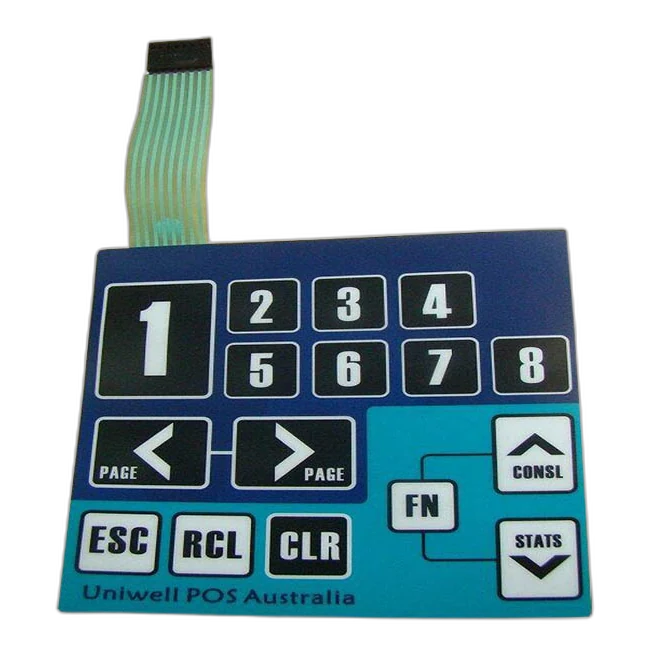
Que es un interruptor de membrana?
Un interruptor de membrana es un conjunto electrico delgado y personalizado fabricado con capas flexibles. Proporciona una interfaz frontal sellada, de bajo perfil, impresa y personalizable para equipos.
Membrane switch basics include structure, operation, use cases, limits, and specification details without duplicating the custom membrane switch product page.
Respuesta rapida: un interruptor de membrana es una interfaz electrica por capas.
A membrane switch usually includes a graphic overlay, overlay adhesive, spacer, circuit layer, switch contacts, tail, connector, and rear adhesive. When the user presses a key area, two conductive contact areas meet, the circuit closes, and the product electronics receive the input signal.
Que hay dentro de un interruptor de membrana?
The exact stack varies by design, but most OEM membrane switches use these functional layers.
| Layer | What it does | Specification details to define |
|---|---|---|
| Graphic overlay | Provides the visible front surface with icons, labels, windows, logos, and key zones | PET or PC film, finish, colors, windows, embossing, cleaning exposure |
| Adhesivo del overlay | Bonds the overlay to the internal switch stack | Adhesivo thickness, lamination quality, edge condition, bubbles, material compatibility |
| Capa espaciadora | Keeps contacts separated until the key area is pressed | Key travel, hole accuracy, sealing path, switch spacing, dome clearance |
| Capa de circuito | Carries printed traces and contact pads | Silver printed circuit, PCB/FPC option, matrix layout, pinout, test requirements |
| Domo metalico or contact area | Creates tactile click or closes a non-tactile contact | Actuation force, dome size, tactile response, contact reliability |
| Cola y conector | Routes the circuit to the product electronics | Tail length, exit direction, pitch, ZIF/crimp connector, stiffener, bend radius |
| Rear adhesive or backing | Mounts the finished switch to the product housing | Housing material, surface texture, installation pressure, temperature, cleaning exposure |
How does a membrane switch close the circuit?
The working principle is simple, but the final feel and reliability depend on the full stack.
| Step | Que ocurre | What affects performance |
|---|---|---|
| 1. Resting state | The spacer keeps conductive contacts separated | Spacer thickness, contact design, dome height, overlay support |
| 2. Pressing the key | The user presses a printed key area on the overlay | Key size, overlay thickness, embossing, dome force, support surface |
| 3. Circuit closure | The upper and lower contact areas meet and complete the circuit | Contact material, alignment, dome stability, contamination control |
| 4. Signal output | The signal travels through the tail and connector to the electronics | Pinout, tail routing, connector pitch, bend radius, strain relief |
| 5. Release | The key returns to the open state after the press | Dome snap, overlay recovery, spacer design, lifecycle requirement |
Membrane switch vs related interface terms
These terms are often mixed in RFQs. Use the differences below to avoid unclear quotations.
| Term | Meaning | When it matters |
|---|---|---|
| Membrane switch | A layered electrical switch assembly with printed controls and circuit contacts | When the interface must send input signals to electronics |
| Membrane keypad | A keypad-style membrane switch with multiple defined keys | When the product needs a button array or numeric/function keypad |
| Graphic overlay | The printed visible front layer, with or without switch function | When the requirement may only be printing, windows, adhesive, and surface protection |
| Mechanical switch panel | Uses separate mechanical buttons or switches behind a panel | When high travel, replaceable switches, or a different tactile feel is required |
| Tacto capacitivo interface | Uses touch sensing rather than mechanical contact closure | When a flat sealed surface and modern touch feel are required |
A membrane switch is chosen for integration, not only thinness.
A strong design connects the overlay, circuit, adhesive, connector, enclosure, cleaning environment, and inspection plan. If those details are separated, the part may look correct but fail during assembly or use.
- Elegir it when the product needs custom printed controls, a low-profile sealed surface, and a flexible connection to electronics.
- Do not define it only by artwork; define key feel, tail routing, connector, adhesive surface, and environment.
- Tactile, non-tactile, backlit, waterproof, LED, PCB/FPC, and metal dome versions solve different design problems.
- Prototipo review is valuable when enclosure fit, key feel, window alignment, or connector routing is not yet proven.
- For harsh environments, sealing depends on the complete product system, not only the membrane switch itself.
RFQ note: Send outline drawings, artwork, key layout, circuit or pinout, connector requirement, enclosure material, surface finish, cleaning exposure, compliance needs, and expected volume.

When should an OEM buyer choose a membrane switch?
A membrane switch is practical when the interface needs more than a printed label but less thickness and complexity than many mechanical button assemblies.
Sealed and cleanable control surface
A smooth overlay can reduce gaps around individual buttons and support cleaning in medical, industrial, appliance, and outdoor products.
Custom graphics and button layout
Legends, warnings, display windows, icons, and button zones can be printed to match the product enclosure and operator workflow.
Thin structure with flexible connection
A membrane switch can fit compact front panels and connect to electronics through a flexible tail, ZIF connector, crimp connector, or PCB/FPC support.
Repeatable production after sample approval
Once materials, artwork, circuit, connector, adhesive, and inspection criteria are locked, repeat orders can follow the approved structure.
Integrated lighting or display windows
LED indicators, backlit icons, dead-front graphics, and clear display windows can be reviewed when the interface needs visual feedback.
Controlled quality checks
Visual inspection, dimensional checks, continuity testing, actuation review, adhesion review, and packing inspection can be defined by project need.
Recursos relacionados
Detailed buyer questions
Is a membrane switch the same as a membrane keypad?
Not exactly. A membrane keypad is usually a keypad-style membrane switch assembly with multiple defined key areas, while a membrane switch can be a simpler or more specialized control interface.
Is a membrane switch waterproof?
Not automatically. Waterproof or sealed performance depends on overlay material, adhesive, edge design, tail exit, enclosure integration, gasket strategy, and the test requirement.
Can membrane switches be tactile?
Yes. Tactile versions usually use metal domes or formed key areas to create a click response. Non-tactile versions close the circuit without a strong mechanical click.
Can a membrane switch include LEDs or backlighting?
Yes. LED indicators, backlit icons, light guide films, and dead-front graphics can be integrated when the stack, printing opacity, and circuit routing are reviewed together.
What is the biggest mistake when specifying a membrane switch?
A common mistake is sending only artwork without the enclosure, connector, adhesive surface, environment, and quality requirements. The part may look right but be difficult to assemble or unreliable in use.
Puede JASPER revisar una muestra existente?
Yes. A sample can be reviewed together with drawings, photos, measurements, connector notes, and known problems from the previous supplier or production run.
What should be confirmed before tooling?
Outline dimensions, key layout, artwork, material, adhesive, circuit, pinout, connector, tail route, environment, compliance needs, and inspection criteria should be reviewed before tooling or sample approval.
When is a membrane switch not the best choice?
It may not be ideal when the product needs high-travel mechanical buttons, heavy-force controls, replaceable individual switches, or a user feel that cannot be achieved with a thin layered structure.
Need help defining a membrane switch structure?
Send your layout, enclosure details, connector requirements, and application environment so JASPER can review whether a membrane switch fits the product and what structure should be sampled.
Solicitar revision tecnica