
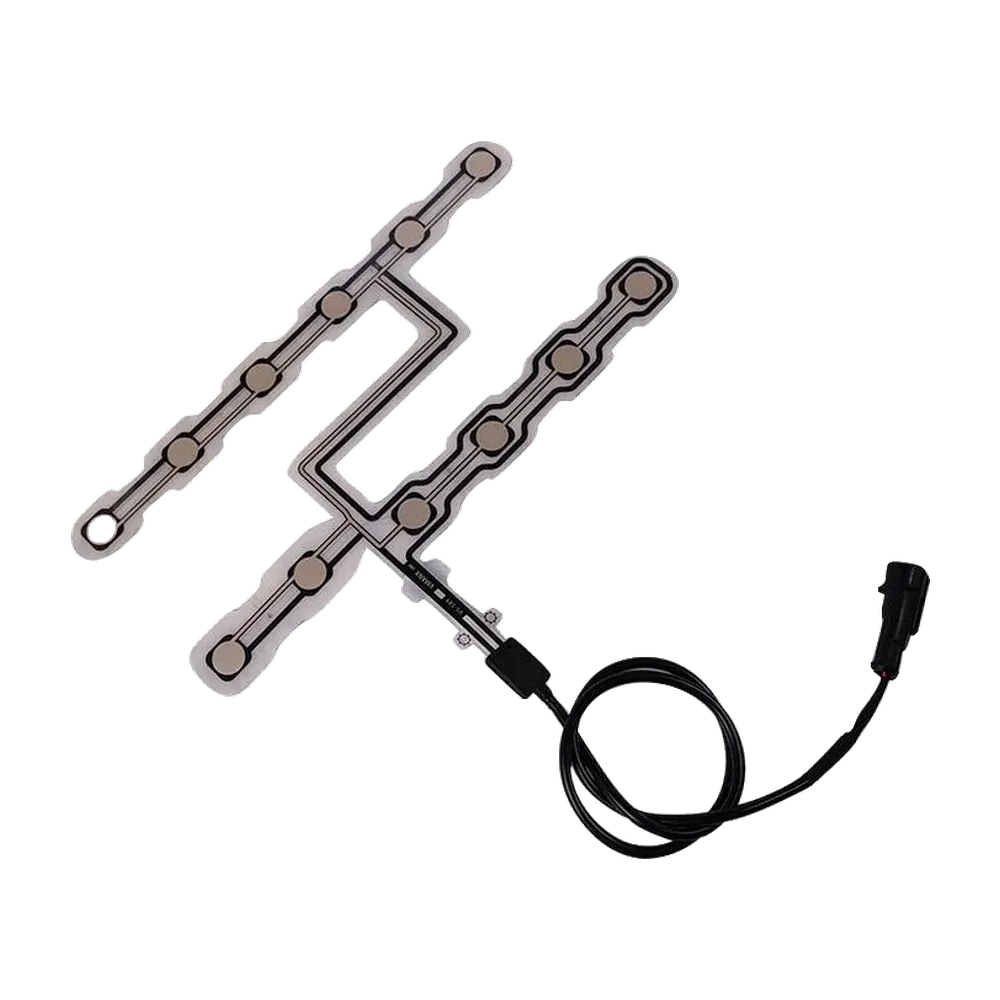
Personalizado automotive seat sensing
Sensor flexible de presion de membrana
Sensores flexibles de presion de asiento tipo membrana fabricados con capas impresas, separadores y colas personalizadas para programas de asiento OEM.
OEMs que integran nuestras piezas de interfaz





Respuesta rapida
Un sensor de presion de membrana flexible es una estructura sensora delgada y flexible que detecta presion mediante un diseno de circuito de membrana por capas. En un asiento automotriz, este tipo de sensor puede colocarse dentro o bajo el area del cojin para apoyar deteccion de presion, deteccion de ocupacion y entrada de recordatorio de cinturon.
Para JASPER Electronics, el sensor de presion de membrana flexible es una extension natural de nuestro trabajo en membrane switch, circuito flexible y fabricacion de thin-film. El stack exacto de materiales, metodo de sensado, salida de cable y metodo de sellado deben confirmarse segun el diseno del asiento, requisito de fuerza y plan de validacion.
Texto inicial
JASPER Electronics fabrica productos de interfaz de membrana flexible y thin-film para proyectos donde importan forma, espesor, ruteo y comportamiento de senal repetible. Un sensor de presion de asiento con membrana flexible usa esa misma logica de fabricacion en un entorno de asiento automotriz: debe ubicarse dentro del cojin, seguir la geometria del asiento y entregar una salida definida cuando se alcanza la condicion de presion objetivo.
JASPER supports engineering teams evaluating a custom membrane seat pressure sensor, not a generic industrial pressure transducer. Nuestro enfoque es el formato de sensor flexible de presion para asiento automotriz: delgado, ligero, conformado al cojin y disenado alrededor de la confirmed installation position, trigger condition, cable route, connector, and moisture exposure.
A car seat membrane pressure sensor project is rarely solved by choosing one catalog item. The seat foam, trim cover, support structure, occupant condition, and electronic interface can all change the required sensing zone. That is why our work starts with drawings, samples, and engineering notes before we define the final membrane layer structure.
Membrane Sensor Structure
A membrane seat pressure sensor is usually built as a layered thin-film structure. The exact stack depends on confirmed material stack and circuit design, but the working concept is consistent: flexible layers are arranged so that pressure at the designed sensing zone changes the electrical condition or closes the designed contact path.
| Structure area | Typical role in a membrane seat pressure sensor | JASPER engineering note |
|---|---|---|
| Flexible film layer | Provides the thin, bendable carrier for the sensor shape | Material must be confirmed by seat environment, assembly method, and validation plan |
| Conductive / sensing layer | Creates the pressure-sensitive electrical path depending on design | We avoid assuming ink, metal, or circuit format before the stack is confirmed |
| Spacer / adhesive structure | Controls separation, bonding, and pressure response depending on design | The spacer geometry can affect trigger behavior and repeatability |
| Sensing zone | Defines the active area that reacts to cushion pressure | Shape and location should match seat foam and occupant load path |
| Cable tail | Routes the output away from the cushion area | Cable exit direction should be checked against seat frame movement and harness path |
| Connector output | Connects the sensor to the customer-side electronic system | Tipo de conector should be supplied by the customer or selected during prototype review |
For seat use, the thin film seat pressure sensor must be designed as part of the cushion assembly. A sensor that works on a flat bench may behave differently after it is placed under foam, trim, heating layers, ventilation channels, or a molded support surface. We therefore ask for the seat structure before locking the sensing area.
Why Flexible Membrane Sensors Fit Car Seats
A flexible membrane seat sensor fits automotive seat projects because the sensor can be made thin, shaped, and routed around cushion geometry. The benefit is not only the sensor itself; the benefit is the ability to adapt the membrane design to the seat system.
| Requirement in car seat integration | Why a flexible membrane sensor helps | What to confirm before production |
|---|---|---|
| Thin profile | A thin film seat pressure sensor can sit inside the cushion stack without adding a bulky mechanical part | Available installation thickness and compression path |
| Flexibility | The membrane format can follow curved or soft seat areas better than a rigid component | Bend area, fixed area, and unsupported area |
| Personalizado sensing zones | The active area can be shaped around the occupant load path | Seat foam drawing, target sensing position, and trigger condition |
| Cushion integration | The sensor can be planned for under-cushion, in-cushion, or surface-adjacent placement depending on design | Foam groove, trim layer, and assembly method |
| Cable routing | The tail and cable direction can be designed to leave the cushion safely | Harness route, strain relief, and connector location |
| OEM shape customization | The outline can be matched to a specific seat platform rather than a catalog pad | CAD drawing, sample seat, or marked installation sketch |
This is why a membrane seat occupancy sensor is useful for custom automotive seating systems, commercial vehicle seats, and passenger detection projects. The membrane format gives the design team control over geometry first, then sensing behavior.
Personalizado Manufacturing Options
JASPER customizes sensor flexible de presion de asiento projects around the confirmed seat design. The options below are normally defined during prototype development and sample validation.
| Personalizado option | What can be adjusted | Information needed from the customer |
|---|---|---|
| Personalizado shape | Sensor outline, corner shape, cutout, and cushion-fit geometry | Seat drawing, marked installation area, or sample |
| Sensing area | Single zone or defined pressure-sensitive area layout | Target occupant position and load path |
| Trigger force | Pressure condition required to activate the sensor | Target trigger condition and test method |
| Layer structure | Film, sensing, spacer, adhesive, and backing arrangement depending on design | Confirmed material stack and circuit requirement |
| Cable length | Cable route from sensor body to customer-side harness | Seat frame route and connector location |
| Connector | Terminal or connector interface for the electronic system | Connector drawing, mating part, or harness specification |
| Waterproof or moisture-resistant design | Edge sealing, cable exit protection, and moisture-control approach depending on design | Exposure condition and validation requirement |
| Sample validation | Prototype check against the actual seat cushion and electronics | Seat sample, test fixture, and pass/fail condition |
| OEM/ODM production | Repeatable production based on approved drawings and samples | Approved drawing, BOM, inspection criteria, and forecast |
A flexible seat occupancy sensor should not be finalized only from a short product name or product photo. For JASPER, the safer process is drawing review, sensing-zone definition, sample build, seat-fit check, signal check, and then OEM/ODM production planning.
Aplicaciones
A sensor flexible de presion de asiento can be used in seat systems where a thin pressure-sensitive seat mat or membrane contact structure is preferred over a rigid device. The exact safety logic and vehicle electronics remain the responsibility of the customer-side system design.
Common project scopes include:
– Seat occupancy detection for passenger or driver seats – Seat belt reminder systems that need a seat presence input – Passenger detection in custom seating layouts – Commercial vehicle seats, bus seats, or shuttle seats – Personalizado automotive seating systems with non-standard cushion geometry – Film type seat sensor projects where the sensor outline must match the seat pad
JASPER does not position the product as a generic industrial pressure sensor. Our manufacturing scope is the flexible membrane seat sensor format for automotive seat pressure and occupancy detection projects.
Engineering Notes
To design a flexible membrane pressure sensor for a car seat, JASPER needs the seat and system details before we confirm the final structure. The best RFQ package includes mechanical, electrical, and validation information.
| Engineering input | Why it matters |
|---|---|
| Installation position | Defines whether the sensor sits under foam, inside foam, near trim, or near the support surface |
| Seat foam / cushion structure | Foam softness, groove position, and cushion stack can change trigger behavior |
| Trigger condition | The target pressure or occupant condition drives sensing zone and layer design |
| Required signal type | The customer-side circuit must match the sensor output concept |
| Cable route | Cable exit direction affects assembly, movement, and strain relief |
| Connector spec | The connector must match the seat harness or control module interface |
| Environmental exposure | Moisture, cleaning, sweat, and seat ventilation exposure affect sealing decisions |
| Drawing or sample | A CAD file or physical sample reduces guesswork during prototype design |
If the structure is not confirmed, we will describe it as depending on confirmed material stack and circuit design. That wording is intentional. It prevents the project from locking into an unsupported material claim before the actual seat sample, target force, and electrical interface are reviewed.
Preguntas frecuentes
What is a flexible membrane pressure sensor?
A flexible membrane pressure sensor is a thin, flexible layered sensor that detects pressure through a membrane circuit structure. In car seat projects, it can be designed as a membrane seat pressure sensor or thin film seat occupancy sensor for cushion-area integration.
Why use a flexible membrane sensor in a car seat?
A flexible membrane sensor fits a car seat because it can be thin, shaped, and routed around the cushion structure. It can support seat occupancy detection or seat belt reminder input while leaving the exact sensing zone, trigger condition, cable, connector, and layer structure open for customization.
Can JASPER customize the membrane sensor shape and sensing area?
Yes. JASPER can customize the membrane sensor outline, sensing area, trigger condition, layer structure, cable length, connector, and moisture-resistant design depending on confirmed material stack and circuit design. For best results, send the seat drawing, installation position, target trigger condition, and connector requirement.
Request a Flexible Membrane Seat Sensor Quote
Necesita un sensor flexible de presion para un proyecto de asiento automotriz?
Send JASPER your seat drawing, sample photo, target sensing area, trigger condition, cable route, and connector specification. We will review the structure and prepare a custom membrane sensor proposal.
Related seat sensor products
Sensor de ocupacion de asiento
Volver al hub de sensores de asiento para comparar las siete rutas.
Back to hub →Sensor de presion de asiento
Pressure-sensing assembly matched to your seat electronics.
Review →Sensor recordatorio de cinturon
Occupancy input paired with belt-buckle status for SBR logic.
Review →Solicitar cotizacion
Envie el plano del asiento, zona de deteccion, ruta del cable y conector.
Start RFQ →Solicitar cotizacion de sensor flexible de presion de asiento
Envie el plano del asiento, posicion de instalacion, zona de deteccion, ruta del cable, requisito de conector y calendario de muestras. Revisaremos la construccion y responderemos con materiales, enfoque y cotizacion.
Solicitar cotizacion de sensor de asiento