
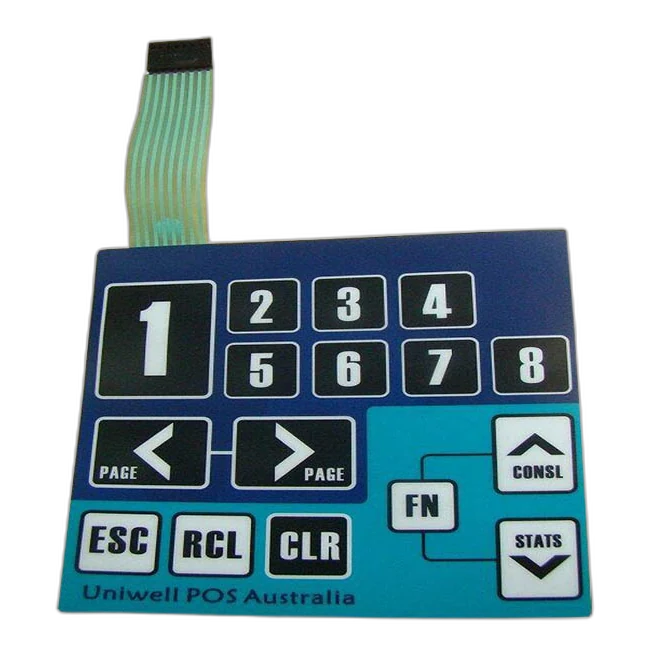
メンブレンスイッチの種類
一般的なメンブレン スイッチのタイプには、タクタイル、非タクタイル、メタル ドーム、バックライト付き、LED、防水、PCB/FPC 対応、静電容量式タッチ インターフェイスなどがあります。
最適なタイプは、ユーザーのフィードバック、シーリング、照明、回路の複雑さ、コネクタの配線、製品の外観、および機器が耐えなければならない環境によって異なります。
簡単な答え: 名前ではなく、リスクに基づいてタイプを選択してください。
触覚メンブレン スイッチにより、ユーザーは感触で押されたことを確認できます。非タクタイルスイッチにより表面はより平坦に保たれます。バックライト付きおよび LED バージョンにより視認性が向上します。防水バージョンは、エンクロージャとテール出口が密閉をサポートしている場合にのみ露出を解決します。 PCB/FPC 対応スイッチは、回路、LED、またはコネクタがより複雑になる場合に役立ちます。
メンブレンスイッチの種類をユースケースごとに比較
使用例から始めて、エンクロージャ、電子機器、オペレータの条件、検査要件に照らして構造を確認します。最終的な構造は、エンクロージャ、電子機器、オペレータの条件、および検査要件に照らして検討する必要があります。
| Type | 主な用途 | What changes in the design | Related page |
|---|---|---|---|
| 触覚メンブレンスイッチ | Interfaces requiring click feedback | 金属ドームまたは成形構造を使用して、オペレーターに明確な操作感を与えます。 | Review option |
| Non-tactile membrane switch | Smooth surfaces and simple controls | Close the circuit without a strong click, useful when a flatter and quieter interface is preferred. | Review option |
| Metal dome membrane switch | Defined tactile response and stable force | Use stainless steel domes to control snap feel, actuation force, and contact closure. | Review option |
| Backlit membrane switch | Low-light use, icons, indicators | Use LEDs, light guide films, windows, opacity control, and dead-front graphics for visibility. | Review option |
| Waterproof membrane switch | Moisture, cleaning, outdoor exposure | Review overlay, adhesive, edges, tail exit, enclosure support, and exposure level as one sealing system. | Review option |
| PCB/FPC membrane switch | Complex circuits, LEDs, connector support | Add PCB or FPC support when routing density, LED placement, connector stability, or electronics integration requires it. | Review option |
| Capacitive touch interface | Flat sealed surface with no key travel | Use touch sensing through a flat surface when the product needs a modern sealed interface and electronics support it. | Review option |
それぞれのタイプが解決すること
実際のプロジェクトの多くは、LED インジケータを備えた触覚キー、防水接着戦略、コネクタ近くの PCB サポートなど、いくつかのタイプを組み合わせています。
触覚メンブレンスイッチ
主な用途: Interfaces requiring click feedback
- 金属ドームまたは成形構造を使用して、オペレーターに明確な操作感を与えます。
- 生産前にアートワーク、レイヤースタック、回路、テール出口、コネクタ、サンプル承認の詳細を確認してください。
Non-tactile membrane switch
主な用途: Smooth surfaces and simple controls
- Close the circuit without a strong click, useful when a flatter and quieter interface is preferred.
- 生産前にアートワーク、レイヤースタック、回路、テール出口、コネクタ、サンプル承認の詳細を確認してください。
Metal dome membrane switch
主な用途: Defined tactile response and stable force
- Use stainless steel domes to control snap feel, actuation force, and contact closure.
- 生産前にアートワーク、レイヤースタック、回路、テール出口、コネクタ、サンプル承認の詳細を確認してください。
Backlit membrane switch
主な用途: Low-light use, icons, indicators
- Use LEDs, light guide films, windows, opacity control, and dead-front graphics for visibility.
- 生産前にアートワーク、レイヤースタック、回路、テール出口、コネクタ、サンプル承認の詳細を確認してください。
Waterproof membrane switch
主な用途: Moisture, cleaning, outdoor exposure
- Review overlay, adhesive, edges, tail exit, enclosure support, and exposure level as one sealing system.
- 生産前にアートワーク、レイヤースタック、回路、テール出口、コネクタ、サンプル承認の詳細を確認してください。
PCB/FPC membrane switch
主な用途: Complex circuits, LEDs, connector support
- Add PCB or FPC support when routing density, LED placement, connector stability, or electronics integration requires it.
- 生産前にアートワーク、レイヤースタック、回路、テール出口、コネクタ、サンプル承認の詳細を確認してください。
Capacitive touch interface
主な用途: Flat sealed surface with no key travel
- Use touch sensing through a flat surface when the product needs a modern sealed interface and electronics support it.
- 生産前にアートワーク、レイヤースタック、回路、テール出口、コネクタ、サンプル承認の詳細を確認してください。
How to choose the right membrane switch type
Start with how the product is used, then check the interface stack. The right type is not chosen by product name alone.
| Decision question | If the answer is yes | Type direction to review |
|---|---|---|
| Do operators need press confirmation by feel? | Tactile feedback can reduce uncertainty during operation | Tactile or metal dome membrane switch |
| Must the surface be flat, quiet, or easy to wipe? | A strong click may not be necessary and a flatter stack may be preferred | Non-tactile membrane switch or capacitive touch interface |
| Will the product be used in low light? | Icons, key zones, and status may need controlled lighting | Backlit, LED, light-guide, or dead-front structure |
| Will the product face water, cleaning, or outdoor exposure? | Sealing needs to be reviewed as a complete product system | Waterproof membrane switch with enclosure/tail-exit review |
| Are there LEDs, dense routing, or connector stability needs? | A basic printed circuit may not give enough support | PCB/FPC membrane switch or reinforced connector area |
| Does the product need a modern no-travel touch surface? | Touch sensing and electronics support must be reviewed early | Capacitive touch panel or capacitive touch switch |
| Will users wear gloves or operate under vibration? | The interface may need stronger tactile or visual confirmation | Tactile, larger key zones, clear legends, and sample testing |
Information that helps JASPER recommend a type
A supplier cannot reliably choose the type from a product name alone. The useful details are how the user presses the interface and what the interface must survive.
- Product application and operator environment
- Need for click feedback or flat/no-travel operation
- Water, cleaning, dust, UV, oil, or temperature exposure
- Low-light operation, LED indicators, backlit icons, or dead-front symbols
- Key layout, key size, legends, display windows, and artwork revision
- Circuit complexity, matrix, LEDs, connector type, pitch, and pinout
- Tail length, tail exit direction, bend radius, contact side, and stiffener
- Housing material, surface texture, adhesive area, and assembly process
Practical note: If a project needs tactile feedback, waterproof sealing, LEDs, and PCB/FPC support, do not treat those as separate add-ons. They affect the same stack and should be reviewed together before sampling.

Membrane switch types are often combined
The most useful RFQ language describes the full combination, not just one label.
| Combination | Why buyers use it | Risk to review early |
|---|---|---|
| Tactile + LED indicators | Clear press feedback plus visible status | Dome placement, LED routing, spacer clearance, opacity, current path |
| Waterproof + backlit | Outdoor or wipe-down use with low-light visibility | Window sealing, light leakage, edge path, tail exit, adhesive choice |
| Non-tactile + cleanable overlay | Flat control surface for simple functions and frequent wiping | Contact reliability, key location guidance, surface finish, cleaning exposure |
| PCB/FPC + connector support | Complex circuits, LEDs, dense routing, or reinforced connector area | Board thickness, connector height, tail route, strain relief, test access |
| Capacitive + graphic overlay | Modern sealed touch surface with printed icons and windows | Sensitivity, overlay thickness, grounding, noise, gloves, moisture behavior |
| Metal dome + embossed overlay | Stronger tactile guidance and visible key zones | Dome force, embossing height, key support, sample feel approval |
Continue comparing options
These pages connect the type map to working principle, design guide, product pages, and specific structures.
Membrane switch type selection questions
Which membrane switch type is most durable?
Durability depends on the structure, overlay material, adhesive, circuit, enclosure support, environment, and inspection plan. There is no single best type for every product.
Can several membrane switch types be combined?
Yes. A single assembly can include tactile keys, LED indicators, dead-front icons, waterproof sealing review, display windows, shielding, and PCB or FPC support.
Is a tactile switch always better than a non-tactile switch?
No. Tactile feedback is useful when operators need confirmation by feel, but non-tactile structures can be better for flatter surfaces, quieter operation, or simpler control areas.
When should I choose a backlit membrane switch?
Choose backlighting when users operate the product in low light, when icons must be visible at night, or when status indicators and dead-front symbols need controlled illumination.
Does waterproof mean the same thing for every membrane switch?
No. Waterproof performance depends on the full product system: overlay, adhesive, edge design, tail exit, connector protection, enclosure, and the defined exposure test.
When is PCB or FPC support useful?
PCB or FPC support is useful for dense circuits, LEDs, rigid connector areas, fine routing, stronger electronics integration, or when the connector zone needs more stability.
Can a capacitive touch interface replace a membrane switch?
Sometimes. Capacitive touch is useful for flat sealed surfaces, but it needs electronics support and careful review of touch sensitivity, overlay thickness, grounding, noise, and user conditions.
Can JASPER recommend a type from my application?
Yes. Share the product use environment, enclosure, user behavior, key feel target, lighting needs, connector requirement, and expected volume so the structure can be reviewed.
Not sure which membrane switch type fits your project?
Send your product environment, enclosure details, key layout, lighting needs, connector requirement, and sample target. JASPER can review the type combination before tooling.
Request a Type Review