

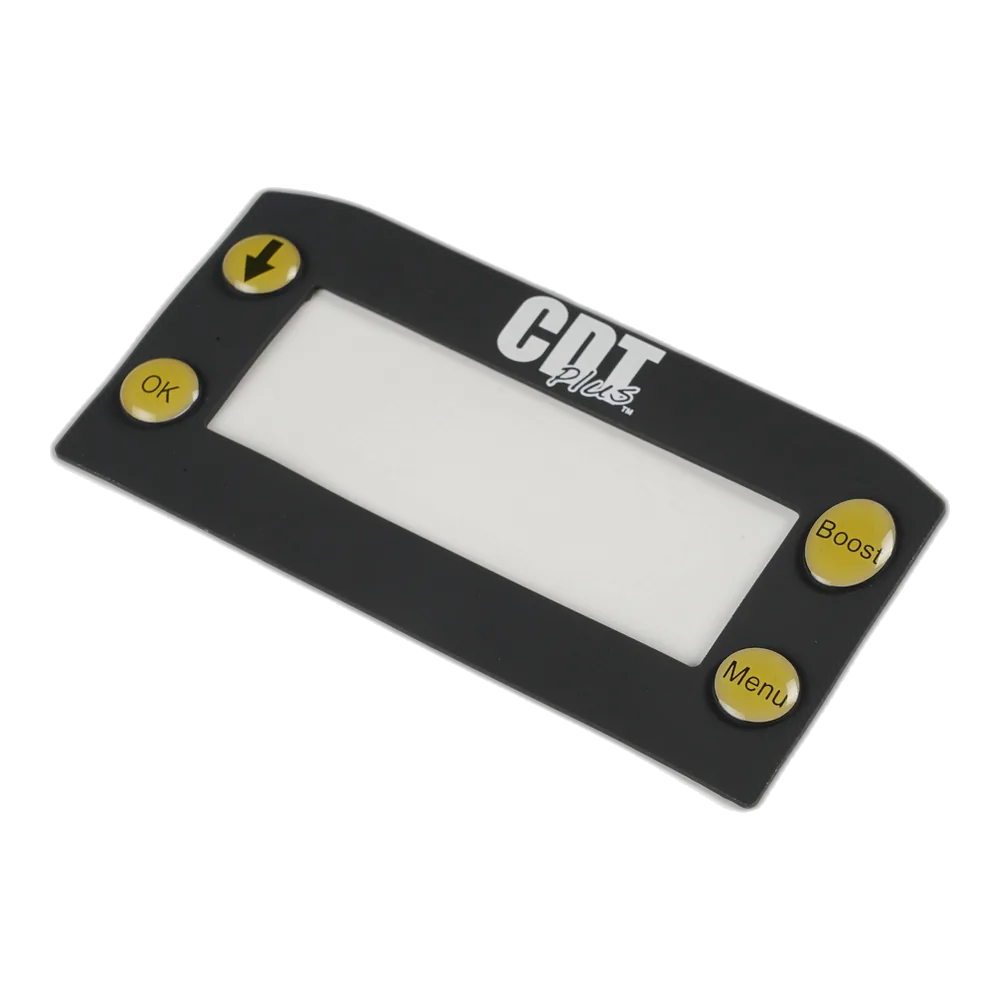
一体型膜制御パネル
カスタムメンブレンスイッチパネル
スイッチ ゾーン、表示ウィンドウ、LED インジケータ、およびコネクタ配線を 1 つの密閉されたフラット プロファイル インターフェイスに組み合わせたマルチキー フロント パネル アセンブリ。
メンブレン スイッチ パネルは、キー アレイ、表示ウィンドウ、LED インジケータ、およびコネクタ インターフェイスを単一のフラット プロファイル ユニットに組み合わせたマルチゾーン制御アセンブリです。
JASPERのインターフェース組立品を採用するOEM





Quick answer: Unlike a standalone membrane keypad, which handles switching only, a membrane switch panel integrates the complete operator interface: input, feedback, display windows, LED indicators, mounting, sealing, and connector routing behind one unified graphic surface. OEM engineers specify panels when the equipment requires more than buttons alone.
単なるキーパッドを超えた、完全なフロントパネル ソリューション
ほとんどの機器には、キーのクラスター以上のものが必要です。オペレーターはステータス インジケーターを読み取り、透明な窓からディスプレイを監視し、触覚のランドマークを頼りに下を向かずに作業します。メンブレン スイッチ パネルは、これらすべてを 1 つの積層アセンブリ (通常、総厚さ 0.5 ~ 2.0 mm) で実現し、エンクロージャに直接接着します。
JASPER Electronics では、一体型メンブレン パネルが東莞で製造されており、スクリーン印刷、ダイカット、SMT LED の配置、最終組み立てが OEM 生産のために 1 か所で調整され、医療、産業、輸送プログラム全体で年間 300 万枚を超えるパネル ユニットを生産しています。当社は ISO 9001:2015 および ISO 14001:2015 認証を取得しており、当社の製品は必要に応じて UL 認定を取得しています。
キーパッドとパネルの違いはスコープです。その範囲が広いため、OEM エンジニアはキーの数だけでなく機械図面を持って当社に来ます。
エンクロージャ、ディスプレイ、コネクタの詳細から始めます
エンクロージャの図面、キー レイアウト、表示ウィンドウの位置、LED 数、電気インターフェイス、コネクタ ピッチ、および環境目標を送信します。 JASPER は、ツーリングを開始する前に、機械的な取り付け、回路ルート、取り付け接着剤、およびシーリングのアプローチをレビューします。
パネルと単純なキーパッドの違いは何ですか?
What sets a panel apart from a simple keypad: the design starts from the enclosure geometry and the operator’s task — not from the circuit alone.
鍵はどこにありますか?
パネルでは、触覚または非触覚キー ゾーン、ドーム フォース、間隔、オーバーレイ凡例、および回路配線が引き続き定義されます。
オペレーターはどこでステータスを読み取るのでしょうか?
透明または着色されたウィンドウ、LCD/OLED カットアウト、埋め込み LED、ライト パイプ、LGF バックライトが同じ表面の一部になります。
アセンブリの取り付けと密閉はどのように行われますか?
背面接着剤、ガスケット付きベゼル、スナップフィットフレーム、テール出口方向、およびコネクタの選択は、エンクロージャに合わせて設計されています。
製造 and 規格対応
Production control matters because one finished panel may combine graphics, switch circuits, display windows, LEDs, adhesives, and a connector tail in a single quality record. Screen printing, die cutting, SMT LED placement, and final assembly stay under one roof so those layers are checked together rather than passed between vendors.
品質 management system for design review, production, and inspection.
Environmental management framework for manufacturing operations.
Flammability-rated overlay material options and UL recognition support where required.
IP65 front-face and IP67 perimeter sealing targets for panel projects.
Peel-strength reference for pressure-sensitive adhesive selection.
Vibration, salt spray, humidity, and environmental test references.
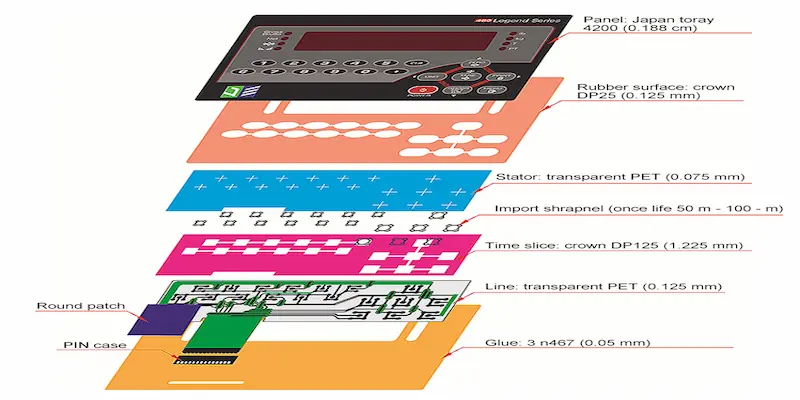
Integrated panel stack
パネルは、印刷された表面層、スイッチ・回路部、背面の取り付け・シール層で構成されます。各層の位置合わせによって、キー、表示窓、LED、接続テールが筐体に適合するかが決まります。
Design priorities
Four decisions to finish before tooling
Two factors determine whether a membrane panel succeeds in the field: how well it fits the enclosure, and how well it fits the operator’s task.
Enclosure fit first
We start every panel project with the mechanical drawing of the host enclosure. The panel must align to existing mounting holes, clear internal standoffs, and route the connector tail to the PCB without sharp bends. Silver-ink circuits need a 3 mm minimum bend radius; FPC circuits tolerate 1.5 mm.
Operator workflow
Gloved hands need key spacing of at least 12 mm center-to-center. Low-light panels may need LED backlighting or LGF illumination behind key legends. Panels cleaned with IPA or quaternary ammonium compounds need a chemical-resistant topcoat; standard polyester without hardcoat can degrade after 500 wipe cycles, while hardcoated PET holds past 5,000.
LED thermal management
Surface-mount LEDs placed directly on the circuit layer generate heat. For panels with more than 8 LEDs, we specify copper-flex circuit layers to dissipate heat and maintain forward-voltage stability across the operating temperature range.
Connector routing
The tail exits the panel at a defined location and pitch. We specify the connector exit direction — bottom, right, or rear — before the circuit layout is drawn. ZIF, FFC, crimp housing, or solder-tail termination is matched to the PCB header, with tail length specified to ±2 mm.
How a Mechanical Control Panel Converts to a Membrane Panel
The process has three steps. First, map the existing button and indicator layout — positions, functions, and electrical interface including voltage, current, and connector pinout. Second, we design a membrane panel to the same footprint so it mounts in the existing enclosure cutout without machining changes.
Third, we build a prototype — typically in 5–7 working days — for fit and function verification before production. The result is a panel that weighs roughly 70% less than the mechanical assembly, seals to IP65 or better, and eliminates the mechanical failure modes of individual button stems and indicator lamp sockets.
- 01Mechanical footprint, enclosure cutout, and mounting review
- 02Button, indicator, display-window, and legend mapping
- 03Voltage, current, connector, and pinout confirmation
- 04Layer stack-up, artwork, adhesive, and seal design
- 05Prototype fit check, electrical test, and production release
Typical Uses
Membrane switch panels appear wherever an operator interface must be flat, sealed, and durable. The following application categories account for the majority of our production volume, each with distinct environmental and electrical requirements.
Industrial HMI
Machine control panels for CNC equipment, PLCs, and conveyor systems. Typical spec: IP65 front seal, tactile domes 250 gf, operating temp −20 °C to +70 °C, and panel sizes from 150 × 100 mm to 400 × 300 mm.
Medical devices
Infusion pumps, patient monitors, and diagnostic instruments. Panels require chemical resistance to IPA and bleach wipes, UL 94 V-0 overlay material, biocompatibility-compliant adhesives, and documentation packages for FDA 510(k) submissions.
Laboratory and test equipment
Analytical instruments and benchtop testers. These panels often carry 30–60 keys plus multiple display windows for LCD readouts; FPC circuits handle the high pin count, and ZIF connectors allow field replacement.
Food and beverage processing
Filling lines, mixers, and packaging machines facing wash-down with high-pressure water, sodium hypochlorite exposure, and caustic cleaners. We specify IP67 full-perimeter seals and chemical-resistant topcoats.
Transportation and marine
Vehicle dashboards, marine helm stations, and rail operator consoles using UV-stable inks that prevent legend fade after 1,000+ hours of direct sunlight, with salt-spray resistance per IEC 60068-2-11.
Building automation
HVAC controllers, access panels, and lighting control stations. These panels typically run under 100,000 cycles but need 10+ years of service life, so we specify UV-stable overlays and 3M VHB mounting adhesive.
Defense and aerospace
Operator consoles for ground support equipment and vehicle systems requiring MIL-STD-810 environmental compliance, NVIS Class B backlighting, and full traceability documentation from raw material to finished assembly.
Request a Custom Panel Quote
Send us your enclosure drawing, key layout, and connector requirements. We return a DFM レビュー and price within 2 business days. Prototypes ship in 5–7 working days from drawing approval. Production lead time is 15–25 working days depending on panel complexity and order quantity. MOQ is 50 units for standard configurations; lower quantities are available for prototype and pilot production runs.
What to send
- Enclosure drawing and panel footprint
- Key layout, legends, and display-window locations
- LED count, light-pipe or LGF expectations
- Voltage, current, connector pitch, and pinout
- IP rating, cleaning protocol, temperature range, and order quantity
Related product context
- graphic overlays for printed surface, windows, textures, and hardcoat decisions
- membrane switches for circuit, dome, adhesive, and tail-routing options
- コントロールパネルのオーバーレイは、操作面の印刷表示、キーのマーク、表示窓の領域を定めます
- membrane switch design guide for drawing and material preparation
Frequently Asked Questions
What is the difference between a membrane switch panel and a single membrane keypad?
A membrane keypad is a standalone array of switch keys — it handles switching only. A membrane switch panel is a complete front-panel assembly: it combines key zones, display windows, LED indicators, and a connector interface into one laminated unit. The panel is designed to the enclosure geometry and covers the full operator-facing surface of the equipment. A keypad is a component; a panel is a finished interface.
Can I integrate buttons, display windows, and LEDs in one membrane panel?
Yes. A typical integrated panel combines 10–50+ key positions, one to four clear or tinted display windows, and embedded LEDs or LGF backlighting — all on a single polyester substrate with one graphic overlay on top. The circuit layer routes LED drive lines alongside switch circuits to a single connector tail. JASPER has produced panels with 64 keys, three LCD windows, and 12 status LEDs as a single assembly, 1.8 mm total thickness.
How do I convert a mechanical control panel to a membrane switch panel?
The process has three steps. First, map the existing button and indicator layout — positions, functions, and electrical interface. Second, we design a membrane panel to the same footprint so it mounts in the existing enclosure cutout without machining changes. Third, we build a prototype, typically in 5–7 working days, for fit and function verification before production.
Related Membrane Switch リソース
graphic overlays
Review overlay materials, print durability, windows, textures, and display-surface requirements.
Explore product →membrane switches
Compare panel builds with broader membrane switch constructions, circuits, adhesives, and sealing options.
製品を見る family →membrane switch design guide
Prepare drawings, material callouts, connector details, and environmental requirements before RFQ.
ガイドを読む →Send your enclosure drawing, key layout, display-window positions, LED count, and connector requirements for DFM レビュー.
Request a Custom Panel Quote