
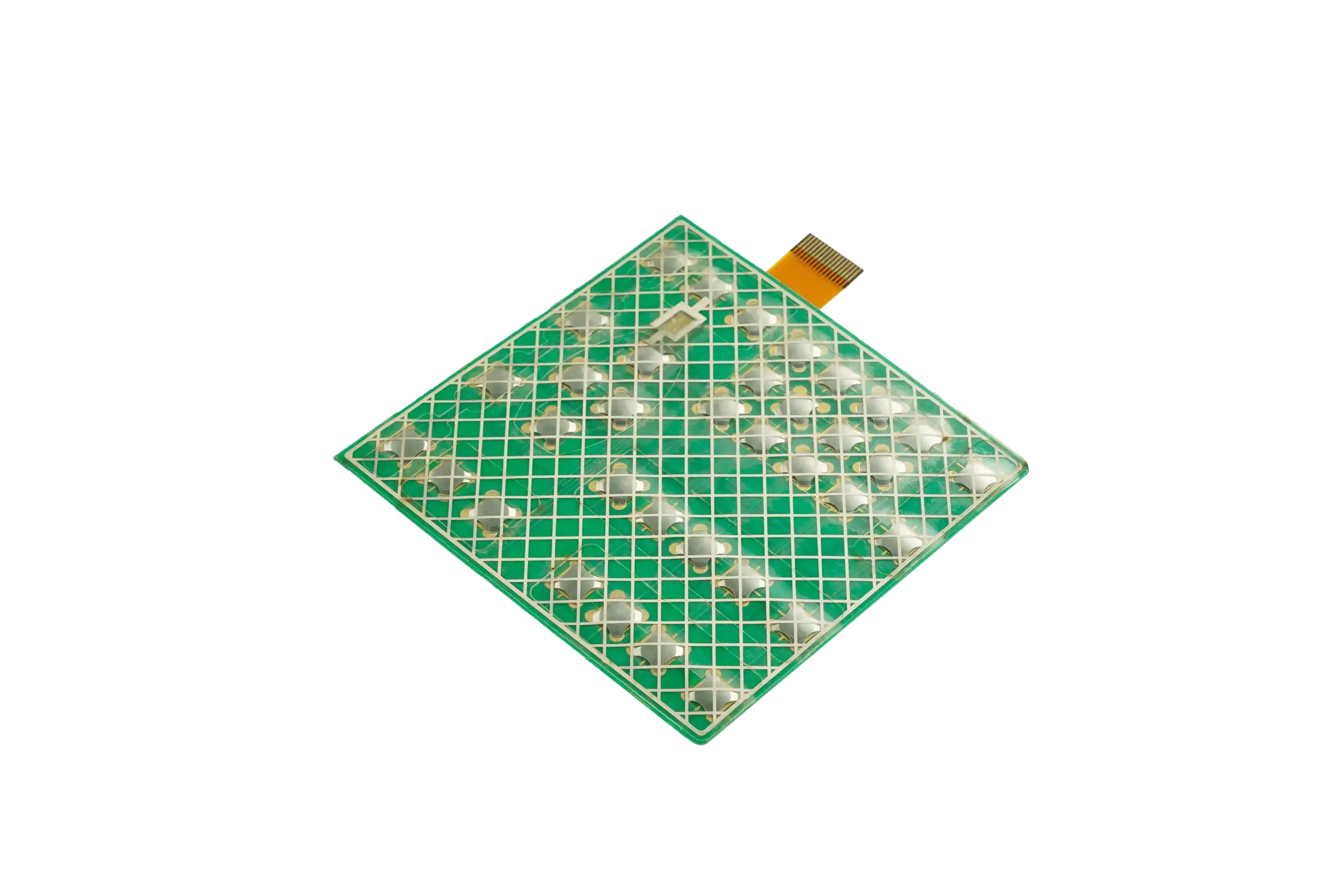
スナップドーム・ステンレススチール・触覚・±5gfバッチ
信頼性の高い触覚フィードバックを備えたメタルドームメンブレンスイッチ
6 つの数値変数によって各キーが指の下でどのように感じられるかを決定するステンレススチール製のドーム キーパッド。
JASPER は、フェルト力がエンジニアリング サンプル (フォークリフト グローブ、手術用タワー、除細動器パネル、ハイサイクル産業用入力) と一致するまで製品を出荷できない OEM 向けにドームベースのキーパッドを製造しています。
JASPERのスイッチを採用するOEM





メタルドームスイッチフォーカス
触覚ページよりも 1 レベル深く、感触を左右する選択が可能になります。
Our tactile membrane switches page treats the keypad as a stack of six independent design choices — dome, key shape, circuit layer, overlay, feedback level, and protection rating. The metal dome drives the tactile feel. Six numeric variables decide how the assembled key registers under a finger, and one testing discipline separates a spec that survives production from one that drifts in the second batch.
キーの形状、回路材料、オーバーレイ グラフィックス、エンボス加工、バックライトは触覚ページ上に残ります。ここでは、ドームの力、形状、および工学サンプルから 10,000 分の 1 単位までの公差をどのように保持するかについて、厳密に検討します。
Quick Answer
メタルドームメンブレンスイッチとは何ですか?
メタル ドーム メンブレン スイッチは、4 脚の形状に形成され、印刷された銀インク回路層とポリカーボネート オーバーレイの間に配置された 0.05 ~ 0.10 mm の AISI 304 ステンレス鋼シートからクリック音が発生する触覚キーパッドです。オーバーレイ グラフィックではクリック音が発生しませんが、ドームではクリック音が発生します。 6 つの数値変数 (力 100 ~ 600 gf、直径 5.0 ~ 20.0 mm、スナップ率 35 ~ 60%、オーバーレイの厚さ 175 ~ 500 μm、サポート ギャップ 0.05 ~ 0.30 mm、およびコンタクト メッキ Ni/Ag/Au) が感触を決定し、JASPER は製造バッチ全体で作動力を ±5 gf に保ちます。
ステンレススチールはクリックです
オーバーレイではなく、ステンレススチールのドームがカチッと音を立てます。
At JASPER Electronics we build dome-based keypads for OEMs whose product cannot ship until the felt force matches the engineering sample within a tight tolerance. Forklift operators in winter gloves. Surgical-tower interfaces under drape. Defibrillator panels that fire on the first deliberate press and ignore every other touch. The audible snap and the firm collapse those operators rely on come from one part: a 0.05–0.10 mm sheet of AISI 304 stainless steel, formed into a four-leg geometry, sitting between the printed silver-ink circuit layer and the polycarbonate overlay.
金属ドームがタクタイルのクリックを生みます。組立状態の荷重のばらつき、導通の受入基準、積層構造全体を案件の検査計画で確認してください。JASPERはクラス50,000のクリーンルームでドームを組み立てます。生産前に測定方法と限界値を確認します。
| Property | What we hold to |
|---|---|
| Dome material | AISI 304 stainless steel, 0.05–0.10 mm sheet |
| Geometry | Four-leg formed dome |
| Batch force tolerance | ±5 gf across a production batch |
| Continuity / acceptability | Every key checked per IPC-A-610 |
| Assembly environment | クラス50,000のクリーンルーム |
| Cycle endurance | 案件の計画で耐久目標と試験条件を定義 |
力の一貫性、連続性の受け入れ、クリーンルームでの組み立ては、サンプルから量産までフェルトのクリック感を同一に保つ 3 つの制御です。
Testing notes
Always measure the assembled keypad — not the loose dome
単体ドームのデータシートと組立済みキーパッドの測定では試験条件が異なります。積層・取付済みの全体を合意した方法で比較してください。表面フィルム、スペーサー、エンボスは結果に影響し、15~25 gfという一定差や増減方向を前提にできません。
オーバーレイ pre-load
選定した積層構造でフィルム厚さと予荷重の影響を測定し、一律の荷重加算値を適用しないでください。
Embossed key tops
A 0.30 mm dome-shape emboss above the key changes how the fingertip loads the dome and can read 20 gf firmer than a flat overlay of the same thickness.
Adhesive compression
The pressure-sensitive adhesive between layers absorbs a small amount of finger pressure before any reaches the dome. That offset is under 5 gf, but it is non-zero.
Our five-sample loop
We build five fully laminated samples to your nominal spec, hand-press and verify each on a force-displacement curve before cutting tooling. The loop usually closes in two iterations and adds about ten working days to the front of the project. See testing and quality for the full first-article protocol, including IEC 60068-2-6 sinusoidal vibration screening.
Where metal dome keypads earn their keep
Gloved industrial input
Forklift and outdoor-equipment panels where a 350–500 gf dome registers cleanly through a heavy or winter glove.
Medical and safety panels
Defibrillator and surgical-tower interfaces that must fire on a deliberate press and ignore incidental touch, with dual-force layouts for confirm versus navigation keys.
High-cycle public controls
高頻度で使う操作部では案件別の耐久目標を合意し、定めた試験条件で荷重とタクタイル応答を評価してください。
RFQ preparation
Send the five values that lock the felt click before tooling.
Send a target dome force, diameter, snap ratio, overlay thickness, and contact-plating preference and we will build five fully laminated samples for your engineering team to press before any tooling is cut. If your spec sheet only names a force, we fill in the other five variables from our default column and flag what we changed when the samples ship.
- Target dome force (100–600 gf) and per-key zones
- Dome diameter and key row pitch
- Snap ratio target and acoustic preference
- オーバーレイ thickness and emboss style
- Support gap and sealing target (IP65 / IP67)
- Contact plating: nickel, silver, or gold flash
製造ベースライン
JASPERは東莞でドーム式メンブレンスイッチの設計確認から組立てまで対応し、クラス50,000のクリーンルームを使用します。
Every key is checked for continuity per IPC-A-610, sealing options reach IP65 and IP67 per IEC 60529, and panels are screened for IEC 60068-2-6 sinusoidal vibration. RoHS Directive 2011/65/EU material options are available, and we hold actuation force to ±5 gf across the batch — for the broader keypad stack beyond the dome, see our membrane keypads catalog.
見積もりを依頼Metal dome membrane switch questions
What’s the difference between a snap-dome and a tactile-dome membrane switch?
Snap-dome and tactile-dome describe the same family of stainless-steel domes — the difference is whether the design optimizes for audible click or felt click. A snap-dome membrane switch uses a taller four-leg geometry with a snap ratio above 50 % and a travel near 0.40 mm, producing a click loud enough to hear across a workshop floor. A tactile-dome membrane switch can use the same dome material at a lower profile (snap ratio closer to 35–45 %, travel near 0.20 mm) to deliver the same finger confirmation without the audible report — the right choice for clinical, library, or open-office contexts. The contact mechanism and the dome material (AISI 304 stainless steel) are identical; only the geometry and the resulting acoustics differ. For applications where neither matters and silence is the spec, see our non-tactile membrane switches page.
How do I choose the right metal dome force for my keypad?
Start with the operator and the environment, not the datasheet. Three questions decide the force. First, what is on the operator’s hand: bare fingertip needs 150–250 gf, thin nitrile glove 200–300 gf, heavy work or winter glove 350–500 gf — the glove adds a damping layer, and a force that feels right bare-handed will not register through a glove at all. Second, how often does the key fire per shift: under 500 presses per day favors a higher force (350 gf+) to prevent accidental actuation, over 5,000 presses per day favors a lower force (150–250 gf) to prevent operator fatigue. Third, what is the safety consequence of a false press: an e-stop on a moving line warrants 400–600 gf so it only fires deliberately, while a volume-up button on a wall panel sits at 150 gf. For gloved-hand input at 2,000 presses per shift with no safety consequence, we typically build the first laminated sample at 280 gf and adjust after your engineer presses it.
Can the dome force be different across keys on the same membrane switch?
Yes. The actuation force is set per dome, not per panel, so we can place a 150 gf dome under a frequently-used Enter key and a 450 gf dome under an adjacent emergency-confirm key in the same laminated keypad. We routinely build dual-force layouts for medical-device panels where the green confirm button must be deliberately pressed and the navigation keys must register at a light touch. The constraint is geometry: each dome footprint requires its own die-cut spacer pocket and its own contact pad pair, so the layout has to be locked at the design stage rather than added in revision. Across a production batch we hold force to ±5 gf per zone — meaning the 150 gf zone stays inside 145–155 gf and the 450 gf zone stays inside 445–455 gf. Send us the per-key force requirement on your CAD file and we will return a sample with the mixed-force layout tested key-by-key.
Continue the membrane switch design review
触覚メンブレンスイッチes
The full six-choice tactile stack — key shape, circuit, overlay, feedback level, and sealing around the dome.
Review tactile switches →Non-tactile membrane switches
The silent, flat-face variant for sealed washdown and quiet-room panels where no click is the spec.
Review non-tactile switches →Membrane switches
Return to the membrane switch family hub to compare keypad structures, circuits, overlays, and sealing choices.
Review membrane switches →Membrane switch design
See how we review stack-up, dome selection, adhesives, sealing, and feedback before tooling.
Review design support →Get a dome-specified sample built to your brief
Send us a target dome force, diameter, snap ratio, overlay thickness, and contact-plating preference and we will build five fully laminated samples for your engineering team to press before any tooling is cut. If your spec only names a force, we fill in the other five variables from our default column and flag what we changed when the samples ship. メール your CAD file or RFQ and we route it to an applications engineer the same business day.
Start RFQ ReviewNeed the rest of the keypad stack? See our membrane keypads catalog for context beyond the dome.
Compare tactile and non-tactile key feel
Compare click feedback, a flatter sealed surface, or a mixed key structure fits the product.