
Rigid Panel and Nameplate Materials
Rigid control panel materials provide structure, surface protection, permanent marking, or a premium equipment face. Glass and acrylic can create optical windows and touch surfaces; metals can add stiffness, durable identification, or an equipment-matched finish; printed polymer labels and domed constructions serve lighter-duty marking roles. The correct choice depends on appearance, impact risk, marking method, mounting, enclosure fit, electrical integration, and the operating environment.
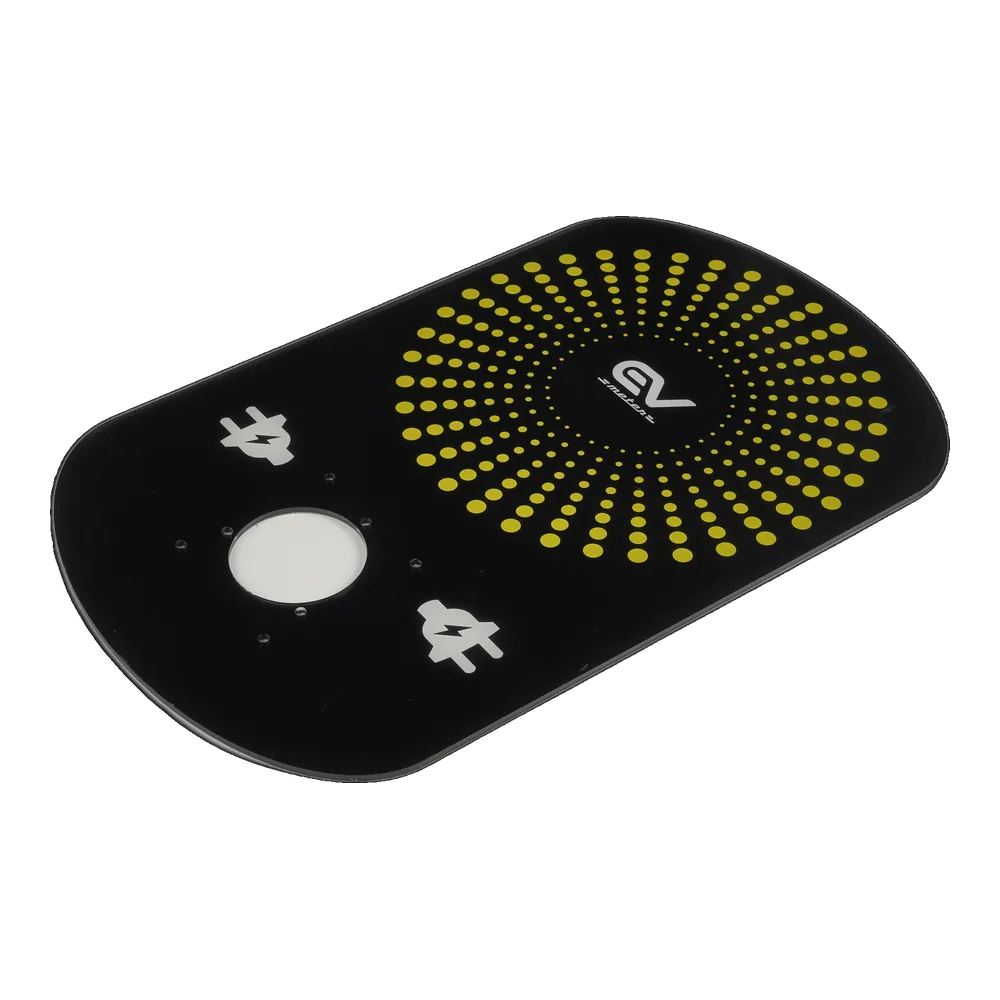
Quick Selection Facts
Choose the substrate only after defining what the finished panel must do.
| Review input | Engineering question | Useful RFQ information |
|---|---|---|
| Appearance | Should the surface look transparent, glossy, brushed, engraved, printed, or equipment-matched? | Artwork, color intent, finish reference, and approved sample |
| Impact and scratch exposure | Will the panel face tools, handling, cleaning, or repeated operator contact? | Use environment and likely contact points |
| Optical window | Is the opening decorative, an indicator window, or a display/touch viewing area? | Display active area, viewing angle, and window artwork |
| Marking | Must graphics sit on the front, behind a clear substrate, or within a metal finish? | Required legends, colors, permanence, and revision method |
| Corrosion environment | Will the panel encounter moisture, salts, cleaners, or process chemicals? | Exposure description and required validation |
| Mounting | Will the part use adhesive, fasteners, studs, clips, or an enclosure pocket? | Enclosure drawing and assembly sequence |
| Touch integration | Does a sensor or display operate through or behind the panel? | Sensor stack, display details, grounding needs, and inactive appearance |
| Edge and fit | Are exposed edges visible or operator-accessible? | Panel outline, tolerances, cutouts, and edge-treatment intent |
Acrylic, glass, aluminum, and stainless steel may each fit one design and fail another. The substrate name is only a starting point; geometry, finish, mounting, and validation complete the specification.
Material Options
The table below describes common engineering roles. It does not confirm that every material, grade, finish, or construction is currently supplied by JASPER. Availability should be checked against the drawing and current approved material list.
| Material family | Typical design role | Reasons to evaluate it | Boundaries to review |
|---|---|---|---|
| Acrylic / PMMA | Rigid printed panel, window, lens, or decorative equipment face | Optical appearance, color options, machinable shapes, and lower mass than many glass or metal constructions | Scratch exposure, edge damage, chemical contact, optical distortion, and mounting stress |
| Glass | Protective face, display window, touch surface, or premium interface panel | Surface appearance, optical clarity, cleaning behavior, and rigidity | Edge condition, impact risk, treatment, print adhesion, mounting stress, and sensor compatibility |
| Aluminum | Equipment nameplate, rigid fascia, identification plate, or panel insert | Low mass, stiffness, machinable features, and finish possibilities | Alloy and finish availability, corrosion environment, grounding, edge condition, and marking process |
| Stainless steel | Nameplate or panel where metal appearance and environmental resistance are priorities | Rigidity, wear-resistant appearance, and integration with metal equipment | Grade, surface finish, weight, forming, marking contrast, and enclosure compatibility |
| Brass or another specialty metal | Decorative identification or a project-specific equipment finish | Distinct appearance and marking possibilities | Treat as an option only after supply, finish, corrosion behavior, and process route are confirmed |
| Polycarbonate or polyester label stock | Flexible or semi-rigid printed equipment identification | Lightweight printed graphics and adhesive mounting | It is not a substitute for a structural panel; review surface wear, edges, adhesive, and environment |
| Polyurethane doming resin over a label | Raised clear visual layer over printed graphics | Depth, gloss, and a protected appearance for suitable labels | Resin availability, edge profile, curing, yellowing risk, chemical contact, and application fit require confirmation |
Use polycarbonate and polyester equipment labels when the requirement is a printed label rather than a rigid structural face.
Marking and Finish Options
Select marking with the substrate. Back printing can protect graphics from direct contact, but panel color, ink opacity, adhesive, and background still affect the result. Front printing may support a different texture or contrast but needs an exposure review.
Metal marking may include printing, etching, engraving, or a finish-integrated process when the material and confirmed route support it. Directional finishes require controlled part orientation. Because finish names vary by material and process, a physical reference is more useful than a descriptive word alone.
Doming places clear resin over printed graphics. Appearance depends on the label, print, resin flow, edge geometry, curing, and mounting surface. This page claims no universal polyurethane doming resin performance or particular resin system.
JASPER’s current supply route for printing, etching, anodizing, engraving, or doming should be confirmed before any process is written into a released drawing. The related printing and finishing for rigid interface panels page can support a process discussion without turning this material page into a list of unverified capabilities.
Integration Decisions
Adhesive mounting needs sufficient bond area and a compatible enclosure. Clear panels may reveal adhesive edges, bubbles, contamination, or uneven backgrounds. Mechanical fasteners can carry load and simplify replacement, but holes, local stress, edge distance, and appearance require coordination.
Display and touch windows must align with active areas, sensors, and enclosure openings. A clear substrate is not automatically suitable for every display or touch technology. Review haze, reflection, tint, air gaps, printed borders, sensor sensitivity, grounding, and the actual assembly.
Panel thickness is a project input affecting rigidity, weight, edges, cutting, fasteners, sensor behavior, and enclosure fit. Metal panels may also introduce grounding or electrical-isolation questions absent from a simple printed label.
Define the assembly datum early. The panel, display, switch, touch sensor, enclosure, fasteners, and adhesive should reference compatible locations so printed legends and physical controls remain aligned.
Manufacturing Implications
The route may include cutting, printing, curing, etching, engraving, finishing, bonding, cleaning, protection, and inspection. Appropriate steps depend on the material and confirmed supply process.
Cut features need to respect visible edges, internal corners, mounting holes, and window quality. Printing needs registration to those features, especially around displays, touch areas, keys, or indicator windows. Clear substrates reveal dust, scratches, adhesive marks, and print defects more readily than opaque panels.
Metal surfaces need controlled handling because direction, sheen, and marks affect the visual match. Glass and acrylic need protection through assembly. Protective film helps only when removal does not introduce residue or trap debris.
Inspection should be based on the released drawing and approved visual standard. It may cover dimensions, artwork registration, color, finish direction, window quality, edge condition, surface defects, mounting features, cleanliness, and fit. No universal tolerance or cosmetic limit is implied by this page.
Common Failure Modes
| Symptom | Areas to investigate | Corrective direction |
|---|---|---|
| Scratches or handling marks | Surface hardness, protective film, cleaning, packing, assembly contact | Match handling controls and protection to the selected face |
| Chipped or damaged edges | Material, cut process, edge geometry, fastener or assembly stress | Review edge treatment, local support, and assembly load |
| Print color or position mismatch | Artwork control, substrate color, ink, registration datum, curing | Approve on the actual substrate and strengthen registration controls |
| Corrosion or finish change | Material grade, finish, cut edges, chemicals, moisture, galvanic contact | Review the complete exposure and adjacent materials |
| Particles in a window | Cleaning, protective liner, adhesive, assembly sequence | Define a cleaner optical assembly path |
| Adhesive show-through | Clear substrate, adhesive pattern, background, surface variation | Move adhesive outside visible zones or revise the visual stack |
| Window distortion | Material, surface, thickness, print, air gap, mounting stress | Inspect with the actual display and mounted geometry |
| Poor alignment | Conflicting datums, enclosure variation, fastener clearance, adhesive slip | Use common assembly references and a controlled fixture where needed |
Alternatives and Design Boundaries
A flexible graphic overlay may be the better family when the part primarily needs printed graphics, embossed keys, a low-profile surface, or conformity to a shaped enclosure. A rigid panel is more appropriate when structure, a hard viewing surface, a thick visual edge, mechanical mounting, or a premium fascia is central to the design.
Material choice alone does not guarantee scratch resistance, corrosion resistance, optical quality, chemical compatibility, or long service life. Those outcomes depend on the exact substrate, grade, finish, print, geometry, mounting, environment, handling, and validation.
Commercial product terms remain on the corresponding pages. Review custom metal equipment nameplates, glass control panels and nameplates, custom acrylic control panels, or polyurethane-domed labels and nameplates when the project is ready for product-specific construction and quotation.
Related Products, Capability and Application
Rigid panels and permanent nameplates often appear on industrial controls, instruments, appliances, and equipment that needs durable identification. The application page for rigid panels and nameplates for industrial controls places these material choices in a broader equipment context.
Related paths:
- Materials for custom interface products
- Custom metal equipment nameplates
- Glass control panels and nameplates
- Custom acrylic control panels
- Polyurethane-domed labels and nameplates
- Graphic overlay printing and finishing
Engineering FAQ
Which control panel material is best for a display window?
There is no universal choice. Review optical clarity, reflection, tint, surface finish, scratch exposure, edge condition, mounting stress, cleaning, and compatibility with the display or touch sensor. Evaluate the actual stack rather than selecting only by the words glass or acrylic.
When should I use a flexible overlay instead of a rigid panel?
Use a flexible overlay when low profile, printed graphics, embossing, or surface conformity is the main need. Consider a rigid panel when the face must provide structure, a hard optical window, mechanical mounting, or a distinct edge and finish.
Can graphics be printed behind a clear panel?
Back printing may protect graphics from direct contact and can create a clean front surface. The final appearance still depends on substrate color, ink opacity, window design, adhesive pattern, and background. Confirm the construction on the actual clear material.
What should a rigid-panel RFQ include?
Provide the outline drawing, material preference, artwork, finish reference, windows, cutouts, edge intent, mounting method, enclosure details, environment, cleaning exposure, display or touch components, and any approved cosmetic sample.
Does a metal nameplate automatically resist corrosion?
No. Corrosion behavior depends on the metal grade, finish, cut edges, chemicals, moisture, adjacent materials, and mounting. State the actual exposure and required validation so the complete construction can be reviewed.
Review the Panel as Part of the Equipment
Send the panel outline, material preference, artwork, finish reference, window and cutout details, mounting method, enclosure drawing, environment, cleaning requirements, and any display or touch stack. If the material is not fixed, describe the appearance and functional priorities so alternatives can be compared without assuming an unsupported grade or process.
Share panel, marking and mounting requirements
Review the Complete Stack Before Tooling
Share the drawing, enclosure, operating conditions, assembly process, approval evidence, quantity, and timing. Unknown values can remain open items; they should not become assumed guarantees.