
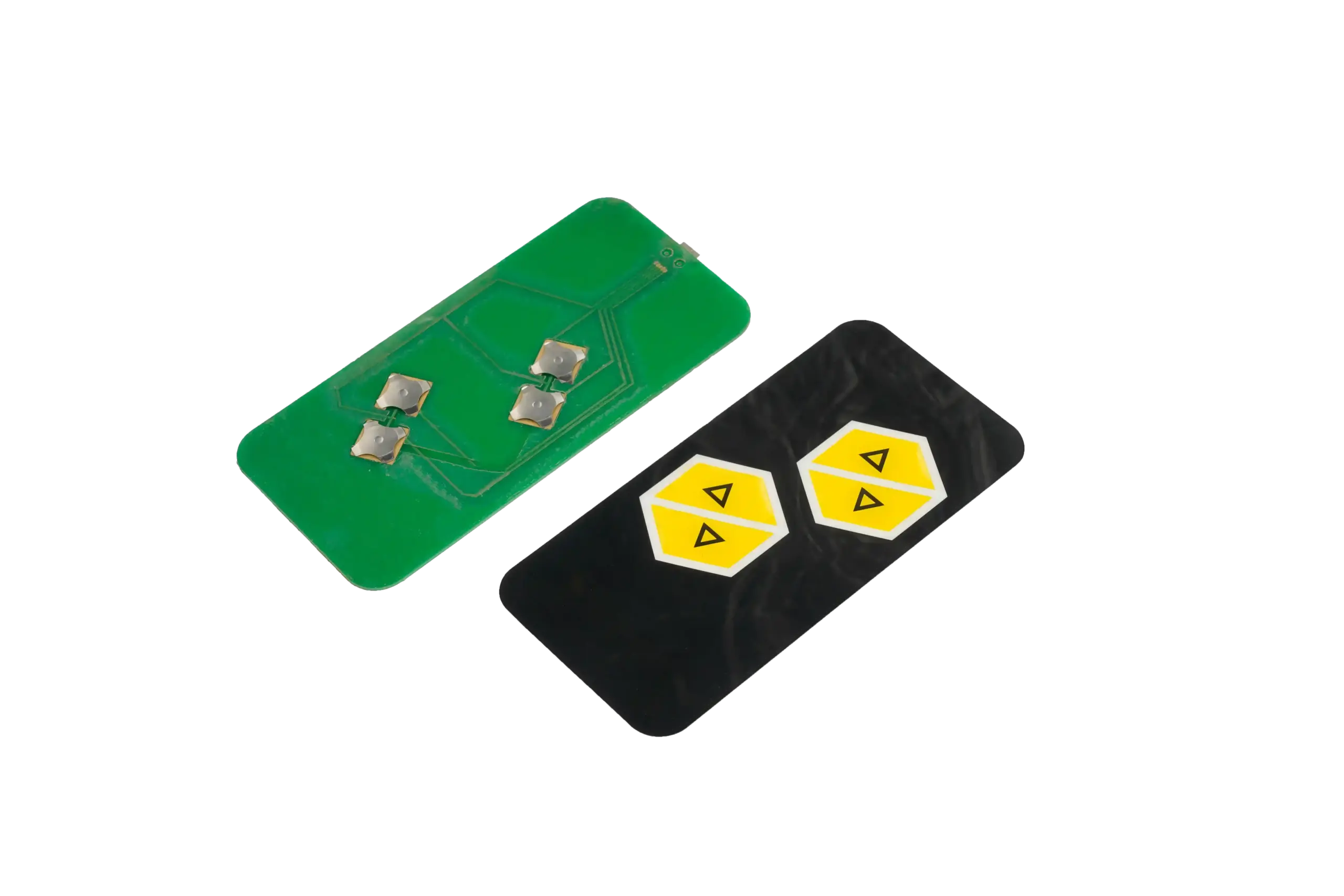
SMT-ready · IPC-6013 flex · built to your pinout
PCB/FPC-Folientastaturen for OEM Interfaces
Copper-on-FR-4 carriers, copper-on-polyimide flex, and hybrids — terminated to your controller pinout and tested before they ship.
JASPER builds PCB-backed and FPC membrane switches for OEM teams whose interface has outgrown silver-ink-on-PET: embedded MCUs, dense traces, and 3-D conformability.
OEMs, die unsere Schalter in ihren Geraeten einsetzen





Built where silver-ink tails run out of room
Silver-ink-on-PET is the workhorse — until the keypad has to carry electronics.
We build PCB- und FPC-Folientastaturen for OEM teams whose interface has outgrown the limits of silver-ink printed on PET. When the keypad has to carry an MCU, drive backlight LEDs, route 24 traces through a 12 mm tail, or fold around a curved housing, the standard polyester stack stops being the right answer. The right answer is a copper-on-FR-4 carrier, a copper-on-polyimide flex, or a hybrid of both — terminated to your controller pinout and tested before it ships.
Silver-ink-on-PET runs at ~10 μm printed silver, holds 0.30 mm trace and space, and ships at 0.20–0.25 mm total thickness for under a dollar a key in volume. For a 24-key matrix on a flat panel with no embedded electronics, nothing beats it on unit cost — it is still our highest-volume construction within the broader membrane switches family. The PCB-backed and FPC variants exist for the projects where printed traces simply will not do the job.
Kurzantwort
What is a PCB or FPC membrane switch?
A PCB or FPC membrane switch replaces the printed silver-ink circuit of a standard membrane keypad with an etched-copper carrier: a rigid FR-4 board (PCB-backed), a polyimide flex circuit (FPC), or a hybrid that laminates both. The copper carrier accepts soldered SMT components — an MCU, LED drivers, current-limit resistors, 2 kV ESD diodes — holds finer traces down to 0.075 mm, and can fold around curved housings. OEMs choose it when component density, trace density, or 3-D conformability exceed what silver-ink-on-PET can deliver.
When standard silver-ink isn’t enough
Three constraints push a design off printed silver onto a copper circuit.
Silver-ink-on-PET is the workhorse construction for most membrane keypads. Three constraints push designs off that workhorse and onto a PCB-backed, FPC, or copper-flex circuit, and each maps to a published acceptance standard rather than a rule of thumb.
JASPER builds both PCB and FPC variants in-house, on an ISO 9001:2015 quality system, with full traceability from copper foil lot through final 100% continuity test. Kundenspezifischers also evaluate Elecflex, Niceone-Tech, and LuphiTech for similar work; we list them because OEM engineers should be comparing more than one supplier on a build that will ship for five years. Where our work tends to win is on engineering response — we put a senior designer on the RFQ rather than a sales template.
| Constraint | Silver-ink limit | Copper circuit answer |
|---|---|---|
| Component density | Printed silver cannot host an MCU, RGB driver, resistors, or TVS diodes | Soldered FR-4 carrier to IPC-A-600 acceptance and J-STD-001 criteria; 2 kV ESD per IEC 61000-4-2 |
| Trace density | 0.30 mm minimum trace / space | Etched copper on polyimide to 0.10 mm — and 0.075 mm with controlled processes |
| 3-D conformability | Single 90° tail fold; not rated for repeated articulation | Polyimide FPC at 6× static / 12× dynamic bend radius, IPC-6013 Class 3 qualified |
A 32-character display ribbon co-routed with a 5×8 keypad matrix on a 14 mm tail needs the etched copper, not the printed ink. Bend, density, and component figures are stated against IPC and IEC acceptance standards.
Structure options — five circuit constructions
A PCB or FPC membrane switch is one of five circuit-construction choices. Pick before the overlay graphic is final; the construction choice drives panel cutout, harness routing, and tooling cost more than the graphic does.
| Construction | Carrier | Cu / ink weight | Min trace / space | Bend radius (static) | Typical thickness | Embedded SMT | Standard cited |
|---|---|---|---|---|---|---|---|
| PCB-backed (rigid) | FR-4, UL 94 V-0 | 1 oz or 2 oz Cu | 0.15 / 0.15 mm | Rigid — N/A | 1.0–1.6 mm | Full SMT, 0402 and up | IPC-A-600, IPC-2221, J-STD-001 |
| FPC, single or double layer | Polyimide (PI) | 0.5 oz or 1 oz Cu | 0.10 / 0.10 mm | 6× substrate thickness | 0.15–0.30 mm | Limited; SMT 0603 and up on stiffened pads | IPC-6013 Class 2 or 3 |
| Copper flex, no membrane stack | Polyimide | 0.5 oz or 1 oz Cu | 0.075 / 0.075 mm | 6× static / 12× dynamic | 0.10–0.20 mm | Qualified flex SMT | IPC-6013 Class 3 |
| Silver-ink-on-PET (standard) | PET 0.125–0.175 mm | Printed Ag, ~10 μm | 0.30 / 0.30 mm | Single 90° tail fold | 0.20–0.25 mm | None; resistor jumpers only | In-house printed-circuit acceptance |
| Hybrid: PCB rigid + FPC tail | FR-4 + PI laminated | Mixed per layer | Per layer above | Tail follows FPC rating | 1.2–2.0 mm | Full SMT on PCB layer | IPC-A-600 plus IPC-6013 |
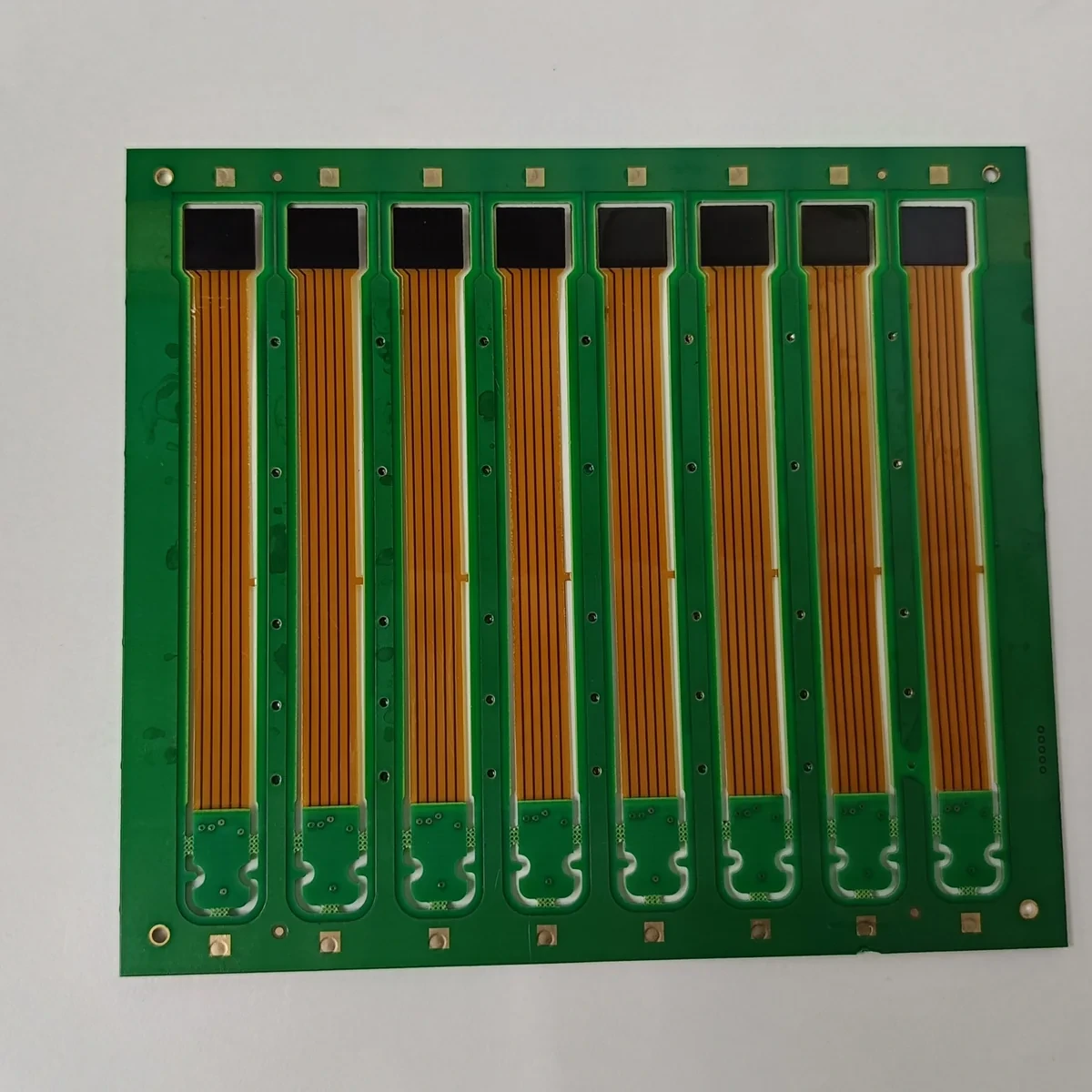
PCB-backed (row 1)
The right call when the keypad needs to host components. We assemble passives down to 0402, RGB LEDs in 0603 / 0805 / 1206 packages, QFN-packaged MCUs, and ZIF tail connectors directly on the FR-4. Backside copper acts as a ground plane and a heat spreader for backlight LEDs. The 1.0–1.6 mm thickness adds rigidity, which is why panel-mounted industrial controllers default to this construction.
FPC (row 2)
Wins when the assembled product has to conform to a curved bezel, share its ribbon path with a TFT or OLED display, or stay below 0.5 mm of total stack. Single-layer FPC is enough for a passive keypad matrix; double-layer adds a ground plane and lets the design hit the 2 kV ESD spec without external TVS placement.
Copper flex without the membrane stack (row 3)
What we ship when the customer wants the flex circuit alone — no dome, no overlay — to interconnect a remote keypad island to a controller. Same IPC-6013 Class 3 qualification, but no laminated PET overlay on top.
Silver-ink-on-PET (row 4)
The baseline, and still our highest-volume construction. We list it in the matrix so engineers can confirm when the PCB and FPC upgrades are actually needed and when they are not — a 24-key flat-panel matrix with no embedded electronics rarely justifies the move to copper.
Hybrid (row 5)
Combines a rigid FR-4 island for component placement with an integrated FPC tail. The result behaves like a small PCBA with a built-in flex pigtail — useful when the controller lives 100 mm away and a separate harness would add a connector failure point. We design these to IPC-A-600 on the rigid section and IPC-6013 on the flex section, qualified as a single assembly. For the upstream choices that interact with this decision, see our membrane switch design review packet.
Connector and routing review
Construction decides what the keypad can do; routing decides whether it integrates on the first sample.
The connector and routing decide whether the keypad will drop into the customer’s existing harness on the first sample. Tail pitch is locked by the receiving connector: 0.5 mm or 1.0 mm pitch for Molex FFC/FPC, AMP/TE FFC, and Hirose DF series ZIF; 2.54 mm for retrofit into legacy pin-header controllers; bare solder pads for direct PCB integration.
Pin 1 location, tail-entry direction, stiffener position, and ZIF actuator face are all design-time variables. Pinout is fully customer-defined — we route to any sequence including non-monotonic mappings that match existing harnesses. For the broader pool of termination styles we keep in inventory, see our membrane switch connectors reference page.
Why JASPER on a copper build
Etched copper, full SMT, and a pinout report on every batch
The copper carrier is only useful if it is built to a published acceptance standard and terminated to the harness you already ship. These four commitments keep a PCB or FPC build out of the rework loop.
Standards-based acceptance
PCB sections to IPC-A-600 and IPC-2221; flex to IPC-6013 Class 2 or 3; assembly to IPC-A-610; solder to J-STD-001 revision H.
Full SMT capability
0402 and larger passives, SOT-23/SOT-353 actives, LED 0603/0805/1206, QFN MCUs, and ZIF connectors on FR-4. See our LED membrane switches for the backlight side.
ESD & EMI hardening
2 kV TVS diodes per IEC 61000-4-2 on every key input, a perimeter guard ring, and a stitched ground plane on PCB or double-layer FPC.
Traceable, tested, documented
Full traceability from copper foil lot through 100% continuity test, with pin 1 marked and a pinout PDF shipped on every batch.
Where PCB and FPC constructions fit best
Component-dense control panels
Panel-mounted industrial controllers needing an MCU for matrix scan, RGB backlight drivers, and current-limit resistors default to a rigid PCB-backed carrier.
Curved and display-integrated interfaces
FPC wins where the keypad must conform to a curved bezel, co-route with a TFT or OLED display ribbon, or stay below 0.5 mm total stack.
Remote keypad interconnect
Copper flex without the membrane stack, or a hybrid PCB + FPC pigtail, links a remote keypad island to a controller 100 mm away without an extra connector failure point.
RFQ preparation
Send the details that decide construction, tail, and pinout.
Send your panel cutout, target circuit construction, controller pinout, and an indicative quantity. We review materials, layer stack, sealing target, connector family, and lead time before any tooling is cut.
- Panel cutout and enclosure depth budget
- Target construction: PCB-backed, FPC, copper flex, or hybrid
- Controller pinout and connector family (Molex, AMP/TE, Hirose, header)
- Tail pitch, length, exit direction, and stiffener position
- Target sealing level: IP65 or IP67 per IEC 60529
- SMT BOM: MCU, LED drivers, resistors, ESD diodes
Manufacturing baseline
JASPER supports OEM PCB and FPC membrane switch builds from design review through production in Dongguan, on an ISO 9001:2015 quality system.
PCB carriers use FR-4 rated UL 94 V-0; flex is qualified to IPC-6013 Class 2 or Class 3; assembly follows IPC-A-610 with J-STD-001 revision H soldering. RoHS Directive 2011/65/EU and REACH SVHC compliance, 2 kV ESD protection per IEC 61000-4-2, and full traceability from copper foil lot through final 100% continuity test are available across the build.
Angebot anfordernPCB and FPC membrane switch questions
When should I use a PCB-backed membrane switch vs an FPC one?
Pick PCB-backed when the keypad must carry SMT components — an MCU, LED drivers, current-limit resistors, 2 kV ESD diodes per IEC 61000-4-2 — survive panel-mount rigidity, or run higher current to backlight LEDs. Pick FPC when the keypad has to fold around a curved housing, share a tail with a display ribbon, hit a total thickness below 0.5 mm, or follow a non-flat panel. PCB-backed adds rigidity and full SMT capability per J-STD-001. FPC adds 3-D conformability qualified to IPC-6013 Class 2 or Class 3. Both replace silver-ink-on-PET when conductivity, trace density, or component-density requirements exceed printed traces. JASPER builds both constructions on the same factory floor and will recommend by application during the RFQ review.
Can a PCB membrane switch include SMT components?
Yes. The FR-4 carrier in a PCB-backed build accepts standard SMT process: 0402 and larger passives, SOT-23 and SOT-353 actives, LED packages in 0603 / 0805 / 1206, QFN-packaged microcontrollers, and ZIF connectors. We assemble per IPC-A-610 acceptance and solder per J-STD-001 revision H. Common builds carry an MCU for matrix scanning, RGB LED drivers, current-limit resistors, and 2 kV ESD diodes on every key input. SMT on FPC is restricted to qualified flex parts — typically 0603 and larger — built on stiffened pads with a reduced reflow profile that respects polyimide thermal limits. Component lists, BOM, and assembly drawings are reviewed at the sample stage before any tooling is cut. For the backlight side of these integrated builds, see our LED membrane switches catalog.
What’s the connector and pinout flexibility on a PCB or FPC membrane switch?
Both PCB-backed and FPC constructions accept any pinout the customer specifies — sequential, scrambled to match a legacy harness, or with intentional pin gaps for keyed alignment. Tail pitch is set by the receiving connector: 0.5 mm or 1.0 mm for Molex, AMP/TE, and Hirose ZIF/FFC families; 2.54 mm for retrofit into legacy pin headers; bare-pad solder for direct PCB-to-PCB integration. Tail length, tail width, stiffener position, and exit direction are all open at design time. JASPER routes the tail to the customer’s controller pinout — no fixed factory mapping is required. We mark pin 1 on every drawing release and ship a pinout PDF with every batch.
Continue the membrane switch construction review
Membrane switches
Zur Folientastatur-Familienseite zurueckkehren, um Tastaturaufbauten, Schaltungen, Overlays und Abdichtungsoptionen zu vergleichen.
Folientastaturen pruefen ->LED membrane switches
Plan backlight driver placement, RGB LED packages, and the integrated PCB carriers that power them.
Review LED switches →Membrane switch design
See how we review stack-up, circuit construction, tail routing, sealing, and grounding before tooling.
Designunterstuetzung pruefen ->Prototyping
The rapid-build workflow behind five fully terminated samples in 10 working days for engineering evaluation.
Review prototyping →Get a PCB or FPC sample built to your pinout
Send us your panel cutout, target circuit construction, controller pinout, and an indicative quantity, and we will build five fully terminated samples to that spec within 10 working days for engineering evaluation. Every sample run includes 100% continuity test on every key, a pinout verification report, and a connector mating-cycle check against your named ZIF or pin-header part number. Most projects close the spec-to-sample loop in two iterations. E-Mail your drawing package or RFQ and a JASPER engineer responds the same business day.
RFQ-Pruefung startenWant the rapid-build workflow first? See how we run prototyping for OEM membrane switch projects.