
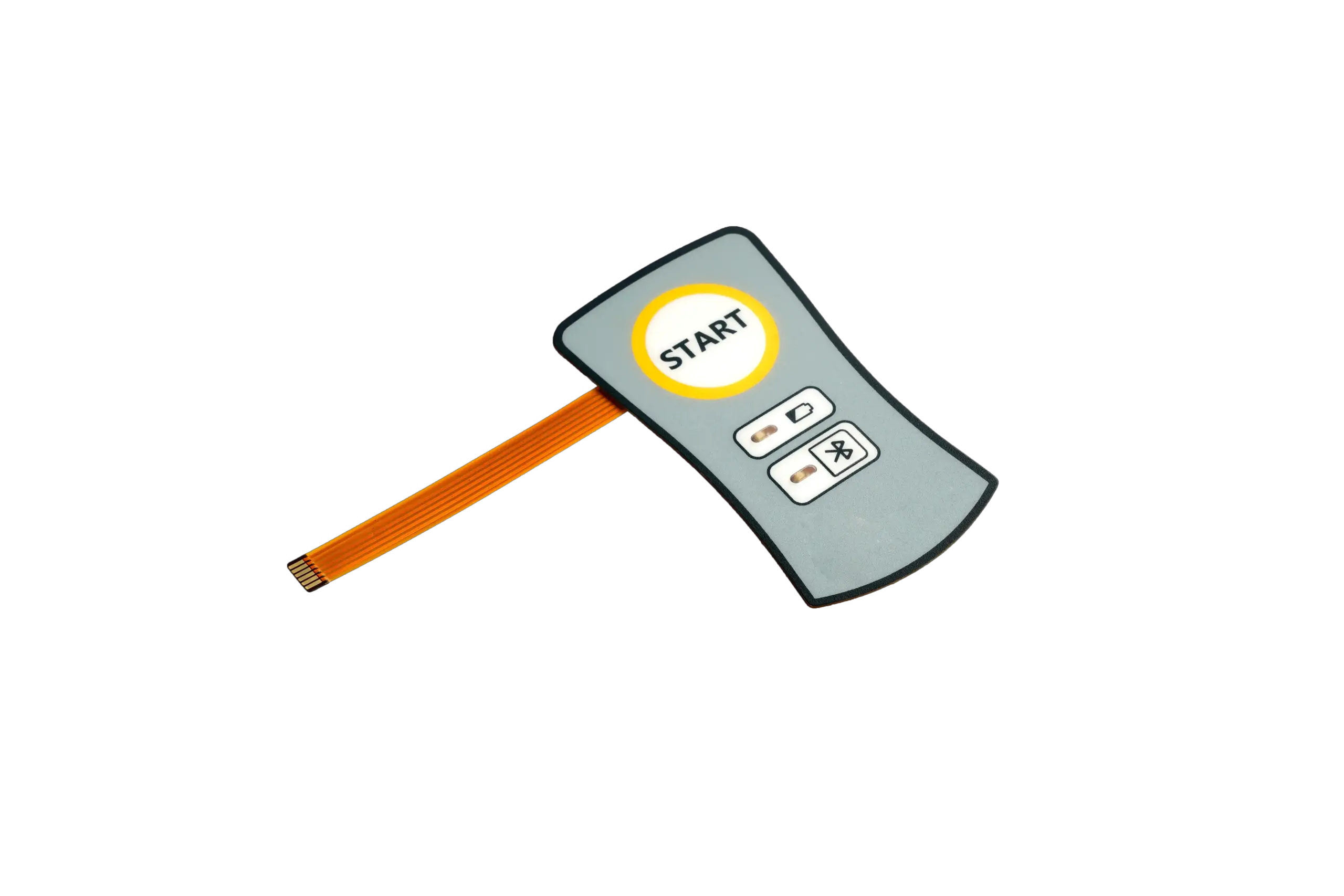
Single button · matrix array · sealed · labeled
Kundenspezifisch Folientasten for Compact Control Panels
Configurable membrane push buttons engineered around how the key feels, labels, and holds up after millions of presses.
JASPER builds Folientasten as single-button assemblies and full multi-button arrays for medical devices, industrial handheld controllers, test and measurement instruments, and HVAC control panels.
OEMs, die unsere Schalter in ihren Geraeten einsetzen





Why button behavior matters
We design the button around the finger, not the other way around.
A membrane button switch sits flush with the panel surface, seals against moisture and dust, and can be printed, embossed, or textured to match the exact interaction your device demands. Release the pressure and the flexible top layer springs back — no pivot, no mechanical parts, no wear-prone mechanism. That simplicity is the point.
OEM engineers choose Folientasten when the brief calls for a thin profile, IP-rated sealing, and a surface that carries graphics and labeling without a separate overlay. We build them as single-button assemblies for dedicated functions and as multi-button arrays for full control panels — both from the same process. Each button is one actuatable zone within a wider membrane switches assembly, so the trade-offs in feel, label, and cycle life are the focus of the product category.
Kurzantwort
What is a membrane button switch?
A membrane button switch — also called a membrane push button or membrane button — is the individual actuatable zone within a membrane switch assembly. When a user presses the button area, the flexible top layer deflects and bridges two conductive traces on the circuit layer below, completing the circuit. Folientasten are used in medical devices, industrial handheld controllers, test and measurement instruments, and HVAC control panels. The total assembly thickness typically runs 0.5 mm to 2.0 mm, making them the preferred choice when a thin profile and IP-rated sealing are required simultaneously.
Button behavior, not editorial neutrality
A flush, sealed key that carries its own graphics — no separate decal, no pivot to wear.
When a user presses the button area, the flexible top layer deflects and bridges two conductive traces on the circuit layer below, completing the circuit; release the pressure and the layer springs back. We write the JASPER scope from JASPER’s direct manufacturing experience, not from a neutral editorial perspective.
The total assembly thickness of a membrane button switch — overlay, spacer, circuit layer, and rear adhesive — typically runs 0.5 mm to 2.0 mm depending on dome selection and connector type. That profile is difficult to match with any mechanical switch technology at equivalent sealing performance. For complete HMI fascias built from these same buttons, see our Folientastatur-Panels.
| Property | Typical value | Notes |
|---|---|---|
| Total assembly thickness | 0.5–2.0 mm | Overlay + spacer + circuit + rear adhesive; varies with dome and connector |
| Metal dome force | 180–400 gf | Snap feedback; ~5 M actuations |
| Polydome force | 100–300 gf | Embossed polyester; ~1 M actuations |
| Non-tactile | No snap feedback | Circuit life 10 M+; overlay wear becomes the limit |
| Label durability | 100,000+ IPA wipes | Printed on overlay; tested per JASPER internal abrasion protocol |
Force ranges and cycle counts are JASPER design baselines; environmental limits are rated to IEC 60068-2.
Practical design notes
Gloved-hand use is the requirement that most often decides dome and geometry.
Gloved-hand use is one of the most common requirements we receive from industrial and medical OEM customers. A standard fingertip button that works fine bare-handed can become unreliable when the operator is wearing nitrile or leather gloves. We have supplied glove-rated Folientasten to customers in food processing, pharmaceutical manufacturing, and field instrumentation.
Membrane button labels are printed on the polyester overlay in the same pass as the graphics — there is no separate decal to peel or fade independently. Our standard overlay printing withstands 100,000+ IPA wipe cycles before visible degradation, tested per internal abrasion protocol, with hard-coat overlays available for harsher environments. These choices sit inside the wider membrane switch design review we run before tooling.
Cycle life by dome
How long a membrane button lasts depends on dome material, force, and environment
Cycle life depends on dome material and actuation force. Operating significantly above the dome’s rated force accelerates fatigue, and environment sets the real-world ceiling — we provide application-specific life estimates on request.
Polydome — 1 million
Embossed polyester dome rated to 1 million actuations at rated force; a cost-effective tactile option for moderate-duty panels.
Metal dome — 5 million
Stainless snap dome rated to 5 million actuations at rated force — roughly 5× a polydome at equivalent force. See our metal dome membrane switches for high-cycle keys.
Non-tactile — 10 M+
With no dome, the circuit layer exceeds 10 million actuations; the limiting factor shifts to overlay wear rather than snap fatigue.
Environment caps it
High humidity above 85% RH, temperatures above 70°C, and solvent or cleaning-agent exposure degrade adhesives, overlays, and silver-paste circuits.
Wo Folientasten am besten passen
Medical and single-function keys
Single-button assemblies seal and label one dedicated function independently from the main interface — common in medical devices.
Industrial handheld and field controllers
Glove-rated buttons with 12 mm minimum diameter and raised or recessed profiles for reliable actuation in food processing and field instrumentation.
Test, measurement and HVAC panels
Thin-profile, IP-rated buttons that carry their own printed graphics across instrument fascias and HVAC control panels.
RFQ preparation
Send the button details that decide dome, geometry, and sealing.
Tell us your button count, actuation force preference, lighting requirement, and operating environment. Our engineering team reviews actuation force, button geometry, and environmental requirements before committing to tooling.
- Button count and single-button vs matrix layout
- Tactile feel: non-tactile, polydome, or metal dome
- Glove type and thickness, if gloves are used
- Lighting: none, EL, LED point source, or light guide
- Termination: tail cable, ZIF connector, or PSA backing
- Expected cycle count, humidity, temperature, and chemical exposure
Manufacturing baseline
JASPER supports OEM membrane button switch builds from design review through production in Dongguan.
We rate assemblies to IEC 60068-2 environmental test standards and can provide test data for specific conditions on request. RoHS and REACH material options are available, with ISO-certified process control across a 5,000 m² factory and 2,500 m² cleanroom production area. Single-button prototype quantities are supported for design validation.
Angebot anfordernMembrane button switch questions
Can you make a single-button membrane switch?
Yes. We manufacture single-button Folientasten as standalone assemblies. A single-button unit includes the overlay, spacer, circuit layer, and termination — either a tail cable with a connector or a ZIF tail for direct PCB connection. Minimum order quantities apply, but we support prototype quantities for design validation. Single-button assemblies are common in medical devices where one dedicated function button needs to be sealed and labeled independently from the main interface.
Can Folientasten include LED backlighting?
Yes. We integrate LED point-source backlighting into Folientasten by routing light through a light guide layer or by positioning surface-mount LEDs on a flex circuit beneath the button area. EL (electroluminescent) backlighting is an alternative for buttons that require even, glow-style illumination rather than a bright point source. Both approaches require the lighting voltage and current to be specified during the design phase — we cannot add backlighting to an existing assembly without a redesign of the circuit layer. If your application requires illuminated membrane buttons, raise it at the first design review so we can account for the additional layers and connector pins.
What factors affect the cycle life of a membrane button?
Three factors dominate: dome material, actuation force, and environment. Metal domes outlast polydomes by roughly 5× at equivalent force — 5 million versus 1 million actuations — while non-tactile designs exceed 10 million actuations with the limit shifting to overlay wear. Operating at forces significantly above the dome’s rated actuation force accelerates fatigue. High humidity (above 85% RH) and temperatures above 70°C degrade adhesive layers and can cause dome corrosion in silver-paste circuits. Chemical exposure — particularly solvents and strong cleaning agents — attacks the overlay and adhesive if the assembly is not specified for chemical resistance. We rate our assemblies to IEC 60068-2 environmental test standards and can provide test data for specific conditions on request. For full-panel feedback choices, see our tactile membrane switches.
Folientastatur-Designpruefung fortsetzen
Tactile membrane switches
Full-panel assemblies with metal dome or polydome feedback for keys that need a physical click.
Taktile Schalter pruefen ->Metal dome membrane switches
High-cycle assemblies rated to 5 million actuations with crisp snap feedback.
Review metal dome switches →Folientastatur-Panels
Complete HMI panels with graphics, backlighting, and connectors built from these buttons.
Review switch panels →Membrane switches
Return to the membrane switch family hub to compare structures, circuits, overlays, and sealing.
Folientastaturen pruefen ->Ready to specify your membrane button switch?
Tell us your button count, actuation force preference, lighting requirement, and operating environment. Our engineering team will return a design recommendation and quote within two business days — rated to IEC 60068-2 and backed by ISO-certified production in Dongguan.
Angebot anfordernNot ready to quote? See how we approach membrane switch design for OEM projects.