
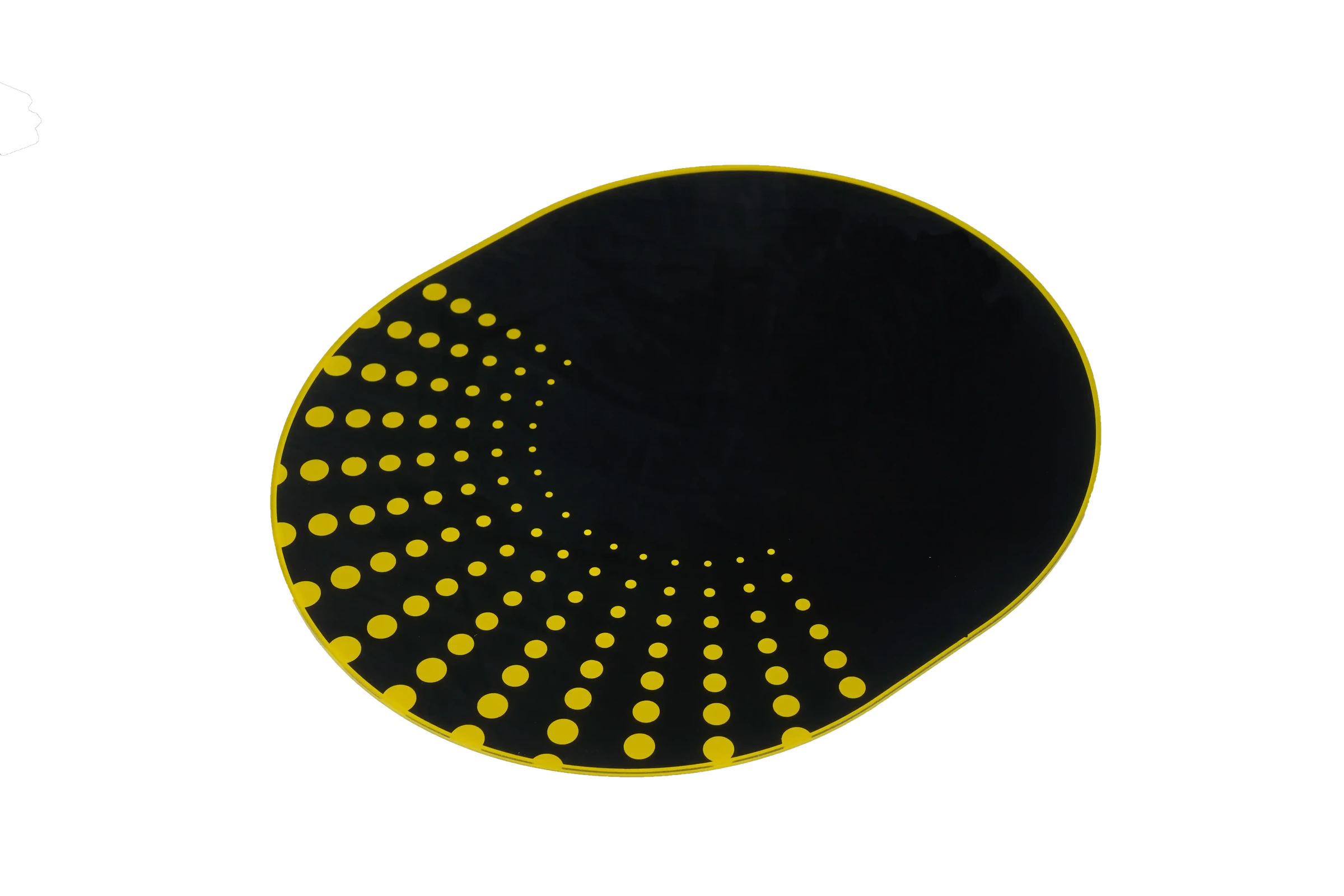
アクリル/PMMAパネル・プリントフェイスプレート・カバーレンズ
OEM 機器用のアクリル (PMMA) パネルおよび銘板
OEM 機器の可視面用の硬質 PMMA フロント パネル (印刷、切断、コーティング、裏面接着剤付き)。
JASPER は、OEM 製品向けにカスタムのアクリル フロント パネルを製造しており、PMMA パネルまたはフェイスプレートとしても販売されています。部品の前面にハードプリントが必要だが、ガラスの方が重かったり高価だったりする場合、通常はアクリルが仕様に優先されます。
JASPERのインターフェース部品を採用するOEM




硬質プラスチックの前面
OEM アクリル パネルとは実際には何なのか、そして実際は何ではないのか。
Start with the part on the bench: a sheet of optical-grade PMMA, machined and printed into a finished interface. One piece can carry the brand logo, the model and serial marking, printed legends, a clear or tinted display window, dead-front icons, capacitive touch graphics, and the adhesive that holds it to the enclosure. That is a long way from the engraved desk plate most people picture when they hear “acrylic nameplate.”
ラベルではなくパネルにするのは基板です。印刷フィルムや金属箔は含まれていません。表面は固体アクリルで、グラフィックはほとんどの場合第 2 面に印刷されるため、指先はインクではなくアクリルに接触します。
Set it next to a glass nameplate and the trade is hardness for practicality. Polymethyl methacrylate weighs less, takes an impact better, and machines on CNC or laser gear that glass would fight. It also tools for less money. The one place glass wins is scratch resistance, so any acrylic panel that gets touched or wiped daily gets an anti-scratch hard coat to close that gap.
The line between acrylic and a PET or PC custom graphic overlay is rigidity. A film overlay flexes with the panel and can laminate straight onto a membrane switch stack. Acrylic stays flat and hard — exactly what a window, a cover lens, or a solid-feeling faceplate needs.
Quick Answer
アクリルパネルとは何ですか?
アクリル パネル (PMMA フロント パネルまたはアクリル フェイスプレートとも呼ばれます) は、OEM 機器用の硬質プラスチックの前面部品です。印刷された銘板、透明なカバー レンズ、表示窓、デッドフロント インジケータ パネル、または単に製品の目に見える面として機能します。ほとんどは光学グレードの PMMA です。シルク スクリーンまたは UV で第 2 面に印刷され、CNC またはレーザーで切断され、傷防止コートで仕上げられ、3M 接着剤で裏打ちされています。エンジニアは、ガラスがデザインのニーズよりも重かったり、成形に時間がかかったり、高価だったりする場合にアクリルに手を伸ばします。一般的な業界基準は、厚さ 0.5 ~ 10 mm、寸法精度 ±0.03 mm、および印刷およびコーティングされたスタック上の ASTM 5B クロスカット接着力です。
アクリルオプション
7 つの決定により、カスタム PMMA アクリル フロント パネル上のツールが決まります。
Before we quote, we walk a project through the same checklist. Half the value is catching the cases where the part is really a glass nameplate, a PET/PC graphic overlay, or a metal plate wearing an acrylic label.
| Requirement | Typical options | Design note |
|---|---|---|
| Acrylic material | Optical-grade cast or extruded PMMA; clear, colored, tinted, or opal/diffusing | Optical-grade acrylic gives high transparency and good light transmission for windows and LED diffusion. |
| Thickness | 0.5–10 mm typical; ~1 mm common for thin window panels (industry reference) | Thicker acrylic feels rigid and premium; thinner panels suit flush windows and lightweight covers. |
| Printing method | Second-surface silk-screen printing, digital UV printing, epoxy/polyester ink, dead-front masks | Second-surface printing protects the graphics behind the acrylic. Pantone/PMS color matching available. |
| Cutting and forming | CNC cutting, laser cutting, routing, drilling, cutouts, beveled (2.5D) edges, radius corners | Acrylic is easier and cheaper to cut and form than glass, which helps complex shapes and windows. |
| Display windows | Clear, tinted, smoked, opal/diffusing, anti-glare, dead-front, backlit icons | The window must match the LCD, OLED, segment LED, indicator LED, or capacitive touch sensor behind it. |
| Surface finishing | Gloss, matte, anti-glare (AG), anti-reflective (AR), anti-fingerprint (AF), anti-scratch hard coat, electroplated mirror | Acrylic is softer than glass, so an anti-scratch hard coat is common where the panel is touched or cleaned often. |
| Adhesive mounting | 3M 467MP, 3M 468MP, 3M 300LSE, 3M 9088 / 9088FL; full or selective adhesive | Adhesive choice depends on the enclosure material, panel size, temperature cycling, and cleaning chemistry. |
| Protection and QC | PE protective film; ±0.03 mm accuracy, >100 alcohol wipes, ASTM 5B adhesion (industry references) | These numbers are common industry references; JASPER confirms practical limits per project rather than as fixed guarantees. |
Material route comparison
Acrylic, glass, PET/PC film, metal, and doming labels each earn their place differently.
Any of them can end up on the front of a machine. Picking the wrong one shows up later as a scratch, a crack, a delamination, or a part that costs twice what it should.
Acrylic panel
A light, rigid PMMA face that cuts, lasers, and forms cheaply, with clear or colored windows and an optional hard coat.
Glass nameplate
Reach for a glass nameplate when the front has to survive heavy scratching, feel genuinely premium, or carry a high-end display window.
PET / PC overlay
Use custom graphic overlays for flexible printed film, low-profile adhesive overlays, and membrane switch top layers.
Metal or doming label
Metal nameplates are rugged ID plates; doming label nameplates are raised glossy badges, not display covers.
Design checks
Tell us what the front has to do, not just what it should say.
Artwork alone rarely settles a quote. We look at panel size, the windows, how the backlight behaves, the cut features, edge and surface finish, how much area the adhesive gets, the cleaning routine, and where the part has to pass inspection.
- Panel size, thickness target, and enclosure depth
- Display windows, LED indicators, dead-front icons, and touch zones
- Clear, tinted, opal/diffusing, or dead-front window requirement
- CNC or laser cut profile, holes, slots, beveled (2.5D) edges, radius corners
- Pantone / PMS colors, opacity, masks, and the printed stack
- Surface finish: gloss, matte, AG, AR, AF, anti-scratch hard coat, mirror
- Mounting surface: aluminum, powder coat, ABS, PC, painted steel
- Cleaning chemistry, UV exposure, temperature swing, humidity
- RoHS, REACH, UL, medical, automotive, or IP target
What to send
An Adobe Illustrator file, a press-ready PDF, an EPS, a DXF for cut features, or a CAD/STEP drawing all work. Vector icons and separate cut and window layers cut review time the most.
If glass, metal, or a PET/PC overlay turns out to be the better front for your part, we will say so before any tooling is cut.
見積もりを依頼Acrylic panel questions
Is an acrylic panel the same as a glass nameplate?
No. Both can be clear or printed, but they behave differently on a product. Acrylic (PMMA) is lighter, takes a knock better, and cuts or forms more easily — usually for less money — which makes it a good fit for clear covers, lightweight panels, and lit or diffuser windows. Glass is harder, heavier, and far more scratch resistant, so it earns the premium display windows and high-end faces. Because acrylic is the softer of the two, an anti-scratch hard coat goes on anything that gets handled or cleaned a lot. Treat them as two routes, not as drop-in substitutes.
Can an acrylic panel include display windows, dead-front icons, or touch zones?
Yes. A single acrylic panel can carry clear, tinted, or opal windows, dead-front printed icons, backlit indicators, capacitive touch graphics, and LED diffusion. The trick is tuning print opacity, transmission, backlight brightness, and the window edge together. If an icon has to vanish when off, we build the dead-front layer around the light source behind it; if a display has to stay readable in sunlight, we look at anti-glare, AR, or tinted-window options.
What files and details are needed for a custom acrylic panel quote?
Send the artwork, the part drawing, the window or display layout, the target thickness, the mounting surface, the edge and cut features, and the working environment. A STEP file or enclosure drawing helps, and so do Pantone colors, LED or display specs, the surface-finish requirement, the cleaning chemistry, the temperature range, and the annual quantity. We will confirm whether acrylic, glass, metal, or a PET/PC overlay is the right front-surface route before recommending tooling.
Continue the front-surface material review
Graphic overlays
Head back to the グラフィックオーバーレイ hub to weigh every printed front-surface option.
Review graphic overlays →Glass nameplate
See where rigid screen-printed glass beats acrylic on scratch resistance and feel.
Review glass nameplates →Custom graphic overlays
Compare acrylic with flexible PET/PC printed film overlays built from your artwork.
Review custom overlays →Graphic overlay materials
Weigh PET, PC, acrylic, glass, adhesive, coating, and environmental trade-offs in one place.
Review materials →Get an acrylic panel reviewed before tooling
Send the artwork, the panel drawing, the display-window locations, the backlight notes, the surface-finish requirement, and the mounting surface. We will go through the print stack, the acrylic-versus-glass call, the cutting and edge finishing, the surface coating, and the adhesive, and tell you whether the part should stay acrylic or move to a custom graphic overlay.
Start RFQ ReviewStill weighing materials? Start with our graphic overlay materials reference.