
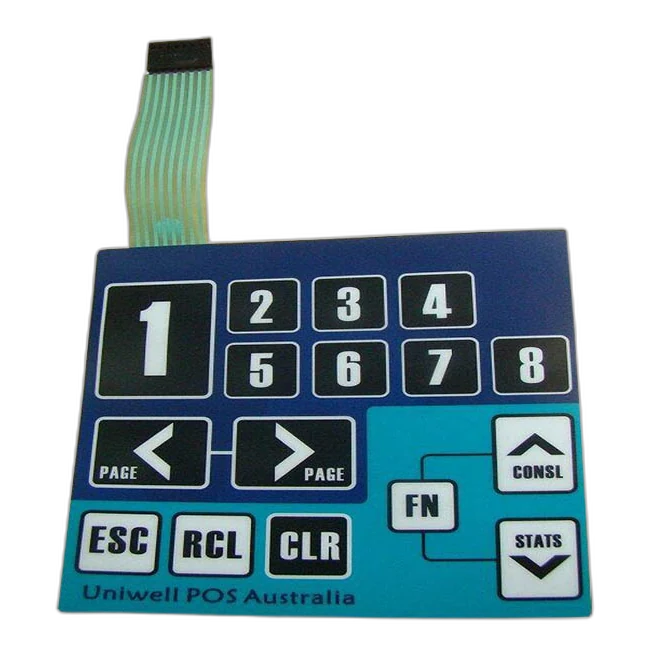
Folientastatur-Typen
Common membrane switch types include tactile, non-tactile, metal dome, backlit, LED, waterproof, PCB/FPC-supported, and capacitive touch interfaces.
The best type depends on user feedback, sealing, lighting, circuit complexity, connector routing, product appearance, and the environment the equipment must survive.
Quick answer: choose the type by risk, not by name.
A tactile membrane switch helps users confirm a press by feel. A non-tactile switch keeps the surface flatter. Hinterleuchtet and LED versions solve visibility. Wasserdicht versions solve exposure only when the enclosure and tail exit support sealing. PCB/FPC-supported switches help when circuits, LEDs, or connectors become more complex.
Compare membrane switch types by use case
Start with the use case, then confirm the structure against the enclosure, electronics, operator conditions, and inspection requirements. A final structure should still be reviewed against the enclosure, electronics, operator conditions, and inspection requirements.
| Type | Best for | What changes in the design | Related page |
|---|---|---|---|
| Taktil membrane switch | Interfaces requiring click feedback | Use metal domes or formed structures to give operators a clear actuation feel. | Review option |
| Non-tactile membrane switch | Smooth surfaces and simple controls | Close the circuit without a strong click, useful when a flatter and quieter interface is preferred. | Review option |
| Metal dome membrane switch | Defined tactile response and stable force | Use stainless steel domes to control snap feel, actuation force, and contact closure. | Review option |
| Hinterleuchtet membrane switch | Low-light use, icons, indicators | Use LEDs, light guide films, windows, opacity control, and dead-front graphics for visibility. | Review option |
| Wasserdicht membrane switch | Moisture, cleaning, outdoor exposure | Review overlay, adhesive, edges, tail exit, enclosure support, and exposure level as one sealing system. | Review option |
| PCB/FPC membrane switch | Complex circuits, LEDs, connector support | Add PCB or FPC support when routing density, LED placement, connector stability, or electronics integration requires it. | Review option |
| Capacitive touch interface | Flat sealed surface with no key travel | Use touch sensing through a flat surface when the product needs a modern sealed interface and electronics support it. | Review option |
What each type solves
Many real projects combine several types: for example, tactile keys with LED indicators, a waterproof adhesive strategy, and PCB support near the connector.
Taktil membrane switch
Best for: Interfaces requiring click feedback
- Use metal domes or formed structures to give operators a clear actuation feel.
- Confirm artwork, layer stack, circuit, tail exit, connector, and sample approval details before production.
Non-tactile membrane switch
Best for: Smooth surfaces and simple controls
- Close the circuit without a strong click, useful when a flatter and quieter interface is preferred.
- Confirm artwork, layer stack, circuit, tail exit, connector, and sample approval details before production.
Metal dome membrane switch
Best for: Defined tactile response and stable force
- Use stainless steel domes to control snap feel, actuation force, and contact closure.
- Confirm artwork, layer stack, circuit, tail exit, connector, and sample approval details before production.
Hinterleuchtet membrane switch
Best for: Low-light use, icons, indicators
- Use LEDs, light guide films, windows, opacity control, and dead-front graphics for visibility.
- Confirm artwork, layer stack, circuit, tail exit, connector, and sample approval details before production.
Wasserdicht membrane switch
Best for: Moisture, cleaning, outdoor exposure
- Review overlay, adhesive, edges, tail exit, enclosure support, and exposure level as one sealing system.
- Confirm artwork, layer stack, circuit, tail exit, connector, and sample approval details before production.
PCB/FPC membrane switch
Best for: Complex circuits, LEDs, connector support
- Add PCB or FPC support when routing density, LED placement, connector stability, or electronics integration requires it.
- Confirm artwork, layer stack, circuit, tail exit, connector, and sample approval details before production.
Capacitive touch interface
Best for: Flat sealed surface with no key travel
- Use touch sensing through a flat surface when the product needs a modern sealed interface and electronics support it.
- Confirm artwork, layer stack, circuit, tail exit, connector, and sample approval details before production.
How to choose the right membrane switch type
Start with how the product is used, then check the interface stack. The right type is not chosen by product name alone.
| Decision question | If the answer is yes | Type direction to review |
|---|---|---|
| Do operators need press confirmation by feel? | Taktil feedback can reduce uncertainty during operation | Taktil or metal dome membrane switch |
| Must the surface be flat, quiet, or easy to wipe? | A strong click may not be necessary and a flatter stack may be preferred | Non-tactile membrane switch or capacitive touch interface |
| Will the product be used in low light? | Icons, key zones, and status may need controlled lighting | Hinterleuchtet, LED, light-guide, or dead-front structure |
| Will the product face water, cleaning, or outdoor exposure? | Sealing needs to be reviewed as a complete product system | Wasserdicht membrane switch with enclosure/tail-exit review |
| Are there LEDs, dense routing, or connector stability needs? | A basic printed circuit may not give enough support | PCB/FPC membrane switch or reinforced connector area |
| Does the product need a modern no-travel touch surface? | Touch sensing and electronics support must be reviewed early | Capacitive touch panel or capacitive touch switch |
| Will users wear gloves or operate under vibration? | The interface may need stronger tactile or visual confirmation | Taktil, larger key zones, clear legends, and sample testing |
Information that helps JASPER recommend a type
A supplier cannot reliably choose the type from a product name alone. The useful details are how the user presses the interface and what the interface must survive.
- Product application and operator environment
- Need for click feedback or flat/no-travel operation
- Water, cleaning, dust, UV, oil, or temperature exposure
- Low-light operation, LED indicators, backlit icons, or dead-front symbols
- Key layout, key size, legends, display windows, and artwork revision
- Circuit complexity, matrix, LEDs, connector type, pitch, and pinout
- Tail length, tail exit direction, bend radius, contact side, and stiffener
- Housing material, surface texture, adhesive area, and assembly process
Practical note: If a project needs tactile feedback, waterproof sealing, LEDs, and PCB/FPC support, do not treat those as separate add-ons. They affect the same stack and should be reviewed together before sampling.

Membrane switch types are often combined
The most useful RFQ language describes the full combination, not just one label.
| Combination | Why buyers use it | Risk to review early |
|---|---|---|
| Taktil + LED indicators | Clear press feedback plus visible status | Dome placement, LED routing, spacer clearance, opacity, current path |
| Wasserdicht + backlit | Outdoor or wipe-down use with low-light visibility | Window sealing, light leakage, edge path, tail exit, adhesive choice |
| Non-tactile + cleanable overlay | Flat control surface for simple functions and frequent wiping | Contact reliability, key location guidance, surface finish, cleaning exposure |
| PCB/FPC + connector support | Complex circuits, LEDs, dense routing, or reinforced connector area | Board thickness, connector height, tail route, strain relief, test access |
| Capacitive + graphic overlay | Modern sealed touch surface with printed icons and windows | Sensitivity, overlay thickness, grounding, noise, gloves, moisture behavior |
| Metal dome + embossed overlay | Stronger tactile guidance and visible key zones | Dome force, embossing height, key support, sample feel approval |
Continue comparing options
These pages connect the type map to working principle, design guide, product pages, and specific structures.
Membrane switch type selection questions
Which membrane switch type is most durable?
Durability depends on the structure, overlay material, adhesive, circuit, enclosure support, environment, and inspection plan. There is no single best type for every product.
Can several membrane switch types be combined?
Yes. A single assembly can include tactile keys, LED indicators, dead-front icons, waterproof sealing review, display windows, shielding, and PCB or FPC support.
Is a tactile switch always better than a non-tactile switch?
No. Taktil feedback is useful when operators need confirmation by feel, but non-tactile structures can be better for flatter surfaces, quieter operation, or simpler control areas.
When should I choose a backlit membrane switch?
Choose backlighting when users operate the product in low light, when icons must be visible at night, or when status indicators and dead-front symbols need controlled illumination.
Does waterproof mean the same thing for every membrane switch?
No. Wasserdicht performance depends on the full product system: overlay, adhesive, edge design, tail exit, connector protection, enclosure, and the defined exposure test.
When is PCB or FPC support useful?
PCB or FPC support is useful for dense circuits, LEDs, rigid connector areas, fine routing, stronger electronics integration, or when the connector zone needs more stability.
Can a capacitive touch interface replace a membrane switch?
Sometimes. Capacitive touch is useful for flat sealed surfaces, but it needs electronics support and careful review of touch sensitivity, overlay thickness, grounding, noise, and user conditions.
Can JASPER recommend a type from my application?
Yes. Share the product use environment, enclosure, user behavior, key feel target, lighting needs, connector requirement, and expected volume so the structure can be reviewed.
Not sure which membrane switch type fits your project?
Send your product environment, enclosure details, key layout, lighting needs, connector requirement, and sample target. JASPER can review the type combination before tooling.
Request a Type Review