
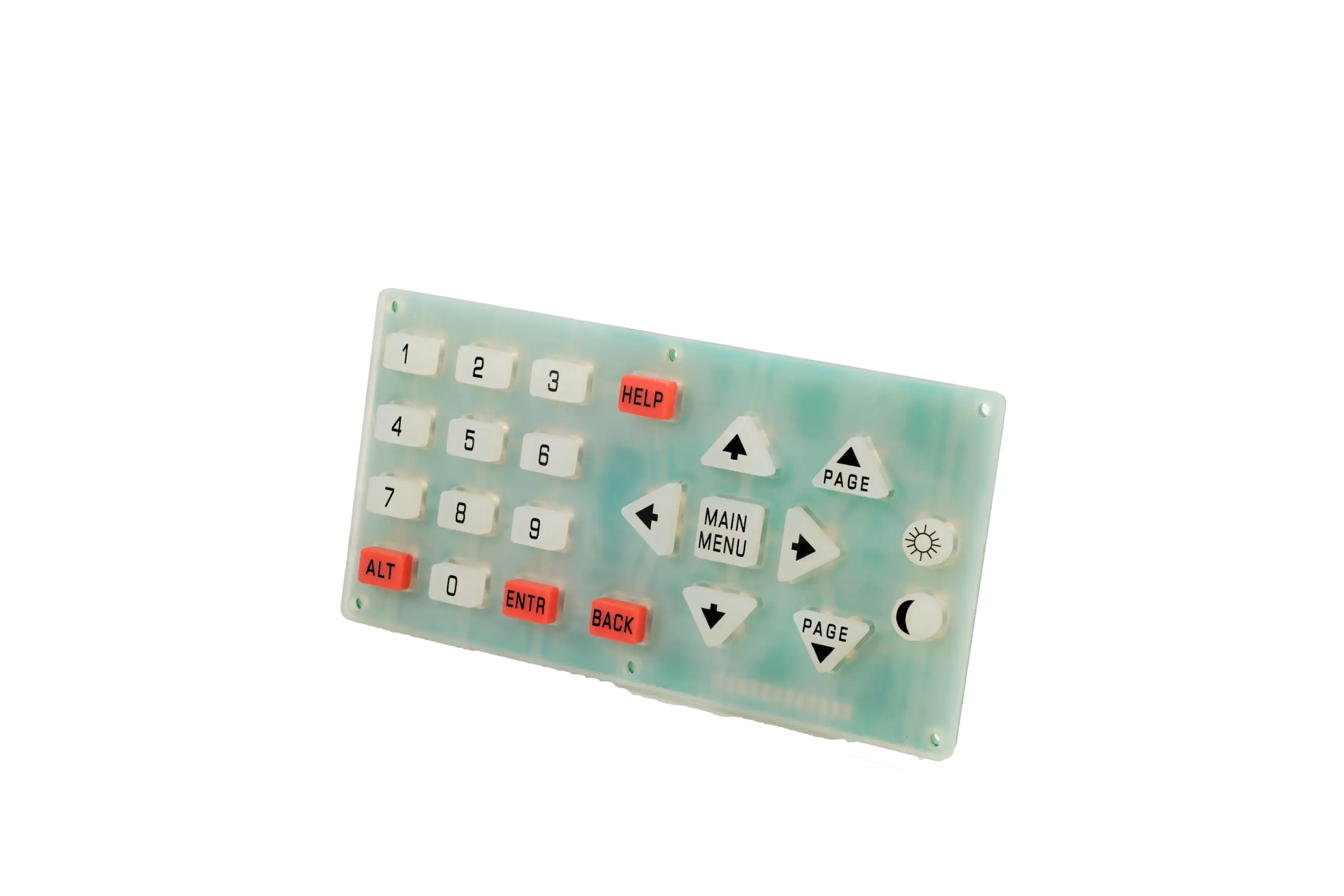
Silikontastatur-Baugruppen
A silicone keypad assembly combines the molded rubber keypad with the circuit, LEDs, Steckverbinder, spacer, adhesive, housing interface, and final test needed to make it work inside the OEM product. Instead of sourcing a rubber mat, PCB, membrane layer, and assembly process from separate suppliers, JASPER can build the keypad as a tested HMI module. This is the best route when stack height, alignment, backlighting, sealing, or electrical reliability matters.
When a Rubber Keypad Should Become an Assembly
A silicone rubber keypad looks like one part from the outside, but it rarely works alone. It needs something to press, something to align it, something to seal against, and often something to illuminate it.
If those pieces are designed separately, small errors accumulate:
- A carbon pill lands half a millimeter off the PCB contact.
- The silicone key bottoms out before the circuit closes cleanly.
- An LED creates a hot spot under the wrong part of the legend.
- A housing rib blocks a key from returning fully.
- Adhesive thickness changes the tactile feel.
- The keypad seals in the prototype but leaks after enclosure tolerance shifts.
A silicone keypad assembly prevents these problems by treating the keypad, circuit, lighting, spacer, adhesive, and housing datum as one stack.
JASPER supplies both individual silicone keypads and complete keypad assemblies. For OEM teams, the assembly route is often faster because one supplier owns the interface between the rubber, electronics, graphics, and mechanical fit.
What Can Be Included in a Silikontastatur-Baugruppe
| Assembly element | Purpose | Typical options |
|---|---|---|
| Silicone rubber keypad | User-facing molded key surface | Conductive, backlit, laser-etched, printed, coated, or sealed designs |
| Conductive contact | Closes the circuit | Carbon pill, conductive ink, metal dome actuator, metal pill, or non-conductive actuator |
| Circuit carrier | Electrical interface | Rigid PCB, FPC, PET circuit, membrane switch layer, or hybrid stack |
| Lighting | Illuminated symbols or status indication | LEDs, light-blocking spacer, diffuser, translucent silicone, laser-etched legends |
| Spacer and adhesive | Controls stack height and bonding | Die-cut adhesive, foam spacer, PET spacer, 3M adhesive options |
| Connector | Connects to the product electronics | FPC-Tail, ZIF Steckverbinder, wire harness, board Steckverbinder, solder pads |
| Housing interface | Locates and seals the assembly | Locating pins, ribs, bosses, perimeter lip, gasket features |
| Testing | Verifies function before shipment | Continuity, resistance, LED, visual, force, and application-specific inspection |
Not every project needs the full list. The point is to define which supplier owns each interface before tooling starts.
Common Assembly Architectures
Rubber keypad + PCB
This is the most common structure for electronic controls. The silicone keypad sits over a PCB with contact pads, LEDs, resistors, Steckverbinders, and sometimes the product electronics. It is a good fit for backlit keypads, higher-volume products, and assemblies that need repeatable electrical testing.
Rubber keypad + FPC
A flexible circuit is useful when the keypad must fit a compact enclosure, route around a bend, or connect to a board in another location. The main design concerns are stiffener placement, bend radius, Steckverbinder location, and keypad-to-contact alignment.
Rubber keypad + membrane switch
A silicone keypad can actuate a membrane switch layer when the product needs a molded key surface but still benefits from a printed membrane circuit, spacer, and tail. This hybrid approach can work well for sealed front panels and custom HMI layouts.
Rubber keypad + plastic housing
Some projects require the keypad to be mounted into a plastic bezel or enclosure before shipment. In that case, the assembly design must control compression, retention, sealing lip, screw bosses, and the way the operator presses the key through the housing opening.
Full HMI module
A full module may include silicone keypad, PCB, LEDs, membrane layer, graphic overlay, adhesive, Steckverbinder, and mechanical carrier. This is the right choice when the buyer wants a tested input assembly rather than a collection of parts.
Design Issues We Resolve Before Production
| Issue | Why it matters | Assembly-level fix |
|---|---|---|
| Key-to-contact alignment | Misalignment causes intermittent switching | Add datum features, review tolerance stack, align keypad and circuit together |
| Stack height | Too tall or too short changes feel and contact pressure | Define spacer, adhesive, housing, and PCB height before tooling |
| LED position | Wrong LED location creates hot spots or dim legends | Review optical path before PCB release |
| Sealing compression | Uneven compression causes leaks or poor feel | Define gasket lip, housing compression, and screw/boss layout |
| Connector location | Poor routing creates assembly stress | Confirm tail path, bend radius, and Steckverbinder clearance |
| Test coverage | Untested modules push failures to final product build | Add continuity, resistance, LED, force, and visual inspection steps |
These are not cosmetic details. They decide whether the keypad installs easily and works consistently in the customer’s assembly line.
Why OEM Teams Choose an Assembly Supplier
The main benefit is accountability. If one supplier makes the rubber, another makes the PCB, and a third performs assembly, every tolerance issue becomes a debate. With an integrated keypad assembly, the same engineering review covers the molded rubber, circuit, light path, Steckverbinder, and final test.
That usually helps when the product has:
- Tight enclosure space
- Backlit legends or status indicators
- Sealing requirements
- Carbon-pill contact reliability concerns
- Multiple suppliers currently sharing one HMI stack
- A launch schedule that cannot absorb repeated prototype loops
- A need for incoming modules that are already electrically tested
For simple low-volume products, a rubber keypad alone may be enough. For production OEM controls, assembly review often saves more time than it costs.
Anwendungen
Silikontastatur-Baugruppen fit:
- Medical device control modules and handheld controllers
- Automotive switches, remotes, seat-control modules, and illuminated buttons
- Industrial HMI panels, machine controls, and field instruments
- Marine electronics, security panels, and outdoor controllers
- Appliance controls, consumer electronics, and remote-control products
They are especially useful when the product needs both a physical key feel and a controlled electronics interface.
RFQ-Checkliste
For a silicone keypad assembly quote, send:
- Keypad drawing, enclosure drawing, or STEP file
- PCB, FPC, PET circuit, or membrane switch drawing if available
- Key count, key height, travel, and actuation-force target
- Contact method: carbon pill, conductive ink, metal dome, actuator, or unknown
- Backlighting requirement and LED plan if available
- Connector type, tail length, pinout, or cable requirement
- Sealing, cleaning, UV, oil, temperature, or chemical exposure
- Required tests: continuity, resistance, LED, force, IP, vibration, or visual standards
- Prototype quantity, annual volume, and launch schedule
FAQ
What is a silicone keypad assembly?
A silicone keypad assembly is a functional HMI module that combines a molded silicone keypad with the circuit, contacts, lighting, Steckverbinder, spacer, adhesive, housing interface, and test process needed for installation into an OEM product.
Can JASPER supply both the silicone keypad and PCB?
Yes. JASPER can support silicone keypad plus PCB, FPC, PET circuit, membrane switch layer, LEDs, Steckverbinder, adhesive, spacer, and final electrical test. The exact scope depends on whether the buyer wants a component or a tested assembly.
Is a keypad assembly better than buying the rubber keypad alone?
It is better when alignment, backlighting, sealing, stack height, or electrical testing matters. Buying the rubber keypad alone can be fine for simple projects, but an assembly reduces interface risk when several parts must work together inside a tight enclosure.
Can a silicone keypad assembly include backlighting?
Yes. Backlit assemblies can include translucent silicone, opaque coating, laser-etched legends, LEDs, resistors, PCB or FPC, light-blocking spacer, Steckverbinder, and final LED inspection.
What should be tested before shipment?
Typical tests include visual inspection, key actuation feel, continuity, contact resistance, LED function, Steckverbinder orientation, and dimensional checks. Application-specific projects may also require IP sealing, abrasion, cleaning, vibration, or life-cycle validation.
Source One Tested Keypad Module
Send the keypad layout, enclosure drawing, circuit plan, lighting requirement, and test expectations. We will help define whether JASPER should supply the rubber keypad alone or the complete silicone keypad assembly.
Benoetigen Sie Hilfe bei Silikontastatur-Baugruppen?
Senden Sie Zeichnung, Layout, Einsatzumgebung, Schaltungsplan und Jahresmenge. Wir pruefen den Tastaturaufbau vor dem Tooling.
Angebot anfordern