

Table of Contents
Quick Answer: Membrane switch technical specifications cover five key domains: (1) Material specifications—overlay substrates (polyester 0.125-0.500mm, polycarbonate 0.175-0.500mm with hardness 2H-8H), circuit materials (0.125-0.175mm polyester), adhesives (0.05-0.175mm acrylic with >1000g/25mm peel strength); (2) Electrical specifications—contact resistance <100Ω when actuated, >10MΩ insulation when open, bounce time <5ms, switching capacity 50VDC/100mA maximum; (3) Mechanical specifications—tactile domes 150-600gf actuation force with >60% snap ratio, 5-20M cycle life, dimensional tolerances ±0.25mm; (4) Environmental specifications—operating temperature -40°C to +85°C, humidity resistance 85/85 test for 1000 hours, IP54-IP69K sealing ratings; (5) Optical specifications—color tolerance ΔE<2.0, hardness 2H-8H, light transmittance >85% for backlit windows. Compliance standards include UL 508/969, IEC 60068, ISO 9001/13485/IATF 16949, with industry-specific requirements for medical (FDA, ISO 10993), automotive (AEC-Q200 environmental), and aerospace (MIL-STD-810) applications.
Technical specifications form the engineering language defining membrane switch performance, reliability, and quality. Unlike general product descriptions, specifications provide quantifiable, verifiable parameters enabling objective evaluation, manufacturing quality control, and compliance verification.
After 15 years specifying and testing membrane switches at JASPER Display for applications ranging from consumer appliances to FDA-cleared medical devices and MIL-STD qualified aerospace systems, I've learned that comprehensive specifications prevent costly redesigns, manufacturing disputes, and field failures. This technical reference guide provides the essential specifications, measurement methods, and acceptance criteria for professional membrane switch procurement and qualification.
Material Specifications
Material selection fundamentally determines membrane switch performance, durability, and cost. Specifications must define exact material types, thicknesses, surface treatments, and physical properties.
Overlay Materials
The overlay forms the user interface and must withstand environmental exposure, repeated actuation, and chemical contact throughout the product lifecycle.
Polyester (PET) Overlay Specifications:
| Parameter | Specification | Test Method | Typical Value |
|---|---|---|---|
| Thickness | 0.125mm, 0.175mm, 0.250mm ±10% | Micrometer per ASTM D374 | 0.175mm (7 mil) |
| Tensile strength | ≥165 MPa (24,000 psi) | ASTM D882 | 172 MPa |
| Elongation at break | ≥100% | ASTM D882 | 120-150% |
| Shrinkage (150°C, 30 min) | <0.5% MD/TD | ASTM D1204 | 0.2-0.3% |
| Surface hardness (with hard coat) | 3H-6H minimum | ASTM D3363 (pencil test) | 4H-5H |
| Temperature range | -40°C to +105°C continuous | UL 746B | -40°C to +105°C |
| Dielectric strength | ≥7 kV/mm | ASTM D149 | 8-10 kV/mm |
| Light transmittance (clear) | ≥88% (visible spectrum) | ASTM D1003 | 89-91% |
Polycarbonate (PC) Overlay Specifications:
| Parameter | Specification | Test Method | Typical Value |
|---|---|---|---|
| Thickness | 0.175mm, 0.250mm, 0.375mm, 0.500mm ±10% | Micrometer per ASTM D374 | 0.250mm (10 mil) |
| Tensile strength | ≥60 MPa (8,700 psi) | ASTM D638 | 62-65 MPa |
| Impact strength (Izod) | ≥600 J/m (no break) | ASTM D256 | 800+ J/m |
| Shrinkage (150°C, 30 min) | <0.3% MD/TD | ASTM D1204 | 0.1-0.2% |
| Surface hardness (with hard coat) | 5H-8H minimum | ASTM D3363 (pencil test) | 6H-7H |
| Temperature range | -40°C to +125°C continuous | UL 746B | -40°C to +125°C |
| Chemical resistance (IPA, 24hr) | No visible damage or dimensional change | ASTM D543 | Pass |
| Flammability | UL 94 V-2 minimum (V-0 available) | UL 94 | V-2 |
Surface Treatment Specifications:
- Hard coat: UV-cured polysiloxane coating, 3-8 micron thickness, pencil hardness 3H-8H, abrasion resistance ≥100 cycles Taber CS-10F/1000g (ASTM D1044)
- Anti-glare (AG): Matte surface finish, gloss 10-30 units at 60° (ASTM D523), haze 10-40% (ASTM D1003)
- Anti-reflective (AR): Multi-layer optical coating, reflectance <1% at 550nm wavelength
- Antimicrobial: Silver ion or copper-based coating, ≥99.9% bacterial reduction in 24 hours (ISO 22196)
- UV-resistant: UV stabilizers, <5 ΔE color shift after 1000 hours QUV-A exposure at 340nm (ASTM G154)
Circuit Substrates
Circuit layers require dimensional stability, excellent ink adhesion, and consistent electrical properties.
Polyester Circuit Substrate Specifications:
- Material: Biaxially oriented polyester (BOPET) film, heat-stabilized grade
- Thickness: 0.125mm (5 mil) or 0.175mm (7 mil), ±10% tolerance
- Surface treatment: Corona or flame treated to ≥38 dynes/cm surface energy
- Dimensional stability: <0.1% shrinkage at 150°C for 30 minutes (critical for registration)
- Dielectric constant: 3.0-3.3 at 1 MHz (IEC 60250)
- Dissipation factor: <0.005 at 1 MHz
- Volume resistivity: >10¹⁵ Ω·cm (ASTM D257)
- Moisture absorption: <0.4% at 23°C/50% RH (ASTM D570)
Polyimide (Kapton) Tail Stiffener Specifications:
- Thickness: 0.125mm (5 mil) or 0.250mm (10 mil)
- Temperature rating: Continuous use -269°C to +400°C
- Tensile strength: ≥165 MPa (ASTM D882)
- Application: ZIF connector tail stiffener for insertion rigidity
Adhesive Specifications
Adhesive performance directly impacts membrane switch reliability, particularly resistance to delamination and environmental degradation.
Acrylic Transfer Adhesive Specifications:
| Parameter | Specification | Test Method |
|---|---|---|
| Thickness | 0.05mm, 0.10mm, 0.125mm, 0.175mm ±15% | Micrometer per ASTM D3652 |
| 90° peel strength (initial) | ≥1000 g/25mm (to stainless steel) | ASTM D3330 (initial after 20 min dwell) |
| 90° peel strength (aged) | ≥800 g/25mm (72hr @ 23°C/50%RH) | ASTM D3330 |
| Shear strength | ≥10,000 minutes (1kg, 25mm², 70°C) | ASTM D3654 |
| Temperature resistance | -40°C to +120°C continuous | Thermal cycling per IEC 60068-2-14 |
| Humidity aging | ≥80% initial peel strength after 1000hr 85/85 | IEC 60068-2-78 |
| Outgassing (for aerospace) | TML <1.0%, CVCM <0.1% | ASTM E595 |
Conductive Materials
Conductive inks and metal domes must maintain consistent electrical properties throughout the product lifetime.
Silver Ink Specifications:
- Sheet resistance: 0.01-0.05 Ω/sq at 10-12 micron dry thickness (four-point probe per ASTM F390)
- Adhesion: 5B rating cross-hatch test (ASTM D3359), no removal after 100 double rubs with MEK
- Flexibility: <10% resistance increase after 100,000 flex cycles at 3mm radius mandrel
- Humidity stability: <5% resistance change after 1000 hours 85°C/85% RH (IEC 60068-2-78)
- Shelf life: 6 months minimum at 18-24°C storage
Tactile Metal Dome Specifications:
- Material: Stainless steel 301 or 304, temper: Full Hard (H)
- Thickness: 0.05-0.10mm ±0.005mm
- Plating options: Gold (0.05-0.30 micron), Nickel (2-5 micron), Tin (5-10 micron)
- Actuation force tolerance: ±20gf from nominal (150-600gf range)
- Snap ratio: >60% (peak force ÷ bottom-out force)
- Contact resistance: <100mΩ at 100gf preload (four-wire Kelvin measurement)
- Life cycle: 5-20 million actuations with <20% force degradation
Electrical Specifications
Electrical parameters define membrane switch functionality and compatibility with control electronics.
Resistance Parameters
Contact Resistance (Closed State):
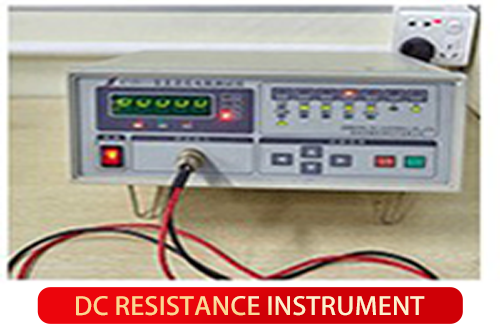
- Specification: <100Ω when actuated at specified force (measured with four-wire Kelvin method)
- Test condition: 50-100mA test current, actuation force at nominal + 50gf
- Stability: <10% variation over 10 consecutive actuations at beginning of life
- End-of-life criterion: <200Ω after rated cycle life testing
Trace Resistance:
- Specification: Design-dependent, typically <100Ω total from button to connector pin
- Calculation: R = ρ × (L/W) where ρ = sheet resistance (Ω/sq), L = trace length, W = trace width
- Example: 50mm trace length, 1mm width, 0.03Ω/sq ink = 50×0.03/1 = 1.5Ω trace resistance
- Tolerance: ±10% from calculated value
Tail Connector Resistance:
- Specification: <20Ω per conductor from circuit trace termination to connector contact point
- ZIF connector crimp: <10Ω contact resistance when mated
- Solder termination: <5Ω joint resistance
Insulation Requirements
Insulation Resistance (Open State):
- Specification: >10 MΩ (10,000,000 Ω) between any two adjacent contacts when not actuated
- Test voltage: 50-100 VDC applied for 60 seconds
- Test method: Megohmmeter per IEC 60512-2-1
- Environmental condition: After 95% RH, 40°C, 96 hours conditioning
- Medical device requirement: >100 MΩ for patient-connected equipment
Dielectric Withstanding Voltage:
- Specification: No breakdown at 500 VAC for 60 seconds between conductors (for general industrial)
- Medical devices: 1000-4000 VAC depending on isolation type (basic, supplemental, reinforced per IEC 60601-1)
- Test method: Hipot test per IEC 60512-2-1
- Leakage current limit: <10 μA at test voltage
Switching Characteristics
Bounce Time:
- Specification: <5 milliseconds typical, <10ms maximum
- Definition: Time from initial contact closure to stable contact (no opens >1μs)
- Test: Oscilloscope measurement with 10kΩ pull-up resistor, 5V supply
- Design mitigation: Electronic debouncing (10-50ms software delay) in control circuit
Switching Speed:
- Make time: <1ms from actuation force applied to contact closure
- Break time: <1ms from force released to contact opening
- Maximum switching frequency: 10-20 Hz practical limit (limited by human actuation speed, not electrical constraints)
Switching Capacity:
| Load Type | Maximum Voltage | Maximum Current | Maximum Power |
|---|---|---|---|
| DC resistive load | 50 VDC | 100 mA | 5 W |
| AC resistive load | 24 VAC | 100 mA | 2.4 VA |
| Logic level (typical) | 5 VDC | 10 mA | 50 mW |
| Recommended operating point | 5-24 VDC | 5-50 mA | 0.25-1 W |
Important Notes:
- Membrane switches are not suitable for switching inductive loads (relays, motors) or lamp loads without suppression
- Use external relay or transistor for loads exceeding these ratings
- Contact life reduces significantly with higher switching currents (arcing degradation)
- For longest life, operate at lowest practical voltage and current
Mechanical Specifications
Mechanical specifications define the physical performance characteristics users directly experience.
Tactile Dome Specifications
Actuation Force Specifications:
| Dome Diameter | Force Range | Tolerance | Snap Ratio | Travel Distance |
|---|---|---|---|---|
| 6mm | 150-250gf | ±20gf | >60% | 0.3-0.4mm |
| 8mm | 180-320gf | ±20gf | >60% | 0.4-0.5mm |
| 10mm | 200-350gf | ±20gf | >60% | 0.5-0.6mm |
| 12mm | 250-450gf | ±20gf | >60% | 0.6-0.7mm |
Life Cycle Specification:
- Standard grade: 5 million actuations minimum at nominal force +25%
- Long-life grade: 10 million actuations minimum
- Premium grade: 20 million actuations minimum
- Test method: Automated actuation tester, cyclic loading at 2-5 Hz frequency
- Pass criteria: Force within ±20% of initial value, snap ratio >50%, no cracks or permanent deformation
- Environmental cycling: Life test after temperature cycling (-40/+85°C, 10 cycles) and humidity aging (85/85, 168 hours)
Dimensional Tolerances
Standard Manufacturing Tolerances:
| Feature | Standard Tolerance | Tight Tolerance (premium) |
|---|---|---|
| Overall panel dimensions | ±0.50mm | ±0.25mm |
| Button center-to-center spacing | ±0.25mm | ±0.15mm |
| Mounting hole location | ±0.25mm | ±0.15mm |
| Mounting hole diameter | +0.15/-0mm | +0.10/-0mm |
| Emboss-to-print registration | ±0.50mm | ±0.30mm |
| Print color-to-color registration | ±0.25mm | ±0.15mm |
| Dome-to-window alignment | ±0.50mm | ±0.30mm |
| Tail connector length | ±1.00mm | ±0.50mm |
Peel Strength Requirements
90° Peel Adhesion Test (ASTM D3330):
- Overlay to circuit bond: ≥1200 g/25mm initial, ≥1000 g/25mm after aging
- Panel mounting adhesive: ≥1500 g/25mm to powder-coated steel, ≥1200 g/25mm to ABS plastic
- Aging conditions: 72 hours @ 23°C/50% RH, or 168 hours 85/85 humidity test
- Pass criterion: Cohesive failure within adhesive (not adhesive-to-substrate interface failure)
Shear Adhesion Test (ASTM D3654):
- Test setup: 1 kg weight suspended from 25mm² bonded area at 70°C
- Specification: ≥10,000 minutes (7 days) without failure for general purpose adhesives
- High-temperature grade: ≥10,000 minutes at 90°C for automotive under-hood applications
Environmental Specifications
Environmental specifications ensure membrane switches function reliably across expected operating conditions and storage environments.
Temperature Specifications:
| Application Category | Operating Range | Storage Range | Test Standard |
|---|---|---|---|
| Consumer indoor | 0°C to +60°C | -20°C to +70°C | IEC 60068-2-1/2 |
| Industrial standard | -20°C to +70°C | -40°C to +85°C | IEC 60068-2-1/2 |
| Industrial extended | -40°C to +85°C | -40°C to +105°C | IEC 60068-2-1/2 |
| Automotive | -40°C to +85°C (interior) | -40°C to +105°C | ISO 16750-4 |
| Military/aerospace | -55°C to +125°C | -62°C to +150°C | MIL-STD-810 Method 501/502 |
Temperature Cycling Test:
- Cycle profile: -40°C (30 min) → +85°C (30 min), 15 min transition ramps
- Number of cycles: 10-100 cycles depending on application severity
- Test per: IEC 60068-2-14 (Test Nb)
- Pass criteria: No delamination, cracking, or electrical failure; <20% actuation force change; dimensional change <0.5mm
Humidity Specifications:
- Operating humidity: 10-95% RH non-condensing (consumer/industrial)
- 85/85 humidity aging: 85°C / 85% RH for 168-1000 hours per IEC 60068-2-78
- Pass criteria: Insulation resistance >10MΩ, contact resistance <150Ω, adhesion >80% initial, no corrosion or visual degradation
- Condensing humidity: 95% RH @ 40°C, 96 hours (IEC 60068-2-30) for harsh environments
IP (Ingress Protection) Rating Specifications:
- IP54: Dust-protected (limited ingress), splash water resistant - consumer indoor applications
- IP65: Dust-tight, water jet resistant (12.5 L/min from 3m) - general industrial, medical
- IP66: Dust-tight, powerful water jet resistant (100 L/min from 3m) - food processing, harsh industrial
- IP67: Dust-tight, immersion up to 1 meter for 30 minutes - marine, outdoor mobile equipment
- IP68: Dust-tight, continuous immersion >1 meter (manufacturer specified depth/duration) - underwater equipment
- IP69K: Dust-tight, high-pressure high-temperature washdown (80°C, 80-100 bar) - food processing, chemical washdown
- Test per: IEC 60529
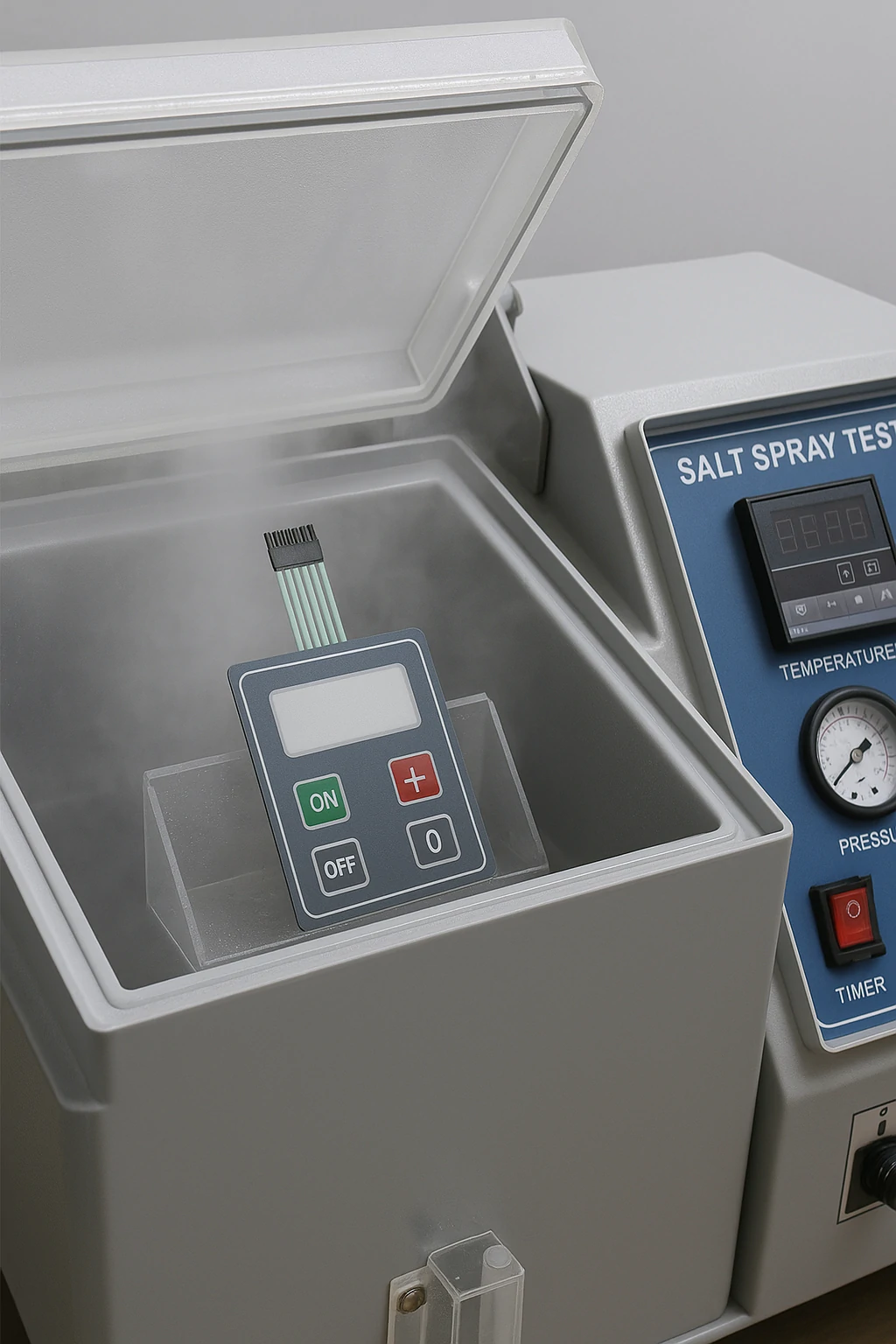
Chemical Resistance Specifications:
- Standard chemicals (24-hour immersion, 23°C): Isopropyl alcohol (IPA), water, mild detergents
- Medical-grade: Hydrogen peroxide (3-10%), quaternary ammonium compounds, bleach (0.5% sodium hypochlorite)
- Industrial: Oils (hydraulic, cutting fluids), coolants, aliphatic hydrocarbons
- Automotive: Gasoline, diesel fuel, brake fluid, antifreeze, sunscreen, hand sanitizer
- Test method: ASTM D543 (immersion test)
- Pass criteria: No visible damage, dimensional change <1%, color shift ΔE <3, resistance change <10%
UV Resistance:
- Test: QUV accelerated weathering, UVA-340 lamps, 0.89 W/m²/nm irradiance at 340nm
- Cycle: 8 hours UV @ 60°C, 4 hours condensation @ 50°C, per ASTM G154
- Duration: 500-5000 hours depending on application (outdoor vs indoor with window exposure)
- Pass criteria: Color shift ΔE <5, gloss retention >70%, no cracking, chalking, or delamination
Optical Specifications
Optical specifications ensure visual quality, readability, and consistent appearance.
Color Specifications:
- Color matching: Pantone color system (PMS) standard
- Color tolerance: ΔE <2.0 from Pantone standard (measured with spectrophotometer, D65 illuminant, 10° observer)
- Batch-to-batch consistency: ΔE <1.5 between production lots
- Color shift after aging: ΔE <3.0 after 1000 hours 85/85 humidity test
- Metamerism: Acceptable color match under D65 daylight, A illuminant (incandescent), and F11 (TL84 fluorescent)
Gloss Specifications:
- Gloss finish: 80-120 gloss units at 60° per ASTM D523
- Semi-gloss: 30-70 gloss units
- Matte (anti-glare): 5-25 gloss units
- Velvet texture: 2-10 gloss units with tactile texture
Haze Specifications (for matte finishes):
- Light matte: 5-20% haze per ASTM D1003
- Medium matte: 20-40% haze
- Heavy matte: 40-70% haze
- Balance: Higher haze reduces glare but decreases graphic sharpness and color saturation
Backlighting Specifications:
- Window transmittance: ≥85% for clear windows, 50-70% for diffused/tinted windows
- Light leakage: <10% of window luminance measured at 5mm from window edge in dark room
- Luminance uniformity: ≥70% (minimum luminance ÷ maximum luminance across window area)
- Viewing angle: >50% luminance at ±45° from normal incidence
- LED specifications: Wavelength (red: 620-630nm, green: 520-530nm, blue: 465-475nm, white: 5000-6500K CCT), forward voltage (red: 2.0-2.2V, green/blue: 3.0-3.4V, white: 3.0-3.6V), forward current 10-30mA
Testing Standards and Methods
Standardized test methods ensure repeatable, objective performance verification.
Key Test Standards by Category:
Dimensional and Physical Tests:
- ASTM D374: Thickness measurement of solid electrical insulation
- ASTM D638: Tensile properties of plastics
- ASTM D882: Tensile properties of thin plastic sheeting
- ASTM D3363: Film hardness by pencil test
- ASTM D1044: Abrasion resistance (Taber abraser)
Adhesive Tests:
- ASTM D3330: Peel adhesion of pressure-sensitive tape
- ASTM D3654: Shear adhesion of pressure-sensitive tape
- ASTM D3359: Measuring adhesion by tape test (cross-hatch)
Electrical Tests:
- IEC 60512-2-1: Electromechanical components for electronic equipment—Contact resistance and insulation resistance tests
- ASTM F390: Sheet resistance of thin metallic films with a collinear four-probe array
- ASTM D149: Dielectric breakdown voltage and dielectric strength
- ASTM D257: DC resistance or conductance of insulating materials
Environmental Tests (IEC 60068 series):
- IEC 60068-2-1: Cold test (Test A)
- IEC 60068-2-2: Dry heat test (Test B)
- IEC 60068-2-14: Change of temperature test (Test N)
- IEC 60068-2-30: Damp heat, cyclic (Test Db)
- IEC 60068-2-78: Damp heat, steady state (Test Cab)
IP Rating Tests:
- IEC 60529: Degrees of protection (IP Code) - dust and water ingress testing
- IP6X: Dust-tight test (20 mbar vacuum, talcum powder, 8 hours)
- IPX7: Immersion 1 meter, 30 minutes
- IPX9K: High-pressure high-temperature spray (80°C, 80-100 bar, 4 angles, 30 seconds each)
Industry-Specific Standards:
- Medical: ISO 10993 (biocompatibility), IEC 60601-1 (medical electrical equipment safety), IEC 60601-1-2 (EMC for medical devices)
- Automotive: ISO 16750 (environmental conditions), USCAR-2 (performance specification), SAE J1455 (human factors)
- Aerospace: MIL-STD-810 (environmental engineering), DO-160 (airborne equipment environmental conditions), ASTM E595 (outgassing)
- Food equipment: NSF/ANSI 169 (special food equipment and devices), 3-A Sanitary Standards
Certification Requirements
Certifications demonstrate compliance with safety, quality, and regulatory requirements for specific markets and applications.
Safety Certifications:
- UL 508: Industrial control equipment (UL recognition mark for membrane switches used in control panels)
- UL 969: Marking and labeling systems (covers membrane switch graphic overlays used as equipment labels)
- CE marking: European conformity - requires compliance with applicable EU directives (Low Voltage, EMC, RoHS)
- CSA certification: Canadian Standards Association - alternative to UL for North American market
Quality System Certifications:
- ISO 9001:2015: Quality management systems - baseline requirement for all manufacturers
- ISO 13485:2016: Medical devices quality management - required for medical device applications
- IATF 16949:2016: Automotive quality management - required for automotive tier suppliers
- AS9100D: Aerospace quality management - required for aerospace and defense applications
Environmental/Materials Compliance:
- RoHS (2011/65/EU): Restriction of Hazardous Substances - limits lead, mercury, cadmium, hexavalent chromium, PBB, PBDE in electrical/electronic equipment
- REACH (EC 1907/2006): Registration, Evaluation, Authorization of Chemicals - EU chemical substances regulation
- California Prop 65: Safe Drinking Water and Toxic Enforcement Act - warning requirements for carcinogens/reproductive toxins
- Conflict minerals: Dodd-Frank Act Section 1502 - reporting on tin, tantalum, tungsten, gold sourcing
Medical Device Regulations:
- FDA 21 CFR Part 820: Quality System Regulation for US medical devices
- MDR 2017/745: Medical Device Regulation for European Union
- ISO 10993 series: Biological evaluation of medical devices (biocompatibility testing)
- IEC 60601-1: Medical electrical equipment safety standard
- 510(k) submission: FDA premarket notification (for Class II medical devices)
Automotive Standards:
- PPAP (Production Part Approval Process): AIAG standard for part approval documentation
- IMDS (International Material Data System): Material composition reporting for automotive supply chain
- FMVSS 302: Federal Motor Vehicle Safety Standard for flammability of interior materials
- VDA standards: German automotive industry association standards (VDA 270 for emissions, etc.)
Performance Validation
Comprehensive validation testing verifies membrane switches meet all specifications under actual use conditions.
Design Validation Testing (DVT) Plan:
Phase 1: Dimensional Verification
- CMM or optical measurement of critical dimensions (±0.25mm tolerance verification)
- Hole location and diameter verification
- Emboss height measurement
- Layer registration verification (dome-to-window, circuit-to-circuit alignment)
- Sample size: 5 units from pilot build
Phase 2: Electrical Characterization
- Contact resistance at beginning-of-life (100% testing, <100Ω spec)
- Insulation resistance (>10MΩ between all contact pairs)
- Actuation force measurement (±20gf tolerance from nominal)
- Bounce time measurement (<5ms typical)
- Sample size: 10 units, all buttons tested
Phase 3: Environmental Qualification
- Temperature cycling: -40/+85°C, 100 cycles, measure electrical before/after
- Humidity aging: 85/85, 1000 hours, measure resistance change
- Thermal shock: -40°C to +85°C with <5 minute transfer time, 10 cycles
- Vibration: per IEC 60068-2-6 or application-specific profile
- Sample size: 10 units per test (destructive testing)
Phase 4: Life Cycle Testing
- Automated actuation to specified cycle count (5M, 10M, or 20M cycles)
- Measure actuation force every 1M cycles, <20% degradation allowed
- Final electrical verification (resistance, insulation)
- Visual inspection for cracking, delamination, dome fatigue
- Sample size: 5-10 units cycled to end-of-life
Phase 5: Application-Specific Testing
- Chemical resistance to application-specific chemicals
- IP rating verification per IEC 60529
- UV aging for outdoor applications (QUV per ASTM G154)
- Sterilization compatibility for medical devices
- Flammability testing (UL 94, FMVSS 302) if required
- Sample size: 3-5 units per test
Acceptance Criteria Summary:
- Zero functional failures allowed in dimensional and electrical phases
- <20% parameter degradation allowed after environmental qualification
- 95% pass rate minimum for life cycle testing (1 failure allowed in 10-unit sample)
- All application-specific tests must pass with zero failures
Frequently Asked Questions
What are the most important specifications to define for a membrane switch?
The six critical specification categories are: (1) Material specifications—overlay substrate type/thickness (polyester vs polycarbonate, 0.175-0.375mm typical), surface treatment (hard coat hardness 4H-6H), and temperature rating; (2) Electrical specifications—contact resistance (<100Ω), insulation resistance (>10MΩ), and switching voltage/current ratings; (3) Tactile specifications—actuation force (180-450gf typical) with ±20gf tolerance, snap ratio >60%, and cycle life (5-20M actuations); (4) Environmental specifications—operating temperature range (-40°C to +85°C standard industrial), IP rating (IP65 minimum for sealed), and humidity tolerance (85/85 test); (5) Dimensional tolerances—overall dimensions (±0.50mm standard), hole locations (±0.25mm), registration tolerances; (6) Compliance requirements—certifications needed (UL, CE, ISO 13485 for medical, IATF 16949 for automotive). These six categories encompass 80% of specification-related issues.
How do I specify the correct actuation force for my application?
Actuation force selection depends on user type and operating conditions: For bare-finger operation by general users, specify 180-250gf (provides positive feedback without excessive fatigue). For professional/industrial bare-finger use, specify 250-300gf (prevents accidental activation in vibration environments). For thin work gloves (latex, nitrile), increase to 300-350gf. For heavy work gloves or chemical-protective gloves, specify 400-450gf or higher. For users with reduced hand strength (elderly, medical patients), specify lower forces 150-200gf. Consider operating environment—add 50-100gf in high-vibration environments to prevent false triggering. User testing with prototype force samples is essential—order tactile domes in 3 force variants (e.g., 200/280/350gf) and test with actual users to determine optimal feel. Remember ±20gf manufacturing tolerance when specifying.
What IP rating should I specify for my application?
IP rating selection depends on exposure level: IP54 for indoor clean environments with only splash protection needed (consumer appliances, office equipment, indoor medical devices). IP65 for general industrial and medical applications requiring dust-tight sealing and water jet resistance (manufacturing equipment, hospital diagnostic devices, most indoor control panels). IP66 for harsh washdown environments with high-pressure cleaning (food processing, pharmaceutical equipment, chemical processing). IP67 for equipment subject to temporary water immersion or continuous outdoor exposure (marine electronics, outdoor mobile equipment, handheld instruments). IP68 for continuous submersion applications (underwater equipment, must specify depth and duration). IP69K for high-pressure high-temperature steam cleaning (food processing with 80°C washdown). Specify minimum required rating—higher IP ratings increase cost without benefit if not needed.
What test standards should membrane switches be tested to?
Essential test standards vary by application: For all applications—IEC 60068-2-1/2 (temperature), IEC 60068-2-14 (temperature cycling), IEC 60512-2-1 (electrical contact resistance), ASTM D3330 (adhesion peel test). For medical devices—ISO 10993 biocompatibility series (cytotoxicity, sensitization, irritation minimum), IEC 60601-1 (electrical safety), IEC 60601-1-2 (EMC), FDA 21 CFR Part 820 compliance. For automotive—ISO 16750-4 (environmental), USCAR-2 (performance), FMVSS 302 or ISO 3795 (flammability), VDA 270 (emissions). For industrial control—UL 508 (industrial control equipment), IEC 60068-2-78 (humidity 85/85 test), IEC 60529 (IP rating verification). For aerospace/defense—MIL-STD-810 Methods 501/502/507/514/516 (environmental), ASTM E595 (outgassing), DO-160 (airborne equipment). Specify test standards in procurement specification to ensure objective verification.
How tight should dimensional tolerances be specified?
Standard manufacturing tolerances (±0.25-0.50mm) are appropriate for most applications and provide best cost-to-performance ratio. Specify ±0.50mm for overall panel dimensions, non-critical features, cosmetic graphics. Use ±0.25mm for button center-to-center spacing, mounting hole locations, functional alignment features. Tighter tolerances (±0.15mm) significantly increase cost (+20-50%) and may require premium manufacturing processes—only specify when truly required for critical interface alignments (display window cutouts, precision mechanical mounting, optical alignments). Looser tolerances (±1.00mm) acceptable for connector tail length, non-critical cutouts. Tolerance stack-up analysis important—if membrane switch mounts to injection-molded plastic housing (±0.30mm typical), specifying ±0.15mm membrane switch tolerance provides no system-level benefit. Match tolerances to mating part tolerances and functional requirements, not arbitrary precision.
What cycle life should I specify for my membrane switch?
Calculate required cycle life based on usage pattern: For consumer appliances (occasional use), 1-3 million cycles sufficient for 10-15 year product life with <10 actuations/day average. For professional/medical equipment (regular daily use), specify 5-10 million cycles supporting 50-100 actuations/day over 10 year lifespan. For industrial control (frequent operator use), specify 10-20 million cycles for 200-500 actuations/day over 10 years. For high-frequency applications (gaming, test equipment), specify 20+ million cycles. Calculation example: Medical device used 50×/day × 365 days × 10 years = 182,500 actuations—specify 5M cycles (27× safety factor accounts for worst-case scenarios). Higher cycle life specifications increase cost (premium domes, thicker overlays)—match specification to actual need. Request life cycle test data from manufacturer showing force degradation curve over rated life.
References
- IEC 60068 Series - Environmental Testing Standards
- ASTM D3330 - Standard Test Method for Peel Adhesion of Pressure-Sensitive Tape
- IEC 60529 - Degrees of Protection Provided by Enclosures (IP Code)
- IEC 60512 - Electromechanical Components for Electronic Equipment
- ISO 10993 - Biological Evaluation of Medical Devices
- UL 508 - Standard for Industrial Control Equipment
- MIL-STD-810 - Environmental Engineering Considerations and Laboratory Tests