
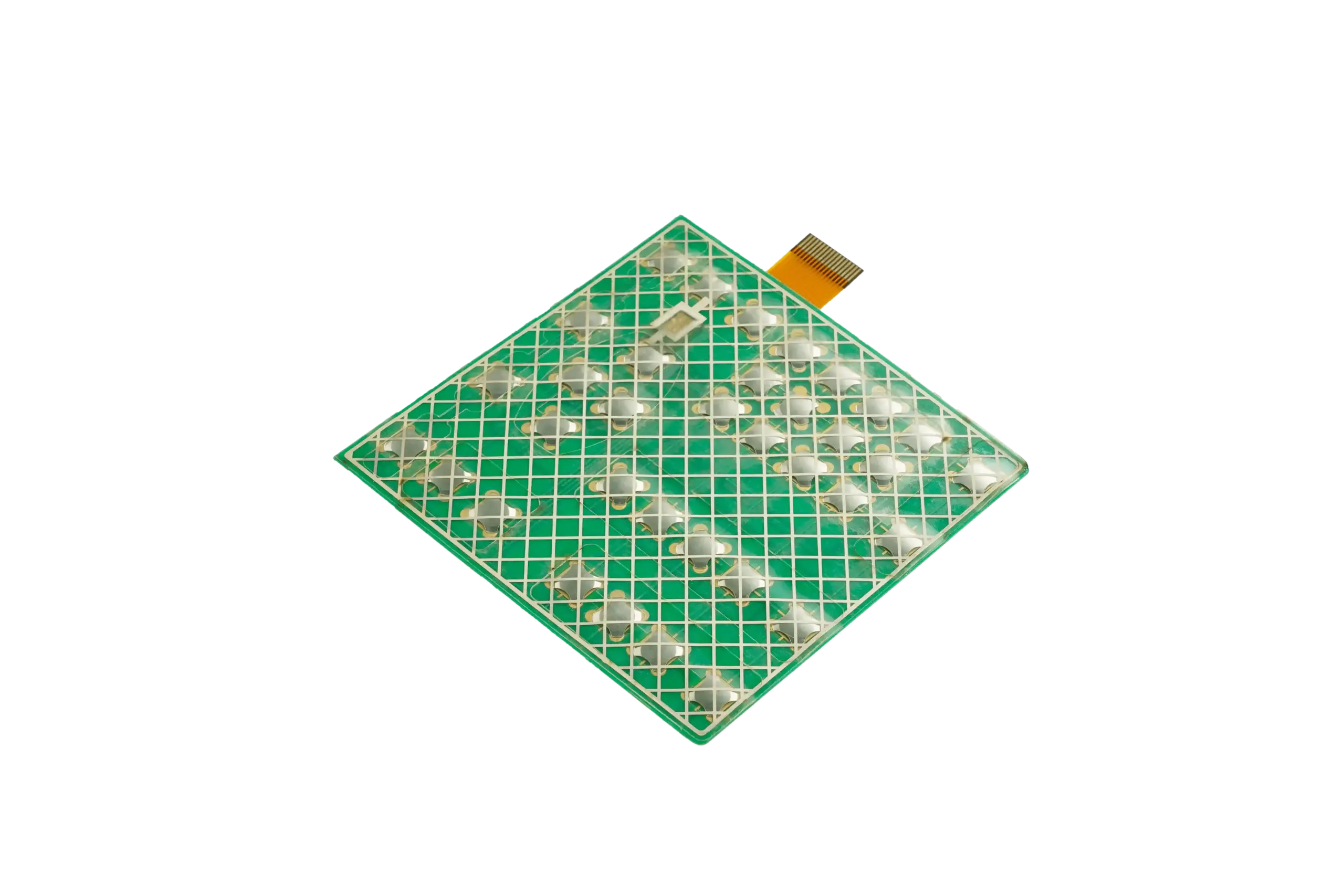
Snap dome · stainless steel · tactile · ±5 gf batch
Interruptores de membrana con domos metalicos y respuesta tactil confiable
Keypads con domos de acero inoxidable donde seis variables numericas deciden como se siente cada tecla bajo el dedo.
JASPER fabrica keypads basados en domo para OEMs cuyo producto no puede enviarse hasta que la fuerza percibida coincida con la muestra de ingenieria — forklift gloves, surgical towers, defibrillator panels, and high-cycle industrial input.
OEMs que integran nuestros switches en sus equipos





Enfoque del metal dome switch
Un nivel mas profundo que la pagina tactil — hasta la eleccion que define la sensacion.
Our tactile membrane switches page treats the keypad as a stack of six independent design choices — domo, forma de tecla, capa de circuito, overlay, nivel de respuesta y grado de proteccion. El domo metalico define la sensacion tactil. Seis variables numericas deciden como registra la tecla ensamblada bajo el dedo, y una disciplina de prueba separa una especificacion estable en produccion de otra que deriva en el segundo lote.
Key shape, circuit materials, overlay graphics, embossing, and backlighting stay on the tactile page; here we stay strictly on the dome — its force, its geometry, and how we hold tolerance from the engineering sample to the ten-thousandth unit.
Respuesta rapida
Que es un metal dome membrane switch?
A metal dome membrane switch is a tactile keypad whose click comes from a 0.05–0.10 mm sheet of AISI 304 stainless steel, formed into a four-leg geometry and seated between the printed silver-ink circuit layer and the polycarbonate overlay. The overlay graphic does not produce the click — the dome does. Six numeric variables (force 100–600 gf, diameter 5.0–20.0 mm, snap ratio 35–60%, overlay thickness 175–500 μm, support gap 0.05–0.30 mm, and contact plating Ni/Ag/Au) decide the feel, and JASPER holds actuation force to ±5 gf across a production batch.
Stainless steel is the click
The stainless steel dome makes the click — not the overlay.
At JASPER Electronics we build dome-based keypads for OEMs whose product cannot ship until the felt force matches the engineering sample within a tight tolerance. Forklift operators in winter gloves. Surgical-tower interfaces under drape. Defibrillator panels that fire on the first deliberate press and ignore every other touch. The audible snap and the firm collapse those operators rely on come from one part: a 0.05–0.10 mm sheet of AISI 304 stainless steel, formed into a four-leg geometry, sitting between the printed silver-ink circuit layer and the polycarbonate overlay.
The overlay graphic does not produce the click. The dome does. We hold actuation force to ±5 gf across a production batch, run continuity on every key per IPC-A-610 acceptability practice, and assemble inside a Class 10,000 / ISO 7 cleanroom per ISO 14644-1. If the engineering sample clicks at 280 gf, the ten-thousandth unit off our line clicks at 280 gf too. That consistency is set by the six dome variables.
| Property | What we hold to |
|---|---|
| Dome material | AISI 304 stainless steel, 0.05–0.10 mm sheet |
| Geometry | Four-leg formed dome |
| Batch force tolerance | ±5 gf across a production batch |
| Continuity / acceptability | Every key checked per IPC-A-610 |
| Assembly environment | Class 10,000 / ISO 7 cleanroom per ISO 14644-1 |
| Cycle endurance | 1,000,000 actuations per key at 50% snap ratio |
Force consistency, continuity acceptance, and cleanroom assembly are the three controls that keep the felt click identical from sample to mass production.
Notas de prueba
Always measure the assembled keypad — not the loose dome
The single most expensive mistake we see on a first-revision OEM spec is testing the loose dome instead of the assembled keypad. The dome supplier’s datasheet reports actuation force on a flat steel block under a calibrated force gauge — no overlay, no spacer, no graphic emboss. That number is 15 to 25 gf lower than what an operator’s finger reads after lamination. Three effects stack up between the loose dome and the assembled key.
Overlay pre-load
A 250 μm PC overlay sitting on top of the dome adds roughly 15 gf; a 500 μm overlay adds closer to 25 gf.
Embossed key tops
A 0.30 mm dome-shape emboss above the key changes how the fingertip loads the dome and can read 20 gf firmer than a flat overlay of the same thickness.
Adhesive compression
The pressure-sensitive adhesive between layers absorbs a small amount of finger pressure before any reaches the dome. That offset is under 5 gf, but it is non-zero.
Our five-sample loop
We build five fully laminated samples to your nominal spec, hand-press and verify each on a force-displacement curve before cutting tooling. The loop usually closes in two iterations and adds about ten working days to the front of the project. See testing and quality for the full first-article protocol, including IEC 60068-2-6 sinusoidal vibration screening.
Where metal dome keypads earn their keep
Gloved industrial input
Forklift and outdoor-equipment panels where a 350–500 gf dome registers cleanly through a heavy or winter glove.
Medical and safety panels
Defibrillator and surgical-tower interfaces that must fire on a deliberate press and ignore incidental touch, with dual-force layouts for confirm versus navigation keys.
High-cycle public controls
Keypads validated to one million actuations per key at a 50% snap ratio, holding the felt click identical across the production batch.
RFQ preparation
Send the five values that lock the felt click before tooling.
Send a target dome force, diameter, snap ratio, overlay thickness, and contact-plating preference and we will build five fully laminated samples for your engineering team to press before any tooling is cut. If your spec sheet only names a force, we fill in the other five variables from our default column and flag what we changed when the samples ship.
- Target dome force (100–600 gf) and per-key zones
- Dome diameter and key row pitch
- Snap ratio target and acoustic preference
- Overlay thickness and emboss style
- Support gap and sealing target (IP65 / IP67)
- Contact plating: nickel, silver, or gold flash
Manufacturing baseline
JASPER assembles dome-based membrane switch builds from design review through production in Dongguan, inside a Class 10,000 / ISO 7 cleanroom per ISO 14644-1.
Every key is checked for continuity per IPC-A-610, sealing options reach IP65 and IP67 per IEC 60529, and panels are screened for IEC 60068-2-6 sinusoidal vibration. RoHS Directive 2011/65/EU material options are available, and we hold actuation force to ±5 gf across the batch — for the broader keypad stack beyond the dome, see our membrane keypads catalog.
Solicitar cotizacionMetal dome membrane switch questions
What’s the difference between a snap-dome and a tactile-dome membrane switch?
Snap-dome and tactile-dome describe the same family of stainless-steel domes — the difference is whether the design optimizes for audible click or felt click. A snap-dome membrane switch uses a taller four-leg geometry with a snap ratio above 50 % and a travel near 0.40 mm, producing a click loud enough to hear across a workshop floor. A tactile-dome membrane switch can use the same dome material at a lower profile (snap ratio closer to 35–45 %, travel near 0.20 mm) to deliver the same finger confirmation without the audible report — the right choice for clinical, library, or open-office contexts. The contact mechanism and the dome material (AISI 304 stainless steel) are identical; only the geometry and the resulting acoustics differ. For applications where neither matters and silence is the spec, see our non-tactile membrane switches page.
How do I choose the right metal dome force for my keypad?
Start with the operator and the environment, not the datasheet. Three questions decide the force. First, what is on the operator’s hand: bare fingertip needs 150–250 gf, thin nitrile glove 200–300 gf, heavy work or winter glove 350–500 gf — the glove adds a damping layer, and a force that feels right bare-handed will not register through a glove at all. Second, how often does the key fire per shift: under 500 presses per day favors a higher force (350 gf+) to prevent accidental actuation, over 5,000 presses per day favors a lower force (150–250 gf) to prevent operator fatigue. Third, what is the safety consequence of a false press: an e-stop on a moving line warrants 400–600 gf so it only fires deliberately, while a volume-up button on a wall panel sits at 150 gf. For gloved-hand input at 2,000 presses per shift with no safety consequence, we typically build the first laminated sample at 280 gf and adjust after your engineer presses it.
Can the dome force be different across keys on the same membrane switch?
Yes. The actuation force is set per dome, not per panel, so we can place a 150 gf dome under a frequently-used Enter key and a 450 gf dome under an adjacent emergency-confirm key in the same laminated keypad. We routinely build dual-force layouts for medical-device panels where the green confirm button must be deliberately pressed and the navigation keys must register at a light touch. The constraint is geometry: each dome footprint requires its own die-cut spacer pocket and its own contact pad pair, so the layout has to be locked at the design stage rather than added in revision. Across a production batch we hold force to ±5 gf per zone — meaning the 150 gf zone stays inside 145–155 gf and the 450 gf zone stays inside 445–455 gf. Send us the per-key force requirement on your CAD file and we will return a sample with the mixed-force layout tested key-by-key.
Continuar la revision de diseno del interruptor de membrana
Tactile membrane switches
The full six-choice tactile stack — key shape, circuit, overlay, feedback level, and sealing around the dome.
Revisar interruptores tactiles ->Non-tactile membrane switches
The silent, flat-face variant for sealed washdown and quiet-room panels where no click is the spec.
Review non-tactile switches →Membrane switches
Volver al hub de interruptores de membrana para comparar estructuras de teclado, circuitos, overlays y opciones de sellado.
Revisar interruptores de membrana ->Membrane switch design
See how we review stack-up, dome selection, adhesives, sealing, and feedback before tooling.
Revisar soporte de diseno ->Get a dome-specified sample built to your brief
Send us a target dome force, diameter, snap ratio, overlay thickness, and contact-plating preference and we will build five fully laminated samples for your engineering team to press before any tooling is cut. If your spec only names a force, we fill in the other five variables from our default column and flag what we changed when the samples ship. Email your CAD file or RFQ and we route it to an applications engineer the same business day.
Iniciar revision RFQNeed the rest of the keypad stack? See our membrane keypads catalog for context beyond the dome.
Compare tactile and non-tactile key feel
Compare si el producto necesita feedback de clic, una superficie sellada mas plana o una estructura mixta de teclas.