

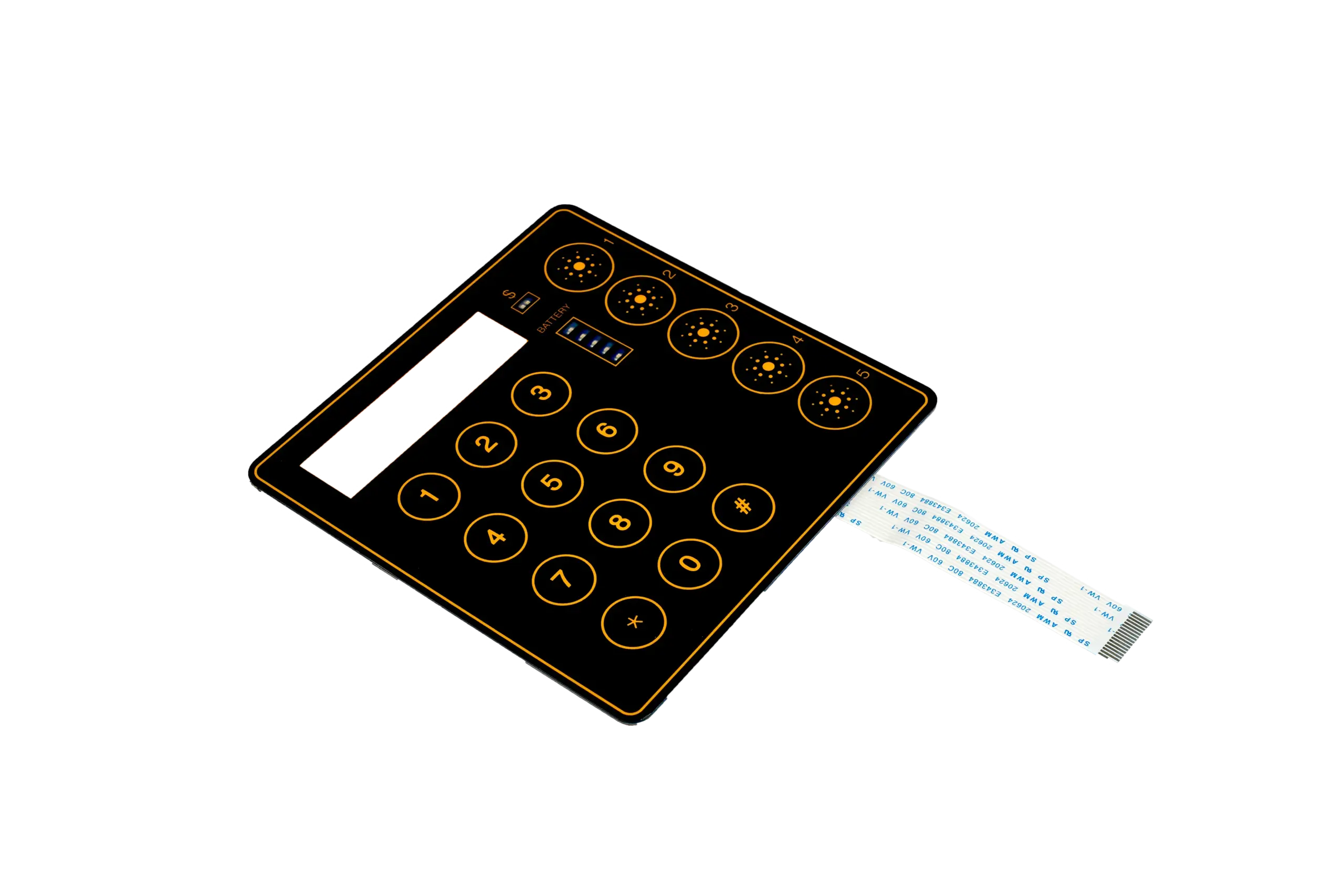
Smooth · sealed · silent · low-profile
Interruptores de membrana no tactiles — Paneles de control lisos y sellados para equipos OEM
Membrane keypads delgados y faciles de limpiar para equipos OEM donde no tener clic es una decision de diseno.
JASPER fabrica non-tactile membrane switches para paneles sellados de lavado, interfaces esteriles, salas silenciosas, HMIs embebidos delgados y equipos publicos de alto ciclo.
OEMs que integran nuestros switches en sus equipos





Por que los compradores eligen sin clic
No tactil no es la opcion de reserva cuando un domo no cabe.
Muchas paginas tratan los non-tactile membrane switches como la opcion que se elige cuando no cabe un domo tactil. Nosotros no lo vemos asi. Across more than two decades — 23 years of OEM control-panel work — a recognizable set of buyers asks us specifically for no click: food-grade equipment that gets hosed off every shift, sterile bedside monitors, instrument fascias that disappear inside thin bezels, and kiosks running through millions of presses.
Para esos proyectos, una cara lisa y sellada es la primera eleccion deliberada, no un compromiso en la respuesta. El reto de diseno es hacer evidentes las zonas de tecla sin un domo tactil bajo el dedo. Where a project genuinely needs a physical click, the tactile membrane switches we also build differ in actuation, lifespan, and panel thickness.
Respuesta rapida
Que es un non-tactile membrane switch?
A non-tactile membrane switch is a flat membrane switch without a metal dome or snap-action layer. Pressing the graphic overlay closes the printed circuit through a spacer, while feedback comes from LED state changes, a buzzer, an on-screen confirmation, or the equipment firmware. OEMs choose this structure for smooth sealed surfaces, silent operation, 0.5–0.9 mm low-profile stacks, and 5–10 million typical actuations.
Smooth, sealed surface
A flat face removes dome edges, click noise, and unnecessary stack height.
A non-tactile membrane switch is the simpler half of the membrane switches family. It has no metal dome, no embossed polyester dome, and no separate snap-action layer. Pressing the overlay brings the upper and lower printed-silver circuits into contact through a die-cut spacer; release, and the natural stiffness of the polyester top layer breaks the contact.
A flat face means no embossment ridge to trap water, sugar syrup, detergent, or cleaning residue. Bonded around the perimeter with 3M 467MP or an equivalent transfer adhesive, a properly mounted non-tactile panel can be specified up to IP65, IP67, or IP69K under IEC 60529 depending on enclosure design.
| Property | Non-tactile typical | Tactile contrast |
|---|---|---|
| Overall stack height | 0.5–0.9 mm | 1.2–2.0 mm |
| Actuation force | 55–285 gf; 10–50 gf capacitive variant | 180–450 gf |
| Key travel | 0.13–0.50 mm | 0.6–1.5 mm |
| Lifespan at similar duty | 5–10 million actuations | About 1–3 million actuations |
| Sealing potential | IP65 / IP67 / IP69K | IP65 / IP67 typical |
Force, travel, and lifespan figures are benchmarked against public Butler Technologies data; sealing scale follows IEC 60529.
Notas de diseno
On a smooth panel, the graphic overlay has to do the work a dome normally does.
The trade we make for a flat, silent face is that the panel gives the operator no felt cue where one key ends and the next begins. Bad graphic-overlay layout on a non-tactile panel will produce dropped inputs and accidental presses no matter how good the underlying membrane switch design is.
We treat printed borders, color blocks, dead-front separation, firmware feedback, and ambient-light contrast as functional design decisions, not decoration.
Four layout rules
How we keep controls obvious on a smooth membrane panel
Without a click, feedback has to move to the eye, ear, screen, or firmware loop. These four rules make a smooth membrane keypad usable in the field.
Visible key boundaries
Each active region gets a printed border, color-block fill, or contrast panel aligned to the key area within ±0.3 mm.
Dead-front separation
Inactive icons and status graphics stay hidden until a backlight LED turns on, reducing false presses on flat surfaces.
Confirmed dwell feedback
LED change, buzzer pulse, or screen confirmation should fire within 50–100 ms; the switching layer closes well under 5 ms.
Environmental contrast
Kitchen lighting, MRI rooms, outdoor equipment, and control rooms need different overlay colors and viewing-angle choices. We review ambient light and operator viewing angle on every membrane keypads project where the keys are non-tactile.
Where non-tactile panels fit best
Food and beverage washdown
Smooth overlays avoid raised key edges that trap liquid, detergent, or sugar residue during daily cleaning.
Medical and cleanroom equipment
Sealed PET or PC surfaces support repeated wipe-down routines where loose fibers and edge contamination matter.
Public and high-cycle controls
Kiosks, vending, ticketing, and parking systems benefit from long actuation life without metal dome fatigue.
RFQ preparation
Send the layout details that decide whether no-click works.
Send your panel drawing, sketch, or sample. We review materials, layer stack, sealing target, active-key boundaries, feedback channel, and lead time before tooling.
- Panel dimensions and enclosure depth budget
- Key map, active regions, and printed boundary style
- Target sealing level: IP65, IP67, or IP69K
- Feedback method: LED, buzzer, screen, or firmware state
- Cleaning chemistry: IPA, quat-ammonium, peracetic acid, or detergent
- Expected cycle count and operating environment
Manufacturing baseline
JASPER supports OEM membrane switch builds from design review through production in Dongguan.
RoHS, REACH, and UL-rated material options are available on request, including UL94 V-0 PC/PET overlay options where the project requires them. Typical PET/PC overlay material ranges can support −40 °C to +85 °C depending on the confirmed film, adhesive, and circuit stack, with ISO-certified process control across a 5,000 m² factory and 2,500 m² cleanroom production area.
Solicitar cotizacionNon-tactile membrane switch questions
When does a non-tactile membrane switch make sense over a tactile one?
Choose non-tactile when the front face must stay sealed and survive daily washdown, when audible silence matters, when the enclosure cannot accept a 1.5–2.0 mm tactile stack, or when the keypad will see more than five million actuations over its service life. If a project sits between patterns, such as a slim sealed analyzer that still needs operator confirmation, a hybrid layout can combine tactile and non-tactile keys.
How does a non-tactile membrane switch give the user feedback?
Feedback shifts off the finger and onto vision and sound. Common channels include a discrete LED per key, a status LED, a backlit graphic that changes color or wakes a dead-front icon, an integrated piezo or electromagnetic buzzer, or on-screen confirmation. The printed-silver switching layer closes well under 5 ms, so perceived response is set by the firmware loop rather than the keypad. Reliability is not the trade-off it sometimes looks like: at 5–10 million typical actuations, a non-tactile life matches or exceeds a metal-dome tactile design under similar duty.
Can I mix tactile and non-tactile keys on the same membrane panel?
Yes. JASPER builds hybrid panels where critical or safety-relevant keys such as start, stop, emergency-stop, mode select, or glove-operated keys get embossed metal-dome tactile response while the rest of the keypad stays smooth. The two zones share the same printed circuit film and graphic overlay, so the cost increase comes from the metal-dome layer and selective embossing rather than a completely separate assembly. For the tactile half of a hybrid panel, see our tactile membrane switches page; for the broader design trade-off, our tactile vs non-tactile guide walks through it in more detail.
Continuar la revision de diseno del interruptor de membrana
Tactile membrane switches
Compare snap-dome feedback, force ranges, and hybrid layouts for keys that need a physical click.
Revisar interruptores tactiles ->Membrane switches
Volver al hub de interruptores de membrana para comparar estructuras de teclado, circuitos, overlays y opciones de sellado.
Revisar interruptores de membrana ->Membrane keypads
Plan keypad layouts, connectors, graphic overlay materials, and OEM control interface details.
Revisar teclados de membrana ->Membrane switch design
See how we review stack-up, adhesives, tail routing, sealing, and feedback before tooling.
Revisar soporte de diseno ->Get a non-tactile panel quoted by our engineers
Send your panel drawing, sketch, or sample. We come back within one business day with materials, layer stack, sealing rating, feedback channel, and lead time — using the same RoHS, REACH, and UL-rated material options that supply our ISO-certified production. After more than twenty years of OEM work, most of our quotes ship with a note on what to change before tooling rather than a clean “yes” — which is what saves cost downstream.
Iniciar revision RFQNot ready to quote? See how we approach membrane switch design for OEM projects.