
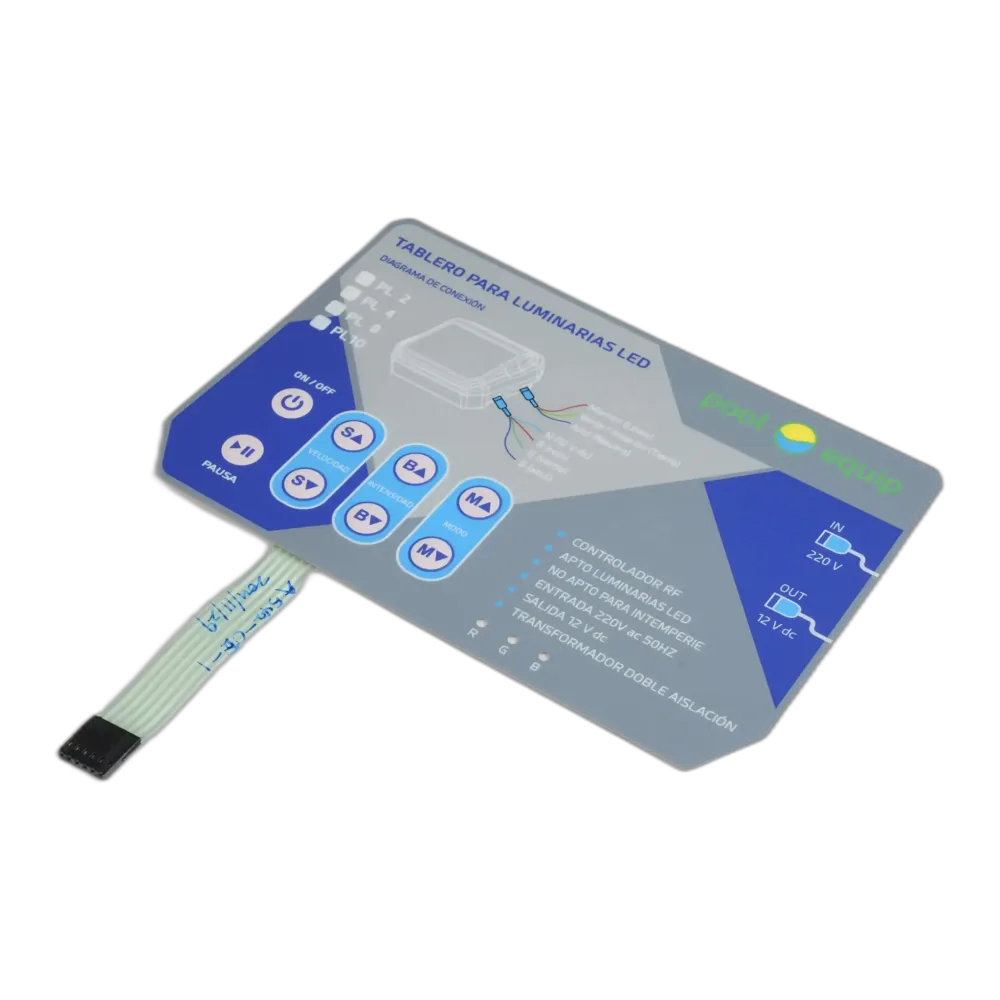
Sealed · IP67 · IP68 · IP69K · field-proven
Waterproof Membrane Switches and Sealed Control Interfaces
Sealed control panels engineered as one system — overlay, edges, tail exit, adhesives, housing, and verified testing.
We build waterproof membrane switches for marine helms, outdoor handhelds, medical wash-down equipment, industrial pendant stations, food-grade panels, and field-service tools.
OEMs that ship with our switches inside





Waterproofing is a system, not a material
Waterproofing a membrane switch is a system — not a material, not a single IP rating, and not a layer you bolt on at the end.
Six places on the assembly carry water-ingress risk: the front surface, the edge laminate, the tail-exit opening, the pressure-sensitive adhesive, the housing interface, and the test protocol that proves the seal. Fix five and miss one — almost always the tail exit — and the switch will pass IP67 on a bench and fail it in the field. At JASPER Electronics we engineer all six in the same drawing pack and verify the result against IEC 60529, NEMA 250, and, when the application calls for it, MIL-STD-810H Method 506.6.
What keeps those switches alive after twelve months in salt spray or 80 °C hot-water steam is not the polyester — it is how the six pieces fit together. Our engineering team works from your STEP and 2D PDF housing files, returns a marked-up drawing within 24 hours, ships a first-article sample in 7–14 working days, and supplies a test report referencing the exact standard your buyer needs. PPAP submissions are available on request for IATF 16949-regulated programmes. For deeper background on the underlying physics, see our waterproof membrane switch design guidance.
Quick Answer
What makes a membrane switch waterproof?
A membrane switch reaches IP67 only when six things are engineered together: a hard-coated PET overlay, a heat-laminated edge bond, a potted or heat-staked tail exit, an acrylic PSA rated for immersion, a compressible gasket against the housing, and a verified test against IEC 60529 sub-clause 14.2.7 — 1 m of fresh water for 30 minutes. A bare PET-on-PCB stack with no engineered seal is typically only IP54. Miss any one of the six and the rating will not hold once the part leaves the bench.
The six waterproof design factors
Water finds the weakest of six interfaces. We answer six engineering questions before we draw the part.
A waterproof membrane switch is a laminated stack — overlay, adhesive, circuit, spacer, rear adhesive — clamped into a housing. Each of the six factors below closes one ingress path.
1. Seal the front surface
The front layer is a hard-coated PET overlay — typically Autotex F200 or an equivalent abrasion-resistant grade — screen-printed on the second surface so ink and graphics sit under the seal. Embossed keys must not crack the hard coat, so we limit emboss height to 0.6 mm on 0.18 mm PET and run a 100-cycle flex pre-screen. For IP69K wash-down service we add a 1.0–1.5 mm bezel overhang in the housing drawing, deflecting an 80–100 bar steam jet away from the overlay edge.
2. Seal the edges
The overlay-to-circuit edge is heat-laminated through an acrylic PSA tier rated for continuous water exposure. We trim the overlay flush within 0.2 mm of the circuit footprint so no PSA shoulder is exposed to wicking. For IP68 continuous-immersion duty such as buoy-mounted sensors and submerged dock controllers, we recess the switch 0.3 mm into the housing and lay a silicone bead in the bezel groove as a second line of defence.
3. Seal the tail exit
The flex-circuit tail leaving the laminate is where most waterproof membrane switches fail in the field. Capillary action pulls moisture down the tail and into the housing. We seal it in two stages: a heat-staked PET collar molded around the tail at the overlay edge, then a cured-epoxy potting bead at the housing exit slot, with tail width matched to the slot within ±0.1 mm. For service-replaceable assemblies we offer a silicone-grommet exit rated to IP67. This is the factor we will not let a customer skip.
4. Choose the adhesives
We standardise on 3M 467MP and 3M 468MP acrylic transfer adhesives for the internal layers — 0.05 mm and 0.13 mm thick respectively, peel strength ≥18 N / 25 mm on stainless, service range −40 °C to +90 °C. For high-load housing bonds where the switch is the gasket, we specify 3M VHB 4910 or 5952. We size the footprint to leave a 1.5 mm exposed border so the laminate does not see squeeze-out at the edge. See our materials and adhesives reference for the full PSA-by-application chart.
5. Mate with the housing
The seal between the membrane assembly and the bezel is a compressible gasket — Poron microcellular urethane for general-purpose IP65 to IP67 mounting, or 60-Shore-A silicone for IP68 and IP69K. We design the gasket to compress 25–40% in the finished assembly, keeping the seal active even after housing screws relax over a year of thermal cycling. The bezel mating surface must be flat within 0.1 mm per 100 mm of run. When EMI shielding is in the brief, we co-locate a conductive elastomer gasket in the same groove without compromising water resistance.
6. Test the seal
We test against the standard the customer’s certifying body will recognise. IEC 60529 IPX7 drops a sealed unit into 1 m of fresh water for 30 minutes; IPX8 extends to continuous immersion at an agreed depth and duration (typical marine spec is 1.5 m for 24 hours). IP69K, defined by ISO 20653, runs four 80 °C, 80–100 bar steam jets at 30 seconds per position. North American buyers also recognise NEMA 250 Type 4 and Type 4X. For blue-water marine and rugged handhelds we add MIL-STD-810H Method 506.6 rain-test and IEC 60068-2-31 drop-test sequences. Every shipment includes the relevant test report.
The sealed stack
Five laminated layers, clamped into the housing, with every interface engineered against water.
A waterproof membrane switch is the sealed member of the membrane switches family. The overlay carries the seal, the printed circuit carries the contacts, and the adhesives, spacer, and gasket hold the ingress paths closed. Most projects also benefit from reviewing our membrane switch panels overview to see how the sealed stack integrates with the wider control-panel assembly.
Where chemistry compatibility is a question — solvents, fuel, surgical disinfectants — we run a 7-day immersion test on a coupon before we cut the production tool.
Verification standards
How we prove the seal before a part ships
A waterproof claim is only as good as the test behind it. We run the protocol the customer’s certifying body recognises and ship the report with every order.
IPX7 immersion
IEC 60529 sub-clause 14.2.7 — a sealed unit submerged in 1 m of fresh water for 30 minutes, the baseline for IP67 spill and splash duty.
IPX8 continuous
Continuous immersion at a depth and duration agreed with the customer; typical marine spec is 1.5 m for 24 hours for sub-deck and buoy hardware.
IP69K steam-jet
Per ISO 20653 — four 80 °C, 80–100 bar steam jets at 30 seconds per position, used for food-grade and dairy wash-down panels.
NEMA 250 & MIL-STD
NEMA 250 Type 4 / 4X cross-reference for North American buyers, plus MIL-STD-810H Method 506.6 rain test and IEC 60068-2-31 drop test for rugged units.
Application examples and recommended IP ratings
We ship waterproof membrane switches into seven recurring environments. The right IP level depends on what is hitting the surface — rain, hose, sustained immersion, or pressurised steam.
| Industry / Use | Typical product context | Recommended IP rating |
|---|---|---|
| Marine | Helm controls, deck panels, bilge-pump interfaces | IP67 above deck, IP68 sub-deck; MIL-STD-810H 506.6 for blue-water — see our marine applications page |
| Outdoor / Field | Handheld GPS, traffic-sign controllers, weather stations, EV-charger fronts | IP65–IP67 with UV-stable hard-coat overlay — see marine and outdoor applications |
| Medical | Infusion-pump fronts, dental-chair controls, dialysis-machine interfaces | IP67 for spill resistance; IP68 when sterilised by immersion — see medical device applications |
| Industrial control | Forklift consoles, conveyor HMIs, sealed pendant stations | IP65–IP67; NEMA 4 cross-reference for North America — see industrial control applications |
| Wash-down | Food-grade equipment, dairy, pharma cleanroom panels | IP69K per ISO 20653; stainless or anodised-aluminium bezel |
| Appliance | Kitchen ovens, washing machines, water-heater fronts | IP54–IP65; gasketed bezel mount sufficient — see home appliance applications |
| Handheld portable | Ruggedised radios, marine remotes, asset trackers | IP67 plus IEC 60068-2-31 drop-tested |
Tell us which row matches your housing and duty cycle and we will lock the IP target before we cut the first sample.
RFQ preparation
Send the four things that let us lock your IP target before tooling.
Upload your housing drawing and tell us the duty cycle, the IP target, and any LED or tactile-dome callouts. We review materials, layer stack, sealing target, tail-exit seal, and lead time before we cut the first sample.
- Housing drawing — STEP plus 2D PDF
- Duty cycle: rain, hose-down, immersion, or wash-down
- IP target: IP65, IP67, IP68, or IP69K
- Certifying standard: IEC 60529, NEMA 4X, ISO 20653, or MIL-STD-810H
- LED backlighting, tactile-dome, or connector callouts
- Chemistry exposure: solvents, fuel, or surgical disinfectants
Manufacturing baseline
JASPER supports OEM waterproof membrane switch builds from design review through production in Dongguan.
We return a marked-up drawing within 24 hours, a material BOM listing overlay, PSA, gasket, and tail seal by part number, a first-article sample in 7–14 working days, and a test report citing the exact standard. Production lead time after sample sign-off is typically 4–6 weeks for tooling plus 2–3 weeks per order. PPAP submissions are available on request for IATF 16949-regulated programmes, with ISO-certified process control across a 5,000 m² factory and 2,500 m² cleanroom production area.
Request a QuoteWaterproof membrane switch questions
Is every membrane switch waterproof? What makes one IP67?
No. A standard PET-on-PCB membrane stack with no engineered seal is typically rated IP54 — it resists splashes and dust, nothing more. A switch reaches IP67 only when six things are engineered together: a hard-coated PET overlay, a heat-laminated edge bond, a potted or heat-staked tail exit, an acrylic PSA rated for immersion, a compressible gasket against the housing, and a verified test against IEC 60529 sub-clause 14.2.7 — 1 m of fresh water for 30 minutes. Miss one of the six and the IP rating will not hold once the part leaves the bench. Our IP rating guide walks through each step in more detail.
How do I order a waterproof membrane switch for outdoor use?
Send us four things. First, the housing drawing in STEP plus a 2D PDF. Second, the duty cycle — rain, hose-down, sustained immersion, or wash-down with detergent. Third, the IP target and the certifying standard the end-customer needs (IEC 60529, NEMA 4X, ISO 20653, or MIL-STD-810H Method 506.6). Fourth, any LED backlighting, tactile-dome, or connector callouts. We return a marked-up drawing, a material BOM listing the overlay, PSA, gasket and tail seal by part number, a sample in 7–14 working days, and a test report citing the exact standard. Production lead time after sample sign-off is typically 4–6 weeks for tooling plus 2–3 weeks per order.
Can a waterproof membrane switch include LED backlighting and tactile keys?
Yes — neither LEDs nor tactile metal domes break the IP seal when they are integrated inside the laminate. SMD LEDs are reflow-soldered onto the flex circuit below the sealed top layer, so the light source sits behind the same overlay that carries the seal. Embossed polydomes or stainless-steel snap domes are placed under the overlay before lamination, which keeps the top surface continuous and crack-free. One design rule controls the trade-off: the combined dome height and light-guide thickness must stay inside the gasket compression envelope, typically 1.5 mm or less, so the bezel still closes uniformly on the housing gasket and the seal load stays in spec.
Continue the membrane switch design review
Review gasket, tail exit, adhesive, enclosure, and IP target details in the PDF:
waterproof-design-checklistMembrane switches
Return to the membrane switch family hub to compare keypad structures, circuits, overlays, and sealing choices.
Review membrane switches →Membrane switch panels
See how the sealed waterproof stack integrates with the wider OEM control-panel assembly.
Review membrane switch panels →Materials and adhesives
The full PSA-by-application chart, peel strengths, and temperature ranges behind the waterproof stack.
Review materials →Membrane switch design
See how we review stack-up, adhesives, tail routing, sealing, and testing before tooling.
Review design support →Get a waterproof membrane switch quote in 24 hours
Upload your STEP file, your 2D PDF housing drawing, and the IP target you need. We return a marked-up drawing, a material BOM, a sample plan, and a test report citing the exact standard your buyer recognises — IEC 60529, ISO 20653, NEMA 250, or MIL-STD-810H Method 506.6. The tail exit is the factor we will not let a customer skip, which is what keeps the seal alive in the field.
Designing your first sealed control panel? Download our Waterproof Membrane Switch Design Checklist (PDF). It covers the six factors above, the IP test matrix, and the drawing pack we ask for at quote stage.
Designing your first sealed control panel? See how we approach membrane switch design for OEM waterproof projects.
Use these resource pages before quotation
Review capacitive touch, waterproof sealing, RFQ inputs, and downloads before locking artwork, connector, enclosure, or sample requirements.