

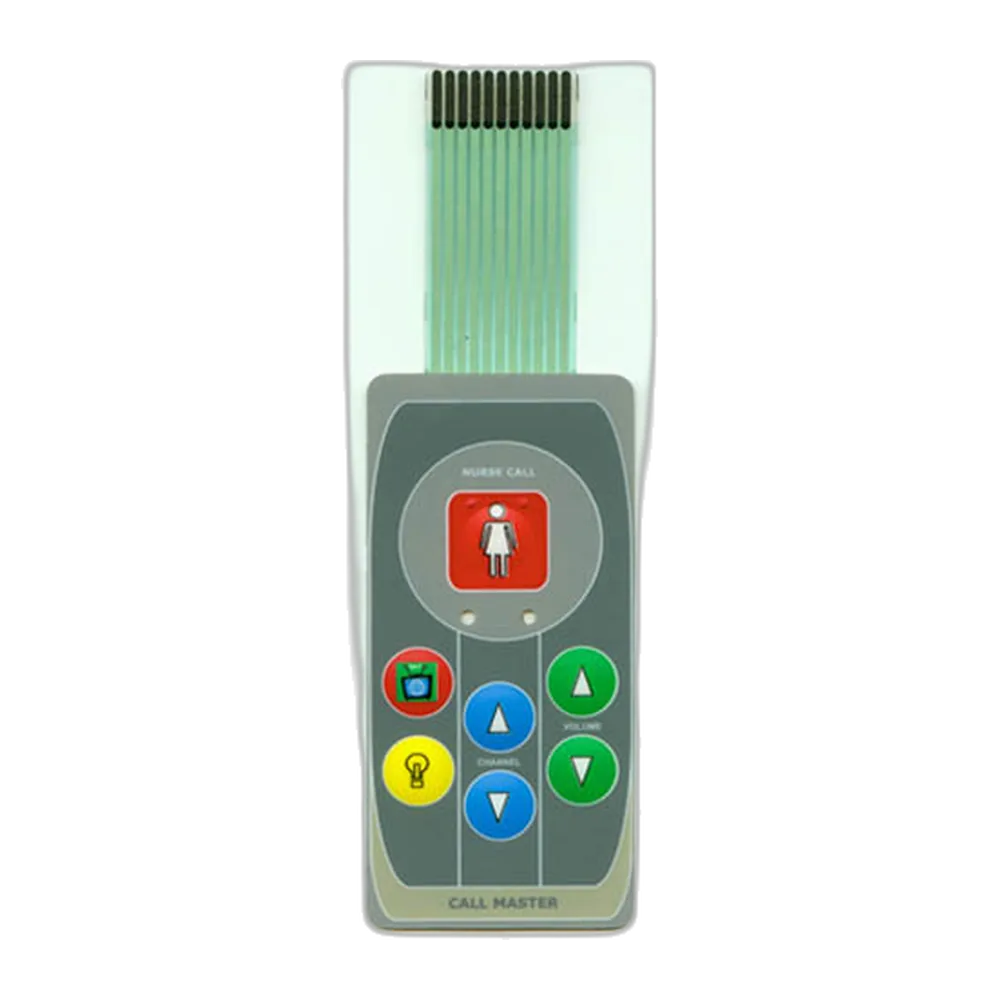
Metal dome tactile feedback
Tactile Membrane Switches with Metal Dome Feedback
Custom tactile membrane switches built around dome force, travel, cleanroom placement, and batch-to-batch click consistency.
A tactile membrane switch gets its click feedback from a stainless-steel metal dome between two printed circuit layers. Force, travel, and click loudness come from the dome geometry — not the overlay graphic.
OEMs that use JASPER interface assemblies








Quick answer: a tactile membrane switch gets its click feedback from a stainless-steel metal dome. When the overlay is pressed, the dome collapses past its buckling point, sends a snap through the keypad, and closes the contact below. The dome geometry sets force, travel, and click loudness.
Built for eyes-off operation
For operators who need to feel that the press registered
Forklift drivers wearing gloves, surgical-tower technicians, factory operators tracking a moving line, and field-test crews cannot always look at a display to confirm input. We build tactile membrane switches so the key press itself sends a consistent confirmation pulse through the operator’s fingertip.
Cleanroom dome placement and 100% continuity testing
JASPER places 304-stainless-steel domes inside a Class 10,000 / ISO 7 cleanroom under ISO 14644-1, laminates the PET and polycarbonate stack, seals the edge, and tests continuity on every key of every unit before shipment under IPC-A-610 acceptability practice.
Layer stack
The dome is only one part of the tactile system
The click you feel after lamination depends on the metal dome, overlay pre-load, emboss height, spacer adhesive, circuit support, and mounting flatness. That is why we validate the fully assembled keypad instead of relying only on a loose-dome datasheet.
Dome material for repeatable buckling and snap-back.
Class 10,000 / ISO 7 cleanroom dome placement.
IP65 / IP67 gasket sealing when specified.
Sinusoidal vibration testing on application request.
Readable tactile stack
Each layer changes the force the operator feels after lamination.
Design considerations
Where tactile specs slip before tooling
The actuation force measured on a loose dome is not the force the operator feels after the keypad is laminated, mounted, and used with the final overlay.
Loose vs assembled force
Loose-dome readings typically run 15–25 gf higher than assembled keypad force because overlay pre-load, spacer adhesive, and emboss geometry shift the dome before the operator presses it.
Emboss depth changes snap
A 0.3 mm emboss over a 250 gf dome can feel firmer than a flat overlay over a 350 gf dome. We set emboss height during design review.
Mounting flatness matters
A keypad bonded to a panel that bows by 0.5 mm across a 200 mm span will read different forces in the center and corners.
Spec-to-sample loop
Validate the assembled feel before production tooling
You send a target such as 250 gf actuation, 0.4 mm travel, and audible click. We build five fully laminated samples before cutting tooling, your team measures and presses, and we adjust dome geometry if the felt force is high or low.
- 01Send dome force, travel, key layout, overlay material, and protection rating.
- 02JASPER reviews the stack, emboss, circuit, tail pitch, and sealing plan.
- 03We build five laminated samples to the target spec.
- 04Your team presses and measures the assembled keypad.
- 05The loop usually closes in two iterations and about ten working days.
Typical uses
Applications where operators need tactile confirmation
Forklifts and off-highway vehicles
Gloved operators need confirmation without looking away from the road, load, or work area.
Medical equipment
Surgical-tower and diagnostic-device controls need repeatable snap with sealed, wipe-clean overlays.
Factory automation
Line operators press keys while watching a moving process instead of a display confirmation.
CNC and industrial controllers
IP-rated tactile keys resist dust, vibration, and repeat actuation in shop-floor environments.
Mobile diagnostic equipment
Field instruments need compact sealed interfaces with dependable key feel.
Packaging and mining machinery
IP65/IP67 variants handle washdown, dust, and vibration better than exposed PCB tactile switches.
Sample request
Get a sample built to your spec
Send your target dome force, travel, key layout, overlay material, and protection rating. We will route the RFQ to a JASPER engineer the same business day.
What to send
- Target actuation force and travel distance
- Key shape, key diameter, and emboss preference
- Overlay material and surface texture
- Tail pitch, termination, and routing direction
- IP65 / IP67 or EMI shielding requirement
Related product context
- metal dome membrane switches for dome variants
- non-tactile membrane switches for silent flat circuits
- membrane switch design support for stack review
- membrane keypads across the broader product family
FAQ
Frequently Asked Questions
What is the difference between a tactile and non-tactile membrane switch?
A tactile membrane switch contains a metal dome that physically collapses when pressed and snaps back when released. A non-tactile membrane switch is a flat printed circuit with no dome; the operator relies on a beep, LED, or screen update.
Can the dome force be customized on a tactile membrane keypad?
Yes. Leg count, dome height, and stainless-steel thickness set actuation force. Standard catalog domes include 150 gf, 250 gf, and 350 gf; custom 100–600 gf forces are available in 25 gf increments with an MOQ of 5,000 units per value.
Is a tactile membrane switch suitable for industrial vibration environments?
Yes. The 304-stainless-steel dome plus laminated PET stack resists vibration-induced false actuation. On request, we test assembled keypads to IEC 60068-2-6 and build IP65/IP67 variants per IEC 60529.
Send your target force, travel, key layout, overlay material, and sealing requirement for tactile sample review.
Request a Tactile Switch SampleCompare tactile and non-tactile key feel
Compare click feedback, a flatter sealed surface, or a mixed key structure fits the product.