
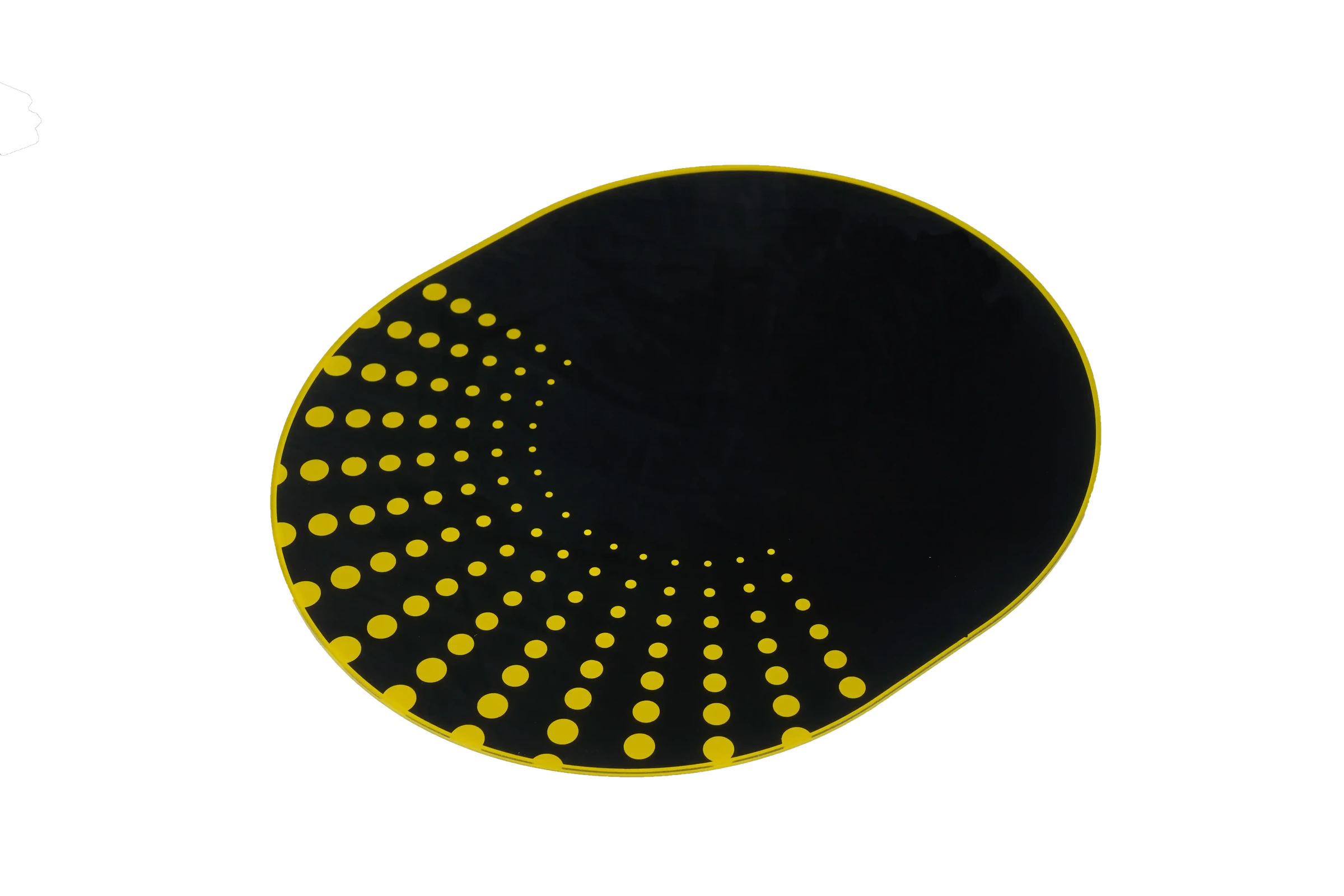
Paneles acrilicos / PMMA · faceplates impresos · lentes de cubierta
Paneles acrilicos PMMA y placas para equipos OEM
Paneles frontales rigidos de PMMA, impresos, cortados, recubiertos y con adhesivo posterior, para la cara visible de equipos OEM.
JASPER fabrica paneles frontales acrilicos personalizados, tambien llamados paneles PMMA o faceplates, para productos OEM. Cuando una pieza necesita un frente impreso duro pero el vidrio seria mas pesado o costoso de lo necesario, el acrilico suele ganar la especificacion.
OEMs que integran nuestras piezas de interfaz




Superficie frontal plastica rigida
Que es realmente un panel acrilico OEM, y que no es.
Empiece con la pieza sobre la mesa: una lamina de PMMA grado optico, mecanizada e impresa como interfaz terminada. One piece can carry the brand logo, the model and serial marking, printed legends, a clear or tinted display window, dead-front icons, capacitive touch graphics, and the adhesive that holds it to the enclosure. That is a long way from the engraved desk plate most people picture when they hear “acrylic nameplate.”
Lo que lo convierte en panel y no en etiqueta es el sustrato. There is no printed film or metal foil involved. The face is solid acrylic, and the graphics almost always print on the second surface, so a fingertip meets acrylic instead of ink.
Set it next to a placa de vidrio and the trade is hardness for practicality. Polymethyl methacrylate weighs less, takes an impact better, and machines on CNC or laser gear that glass would fight. It also tools for less money. The one place glass wins is scratch resistance, so any acrylic panel that gets touched or wiped daily gets an anti-scratch hard coat to close that gap.
The line between acrylic and a PET or PC custom graphic overlay is rigidity. A film overlay flexes with the panel and can laminate straight onto a membrane switch stack. Acrylic stays flat and hard — exactly what a window, a cover lens, or a solid-feeling faceplate needs.
Respuesta rapida
What is an acrylic panel?
An acrylic panel — also called a PMMA front panel or acrylic faceplate — is a rigid plastic front part for OEM equipment. It can act as a printed nameplate, a clear cover lens, a display window, a dead-front indicator panel, or simply the visible face of a product. Most are optical-grade PMMA: printed on the second surface by silk screen or UV, cut on CNC or laser, finished with an anti-scratch coat, and backed with 3M adhesive. Engineers reach for acrylic when glass would be heavier, slower to shape, or more expensive than the design needs. Common industry references are 0.5–10 mm thickness, ±0.03 mm dimensional accuracy, and ASTM 5B cross-cut adhesion on the printed and coated stack.
Acrylic options
Seven decisions settle the tooling on a custom PMMA acrylic front panel.
Before we quote, we walk a project through the same checklist. Half the value is catching the cases where the part is really a placa de vidrio, a PET/PC graphic overlay, or a metal plate wearing an acrylic label.
| Requirement | Typical options | Design note |
|---|---|---|
| Acrylic material | Optical-grade cast or extruded PMMA; clear, colored, tinted, or opal/diffusing | Optical-grade acrylic gives high transparency and good light transmission for windows and LED diffusion. |
| Thickness | 0.5–10 mm typical; ~1 mm common for thin window panels (industry reference) | Thicker acrylic feels rigid and premium; thinner panels suit flush windows and lightweight covers. |
| Printing method | Second-surface silk-screen printing, digital UV printing, epoxy/polyester ink, dead-front masks | Second-surface printing protects the graphics behind the acrylic. Pantone/PMS color matching available. |
| Cutting and forming | CNC cutting, laser cutting, routing, drilling, cutouts, beveled (2.5D) edges, radius corners | Acrylic is easier and cheaper to cut and form than glass, which helps complex shapes and windows. |
| Display windows | Clear, tinted, smoked, opal/diffusing, anti-glare, dead-front, backlit icons | The window must match the LCD, OLED, segment LED, indicator LED, or capacitive touch sensor behind it. |
| Surface finishing | Gloss, matte, anti-glare (AG), anti-reflective (AR), anti-fingerprint (AF), anti-scratch hard coat, electroplated mirror | Acrylic is softer than glass, so an anti-scratch hard coat is common where the panel is touched or cleaned often. |
| Adhesive mounting | 3M 467MP, 3M 468MP, 3M 300LSE, 3M 9088 / 9088FL; full or selective adhesive | Adhesive choice depends on the enclosure material, panel size, temperature cycling, and cleaning chemistry. |
| Protection and QC | PE protective film; ±0.03 mm accuracy, >100 alcohol wipes, ASTM 5B adhesion (industry references) | These numbers are common industry references; JASPER confirms practical limits per project rather than as fixed guarantees. |
Material route comparison
Acrylic, glass, PET/PC film, metal, and doming labels each earn their place differently.
Any of them can end up on the front of a machine. Picking the wrong one shows up later as a scratch, a crack, a delamination, or a part that costs twice what it should.
Acrylic panel
A light, rigid PMMA face that cuts, lasers, and forms cheaply, with clear or colored windows and an optional hard coat.
Placa de vidrio
Reach for a placa de vidrio when the front has to survive heavy scratching, feel genuinely premium, or carry a high-end display window.
PET / PC overlay
Use overlays graficos personalizados for flexible printed film, low-profile adhesive overlays, and membrane switch top layers.
Metal or doming label
Placas metalicas are rugged ID plates; etiquetas doming are raised glossy badges, not display covers.
Revisiones de diseno
Tell us what the front has to do, not just what it should say.
Artwork alone rarely settles a quote. We look at panel size, the windows, how the backlight behaves, the cut features, edge and surface finish, how much area the adhesive gets, the cleaning routine, and where the part has to pass inspection.
- Panel size, thickness target, and enclosure depth
- Display windows, LED indicators, dead-front icons, and touch zones
- Clear, tinted, opal/diffusing, or dead-front window requirement
- CNC or laser cut profile, holes, slots, beveled (2.5D) edges, radius corners
- Pantone / PMS colors, opacity, masks, and the printed stack
- Surface finish: gloss, matte, AG, AR, AF, anti-scratch hard coat, mirror
- Mounting surface: aluminum, powder coat, ABS, PC, painted steel
- Cleaning chemistry, UV exposure, temperature swing, humidity
- RoHS, REACH, UL, medical, automotive, or IP target
Que enviar
An Adobe Illustrator file, a press-ready PDF, an EPS, a DXF for cut features, or a CAD/STEP drawing all work. Vector icons and separate cut and window layers cut review time the most.
If glass, metal, or a PET/PC overlay turns out to be the better front for your part, we will say so before any tooling is cut.
Solicitar cotizacionAcrylic panel questions
Un panel acrilico es lo mismo que una placa de vidrio?
No. Both can be clear or printed, but they behave differently on a product. Acrylic (PMMA) is lighter, takes a knock better, and cuts or forms more easily — usually for less money — which makes it a good fit for clear covers, lightweight panels, and lit or diffuser windows. Glass is harder, heavier, and far more scratch resistant, so it earns the premium display windows and high-end faces. Because acrylic is the softer of the two, an anti-scratch hard coat goes on anything that gets handled or cleaned a lot. Treat them as two routes, not as drop-in substitutes.
Can an acrylic panel include display windows, dead-front icons, or touch zones?
Yes. A single acrylic panel can carry clear, tinted, or opal windows, dead-front printed icons, backlit indicators, capacitive touch graphics, and LED diffusion. The trick is tuning print opacity, transmission, backlight brightness, and the window edge together. If an icon has to vanish when off, we build the dead-front layer around the light source behind it; if a display has to stay readable in sunlight, we look at anti-glare, AR, or tinted-window options.
What files and details are needed for a custom acrylic panel quote?
Send the artwork, the part drawing, the window or display layout, the target thickness, the mounting surface, the edge and cut features, and the working environment. A STEP file or enclosure drawing helps, and so do Pantone colors, LED or display specs, the surface-finish requirement, the cleaning chemistry, the temperature range, and the annual quantity. We will confirm whether acrylic, glass, metal, or a PET/PC overlay is the right front-surface route before recommending tooling.
Continuar la revision del material de superficie frontal
Graphic overlays
Volver al hub de overlays graficos para comparar cada opcion de superficie frontal impresa.
Revisar overlays graficos ->Placa de vidrio
See where rigid screen-printed glass beats acrylic on scratch resistance and feel.
Review placas de vidrio →Personalizado graphic overlays
Compare acrylic with flexible PET/PC printed film overlays built from your artwork.
Revisar overlays personalizados ->Graphic overlay materials
Weigh PET, PC, acrylic, glass, adhesive, coating, and environmental trade-offs in one place.
Revisar materiales ->Get an acrylic panel reviewed before tooling
Send the artwork, the panel drawing, the display-window locations, the backlight notes, the surface-finish requirement, and the mounting surface. We will go through the print stack, the acrylic-versus-glass call, the cutting and edge finishing, the surface coating, and the adhesive, and tell you whether the part should stay acrylic or move to a custom graphic overlay.
Iniciar revision RFQStill weighing materials? Start with our graphic overlay materials reference.