

Table of Contents
- Introduction
- Automotive Industry Standards and Requirements
- Environmental Durability Requirements
- Interior Cabin Applications
- Exterior and Under-Hood Applications
- Safety-Critical System Integration
- Automotive-Grade Material Specifications
- Testing and Validation Protocols
- Special Design Considerations
- Manufacturing and Quality Requirements
- Future Trends and Innovations
- Frequently Asked Questions
- Conclusion
Quick Answer: Automotive membrane switches must meet rigorous standards including temperature resistance from -40°C to +85°C (interior) or +125°C (under-hood), UV stability for 10+ years, resistance to automotive fluids, and compliance with USCAR-2, ISO 16750, and IATF 16949 requirements. These switches provide reliable operation for 1-3 million cycles in applications ranging from climate controls and infotainment systems to engine diagnostics, requiring specialized materials, extensive validation testing, and zero-defect quality systems.
The automotive industry demands exceptional reliability, durability, and performance from every component, with membrane switches facing particularly challenging requirements in vehicle environments. After 15 years at JASPER developing membrane switches for major automotive OEMs and Tier 1 suppliers, I've witnessed the evolution of automotive interface technology and the stringent standards that ensure passenger safety and satisfaction. This comprehensive guide explores the unique requirements, applications, and considerations for membrane switches in automotive environments.
Automotive Industry Standards and Requirements
Automotive membrane switches must comply with numerous industry standards ensuring reliability and safety throughout vehicle lifetime.

USCAR-2 Performance Specifications
USCAR-2 establishes baseline performance requirements for automotive electrical components including membrane switches. Temperature classifications range from Class 1 (-40°C to +85°C) for passenger compartments to Class 4 (-40°C to +125°C) for under-hood applications. Mechanical durability requires 100,000 to 1 million actuations depending on application criticality. Electrical specifications mandate contact resistance below 100 milliohms with maximum change of 50 milliohms over lifetime. Environmental sealing must achieve IP54 minimum, with IP67 for exposed applications.
ISO 16750 Environmental Testing
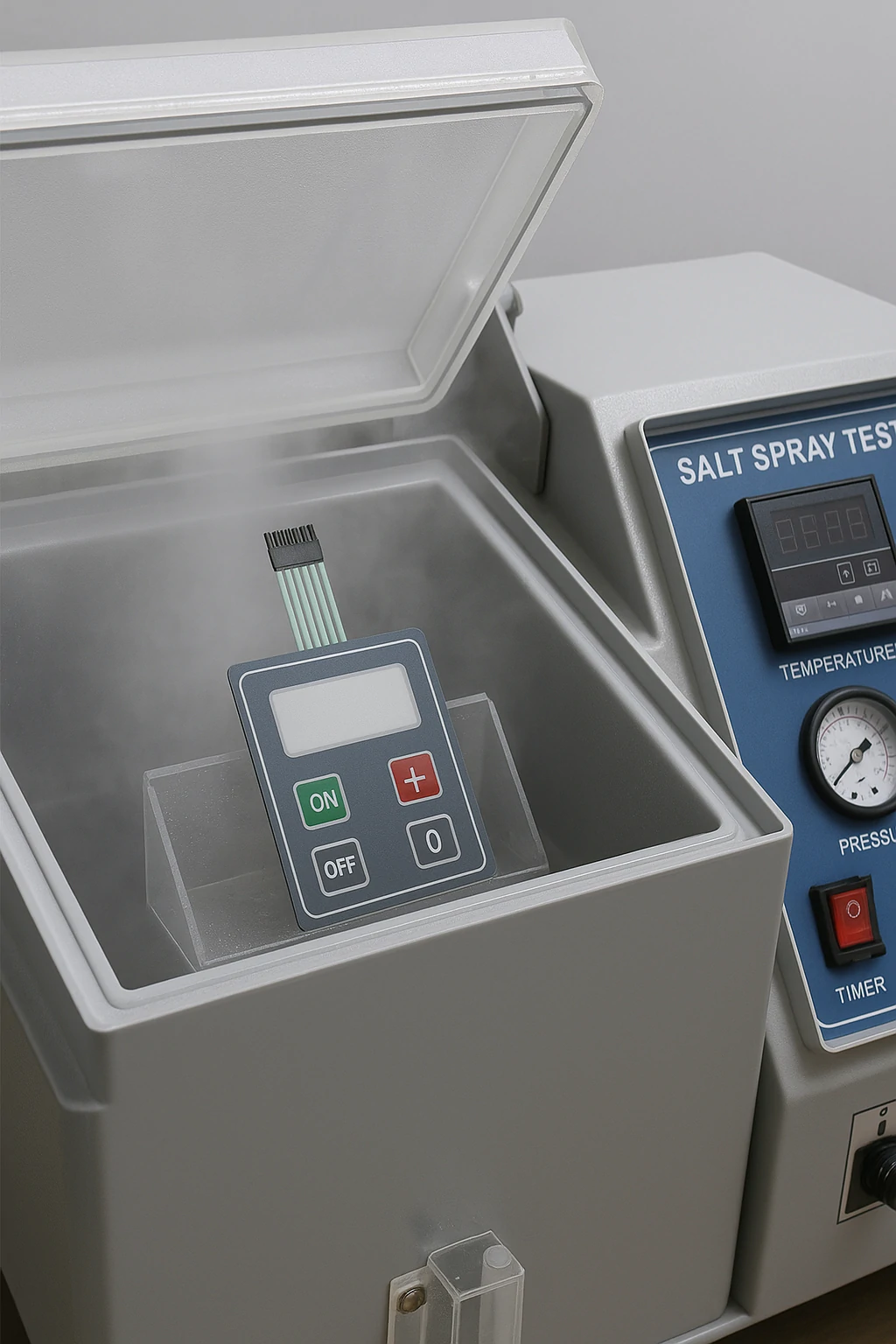
ISO 16750 defines environmental test conditions simulating real-world automotive exposures. Thermal cycling requires 1000 cycles between temperature extremes with 1-hour dwells. Humidity testing at 93% RH and 38°C for 21 days validates moisture resistance. Salt spray exposure for 96 hours ensures corrosion resistance in road salt environments. Chemical resistance testing includes exposure to fuels, oils, cleaners, and automotive fluids. Vibration testing covers 10-2000 Hz frequency ranges with acceleration levels specific to mounting locations.
IATF 16949 Quality Management
IATF 16949 certification demonstrates automotive quality system compliance beyond standard ISO 9001. Advanced Product Quality Planning (APQP) ensures systematic development from concept through production. Production Part Approval Process (PPAP) validates manufacturing capability before volume production. Statistical Process Control (SPC) maintains Cpk values exceeding 1.67 for critical characteristics. Zero-defect initiatives target less than 10 PPM field failure rates. Traceability systems enable rapid response to quality concerns throughout 15+ year vehicle lifecycles.
Environmental Durability Requirements
Automotive environments subject membrane switches to extreme conditions requiring robust design and materials.
Temperature Extremes
Interior cabin switches experience -40°C during winter cold soaks to +85°C under summer sun exposure. Dashboard-mounted switches endure surface temperatures exceeding 105°C from solar loading. Under-hood applications face continuous +125°C with peaks to +150°C near engine components. Thermal shock testing validates performance through rapid transitions between extremes. Materials must maintain dimensional stability within ±0.5% across temperature ranges preventing delamination or warping.
UV and Light Exposure
Automotive switches require 10+ year UV stability under continuous solar exposure. Florida and Arizona outdoor testing validates real-world performance over 2-year exposures. Xenon arc testing accelerates UV aging achieving 2500 kJ/m² total exposure. Color fastness specifications limit fading to ΔE<3 maintaining appearance throughout vehicle life. Materials incorporate UV stabilizers and absorbers preventing polymer degradation and embrittlement. Window integration requires special consideration for concentrated solar exposure through glass.
Mechanical Durability
Vibration resistance covers broadband random vibration simulating road inputs and engine harmonics. Shock testing to 50G validates survival of pothole impacts and door slams. Flexural endurance ensures survival of repeated cable movement in moving applications. Abrasion resistance testing simulates years of finger actuation and cleaning cycles. Impact testing validates resistance to dropped objects and vandalism in commercial vehicles.
Interior Cabin Applications
Interior automotive applications represent the largest segment for membrane switch implementation.

Climate Control Systems
HVAC control panels utilize membrane switches for temperature adjustment, fan speed, and air distribution. Backlit graphics ensure visibility during night driving without causing distraction. Integrated displays show temperature settings and system status through transparent windows. Tactile feedback through metal domes provides positive activation confirmation while driving. Sealed construction prevents dust and liquid ingress maintaining long-term reliability. Typical specifications require 500,000 actuations with maintained tactile response.
Infotainment Controls
Audio system controls integrate membrane switches for volume, tuning, and source selection. Steering wheel controls use flexible membrane switches conforming to curved surfaces. Proximity sensing capabilities enable gesture control reducing driver distraction. Haptic feedback systems provide tactile confirmation without mechanical switches. Multi-function controls adapt based on system mode optimizing interface simplicity. Integration with capacitive touch surfaces creates hybrid interfaces balancing cost and functionality.
Instrument Cluster Integration
Dashboard warning lights utilize membrane switches with selective LED backlighting. Trip computer controls provide menu navigation and setting adjustments. Cruise control interfaces require high-reliability switches for safety-critical functions. Illumination matching ensures consistent appearance with other cabin lighting. Anti-glare surfaces reduce reflections maintaining visibility in bright sunlight. Customizable graphics support multiple vehicle trim levels using common switch assemblies.
Exterior and Under-Hood Applications
Exterior automotive applications demand exceptional environmental resistance from membrane switches.
Door Entry Systems
Keyless entry keypads withstand direct weather exposure including rain, ice, and UV. Sealed construction achieving IP67 prevents water ingress during pressure washing. Freeze-thaw cycling resistance ensures operation after ice accumulation and melting. Vandal-resistant overlays using thick polycarbonate survive deliberate abuse attempts. Backlit numerals provide visibility in darkness while maintaining security. Typical specifications require 1 million actuations over 10-year service life.
Cargo and Utility Controls
Pickup truck bed controls operate hydraulic lifts, lighting, and auxiliary equipment. Trailer brake controllers integrate membrane switches for gain and manual activation. Work truck auxiliary controls manage PTO systems, warning lights, and equipment. Marine-grade materials resist salt spray and humidity in coastal environments. High-contrast graphics ensure visibility in bright sunlight and poor weather. Glove-compatible designs enable operation with work gloves in commercial applications.
Engine Compartment Diagnostics
Under-hood diagnostic panels provide technician interfaces for system testing. High-temperature materials withstand continuous +125°C ambient temperatures. Chemical resistance includes engine oils, coolants, brake fluids, and degreasers. Sealed construction prevents contamination from dirt, grease, and moisture. Clear labeling using permanent graphics survives years of engine bay conditions. Connector sealing maintains reliability despite thermal cycling and vibration.
Safety-Critical System Integration
Safety-related automotive applications impose stringent reliability requirements on membrane switches.
Airbag System Controls
Passenger airbag deactivation switches require fail-safe design preventing inadvertent operation. Dual-circuit designs provide redundancy detecting switch failures or contact welding. Status indication through integrated LEDs confirms system state for passenger safety. Child seat detection interfaces coordinate with weight sensors for deployment decisions. Compliance with FMVSS regulations ensures proper operation in crash scenarios. Quality requirements target zero defects with 100% functional testing.
Emergency Systems
Hazard warning switches must operate reliably after years of non-use in emergencies. Emergency call (eCall) systems activate automatically or manually during accidents. Brake override systems require immediate response without false activation risk. Fire suppression controls in buses provide critical safety functions for passengers. Design validation includes accelerated aging predicting 15+ year reliability. Failure Mode Effects Analysis (FMEA) identifies and mitigates potential failure mechanisms.
Driver Assistance Interfaces
Lane departure warning controls enable driver preference settings for alerts. Adaptive cruise control interfaces manage following distance and speed settings. Parking assistance switches activate sensors and provide mode selection. Blind spot monitoring controls integrate with mirror-mounted indicators. Night vision system controls require intuitive operation without driver distraction. Integration with vehicle CAN bus enables system coordination and diagnostics.
Automotive-Grade Material Specifications
Material selection critically impacts membrane switch performance in automotive environments.
Substrate Materials
Automotive-grade polyester withstands -40°C to +105°C maintaining flexibility and dimensional stability. Polycarbonate substrates provide enhanced impact resistance for exposed applications. Textured surfaces reduce fingerprints and glare while maintaining graphic clarity. UV-stabilized formulations prevent yellowing over 10+ year exposures. Flame-retardant materials meeting FMVSS 302 ensure passenger safety. Thickness ranges from 0.005" to 0.020" balancing flexibility with durability.
Adhesive Systems
Automotive-approved pressure-sensitive adhesives maintain bonding across temperature extremes. Acrylic adhesives provide long-term stability resisting plasticizer migration from substrates. High-temperature adhesives withstand continuous +125°C for engine compartment applications. Low-temperature adhesives maintain flexibility at -40°C preventing cracking or delamination. VHB tapes provide structural bonding eliminating mechanical fasteners in some applications. Differential adhesion enables clean removal for service without residue.
Conductive Materials
Silver-filled inks maintain conductivity through thermal cycling and mechanical flexing. Carbon inks provide cost-effective solutions for non-critical circuit paths. Dielectric inks insulate crossover points preventing short circuits from contamination. Conductive adhesives eliminate soldering for component attachment in flexible circuits. Shielding layers using conductive coatings meet automotive EMC requirements. Migration-resistant formulations prevent silver dendrite growth in humid conditions.
Testing and Validation Protocols
Comprehensive testing validates membrane switch performance throughout automotive service life.
Environmental Test Sequences
Combined environmental testing simultaneously applies temperature, humidity, and vibration stresses. Power temperature cycling operates switches at voltage while cycling temperatures. Thermal shock testing transitions between -40°C and +125°C within 30 seconds. Humidity freeze testing evaluates ice formation effects on switch operation. Dust exposure per ISO 20653 validates sealing effectiveness against particle ingress. Condensation testing simulates moisture formation during temperature transitions.
Mechanical Endurance Testing
Actuator life testing performs 1-3 million cycles monitoring contact resistance changes. Random vibration testing covers 5-2000 Hz at acceleration levels per mounting location. Mechanical shock testing applies 50-100G pulses simulating severe road impacts. Cable flex testing validates survival through millions of movement cycles. Peel strength testing ensures adhesive bonds survive thermal and mechanical stresses. Cross-hatch adhesion testing validates graphic overlay bonding throughout service life.
Electrical Validation
Contact resistance monitoring throughout environmental testing detects degradation. Insulation resistance testing at 500VDC validates electrical isolation integrity. ESD testing to ±25kV validates immunity to static discharge events. EMC testing ensures switches neither emit nor suffer from electromagnetic interference. Voltage load testing confirms operation across 9-16V automotive power ranges. Current carrying capacity validation ensures traces handle specified loads without overheating.
Special Design Considerations
Automotive applications require unique design approaches addressing specific vehicle requirements.
Backlighting Integration
LED backlighting provides illumination matching vehicle interior lighting color and intensity. Light guides distribute illumination evenly across large switch panels. Dead-front graphics appear invisible until illuminated maintaining clean appearance. Selective backlighting highlights active functions while dimming unused controls. PWM dimming control interfaces with vehicle ambient lighting systems. Color temperature matching ensures consistent appearance across different light sources.
Acoustic Considerations
Switch activation noise must remain below cabin noise targets avoiding distraction. Tactile domes selection balances feedback force with acoustic signature. Dampening layers reduce noise transmission through mounting structures. Adhesive selection prevents squeaks and rattles from differential thermal expansion. Venting design equalizes pressure preventing membrane "oil-canning" noise. Validation includes subjective evaluation in actual vehicle environments.
Styling and Appearance
Surface textures match adjacent interior trim materials for integrated appearance. Color matching to interior specifications maintains consistent cabin aesthetics. Graphic design follows automotive HMI guidelines for intuitive operation. Font selection ensures readability while conveying premium quality perception. Surface treatments including soft-touch coatings enhance perceived value. Customization capabilities support multiple trim levels using common tooling.
Manufacturing and Quality Requirements
Automotive membrane switch production demands stringent quality control and documentation.
Production Process Control
Statistical Process Control monitors critical parameters maintaining capability indices above 1.67. In-process inspection at defined intervals prevents defect accumulation through production. Clean room manufacturing minimizes contamination affecting appearance and reliability. Automated optical inspection systems detect defects human inspectors might miss. Traceability systems track materials and processes throughout production for recalls. First article inspection validates new production runs before volume manufacturing.
Supply Chain Management
PPAP documentation demonstrates manufacturing capability for automotive customers. Capacity planning ensures ability to meet volume requirements including surge demands. Contingency planning addresses potential disruptions maintaining supply continuity. Sub-tier supplier management extends quality requirements throughout supply chain. Change control procedures ensure customer notification before any modifications. Annual audits verify continued compliance with automotive quality standards.
Zero-Defect Initiatives
100% functional testing validates every switch before shipment to customers. Burn-in testing catches early failures before products reach vehicle assembly. Containment protocols prevent defective products from reaching subsequent operations. Root cause analysis drives systematic elimination of defect sources. Continuous improvement projects target year-over-year quality improvements. Warranty tracking provides feedback enabling proactive quality enhancements.
Future Trends and Innovations
Emerging technologies and market trends shape future automotive membrane switch development.
Smart Surface Integration
Printed electronics enable intelligent surfaces with integrated sensing and processing. Transparent conductive materials create invisible controls on glass and plastic surfaces. Shape-changing polymers provide dynamic tactile feedback adapting to user preferences. Integration with voice and gesture control creates multimodal interfaces. Personalization capabilities adapt interfaces to individual driver preferences. Connected car features enable over-the-air updates modifying switch functions.
Sustainable Materials
Bio-based polymers reduce environmental impact while meeting performance requirements. Recycled materials incorporation supports circular economy initiatives. Halogen-free formulations eliminate problematic end-of-life disposal issues. Reduced material usage through optimized design minimizes resource consumption. Life cycle assessment guides material selection considering total environmental impact. Biodegradable options develop for non-critical applications reducing landfill burden.
Autonomous Vehicle Interfaces
Mode selection switches enable transitions between autonomous and manual driving. Override controls provide immediate manual intervention when necessary. Status indication interfaces communicate vehicle automation state to occupants. Passenger entertainment controls replace traditional driving interfaces. Emergency stop mechanisms ensure passenger ability to halt autonomous operation. Simplified interfaces reduce complexity as driving tasks become automated.
Frequently Asked Questions
What temperature range must automotive membrane switches withstand?
How many actuations should automotive membrane switches survive?
What automotive standards apply to membrane switches?
Can membrane switches meet automotive EMC requirements?
What makes a membrane switch "automotive-grade"?
How do membrane switches integrate with vehicle electronic systems?
Conclusion
Automotive membrane switches represent one of the most demanding applications for flexible interface technology, requiring exceptional reliability under extreme environmental conditions while meeting stringent quality standards. Success in this market demands comprehensive understanding of automotive requirements, materials, testing protocols, and manufacturing systems.
Critical Success Factors
Meeting automotive specifications requires specialized materials and validated designs surviving 10-15 year service life. Rigorous testing throughout development validates performance under worst-case conditions. Quality systems achieving near-zero defect rates ensure customer satisfaction and safety. Supply chain management maintaining consistent delivery supports just-in-time production. Continuous improvement drives cost reduction while enhancing quality and reliability.
Market Evolution
Electric vehicles create new opportunities with unique interface requirements and reduced under-hood temperatures. Autonomous vehicles shift focus from driver controls to passenger experience interfaces. Shared mobility trends demand increased durability for higher utilization rates. Connected car capabilities enable new functions through software-defined interfaces. Sustainability requirements drive material innovations and design optimization.
Partnership Approach
Early supplier involvement during vehicle development optimizes interface design and integration. Collaborative engineering leverages membrane switch expertise solving complex interface challenges. Long-term partnerships provide stability supporting continuous improvement initiatives. Global support capabilities ensure consistent quality across manufacturing locations. Investment in automotive-specific capabilities demonstrates commitment to market requirements. Success requires viewing suppliers as partners in delivering exceptional vehicle experiences.
References
- USCAR-2 Performance Specification for Automotive Electrical Connector Systems
- ISO 16750 Series - Road Vehicles Environmental Conditions and Testing
- IATF 16949:2016 - Automotive Quality Management System Standard
- SAE J1455 - Recommended Environmental Practices for Electronic Equipment
- AEC-Q200 - Stress Test Qualification for Passive Components
- FMVSS 302 - Flammability of Interior Materials
- JASPER Automotive Application Guide (2024)