

Table of Contents
Quick Answer: Polyester (PET) and polycarbonate (PC) are the two primary graphic overlay materials for membrane switches, each with distinct advantages. Polyester costs 30-40% less, offers excellent printability and dimensional stability, and suits most indoor/commercial applications. Polycarbonate provides superior chemical resistance (especially to alcohols and harsh cleaners), impact resistance 20x greater than polyester, better temperature performance (-40°C to +125°C vs -40°C to +80°C), and is preferred for medical devices, outdoor equipment, and harsh industrial environments. Material selection directly impacts product lifespan, user experience, and total cost of ownership.
Material selection for membrane switch graphic overlays is one of the most consequential design decisions you'll make. After 15 years at JASPER manufacturing switches for applications from medical ventilators to outdoor kiosks, I've seen how the wrong material choice leads to premature failures, costly recalls, and dissatisfied customers.
This guide provides comprehensive technical comparison between polyester and polycarbonate, helping you select the optimal material based on your specific environmental exposure, performance requirements, and budget constraints. Understanding these differences prevents expensive redesigns and ensures your product performs reliably throughout its intended service life.
Material Overview: PET vs PC
Polyester (PET - Polyethylene Terephthalate)
Polyester film is a thermoplastic polymer known for excellent dimensional stability, clarity, and printability. It's the most widely used membrane switch overlay material, accounting for approximately 65% of commercial membrane switch production.
Key Characteristics:
- Excellent dimensional stability (minimal shrinkage or expansion)
- Superior printability with screen printing inks
- High tensile strength and tear resistance
- Good electrical insulation properties
- Available in matte, gloss, or textured finishes
- Standard thicknesses: 0.125mm (5 mil), 0.175mm (7 mil), 0.250mm (10 mil)
Typical Applications: Consumer electronics, appliances, remote controls, control panels, indoor equipment
Polycarbonate (PC)
Polycarbonate is an engineered thermoplastic known for exceptional impact resistance, chemical resistance, and temperature tolerance. It's specified for demanding applications requiring enhanced durability.
Key Characteristics:
- Outstanding impact resistance (20x stronger than polyester)
- Excellent chemical resistance to alcohols, cleaners, oils
- Wide temperature operating range (-40°C to +125°C)
- Superior outdoor weathering and UV resistance
- Low moisture absorption (0.1-0.2% vs 0.6% for polyester)
- Standard thicknesses: 0.175mm (7 mil), 0.250mm (10 mil), 0.375mm (15 mil)
Typical Applications: Medical devices, outdoor equipment, marine controls, industrial panels, automotive dashboards
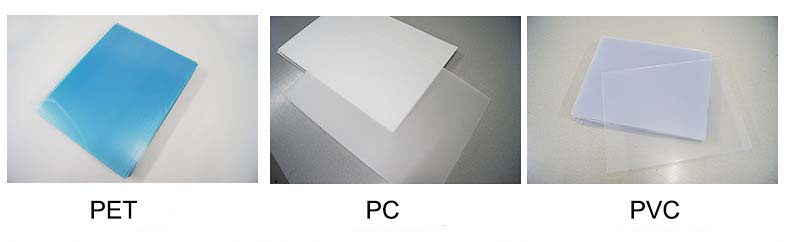
Performance Comparison
Here's a comprehensive technical comparison across critical performance parameters:
| Property | Polyester (PET) | Polycarbonate (PC) | Winner |
|---|---|---|---|
| Tensile Strength | 165 MPa | 60-70 MPa | PET |
| Impact Resistance (Izod) | 25 J/m | 600-850 J/m | PC |
| Operating Temp Range | -40°C to +80°C | -40°C to +125°C | PC |
| Water Absorption (24hr) | 0.6% | 0.1-0.2% | PC |
| Dimensional Stability | Excellent (minimal shrink) | Good (slight expansion) | PET |
| Chemical Resistance | Good (sensitive to strong bases) | Excellent (broad chemical resistance) | PC |
| UV Resistance | Moderate (yellowing over time) | Good (UV-stabilized grades) | PC |
| Printability | Excellent ink adhesion | Good (may require primers) | PET |
| Relative Cost | Baseline (100%) | 130-140% | PET |
| Flammability Rating | UL 94 VTM-0 | UL 94 V-2 (standard) / V-0 (FR grades) | Varies |
Chemical Resistance
Chemical resistance is critical for membrane switches exposed to cleaning agents, industrial chemicals, or outdoor contaminants.
Polyester Chemical Resistance
Resistant to:
- Mild soaps and detergents
- Isopropyl alcohol (70% solution) - limited exposure
- Mineral oils and greases
- Most common solvents at room temperature
Vulnerable to:
- Strong alkalis (sodium hydroxide, ammonia solutions) - causes yellowing and embrittlement
- Concentrated bleach (>5%) - degrades over repeated exposure
- Ketones and esters - can cause surface softening
- Prolonged exposure to alcohols (>90%) - may cause cracking
Polycarbonate Chemical Resistance
Resistant to:
- Alcohols (including 90%+ isopropyl alcohol)
- Bleach solutions up to 10% concentration
- Gasoline and petroleum products
- Most cleaners and disinfectants (including hospital-grade)
- Dilute acids and alkalis
Vulnerable to:
- Strong alkalis (high concentration NaOH) - long-term exposure
- Aromatic hydrocarbons (benzene, toluene) - causes stress cracking
- Some organic solvents (acetone, MEK) - surface attack

In accelerated testing at JASPER, we subjected both materials to 500 cleaning cycles with 70% isopropyl alcohol. Polycarbonate samples showed zero degradation, while polyester samples exhibited slight surface crazing and a 15% reduction in impact strength. For medical devices requiring frequent alcohol cleaning, polycarbonate is the clear choice.
Durability and Impact Resistance
Impact resistance determines how well the overlay withstands physical abuse, accidental drops, and aggressive user interaction.
Impact Performance Testing
Using ASTM D256 impact testing methodology:
- Polyester (0.250mm): Fractures at approximately 25 J/m. Suitable for controlled environments with gentle handling
- Polycarbonate (0.250mm): Withstands 600-850 J/m without fracture. Virtually "unbreakable" in typical use scenarios
This 20-30x advantage makes polycarbonate essential for:
- Public-facing equipment (kiosks, parking meters, outdoor terminals)
- Industrial environments with potential tool strikes or rough handling
- Mobile/portable devices subject to drops
- Vandal-resistant applications
Abrasion Resistance
Both materials offer good abrasion resistance, but performance depends heavily on surface treatment:
- Untreated polyester: ~5,000 cycles (Taber Abrasion CS-10 wheel, 500g load) before visible wear
- Hard-coat polyester: ~15,000-20,000 cycles
- Untreated polycarbonate: ~8,000 cycles (but softer surface scratches more easily)
- Hard-coat polycarbonate: ~30,000+ cycles (best performance)
For high-touch applications (elevators, ATMs, point-of-sale terminals), always specify hard-coat treatments regardless of base material.
Temperature Performance
Operating temperature range affects material selection for extreme environment applications.
Low Temperature Performance
Both materials remain functional at extreme cold:
- Polyester: Rated to -40°C, becomes more brittle below -30°C
- Polycarbonate: Rated to -40°C, maintains better impact resistance at low temperatures
For outdoor winter applications (snow removal equipment, cold storage controls), polycarbonate provides additional safety margin.
High Temperature Performance
Temperature ceiling is where materials diverge significantly:
- Polyester: Maximum continuous operating temperature: +80°C. Above 60°C, adhesive bond strength decreases and dimensional stability suffers
- Polycarbonate: Maximum continuous operating temperature: +125°C. Maintains mechanical properties and adhesive bonds at elevated temperatures
Applications requiring high-temperature performance (automotive dashboards, industrial ovens, outdoor equipment in direct sunlight) benefit from polycarbonate's extended temperature range. Dashboard temperatures regularly exceed 80°C in summer conditions—making polyester unsuitable for automotive applications.
Thermal Cycling Performance
In thermal cycling tests (-40°C to +85°C, 100 cycles), we observed:
- Polyester: Slight edge curling (0.5-1mm) after 50+ cycles, increased adhesive stress
- Polycarbonate: Minimal dimensional change, maintained flat profile throughout testing
For outdoor equipment experiencing daily temperature swings, polycarbonate's lower thermal expansion coefficient (6.5 × 10⁻⁵ vs 7.0 × 10⁻⁵ mm/mm/°C) reduces stress on adhesive bonds and extends service life.
Thickness Selection Guide
Material thickness affects tactile feel, durability, and embossing definition. Standard thicknesses and their typical applications:
Polyester Thickness Options
| Thickness | Mil | Tactile Feel | Best Applications |
|---|---|---|---|
| 0.125mm | 5 mil | Very responsive, thin profile | Non-tactile switches, flat profiles, cost-sensitive applications |
| 0.175mm | 7 mil | Standard, balanced | Most common - consumer electronics, appliances, controls (most popular choice) |
| 0.250mm | 10 mil | Premium feel, rigid | Heavy-duty applications, deep embossing, industrial equipment |
Polycarbonate Thickness Options
| Thickness | Mil | Tactile Feel | Best Applications |
|---|---|---|---|
| 0.175mm | 7 mil | Responsive, flexible | Medical devices, moderate-duty applications |
| 0.250mm | 10 mil | Standard, durable | Most common - outdoor, industrial, marine, automotive (most popular choice) |
| 0.375mm | 15 mil | Very rigid, premium | Vandal-resistant, high-traffic public kiosks, extreme environments |
Thickness Selection Considerations
- Thinner materials (5-7 mil): Better tactile response, lower profile, more cost-effective, but less durable
- Thicker materials (10-15 mil): Enhanced durability, deeper embossing possible, premium feel, higher cost
- Tactile switches: 7-10 mil preferred for optimal dome feedback
- Deep embossing: 10 mil minimum required for emboss depths >0.5mm

Surface Treatments and Coatings
Surface treatments enhance performance and appearance beyond base material properties.
Hard Coat Treatments
Hard-coat treatments dramatically improve abrasion resistance:
- Polyester hard coat: 3-5 micron coating increases abrasion resistance 3-4x
- Polycarbonate hard coat: 5-8 micron coating increases abrasion resistance 4-6x (critical due to PC's softer surface)
- Cost impact: Adds 15-25% to material cost
- Recommendation: Specify hard coat for any high-touch application (ATMs, kiosks, elevators, medical devices)
In field testing of outdoor kiosks, non-hard-coated polycarbonate showed visible scratching within 6 months. Hard-coated versions remained clear and legible after 3+ years in service.
Anti-Glare Treatments
- Matte finish: Chemical etching creates light diffusion, reduces reflections
- Anti-glare coating: Thin film coating provides glare reduction while maintaining clarity
- Applications: Outdoor displays, surgical equipment, automotive dashboards
- Tradeoff: Slight reduction in color vibrancy compared to gloss finish
Anti-Microbial Treatments
- Silver-ion additives: Embedded during manufacturing for continuous antimicrobial effect
- Effectiveness: 99.9% bacterial reduction in standardized testing (JIS Z 2801)
- Applications: Medical devices, food service equipment, high-touch public interfaces
- Cost impact: 20-35% premium over standard materials
Texture Options
- Gloss: Standard finish, maximum color vibrancy and clarity
- Matte: Reduces glare, hides fingerprints, premium tactile feel
- Velvet/suede: Soft-touch finish for consumer products
- Textured patterns: Custom textures for branding or functional grip
Application Selection Guide
Use this decision framework to select the optimal material for your application:
Choose Polyester (PET) When:
- ✓ Indoor or climate-controlled environment
- ✓ Operating temperature stays within -20°C to +60°C
- ✓ Cleaning limited to mild soaps and detergents
- ✓ Budget is primary consideration (cost-sensitive project)
- ✓ High print quality and color accuracy critical
- ✓ Low to moderate usage frequency
- ✓ Protected from direct UV exposure
- ✓ Gentle handling expected (consumer electronics, appliances)
Ideal applications: Home appliances, remote controls, consumer electronics, indoor control panels, vending machines, office equipment
Choose Polycarbonate (PC) When:
- ✓ Outdoor installation or direct sunlight exposure
- ✓ Wide temperature range (-40°C to +85°C or higher)
- ✓ Frequent cleaning with alcohol or harsh disinfectants
- ✓ High-impact or rough handling environment
- ✓ Medical device requiring chemical resistance and cleanability
- ✓ Marine or high-humidity environment
- ✓ Public-facing equipment (vandalism concerns)
- ✓ Extended product lifespan required (7-10+ years)
- ✓ Automotive or transportation application
Ideal applications: Medical devices, outdoor kiosks, marine equipment, industrial controls, automotive dashboards, parking meters, test equipment, military devices
Application-Specific Recommendations
| Application Type | Recommended Material | Thickness | Surface Treatment |
|---|---|---|---|
| Medical ventilator | Polycarbonate | 0.250mm (10 mil) | Hard coat + antimicrobial |
| Microwave oven | Polyester | 0.175mm (7 mil) | Gloss finish |
| Outdoor parking meter | Polycarbonate | 0.375mm (15 mil) | Hard coat + UV protection |
| Industrial HMI panel | Polycarbonate | 0.250mm (10 mil) | Hard coat, anti-glare |
| Remote control | Polyester | 0.175mm (7 mil) | Matte or gloss |
| Marine navigation | Polycarbonate | 0.250mm (10 mil) | Hard coat + anti-glare |
| Fitness equipment | Polyester or PC | 0.175-0.250mm | Hard coat (sweat resistance) |
| ATM keypad | Polycarbonate | 0.375mm (15 mil) | Hard coat (vandal-resistant) |
Environmental and Sustainability Considerations
Recyclability
- Polyester (PET): Highly recyclable (same family as water bottles). Recycling code #1. Can be reprocessed into new PET products
- Polycarbonate (PC): Recyclable but less common. Recycling code #7 (other plastics). Fewer recycling facilities accept PC
For environmentally conscious products, polyester offers easier end-of-life recycling. However, polycarbonate's longer service life may offset recyclability advantage through reduced replacement frequency.
Material Certifications
- RoHS Compliance: Both materials available in RoHS-compliant grades (restriction of hazardous substances)
- REACH Compliance: Both materials compliant with EU chemical regulations
- BPA concerns: Traditional polycarbonate contains BPA (bisphenol-A). BPA-free PC grades available for food contact and sensitive applications at 15-25% premium
- UL certification: Both available with UL 94 flammability ratings
Product Lifespan and Sustainability
From a lifecycle perspective, material longevity matters:
- Polyester typical lifespan: 3-5 years in moderate indoor use, 1-3 years outdoor
- Polycarbonate typical lifespan: 5-7 years indoor, 3-5 years outdoor with UV protection
While polycarbonate costs 30-40% more initially, its 50-100% longer service life can result in lower lifecycle cost and reduced waste from premature replacements.
Cost Analysis
Material Cost Comparison
Based on current market pricing (subject to regional and volume variations):
| Material | Thickness | Treatment | Relative Cost |
|---|---|---|---|
| Polyester | 0.175mm (7 mil) | Standard gloss | Baseline (100%) |
| Polyester | 0.250mm (10 mil) | Standard gloss | 110% |
| Polyester | 0.175mm (7 mil) | Hard coat | 120% |
| Polycarbonate | 0.250mm (10 mil) | Standard | 135% |
| Polycarbonate | 0.250mm (10 mil) | Hard coat | 155% |
| Polycarbonate | 0.375mm (15 mil) | Hard coat | 175% |
| Polycarbonate | 0.250mm (10 mil) | Hard coat + antimicrobial | 190% |
Total Cost of Ownership (TCO)
Material cost is only part of the equation. Consider:
- Replacement frequency: PC's longer life reduces total units needed over product lifetime
- Warranty costs: Premature failures from inappropriate material selection can exceed 10x initial savings
- Field service: Replacement labor often costs more than the part itself
- Brand reputation: Product failures damage customer trust—difficult to quantify but significant
Example TCO Analysis (Outdoor Kiosk, 5-year lifespan):
- Option A - Polyester: Initial cost $12/unit, replacement every 18 months = 4 replacements = $48 + labor ($200/replacement × 3) = $648 total
- Option B - Polycarbonate with hard coat: Initial cost $20/unit, replacement at 5 years = 1 replacement = $40 + labor ($200 × 1) = $240 total
In this scenario, polycarbonate delivers 63% lower TCO despite 67% higher material cost.
Frequently Asked Questions
What is the main difference between polyester and polycarbonate for membrane switches?
The main differences are chemical resistance, impact resistance, and temperature range. Polycarbonate offers superior chemical resistance (especially to alcohols and cleaning agents), 20x greater impact strength, and wider temperature range (-40°C to +125°C vs -40°C to +80°C for polyester). Polyester provides better printability, dimensional stability, and costs 30-40% less. Choose polyester for indoor, climate-controlled applications; choose polycarbonate for outdoor, medical, or harsh environment applications.
Which material is better for medical devices?
Polycarbonate is strongly preferred for medical devices due to superior chemical resistance to hospital-grade disinfectants (70-90% isopropyl alcohol, bleach solutions, quaternary ammonium compounds) and ability to withstand frequent cleaning without degradation. Medical-grade polycarbonate with biocompatibility certifications and antimicrobial treatments is standard for patient-contact or near-contact medical equipment. Polyester degrades with repeated alcohol exposure, making it unsuitable for healthcare applications.
Can I use polyester for outdoor applications?
Polyester can be used for outdoor applications with limitations. It performs adequately in covered outdoor locations or mild climates but yellows and degrades with prolonged UV exposure (1-3 years typical outdoor lifespan vs 3-5 years for UV-stabilized polycarbonate). For direct sunlight exposure, wide temperature ranges, or extended outdoor lifespan requirements, polycarbonate provides significantly better performance and total cost of ownership despite higher initial cost.
What thickness should I choose for my membrane switch?
Thickness selection depends on application requirements. For most applications, 0.175mm (7 mil) provides optimal balance of tactile response, durability, and cost. Choose 0.125mm (5 mil) for ultra-thin profiles or cost-sensitive projects. Choose 0.250mm (10 mil) for heavy-duty applications, deep embossing (>0.5mm), or premium tactile feel. Choose 0.375mm (15 mil) polycarbonate for vandal-resistant public equipment. Thicker materials cost more but provide enhanced durability and deeper embossing capability.
Is hard coat treatment worth the extra cost?
Hard coat treatment is highly recommended for high-touch applications and represents excellent value. It increases abrasion resistance 3-6x (depending on base material) and adds only 15-25% to material cost—typically $1-3 per switch. For applications like ATMs, kiosks, elevators, medical devices, or industrial HMIs with frequent user interaction, hard coat prevents scratching and maintains graphics legibility throughout product life. Field data shows hard-coated switches last 2-4x longer in high-traffic applications, more than justifying the modest cost increase.
How do I know if I need polycarbonate instead of polyester?
Choose polycarbonate if any of these apply: 1) Frequent cleaning with alcohol (>70%) or harsh disinfectants, 2) Outdoor installation or direct UV exposure, 3) Operating temperatures above 60°C or below -20°C, 4) High-impact environment or rough handling, 5) Medical device application, 6) Marine or high-humidity environment, 7) Product lifespan requirement >5 years, 8) Public-facing equipment with vandalism concerns. If none apply and you're operating in controlled indoor environment with gentle handling, polyester provides excellent performance at lower cost.
References
- ASTM D256 - Standard Test Methods for Determining the Izod Pendulum Impact Resistance of Plastics
- ASTM D1003 - Standard Test Method for Haze and Luminous Transmittance of Transparent Plastics
- ASTM D3359 - Standard Test Methods for Measuring Adhesion by Tape Test
- ISO 4892 - Plastics - Methods of Exposure to Laboratory Light Sources
- UL 94 - Standard for Safety of Flammability of Plastic Materials